Share
Untitled
·
Published 11/18/2023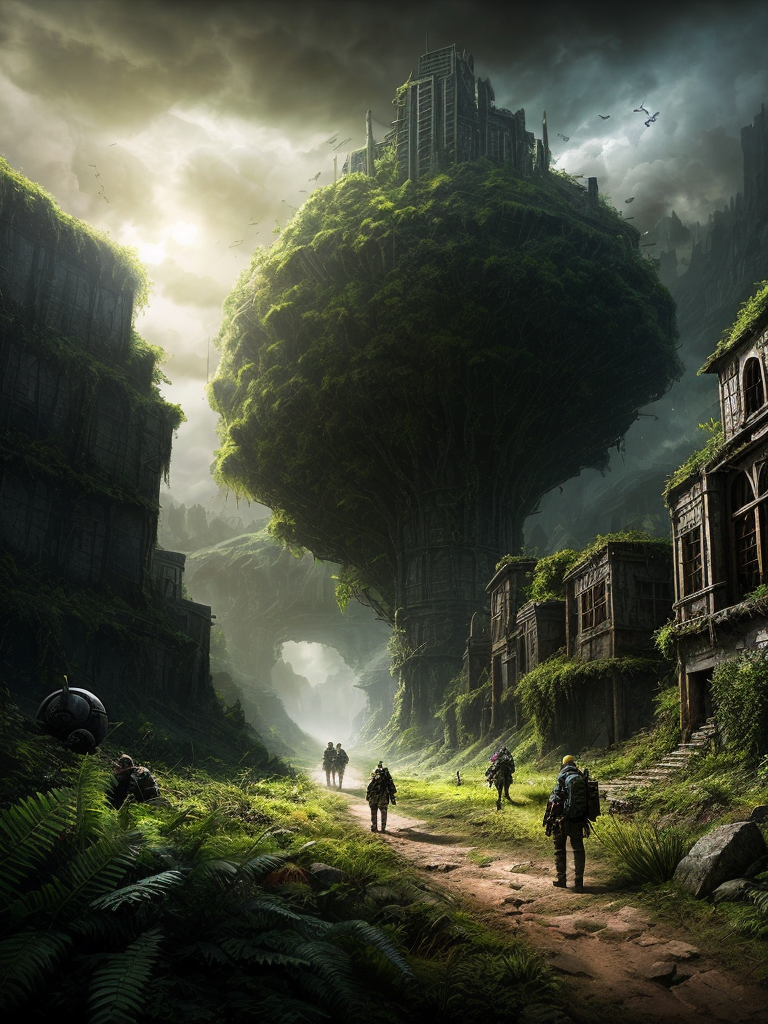
The world had changed. No one could deny that. What was once a bustling city, filled with the sounds of cars and people, was now an overgrown jungle. Trees towered over buildings, their roots breaking through concrete and pavement. Flowers bloomed in every nook and cranny, their vibrant colors a stark contrast to the dull grays and browns of the decaying structures.
And then there were the animals. They roamed freely through the streets, reclaiming their territory. Deer grazed on patches of grass that had broken through the asphalt. Squirrels scurried up and down trees, collecting acorns for the winter that would never come.
But where were the humans? There were few left, scattered across the globe like dust in the wind. Most had perished when nature took its revenge, wiping out entire cities with hurricanes and earthquakes. The survivors knew better than to mess with Mother Nature; they kept to themselves, hidden away in small communities far from civilization.
But there were some who couldn't resist exploring what was left of the world they once knew. A group of scientists had set out on a mission to study how nature had reclaimed its territory after humans were gone. They traveled in an armored vehicle, armed with cameras and notebooks.
Their journey took them through forests and deserts, across mountains and rivers. They documented everything they saw: plants growing out of cars; birds nesting in abandoned buildings; even bears fishing in polluted rivers.
One day, as they made their way through what used to be a suburban neighborhood, they stumbled upon something unexpected: a hatch leading underground.
"What do you think it is?" one of them asked as they gathered around it.
"Could be a bomb shelter," another suggested.
"Only one way to find out," their leader said as he grabbed hold of the handle and pulled it open.
A set of stairs led down into darkness. The scientists pulled out their flashlights and descended, one by one.
What they found at the bottom was beyond anything they could have imagined. The room was filled with advanced technology: computers, monitors, and machines they couldn't even begin to understand.
"What is this place?" one of them asked in awe.
"I don't know," their leader replied. "But we need to find out."
They spent hours exploring the bunker, taking notes and photos of everything they found. There were blueprints for inventions that hadn't been created yet: flying cars, robots that could do household chores, even a machine that could cure cancer.
"This changes everything," one of them said as he looked over the blueprints.
"It does," their leader agreed. "We need to bring this back to our community."
And so they packed up as much as they could carry and made their way back to their vehicle. But as they stepped outside, they realized something was wrong.
The air was still; there were no sounds of birds or insects. The vibrant colors of the flowers had faded, replaced by a sickly gray. And then came the smell: smoke and burning rubber.
They ran towards their vehicle, fearing the worst. Their fears were confirmed when they saw it: a pile of smoldering metal where it once stood.
"Who would do this?" one of them asked in disbelief.
"Doesn't matter," their leader replied as he surveyed the area. "We're on our own now."
They had no choice but to continue on foot. They carried what supplies they had left and made their way through the desolate landscape.
Days turned into weeks as they walked mile after mile, searching for signs of life. They encountered mutated creatures along the way: wolves with three heads; snakes with legs; even a bear that could breathe fire.
But nothing could deter them from reaching their destination. They knew what was at stake: the survival of the human race.
Finally, after what felt like an eternity, they reached their community. The sight that greeted them was both heartwarming and heartbreaking: a small group of survivors, huddled together in a makeshift camp.
"We found something," their leader said as he showed them the blueprints and documents they had salvaged from the bunker. "Something that could save us."
The survivors listened in awe as he explained what they had discovered. They looked at each other, hope shining in their eyes.
"Can you build it?" one of them asked.
"We'll certainly try," their leader replied with a smile.
And so they set to work, using whatever materials they could find to recreate the inventions from the blueprints. It was hard work; there were many setbacks along the way. But they never gave up. They knew what was at stake: the survival of the human race.
Months turned into years as they toiled day and night, creating machines and devices that hadn't been seen in centuries. And slowly but surely, life began to change for the better.
Flying cars filled the sky, replacing pollution with clean air. Robots did all the household chores, freeing up time for more important things. And best of all: cancer became a thing of the past; no one died from it ever again.
The world had changed once more; this time for the better. Humans were no longer an endangered species; they thrived once more.
But they never forgot where it all began: in a hidden underground bunker filled with advanced technology that could save humanity.
Disclaimer
This is a work of fiction, assisted by artificial intelligence. Any names or characters, businesses or places, events or incidents, are fictitious. Any resemblance to actual persons, living or dead, or actual events is purely coincidental.
Content Removal Policy
- Users may report content that may be illegal or violates our Standards.
- All reported complaints will be reviewed and resolved within seven business days.
- Review Process: Our team will assess the reported content against our guidelines.
- Appeals: If you disagree with a decision, you may appeal within 14 days of notification.
- Potential outcomes include: content removal, account warning, or no action if no violation is found.
To report content, email us at [email protected]