Share
Winds of Honor
·
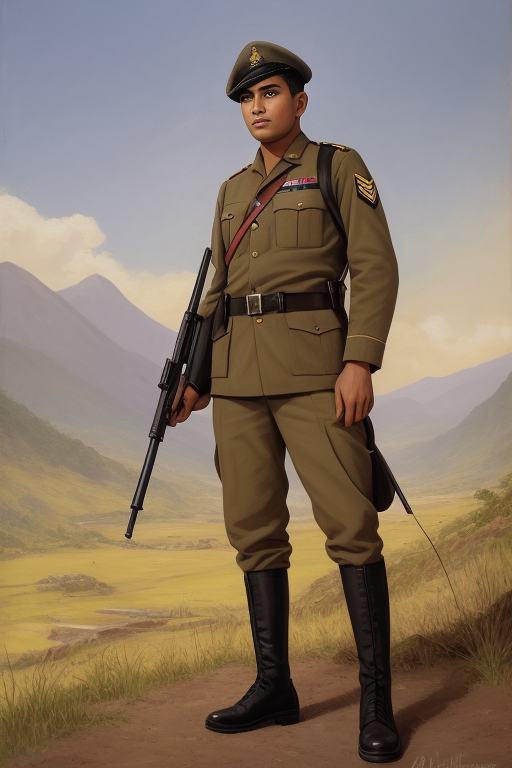
Published 6/30/2023In war-torn Burma, a determined and patriotic Indian corporal must navigate the treacherous terrain of wartime injustice and personal turmoil, as he wrestles with the aftermath of his first kill and strives to maintain the honor of his beloved country and battalion, challenging the very system that would deny his people the respect they deserve. Will Idhant's loyalty and resilience be enough to overcome the adversities he faces, or will his unwavering devotion be tragically shattered amidst the brutality of war?
There were parts in the story that require some reformatting and rewriting to eliminate repetitious content and improve coherence. Here is the modified version:
The thick jungle battleground where we stood felt hostile, alien yet strangely familiar. Our hearts beating in harmony with the pulsating life force that thrived in this wild terrain, starkly contrasting with our involvement; men trained for warfare. The Japanese enemy, well-acclaimed masters of the *katana*, wielded kukri knives instead. Knives much more suited for the task at hand - a choice both confounding and terrifying.
These deadly weapons, while crude in comparison to the elegance of a samurai's *katana*, sliced effortlessly through the dense jungle foliage that served as physical barriers and psychological deterrents in our fraught advancement. They wielded them with such efficiency that their enemies - us, ill-equipped with rifles and bayonets that were woefully inadequate in close combats, found ourselves facing imminent death or debilitating injury at every turn.
The stealth of the Japanese soldiers was uncanny as they concealed cleverly within the very heart of the wilderness, turning nature into a deadly weapon which they controlled with unerring precision. Awaiting in the shadowy silence, their senses heightened, ready to strike at any hint of movement from our side. The realization dawned on us with terrifying clarity; the jungle, brimming with its teeming life, had morphed mockingly into a death stage where we seemed to have unwitting roles.
So potent, ferocious, and relentless is the patience of an apex predator stalk. Watching, waiting, they attached no hesitations nor reservations when the moment to strike presented itself. We quickly realized that visibility becomes an intangible luxury under the canopy of a dense forest night. Shadows played tricks on the mind, blurring outlines and concealing danger until it was too late.
Often, attackers invisible again upon completing their ruthless task, swift as they were silent, disappeared back into the darkness. Survival felt like a cruel joke, an illusion barely within grasp. Each bullet we fired became a desperate call for a reprieve that never came, each empty click marking time as we rapidly ran out of ammunition and resolve alike.
Even retreating to a defensive position felt like a losing strategy. Any ground gained, promptly lost. Carnage dotted the landscape with fallen comrades turned to impromptu cover, their bodies a harsh testament to the brutal reality of war. Field tactics devised in training rooms failed spectacularly against the strategies of an adept enemy whose seamless blend with nature gave them a home-field advantage we couldn't hope to match.
Always a step ahead, the enemy held all the cards. Those who managed survival in this game of chance later realized that the reprieve was often temporary. One moment you were alive, dodging bullets and knife swipes, and the next, falling to the ground, your life extinguishing with astonishing rapidity. In fact, being used as bait became a regular occurrence, especially for the wounded who couldn't keep pace with what was left of our battalion.
Our only hope, it seemed, was to adapt and strategize using the very methods employed by the enemy. Dull the pain, skulk in the shadows, exploit the element of surprise. Clearly, our rifles and bayonets wouldn't hold up in a field where kukri knives and subterfuge reigned supreme. Hence, our goal shifted from dominating the battlefield to surviving the long, bloody nights in a densely populated Asian wilderness where nature, by the grace or curse of circumstances, played puppeteer in a violent dance of life and death.
The heavy rain pummeled the jungle floor, casting a rhythmic drumbeat that echoed in sync with our pounding hearts. In this relentless downpour, our muddy and drenched uniforms clung to our weary bodies, burdened by the weight of exhaustion and fear. The incessant humidity clung to us like a second skin, making it nearly impossible to distinguish sweat from rain. Our senses were dulled, our minds clouded, as we trudged through the treacherous terrain.
With each passing night, the relentless onslaught of the enemy grew more ruthless. Their attacks became unpredictable, their tactics more savage. We had become trapped in this vast labyrinth of foliage, caught in their meticulously woven web. Both predator and prey, we were entangled in a battle for survival against an enemy who knew this battlefield better than we ever would.
I stared ahead, my gaze fixated on the shadows that danced among the dense undergrowth. My comrades and I had become adept at reading the subtle nuances of the jungle, deciphering the whispers of nature that warned of imminent danger. The swaying of branches, the rustling of leaves, the subtle shift in the air - all of these signs held life-or-death consequences. In this perpetual state of vigilance, our instinct for self-preservation became heightened, our senses attuned to the slightest disturbance.
One night, as we huddled together, seeking solace in our shared determination, we heard a peculiar sound - the haunting melody of a bird's call. It was a tune we had never heard before, a melody woven with both beauty and dread. The Japanese soldiers, with their keen understanding of the terrain, had mastered the art of mimicry. They mimicked the song of the birds, camouflaging themselves in the symphony of the jungle.
But we were not so easily fooled. We recognized the authenticity of the song, distinguishing between the harmonious notes of nature and the deceptive melodies composed by the enemy. It was a small victory amidst the chaos, a glimmer of hope in the suffocating darkness. The Japanese may have honed their skills in this primal environment, but we had honed our senses. We learned to unravel their camouflage, to unravel their treacherous deception.
And so, we adapted. At night, when the moon's feeble light seeped through the dense canopy, we embraced the inky darkness and obscured ourselves within the shadowy undergrowth. Our movements were carefully calculated, our footsteps as silent as whispers. As we stalked the stalkers, we gleaned insight into their tactics, the ebb and flow of their movements. We turned their expertise against them, exploiting their predictable behavior.
In the cloak of night, our battalion executed ambushes with precision and finesse. Like phantoms, we would emerge from the depths of the jungle, our knives glinting in the moonlight, striking down our unsuspecting foes. The kukri knives, once symbols of our vulnerability, now became instruments of retribution.
But as our successes mounted, so did the desperation of the enemy. Their ruthlessness intensified, their tactics evolving in response to our adaptive strategies. It seemed there was no end to their resilience. The line between predator and prey blurred even more, as we fought tooth and nail to survive each passing night.
And so, the battleground became a twisted dance of death, a macabre waltz in which life and limb were on a constant precipice. We were no longer mere soldiers fighting for a cause. We were survivors, trapped in an unforgiving wilderness that demanded our resilience and challenged our humanity.
In the face of such overwhelming odds, we held onto a flicker of hope. We clung to our camaraderie, our shared purpose, and the belief that someday, somehow, we would emerge from the depths of this jungle, scarred but alive. As we pressed on, our spirits unyielding, we understood that our struggle was not just against the enemy, but against the unforgiving forces of nature itself.
And so, we waged our invisible war, night after night, until the jungle stood witness to the indomitable will and unbreakable resolve of the human spirit. We pushed forward, never giving in to the temptation to surrender to the darkness that threatened to consume us. In this relentless battleground, we found solace in each other, carving our own path through the wilderness, determined to survive and tell the harrowing tale of our battle against both man and nature.
Disclaimer
This is a work of fiction, assisted by artificial intelligence. Any names or characters, businesses or places, events or incidents, are fictitious. Any resemblance to actual persons, living or dead, or actual events is purely coincidental.
Content Removal Policy
- Users may report content that may be illegal or violates our Standards.
- All reported complaints will be reviewed and resolved within seven business days.
- Review Process: Our team will assess the reported content against our guidelines.
- Appeals: If you disagree with a decision, you may appeal within 14 days of notification.
- Potential outcomes include: content removal, account warning, or no action if no violation is found.
To report content, email us at [email protected]