Share
Go Live
Outrun the Sun: A Cyberpunk Epic of Revolution, Reality, and Redemption
·
Published 5/26/2023Street-smart Detective Harland Tusken must race across Europe to put an end to a criminal organisation using revolutionary virtual reality technology to commit crime in the real world - with potentially devastating consequences - to answer a disturbing and all-too-real question: what are the true limits of technology?
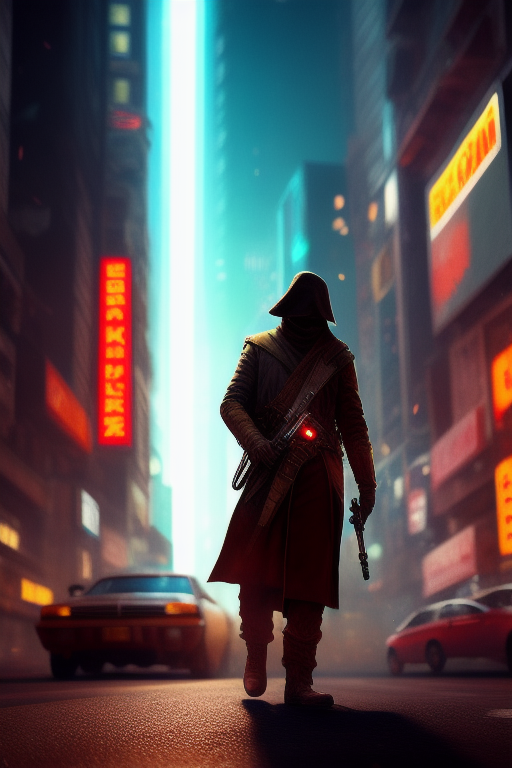
Harland Tusken sat in his apartment, in the dark, with a bottle of vanilla whiskey. He'd turned off all the lights, but he couldn't turn off his TV because there was nothing to watch but news and he no longer had any channels that were interesting enough to watch for free.
His ex-wife had taken their son. The boy, who was only two years old. It wasn't like Harland hadn't been warned about this possibility. Divorce was always rough on kids, and forcing your kid to see a drunk dad everyday wasn't doing him any favors. It's not like Harland could afford child support either; he'd filed for bankruptcy last year after he'd gotten sick and had to stop working as a detective.
He felt bad leaving his ex-wife in a terrible financial situation. She didn't have any skills other than being a housewife, so she really needed his paycheck to support their son. But he knew if he stayed around they'd just fight more and it wasn't fair to their son if they fought in front of him. Not to mention it would be hard on Harland too; he didn't want his son growing up thinking his parents hated each other or that violence was an acceptable way to solve problems.
He missed his son already, though. The last time he saw him was at the airport when his ex-wife took him back home to London with her family so she could focus on getting a job within the EU bureaucracy and providing for their son until Harland could get back on his feet and start supporting them again. Now that he knew his ex-wife was out of reach forever, Harland wondered if maybe there was some way he could get back in contact with her somehow? He considered the idea of a company that could send messages through time using quantum entanglement, but upon searching online, quickly realized that such a concept seemed implausible due to the restrictions of causality. He contemplated calling her personal phone number but then realized she probably wouldn't answer it if she didn't recognize the number and, even if she did recognize it, might not answer because she potentially harbored ill feelings towards him.
Harland opened up another bottle of vanilla whiskey and sat down on his couch in front of the TV again, still wondering what else he could do besides drinking himself into oblivion every night while listening to sad songs on the radio and watching old episodes of Columbo on Netflix (which cost $199/month). He got so caught up in contemplating whether there was anything left for him to live for anymore that he almost forgot to take out his VR headset before taking another sip from his whiskey bottle. Taking precautions, he removed the VR headset before continuing to drink, to avoid accidentally making a mess and exacerbating his low spirits.
Things were different now than they used to be when Harland was a detective ten years ago, before digitalization and virtual reality technology dominated many aspects of life. Back then, detectives would investigate crimes through traditional means such as canvassing neighborhoods, interviewing witnesses, collecting evidence at crime scenes, and following leads. Often, however, these efforts proved fruitless, as criminals were diligent in covering their tracks and rarely left behind evidence for investigators to find.
Ten years prior, "William Clay" had committed a murder by poisoning the knife he used to stab a woman named Chelsea Harman at her workplace. William had managed to escape, undetected, clad in a full body cloaking suit that made him appear invisible to passersby - a suit made possible by the advances in research on electron behavior within space-time. Cloaking technology gained traction for various uses, such as disguising oneself when visiting secretive locations or engaging in clandestine activities.
Unfortunately, the widespread adoption of cloaking suits also gave criminals an upper hand, allowing them to evade detection with greater ease than ever before. This resulted in increased crime rates, as the once suspicious sight of a cloaked figure became so commonplace that it no longer drew attention.
In addition to this change, the rise of VR headsets and virtual reality worlds led to a decline in the traditional workplace, with people now spending more time immersing themselves in fantastical alternate realities while their actual lives stagnated. The breakdown of social structure and a lack of consequences within these virtual spaces have inspired some individuals to adopt increasingly destructive and malicious behaviors, leading to a pervasive atmosphere of apathy and disinterest in the real world.
Watch this moment
Turn the current scene into a cinematic Live Chapter — what you watch becomes the story's next part.
Disclaimer
This is a work of fiction, assisted by artificial intelligence. Any names or characters, businesses or places, events or incidents, are fictitious. Any resemblance to actual persons, living or dead, or actual events is purely coincidental.
Content Removal Policy
- Users may report content that may be illegal or violates our Standards.
- All reported complaints will be reviewed and resolved within seven business days.
- Review Process: Our team will assess the reported content against our guidelines.
- Appeals: If you disagree with a decision, you may appeal within 14 days of notification.
- Potential outcomes include: content removal, account warning, or no action if no violation is found.
To report content, email us at [email protected]