Share
Unveiled Solitude
·
Published 1/30/2026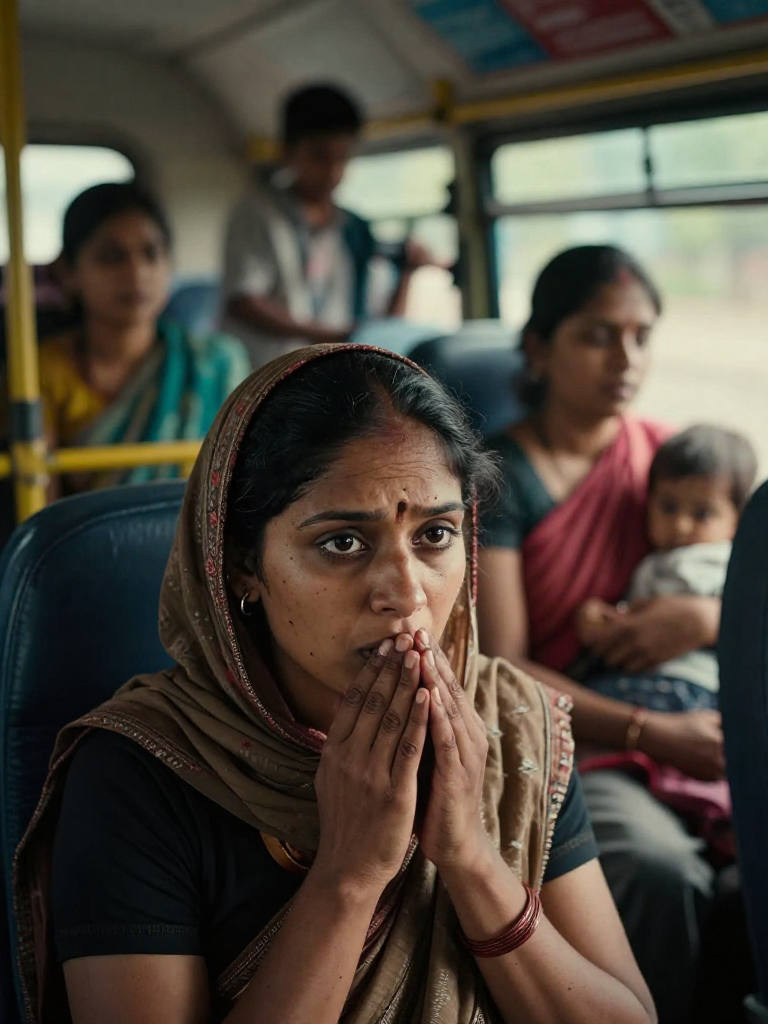
The bus groaned its way through the ochre-dusted landscape, a metal beast breathing its hot, diesel-laden breath over the sleeping fields of rural India. Ten hours. Ten hours of my bones learning the rhythm of potholes, of my skin adhering to the cracked vinyl seat, of the world outside the grimy window dissolving from the frantic chaos of the city into the vast, unending stretch of farmland under a hazy, unforgiving sun.
We were sharing this journey, this particular pocket of suspended time. I, a woman of forty-three summers, a mother who had long ago traded the map of her own desires for the well-worn atlas of her children’s lives. And her. The girl in the seat next to me.
She was a portrait of youth painted in delicate strokes, no more than twenty. A beauty so stark it was almost painful to witness in this gritty context. Her skin was the colour of warm almonds, her eyes large and dark, fringed with lashes so long they cast shadows on her high cheekbones. She was slim, almost fragile-looking, wrapped in a simple but vibrant pink salwar kameez, a sleeping infant swaddled tightly against her chest, a tiny monarch oblivious to the discomforts of his realm. A faint, sweet scent of jasmine and talcum powder clung to her, a small rebellion against the bus’s overwhelming aroma of sweat, spice, and dust.
The journey was a cycle of monotony punctuated by brief, feral bursts of necessity. Every hour or so, the driver would curse and wrestle the bus to a shuddering halt on the barren roadside, shouting a location that was less a name and more a description: “*Chai-wallah ahead!*” or simply, “*Break!*”
The ritual was always the same. The men would spill out first, a stream of white kurta-pyjamas dispersing without ceremony towards the scrubby bushes, turning their backs to the road to relieve themselves, their actions as open and unselfconscious as the sky. A few other women and I would exchange a look, a silent sisterhood of shared predicament, and trek further away, seeking the fragile privacy of a crumbling wall, a large boulder, the deep shadow of a neem tree. We would squat, our saris and salwars held carefully, the hot earth absorbing our small emergencies.
But the girl never moved.
Through every stop, she remained cemented to her seat, her body a tight coil of stillness. She would stare out the window, but her eyes weren’t seeing the flat, golden fields; they were turned inward, focused on a private, mounting agony. Her delicate jaw was perpetually clenched, and her free hand, the one not cradling her baby’s head, would often press hard against her lower abdomen, a silent, desperate pressure. I saw the fine sheen of sweat on her upper lip, despite the fan churning the hot air above us.
I pretended not to notice. Privacy is a currency of great value on such journeys, and I did not want to spend hers without invitation.
The sun began its slow, bloody descent, staining the sky with shades of burnt orange and violet. The bus groaned to another halt. “*Break! Half-hour!*” the driver yelled, killing the sputtering engine. The silence that followed was immediate and heavy.
The familiar exodus began. Men first, then the small cluster of women, including myself, gathering ourselves for the trek. As I stood, I glanced at my seatmate. This time, she had half-risen, her body angled toward the aisle, a look of pure, unadulterated anguish on her beautiful face. She looked out the open door at the vast, empty expanse offering not a single shred of cover, only a few skeletal shrubs. A small, helpless sound escaped her lips, a choked sigh of despair. She sank back into her seat, defeated.
Something in that small sound, in the utter hopelessness of her posture, broke through the unspoken rule of non-interference. The maternal instinct, that deep, worn groove in my soul, overrode the stranger’s caution.
I leaned closer, my voice low. “*Beti?*” I said. Daughter. The word came naturally. “*Kya hua?* What is it?”
She flinched, as if my voice had physically touched a bruise. She wouldn’t meet my eyes, her gaze fixed on the worn toes of her sandals. Her shoulders trembled slightly. The baby, sensing its mother’s distress, stirred and let out a faint whimper.
“I… I need to…” she whispered, the words barely audible. “*Shauchalay.*” The toilet.
A wave of understanding, profound and empathetic, washed over me. Of course. The beautiful, tense young mother, holding a tiny baby, on a bus for ten hours. The fear of leaving her seat, of finding a place, of managing it all with an infant in her arms. The sheer, terrifying logistics of it had kept her prisoner.
“*Arey, chinta mat karo,*” I said, my tone softening into the one I used to soothe my own children. Don’t worry. “There is no proper toilet here. You will have to go here, like the rest of us. Come with me. I will give you privacy. I will stand guard.”
The relief that flooded her face was so potent it was almost heartbreaking. It was the look of a prisoner granted a reprieve. She nodded, her eyes finally meeting mine, glistening with unshed tears of gratitude and shame. She gathered her sleeping child closer and stood up, her movements stiff with pent-up urgency.
I led her off the bus, away from the chai-wallah’s stall where the driver and a few men were smoking, away from the other women who were already heading towards a distant cluster of rocks. I found a spot behind a thick, wild-growing bougainvillaea, its magenta blooms a violent splash of colour against the dust-brown earth. It offered the best screen we were going to get.
“Here,” I said, turning my back to her, creating a human wall. “I will not look. Take your time.”
I heard the rustle of fabric behind me, the quick, frantic fumbling. A soft thud as she presumably laid her baby, still swaddled, on a fold of her own dupatta on the ground. Then a sharp, hissed intake of breath.
I stared fixedly at the weaving pattern of the bougainvillaea leaves, at a lone crow pecking at something in the dirt yards away. The world held its breath. Then it came—not a trickle, but a sudden, powerful torrent. A fierce, relentless cascade that hit the dry earth with a sound like steady rain on a tin roof. It went on and on, a shocking testament to her hours of silent endurance. One minute. Two. A full three minutes of this forceful, unabated release. A sigh, deep and shuddering, came from behind me, the sound of a pressure valve finally, utterly released.
I thought it was over. I heard the rustle again, as if she were beginning to rise. Then a sudden stop. A grunt, soft but strained. Then another.
What followed was a different sound altogether. A series of heavy, wet plops, one after another, falling onto the ground with a solemn, profound weight. *Plop. Plop. Plop.* It was not a few. It was a multitude. A veritable procession. Each one landed with a solid, definite impact, a sound that spoke of immense volume and density. The pace was rapid, desperate, as if a dam had not just been opened but had completely burst. I lost count after a dozen, the sounds merging into a relentless, almost rhythmic liturgy of relief. The air, previously carrying only dust and the faint scent of flowers, began to thicken with a pungent, deeply organic aroma.
It seemed to go on for an eternity. This was not a mere answering of nature’s call; this was an evacuation. A desperate, complete unloading of a burden held for far too long. Finally, the sounds ceased, replaced by the sound of her ragged breathing. Then came the soft, careful rustle of cloth as she cleaned herself, the sound of her salwar being drawn back up.
A moment of silence passed. I dared not turn.
“*Bas?*” I asked softly. All done?
“*Haan,*” came the whisper, thick with exhaustion and a lingering embarrassment. “*Shukriya.*” Thank you.
I turned around slowly, giving her time. She was standing, clutching her baby to her chest once more, her face pale but composed. Her eyes were downcast, avoiding the evidence on the ground between us. The amount was staggering. It was a small mountain, a shocking testament to the sheer physicality of her need. It was clear, in that moment, that this was the accumulation of not just a day, but perhaps two. A monumental holding-back had finally found its end behind a bougainvillaea bush on a deserted roadside.
We walked back to the bus in silence, the unspoken thing hanging heavily between us. As we settled back into our seats, the engine coughing back to life, I looked at her. The tension had drained from her body, leaving her looking young and vulnerable and utterly spent.
The social proprieties, the rules of strangerhood, told me to leave it alone. But the sight of that tremendous physical evidence, the sheer *volume* of her ordeal, pushed a question to my lips. It was odd, I knew it was odd, but the words came out, gentle and curious.
“*Beti,*” I began again, as the bus lurched forward
Disclaimer
This is a work of fiction, assisted by artificial intelligence. Any names or characters, businesses or places, events or incidents, are fictitious. Any resemblance to actual persons, living or dead, or actual events is purely coincidental.
Content Removal Policy
- Users may report content that may be illegal or violates our Standards.
- All reported complaints will be reviewed and resolved within seven business days.
- Review Process: Our team will assess the reported content against our guidelines.
- Appeals: If you disagree with a decision, you may appeal within 14 days of notification.
- Potential outcomes include: content removal, account warning, or no action if no violation is found.
To report content, email us at [email protected]