The Divine Conclave: Unveiling the Veil
·
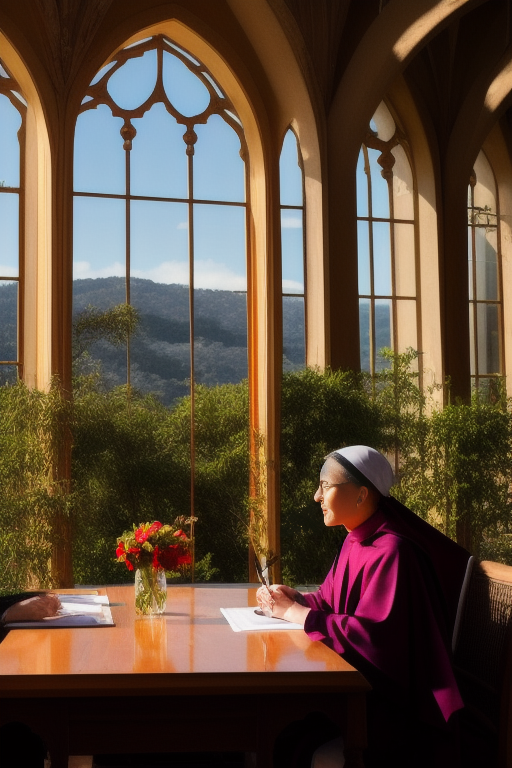
Published 6/21/2023In the midst of a skeptical and intense conference, a wise and unassuming nun challenges the transparency of the Catholic Church's internal elect, igniting a fierce debate that forces everyone to question their integrity and accountability, ultimately leading to a surprising turn of events that could redefine the hierarchy of power within the monastic order.
I've always loved school.
I went to a Catholic elementary school, then a Catholic high school, and now I'm at the University of Notre Dame. So, I've always been surrounded by Catholics. And, there's nothing I love more than the Catholic Church. I love everything about it. The traditions, the rituals, the devotions, the education, the music...
But, sometimes, I don't feel very good about my fellow Catholics. I know they say we're all sinners and that we're all in this together and that it's not fair to judge others by our own standards... But I still think it's fair to judge people by what they do. And there are some people who don't honor their faith at all. They don't live up to their beliefs and values. And sometimes those people are even priests or nuns!
That's why the conference was convened. To decide how well we were living up to our ideals and how honest we were being with one another in our daily lives. Because doing so was hurting the Church. It was hurting us as Catholics and it was hurting us as human beings. We decided that we needed to be more open about these things and start holding each other accountable for our actions.
We decided on an elective system for leadership because it allows for everyone's voice to be heard without sacrificing any one person's vote (except for abbots/abbesses). We use proportional representation so that small groups have their voices heard as well as large ones. And we use ranked voting because it lets everyone make a clear decision while also giving them flexibility of choice within a range of acceptable options. We have found this method to be fantastic at keeping us honest and true to our values - making sure candidates are honest in their claims and do what they promise once elected - while also allowing us to stay true to ourselves and have a variety of viewpoints represented in our leadership who will work together fairly towards whatever goal is set before them by the Church itself or its members who are running for office (usually each other). Who knows better than your fellow Catholics what is most important?
Everyone has an equal chance of winning when they run for office in our system. Everyone gets one vote for every 10 years of age you have on election day, whether you're 8 or 80 or 88 like Sister Maria. Everyone is given a budget where they can share their ideas about what direction the Church should take with everyone else using social media and personal appearances at events around the world where people gather in support of the Church. When people want to support someone whose ideas they like, they give money to that person's campaign fund directly from their bank account instead of writing checks or giving cash to the local parish who then gives it to whoever ran in their area (which usually doesn't end up going to anyone except whoever got elected last time). That way everyone can see exactly who gave what money and how much so they can choose whether or not they want to support that person based on their beliefs instead of just on whose name is on the door of your church building every Sunday morning (and if you don't you miss Mass you have no right to complain when your priest says something you disagree with). This way also keeps out corrupt pay-to-play politicians who only represent big donors instead of their constituents as well as those who pretend to represent them but actually just want power for themselves so that they can get rich even faster through shady deals behind closed doors instead of actually helping anyone else (like most politicians).
So, the conference was convened because some people felt that those in charge had been manipulating information about themselves so that people wouldn't know how dishonest some abbots/abbesses were being with their funds, or how some priests/nuns were engaging in inappropriate relationships. There was some talk about removing select abbots/abbesses from office because some individuals believed that these positions should only be held by men, since Jesus was a man and only men can be priests. Although some thought women could be leaders, they still believed that only men could ordain others, claiming this would preserve "God's design" as established by St. Paul when he wrote his letters. However, this proposal sparked debate considering the contradictions within the various letters of St. Paul.
These conflicting messages surrounding leadership roles in the Church created confusion and brought about doubts regarding the authenticity and intentions of religious teachings. It led to questioning whether God was actually present and involved in guiding the Church, or if divine concerns were merely human projections.
Ultimately, the conference aimed to address these issues and create a more transparent, inclusive, and accountable system, while restoring trust and faith among the Catholic community. The goal was to bring people together, unified in their belief and understanding of the Church's teachings, working towards a better future.
As the conference progressed, tensions ran high and emotions were stirred. People passionately defended their beliefs, quoting scripture and theological arguments to support their positions. It became evident that there were deep divisions within the Catholic community, not only regarding gender roles and leadership, but also on topics like marriage equality, contraception, and the inclusion of LGBTQ+ individuals.
For days, theologians, priests, nuns, and laypeople engaged in fervent debates, struggling to find common ground. It felt as though the very essence of the Church was being questioned and challenged. Yet, amidst all the heated discussions, a quiet voice arose from the back of the conference hall.
It was Sister Maria, the aged nun who had spent her life dedicated to faith and service. With her gentle demeanor and serene presence, she commanded the attention of everyone in the room. As she rose from her seat and spoke, her voice resonated with wisdom and love.
"Dear brothers and sisters," Sister Maria began, her voice filled with compassion. "I believe that the true essence of our faith lies in love. Love for God, love for one another, and love for all humanity. We have spent so much time debating and dividing ourselves over theological interpretations, but if we lose sight of love, we risk losing sight of God Himself."
Her words hung in the air, as if the room held its breath, absorbing the profound truth she had spoken. Sister Maria continued, her voice growing stronger.
"Let us remember the teachings of Jesus, who called us to love our neighbors as ourselves. Let us remember the countless saints who dedicated their lives to compassion and service. Let us remember that the Church is not a mere institution, but the living body of Christ, called to embody His love in the world."
As Sister Maria spoke, hearts began to soften, and walls started to crumble. People on opposing sides of the debates exchanged glances, realizing that beneath the theological arguments, they were all united by a shared desire to live out their faith in love and service.
And so, a transformative shift occurred within the conference. Instead of focusing solely on rules and divisions, participants began exploring ways to cultivate a more compassionate and inclusive Church. There were workshops on empathy and active listening, where participants learned to truly understand each other's experiences and perspectives.
Small groups formed, consisting of diverse individuals who sought to bridge the gaps and heal the divisions within the Catholic community. They engaged in deep conversations, challenged their own biases, and committed themselves to acts of love and understanding.
With time, these smaller groups began to make an impact, slowly radiating their message of love and inclusion throughout their local parishes and communities. They organized outreach programs to support marginalized groups, fostered dialogue between different faith traditions, and advocated for social justice.
The ripple effect of their efforts spread far beyond the conference walls, reaching the corners of the Catholic world. As more and more people witnessed the transformation taking place within the Church, hope was rekindled, and faith in the institution started to rebuild.
And so, the conference that began with division and doubt transformed into a catalyst for change and renewal. It became a turning point in the history of the Catholic Church, reawakening its commitment to love, compassion, and inclusivity. The road ahead would still present challenges, but with hearts open to love, the Catholic community was poised to embrace a brighter future, grounded in faith and united in the spirit of Christ's teachings.
Share this story
Disclaimer
This is a work of fiction, assisted by artificial intelligence. Any names or characters, businesses or places, events or incidents, are fictitious. Any resemblance to actual persons, living or dead, or actual events is purely coincidental.
Content Removal Policy
- Users may report content that may be illegal or violates our Standards.
- All reported complaints will be reviewed and resolved within seven business days.
- Review Process: Our team will assess the reported content against our guidelines.
- Appeals: If you disagree with a decision, you may appeal within 14 days of notification.
- Potential outcomes include: content removal, account warning, or no action if no violation is found.
To report content, email us at [email protected]