Share
The Shifting Record
·
Published 5/1/2026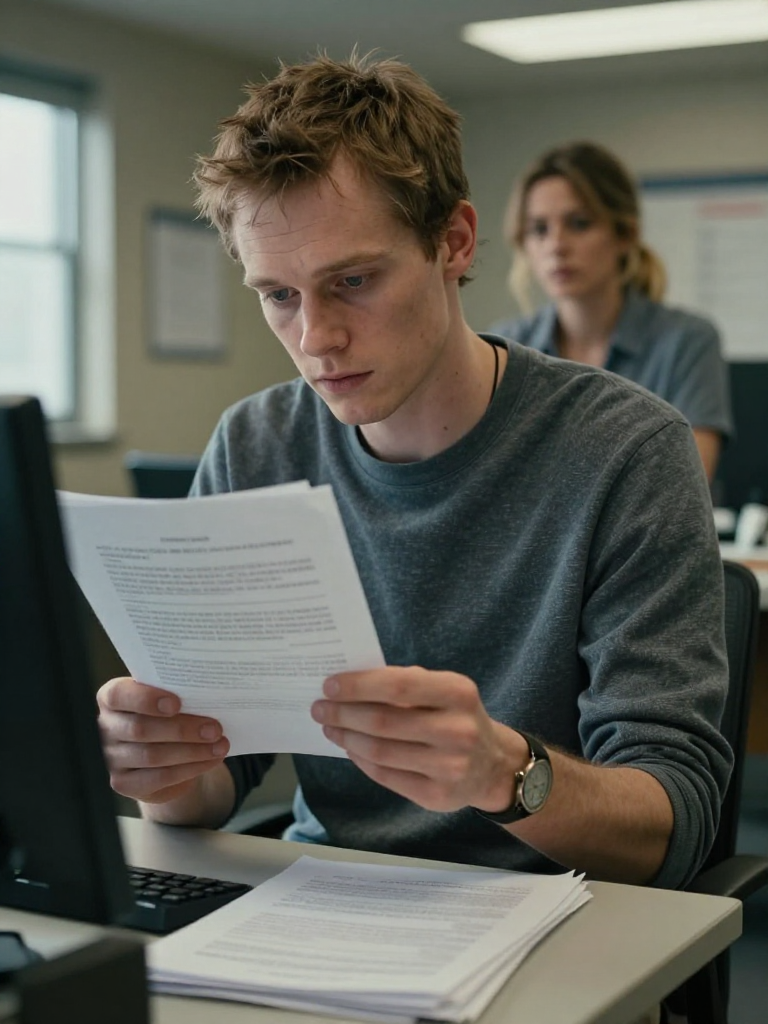
The archives smelled of dust and silence, a particular scent I’ve always found comforting. It smelled of settled things. I logged into the terminal at 8:47 a.m., precisely thirteen minutes before my official start time. This allowed for a two-minute margin of error in the system clock and an eleven-minute window to review my schedule. Predictability is the bedrock of good archival work.
My name is Daniel Reed. My title is Archival Analyst, Grade 4. My function is to document, categorize, and cross-reference the reports that arrive in the Special Acquisitions repository. The reports themselves are a catalog of the technically possible yet deeply illogical. A river in Montana that flowed backward for exactly seventeen minutes, verified by five independent geological surveys but defying all hydrological models. A flock of starlings in Sussex that formed a perfect, motionless cube in the sky for nearly an hour. A child’s chalk drawing in Oslo that could not be erased by any chemical or physical means for three days, then vanished on its own. These are not supernatural events. They are events. They happened. They are simply wrong.
I prefer this work. It reduces the messy complexity of the world into clean, structured data. Each file is a puzzle with edges, and my job is not to solve it, but to ensure its pieces are perfectly preserved. I do not speculate. I observe. I record.
My desk is a gray steel rectangle. On it: one monitor, one keyboard, one notepad, one black pen. My chair does not squeak. The air vent above me hums at a constant, low frequency. This morning, I wore a blue oxford shirt and gray trousers. My hair, which I cut myself every third Sunday with electric clippers set to a #4 guard, was neat. I am a pale man, slightly underweight. I am designed to be overlooked, which is the highest compliment one can receive in this field.
At 8:58 a.m., Claire Donovan entered the main archival bay. Her footsteps were a soft, irregular rhythm on the linoleum floor, distinct from the measured tread of the other analysts. Her dark blonde hair was escaping its loose tie, and the sleeves of her shirt were rolled up to her elbows, revealing a faded tattoo of a geometric bird on her forearm. Her boots were scuffed. She paused at my terminal, her gaze scanning my screen before she looked at me.
“Reed,” she said. Her voice was dry, low. “They’ve flagged another one for you. Whitaker’s request.”
I did not look up from my screen. “Case number?”
“7341-B. The Halcyon Folders.” She leaned a hip against my desk, a breach of protocol I had long ago accepted as part of her nature. “It’s a strange one. Even for us.”
“They are all strange,” I said, typing the case number into the search bar. “That is the definition of the collection.”
“This one is… persistent,” she said. She didn’t elaborate. Claire Donovan was sharp, perceptive, and her skepticism was a refined instrument. If she said it was strange, it was. But strange was not a quantifiable metric.
The file appeared on my screen: HALCYON FOLDER – INCIDENT REPORT 008. The header was standard. Case Officer: H. Whitaker. Date of Acquisition: [REDACTED]. Classification: Anomalous Recurrence.
“What is the nature of the recurrence?” I asked.
Claire gave a small, almost imperceptible shrug. “That’s for you to document. Whitaker just said it needs a fresh set of eyes. Said you’d appreciate its… precision.” She pushed off from my desk. “Good luck.”
I opened the file. The initial report was brief, written in the detached, clinical prose we all employed. It concerned a private library in Vermont. The owner, a retired professor, reported that a specific folder in his study—a simple green cardstock folio—appeared to contain a different single-page document every time it was opened. The documents were all letters, written in the same hand, addressed to various recipients. They were mundane. A complaint about a late parcel. A thank-you note for a dinner party. A request for a book recommendation.
The anomaly was that the letters were always different. The professor, a meticulous man, had begun to log them. He’d recorded seventy-three distinct letters over a period of two weeks. The file contained scanned copies of his log, a spreadsheet with time stamps, and his own handwritten notes. It was a perfect, rational record of an irrational event.
My task was to verify the internal consistency of the archive’s digital copy against the professor’s original log. I began, as always, with the metadata. Date created, date modified, file size. All standard. I cross-referenced the time stamps in the professor’s log with the digital signatures of the scanned documents. They matched.
I read the first letter. A complaint to a department store about a moth-eaten sweater, dated October 12th. I noted the phrasing, the letterhead, the recipient’s address. I pulled up the second letter. A birthday greeting to a “Cousin Eleanor,” dated October 14th. I noted the salutation, the type of ink used in the signature, the paper quality visible in the scan.
It was during my review of the third letter—a note canceling a subscription to a literary journal—that I found the first discrepancy. Not in the letter itself, but in the professor’s log. The log entry for this letter noted a small coffee stain in the upper right corner. The scanned copy in our file was pristine.
A minor inconsistency. Paper is susceptible to degradation. A scan might have been made before the stain occurred, or the stain might have been misreported. I made a note in my own pad: *Log/Scan mismatch – stain?* I moved to the fourth letter.
This one was a receipt of payment for piano tuning services. The professor’s log described the letter as being written on “heavy, cream-colored stock.” The scan showed a sheet of standard white printer paper.
I paused. This was a more significant divergence. Paper type is a fundamental physical property. I checked the scan’s properties. The resolution was high enough to discern texture. The paper in the image was visibly smooth, thin. Not heavy stock.
I felt a slight tightening in my chest, a sensation I recognized as the first sign of procedural contamination. Anomalies are contained within the files. They are not supposed to infect the process of documentation itself.
I closed the file. I took a measured breath. The hum of the air vent was constant. The dust motes hung suspended in the slanted morning light from the high windows. I reopened HALCYON FOLDER – INCIDENT REPORT 008.
I went back to the third letter. The note canceling the subscription. The coffee stain was now present in the scan, a faint sepia bloom exactly as described in the log.
I blinked. I looked at my notepad. My own note—*Log/Scan mismatch – stain?*—was still there.
Slowly, deliberately, I looked back at the fourth letter. The receipt for piano tuning. The paper was now clearly textured, a thick, cream-colored stock. A perfect match to the log.
The air in the room felt thinner. I became acutely aware of the slow, steady beat of my heart. This was not an anomaly within the file. This was the file itself. It was a discrepancy in the archive, and the archive is the only thing I trust.
I highlighted the file path at the top of the screen and copied it. I opened a new window and pasted it in, loading the file anew from the server. This was a fresh call, a new access. The data should be static.
The header loaded. HALCYON FOLDER – INCIDENT REPORT 008.
Case Officer: H. Whitaker.
Date of Acquisition: [REDACTED].
And then, just below, a line I was certain had not been there before.
*Primary Analyst: D. Reed.*
My breath caught. My own initials. My designation. It was not part of the standard header protocol. It was a field that did not exist.
I stared at the screen, my hand frozen above the keyboard. The hum of the vent seemed to grow louder, filling the silent, dusty space around me. The line of text stared back, black and unwavering.
*Primary Analyst: D. Reed.*
It was impossible. And yet, there it was. A fact. A new, illogical fact. Written down.
Disclaimer
This is a work of fiction, assisted by artificial intelligence. Any names or characters, businesses or places, events or incidents, are fictitious. Any resemblance to actual persons, living or dead, or actual events is purely coincidental.
Content Removal Policy
- Users may report content that may be illegal or violates our Standards.
- All reported complaints will be reviewed and resolved within seven business days.
- Review Process: Our team will assess the reported content against our guidelines.
- Appeals: If you disagree with a decision, you may appeal within 14 days of notification.
- Potential outcomes include: content removal, account warning, or no action if no violation is found.
To report content, email us at [email protected]