Share
Untitled
·
Published 3/3/2026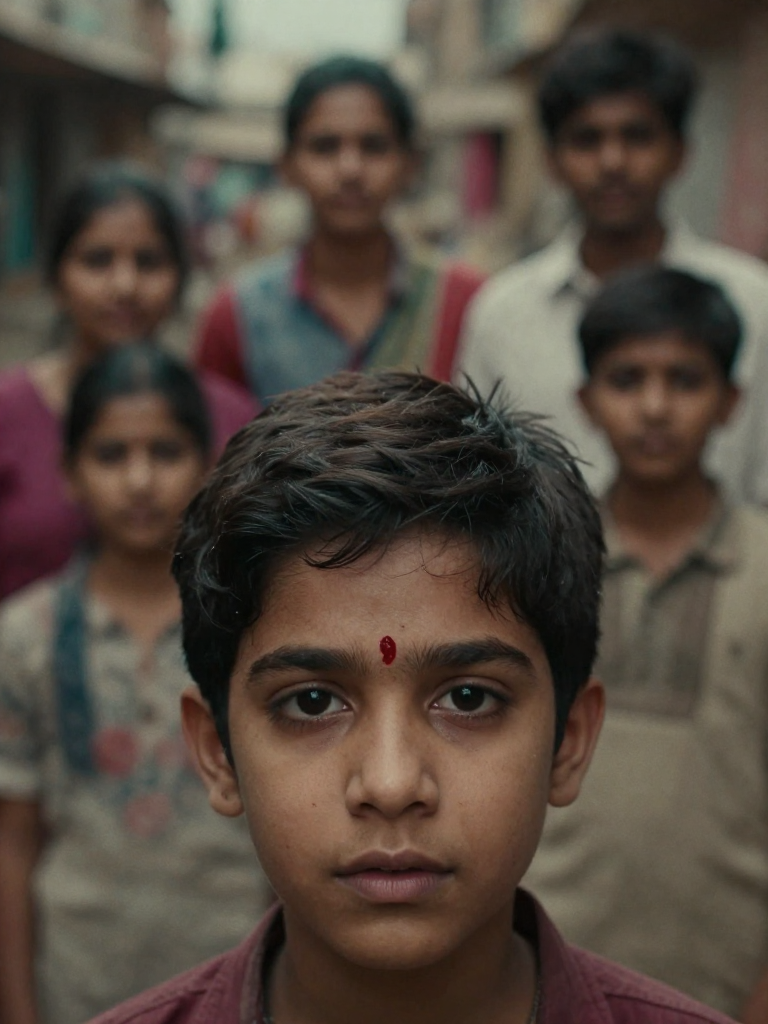
The dust still smells like him.
It’s a thought that comes to me, unbidden, as I sweep the packed-earth floor of our courtyard. The fine, red dust of our village rises in small clouds with each pass of the broom, and it carries the scent of my father’s sweat, the faint, sharp odor of the tobacco he used to chew, the ghost of his presence. It’s been three months since he left us, but this earth remembers. I wonder if the new soil of the city will ever hold our scent this way.
Our world was this: a small farm on the outskirts of the village, a patch of land that my father, Ramlal, had coaxed into life with his own two hands. The sky was a vast, unbroken bowl of blue, and the sun was a familiar, demanding god. We were five. My father, a man of wiry strength and few words, whose laughter was a rare, treasured event. My mother, Ramvati, whose hands were always moving—kneading dough, patting cow dung cakes to dry, smoothing my hair—as if stillness itself was an enemy. My elder sister, Ramkriti, beautiful and restless as a caged bird, with eyes that already saw beyond the horizon of our fields. My younger brother, Ramkumar, all clumsy limbs and boundless energy, a boy who still believed the world was a kind place. And me, Ramchandra. The eldest son. The one expected to hold it all together.
The first crack in our world was not a sound, but a silence. It was the absence of my father’s rhythmic snoring from the charpai in the corner of the courtyard one afternoon. I found him instead, curled on his side, his face a mask of pain, one hand clawing at the front of his kurta, right over his heart. The sound that escaped him was not a cry, but a dry, desperate rasp, like the last air leaving a punctured lung.
The months that followed were a blur of hushed voices, borrowed money, and the stark, antiseptic smell of the hospital in the nearby town. The operation was a success, the doctors said. His heart was mended. But they had fixed the organ and broken the man. The Ramlal who returned to us was a ghost of his former self, a careful, fragile vessel who moved as if he were made of the most delicate clay. The plough remained untouched. The well rope gathered dust.
“The work does not stop because the man does,” my mother said one evening, her voice tight as a drawn wire. Her eyes, usually so warm, were fixed on me and Ramkumar. They held a new, frightening weight. “This family must eat.”
So, we became men overnight. Ramkumar, whose voice had only just begun to crack, and I, who had never known a life beyond the boundaries of our village, packed two small cloth bundles. We took the morning bus to the city, leaving behind the dust and the silence for a different kind of noise—a relentless, grinding roar. We found work as day laborers on a construction site, our bodies learning a new language of ache, our hands growing raw and unfamiliar. We sent money home every month, a ritual that felt both sacred and suffocating. Our calls were brief, our words careful. My father’s voice on the phone was a thin, distant thread.
Then, the world coughed.
It started as a rumor on the news, a strange word we’d never heard before. Corona. It became a curfew, an eerie quiet that fell over our chaotic city. It became a lockdown that trapped us in our cramped, rented room, the fear a thick fog we breathed in with every breath. And then, the phone call came. It was my mother, but her voice was not her own. It was shattered.
“Beta…,” she whispered, and the line was so bad I had to press the phone to my ear until it hurt. “He’s gone. Just… a fever. A cough. They wouldn’t let us come to the hospital. They took his body away… they just took him…”
The silence that followed was the loudest sound I have ever heard. It was the sound of our anchor being ripped from the earth. We couldn’t even go back to bury him. The roads were sealed. We mourned him in that tiny, alien room, with the sounds of a fearful city echoing around us. Our grief had no place to go.
When the world opened up again, it was not to welcome us back. There was nothing to go back to. The land was barren without him. We sold what little we could. We brought my mother and sister to the city. We found a one-room flat in a building that leaned wearily against its neighbors, in a warren of lanes that never saw the sun. The air here smells of sewage and frying oil, a far cry from the dust of home.
We are all here now, the five of us reduced to four, crammed into this new, smaller world. My father’s absence is a physical presence, a sixth member of our family we trip over in the dark. My mother’s eyes are pools of a loneliness so deep I am afraid to look into them for too long. Ramkriti has folded into herself, her restlessness turned inward. Ramkumar tries to fill the silence with jokes that land like stones.
I am the head of this family now. This is what I tell myself every morning when I wake on my thin mattress on the floor. This is my duty. This is my fate.
I just don’t know what that means anymore. Not when my mother looks at me sometimes, and her gaze is not that of a mother to a son, but of a woman to a man. It’s a hungry, desperate look that chills me to my core. And not when I see the way Ramkriti looks at Ramkumar, a secret, possessive light in her eyes that speaks of a bond that has twisted into something else in this pressure cooker of grief and confinement.
The dust of our old life is gone. But the things we have buried are beginning to stir, and I am terrified of what will claw its way into the light.
Disclaimer
This is a work of fiction, assisted by artificial intelligence. Any names or characters, businesses or places, events or incidents, are fictitious. Any resemblance to actual persons, living or dead, or actual events is purely coincidental.
Content Removal Policy
- Users may report content that may be illegal or violates our Standards.
- All reported complaints will be reviewed and resolved within seven business days.
- Review Process: Our team will assess the reported content against our guidelines.
- Appeals: If you disagree with a decision, you may appeal within 14 days of notification.
- Potential outcomes include: content removal, account warning, or no action if no violation is found.
To report content, email us at [email protected]