Share
Go Live
Amazonian Eclipse
·
Published 9/28/2026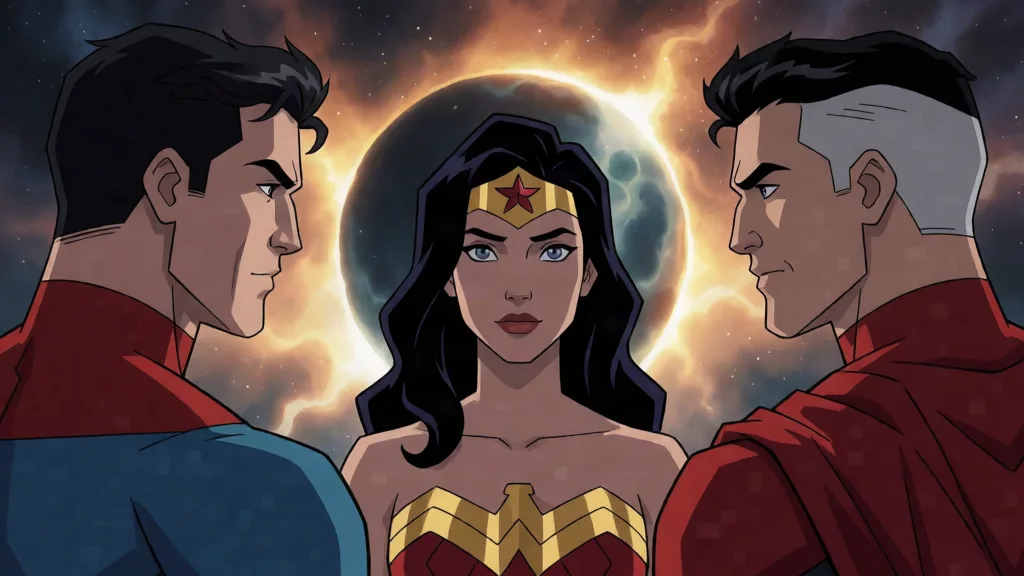
Themyscira does not appear on any map made by man. That's not modesty or myth. It's a fact I've verified with my own hands, sailing every league of the Aegean until the horizon folded in on itself and spat me back out where I started. The island hides because it wants to. The island shows itself only to those it has decided to ruin.
I was three thousand years old the first time I understood that I'd never actually been in love.
You'd think immortality would teach you patience. It teaches you the opposite. It teaches you that time is a river and you're a stone in it, and everything soft gets worn away, and what's left is whatever was hardest in you all along. For me that was duty. For my sisters it was different. Some of them had hate left. Some had grief. Antiope had war, and war kept her sharp until the day it killed her, which she would have called a fair trade.
I had duty. I polished it every morning like a shield.
And then the sky cracked open over the palace and dropped a man into the courtyard.
Not a god. I want to be clear about that, because the poets got it wrong and the poets always get it wrong. He was mortal, bleeding, unconscious, and wearing a red cape that had been torn in three places. His shield arm was bent at an angle that made my stomach turn. He smelled like ozone and burnt hair and something underneath that I couldn't name, something that made the hair on my forearms stand up like I'd walked into a thunderstorm.
I should have let him die.
That's the truth of it. The law of Themyscira was absolute: no man sets foot on our shore. My mother wrote that law in stone before I was carved from clay, and she wrote it for good reasons, reasons that had names and graves. I knew the reasons. I'd memorized the reasons.
But I was the one who found him. Not a sentry. Not Hippolyta. Me, walking back from the eastern cliffs where I'd been training alone, because I couldn't sleep and I never could, and there he was, crumpled in the grass like a dropped doll.
His eyes opened when I knelt beside him.
They were blue. That's a stupid detail to remember. Blue like the sea before a storm, and they focused on me with an intensity that had nothing to do with fear. He looked at me like he'd been looking for me his whole life and had just now, bleeding out in a foreign courtyard, found me.
"You're real," he said.
His voice was wrecked. Blood on his teeth.
"I'm real," I said, because what else do you say to a dying man who's stating the obvious.
"Dreamed you," he said. "Years. Thought I was crazy."
Then he passed out, and I made a decision that I would spend the next century trying to unmake.
I carried him to the healers' quarter myself. Didn't call for help. Didn't announce it. Just lifted him like he weighed nothing, which he nearly did, and walked him through the back corridors where the shadows were thick and the guards were few. My heart was doing something strange in my chest. Not fear. Not guilt, though I should have felt both. Something worse. Something like hunger.
The healers asked no questions. That's the thing about a society of warriors. We know when a thing is being hidden, and we know when not to ask. They stitched him and set his arm and packed his wounds with herbs, and by the second day he was sitting up and asking for water in a language I hadn't heard since Rome.
By the fourth day he was asking for me.
I didn't go. I want that on the record. I stayed away for six days. I trained until my hands bled. I stood on the cliffs and watched the sea and told myself that the feeling in my chest was curiosity, nothing more, that I'd seen a thousand men die and this one was no different, that the law was the law and I was the law's daughter.
On the seventh day I went.
He was in the small room at the end of the healers' hall, the one with the window that faced west. Sunset was coming in orange through the shutters. He'd been given a linen tunic that was too short in the arms, and he was reading a scroll the healers had left him, holding it upside down.
"You're holding it wrong," I said from the doorway.
He looked up. That same look. Like I was a light he'd been walking toward in the dark.
"I can't read your language," he said. "I'm faking it so they think I'm recovering."
"That's dishonest."
"I'm a spy," he said. "It's a professional skill."
I should have turned around and walked out. Instead I crossed the room and sat on the stool beside his bed, and I took the scroll from his hands and turned it right-side up, and I started to read to him. I don't know why. I've had three thousand years to figure out why and I still don't know.
His name was Steven. Steve, he said, everyone calls me Steve. He was a soldier from a world I'd never heard of, a world of cities and machines and wars fought with weapons that made my sisters' spears look like children's toys. He'd been chasing something through a hole in the sky. He'd fallen through and the hole had closed behind him.
"So I'm stuck here," he said. Not a question.
"For now," I said.
"For how long?"
I didn't answer. I didn't know.
Here's what I remember about that first week, and I remember it in pieces, the way you remember a fever. The way he laughed when I told him my sisters could bench-press a horse. The way he asked questions, endless questions, about everything, about the island and the sea and the stars and whether we had coffee, and when I said no he looked at me like I'd told him the sun didn't rise. The way his hand brushed mine reaching for a cup and neither of us moved away.
The way I started finding reasons to walk past the healers' hall.
The way I started sleeping less, which I hadn't thought possible.
My mother noticed. Of course she noticed. Hippolyta has ruled this island for longer than most civilizations have existed, and she has eyes in every wall. She said nothing for two weeks. Then one evening she came to my chambers and stood in the doorway and looked at me the way she looked at a battlefield before the fighting started.
"You've been spending time with the outsider," she said.
"He's recovering."
"He's a man."
"He's a soldier who fell through the sky, Mother. He's a prisoner of circumstance."
"He's a man," she said again, and there was something in her voice I'd never heard before. Not anger. Fear. My mother, who had faced down gods and armies and the wrath of Olympus itself, was afraid.
I should have listened.
But that night I went back to his room, and he was awake, and the moon was coming in through the window and painting the floor silver, and he looked at me with those blue eyes and said, "I dreamed about you again."
"Tell me," I said.
And he did. And I sat on the edge of his bed and listened, and when he finished I kissed him, and the world did not end, and the law did not strike me down, and the only thing that happened was that his hands came up to hold my face and his mouth opened under mine and I felt something I had never felt in three thousand years of living.
I felt like I'd come home.
I didn't know then what he was. I didn't know what the dreams meant, or why a man from another world would dream of a woman he'd never met, or what force had bent the sky to bring him to my shore. I only knew that his skin was warm and his heart was beating against my chest and that for the first time in my long, long life, I wanted something for myself.
That's how it starts, isn't it. Every disaster. Every love story. Every war.
With a woman deciding, just once, to want.
Watch this moment
Turn the current scene into a cinematic Live Chapter — what you watch becomes the story's next part.
Disclaimer
This is a work of fiction, assisted by artificial intelligence. Any names or characters, businesses or places, events or incidents, are fictitious. Any resemblance to actual persons, living or dead, or actual events is purely coincidental.
Content Removal Policy
- Users may report content that may be illegal or violates our Standards.
- All reported complaints will be reviewed and resolved within seven business days.
- Review Process: Our team will assess the reported content against our guidelines.
- Appeals: If you disagree with a decision, you may appeal within 14 days of notification.
- Potential outcomes include: content removal, account warning, or no action if no violation is found.
To report content, email us at [email protected]