Share
Go Live
The Unerasable
·
Published 9/18/2026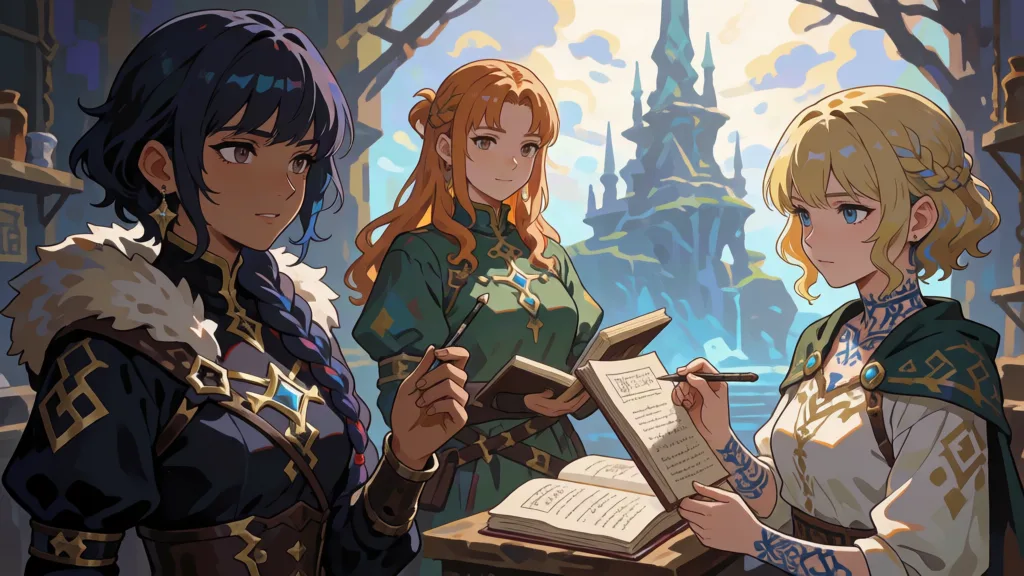
The first time I saw the word, it was bleeding.
Not literally. Ink doesn't bleed, not really, though any scribe worth their salt will tell you it can look like it does when the paper's cheap and the writer's hand is shaking. This was a prison record, one of hundreds I'd stolen from the archive over the years, and the word sat in the margin like a tumor: *Keshara*.
I knew every dialect of the Spire's underbelly. I knew the slang of the dockworkers and the code-talk of the smugglers and the baby-talk that prisoners used when they wrote letters to children they'd never see again. But *Keshara* wasn't any of those. It wasn't anything. It was a hole in the language, a word that meant nothing and everything, and someone had tried to scratch it out so hard the paper had torn.
I was still staring at it when Ilyra came in and dropped a loaf of bread on my desk.
"You're doing the thing," she said.
"What thing?"
"The thing where you forget to eat and then get dramatic about it later." She pulled off her coat, which was damp with rain and smelled like the tannery district. "I could hear your stomach from the street."
I looked up. She had ink on her jaw, a smudge of it, like she'd been resting her chin on her hand while she worked. Her hair was escaping its twine again, dark curls sticking to her temples. She was the most beautiful thing I'd ever seen, and I told her so at least twice a week, and she never believed me.
"I'm not hungry," I said.
"You're always hungry. You just forget." She tore the loaf in half and put one piece directly on top of the record I was reading. "Eat. Then tell me what's got you making that face."
I ate. She was right, of course. She was always right about the small things, which is how I knew to trust her with the big ones.
The bread was still warm. She must have gone out of her way to get it from the baker on Coffin Lane, the one who sold loaves with rosemary baked into the crust. I hadn't asked her to. I hadn't even mentioned I was running low on food, which meant she'd noticed anyway, which meant she'd been paying attention. That was Ilyra. She noticed. She remembered. She showed up with bread and ink on her face and expected nothing in return.
I tore off another piece and held it out to her. She took it, chewing slowly, watching me.
"There's a word," I said.
"There are a lot of words. You use too many of them."
"This one's different." I pulled the record out from under the bread and turned it toward her. "Look."
She leaned in. The candle on my desk flickered, throwing shadows across her sharp cheekbones. Her eyes moved over the page, reading the way she did everything: quickly, precisely, missing nothing.
"*Keshara*," she said. "Never seen it before."
"Neither have I. And I've read every execution song in the Spire's archives. Every prison ledger. Every confession, every testimony, every last will and testament of every prisoner who died in that place." I tapped the word. "This isn't in any of them."
"Except this one."
"Except this one."
She straightened up, wiping her hands on her trousers. "So someone made a mistake. Left a word they shouldn't have. It happens."
"It doesn't happen. Not in these records. The scribes who keep the Spire's archives don't make mistakes. They're too afraid to." I picked up the record and held it to the light. "And look at this. Someone tried to scratch it out. But they did it after the ink dried. See how the paper's torn? They were in a hurry."
Ilyra was quiet for a moment. I watched her think, watched the way her grey eyes narrowed and her mouth pressed into a thin line. She was weighing something, I could tell. Deciding whether to engage or dismiss.
She engaged.
"Where'd you get this one?" she asked.
"Off a dead man."
She didn't flinch. She never did, not at the things I said, not at the things I did. She just waited for me to explain.
"His name was Corvin Ash. He was a guard at the Spire, low-level, nothing special. Died three weeks ago of a fever that turned his skin yellow. His wife sold his effects to pay for the funeral. I bought the records off her for two silver marks."
"You robbed a widow."
"I paid her fair price. She didn't know what she had." I set the record down. "Corvin Ash was assigned to the west wing, the section they closed off after the riots. He kept his own copies of the prisoner logs. Unofficial. The kind the Spire doesn't know exist."
"And this word is in his copies?"
"This word is in one of them. Just one. A prisoner who was executed forty years ago. His name's been scratched out, but the word *Keshara* is written next to the date of his death."
Ilyra crossed her arms. "So what does it mean?"
"I don't know. That's what's interesting."
"It's what's dangerous, is what it is." She reached over and took the record from my hands, turning it toward the candlelight. "You said the Spire doesn't make mistakes. If this word is here, it's here on purpose. Someone wanted it found."
"Or someone wanted it hidden. There's a difference."
"Is there?"
I didn't have an answer for that. She was right, and I hated when she was right, mostly because it meant I had to think harder.
I got up and walked to the window. The rain had stopped, leaving the street below slick and shining. The Drowned Spire rose in the distance, its black towers cutting into the night sky like broken teeth. I could see the lights in the upper windows, the ones where the administrators lived, the ones where they kept their secrets locked behind doors that required three keys and a blood oath to open.
I'd been inside those towers once. I'd walked their halls and sung their songs and smiled at their masters. I'd been a good little bard, a pretty voice for their pretty parties, and I'd learned more in six months of performing than most people learned in a lifetime of spying.
I'd also learned when to leave.
"Vesper." Ilyra's voice was soft now. She'd moved closer without me hearing her, which was a talent of hers, one that had saved my life more than once. "What are you thinking?"
"I'm thinking about the song."
"What song?"
"The execution song. The one they sing when they hang a prisoner in the west wing. I've heard it a hundred times, but I never paid attention to the words." I turned to face her. "There's a line in it. A word that doesn't rhyme with anything else. I always thought it was a mistake, a scribe's error that got passed down through the generations."
"But it's not a mistake."
"No. It's *Keshara*."
She was quiet for a long moment. Then she said, "Show me."
I crossed to the shelf where I kept my notes, the stacks of paper and parchment and stolen records that filled every corner of our small apartment. I found the transcript of the execution song, one I'd copied myself three years ago, and spread it on the table between us.
"There." I pointed to the line. "See it? Right before the final verse. *And when the Keshara calls your name, the stones will remember what the living forget.*"
Ilyra read it twice. Then she read it a third time, her lips moving silently.
"That's not a word," she said. "That's a name."
"A name for what?"
"I don't know. But it's a name." She looked up at me, and there was something new in her eyes, something I recognized. It was the look she got when she was about to do something reckless. "We need to find out."
I grinned. I couldn't help it. "I thought you said it was dangerous."
"It is. But you're going to do it anyway, and I'd rather be there to keep you from getting yourself killed." She reached for the bread and tore off another piece. "Besides. If someone went to the trouble of hiding this word, it means there's something worth hiding. And I don't like being lied to."
"No," I said. "You don't."
She threw the bread at my head. I caught it, laughing, and for a moment the world was small and warm and ours.
That was the last night things were simple.
---
We started with the archives.
The Spire's public records were kept in a building on the eastern edge of the city, a squat stone structure that smelled like dust and decay. Anyone could request access, provided they had a legitimate reason and a bribe for the clerk. I had both.
The clerk's name was Merrit, and he was a small man with a nervous twitch in his left eye and a fondness for cheap wine. I'd known him for years, ever since I'd first started stealing records from under his nose. He thought I was a historian. I let him think that.
"Vesper Cantor," he said, not looking up from his desk. "I was wondering when you'd show up."
"Merrit. You look well."
"I look terrible. I've been sick for a week." He finally raised his head, and his eye twitched twice in quick succession. "What do you want?"
"I need access to the west wing records. The ones from the riots."
He went still. Not a dramatic stillness, just a pause, a hesitation that lasted half a breath too long.
"Those are sealed," he said.
"I know. That's why I'm asking you."
"They're sealed by order of the High Administrator. No one's allowed to see them without a writ."
"Then get me a writ."
"I can't get you a writ. I'm a clerk, not a magistrate."
I leaned on his desk, letting my coat fall open just enough to show the silver pendant at my throat. It was a cheap trick, but it worked more often than not. People saw the key and thought of the Spire's inner circles, thought of power and influence and things they didn't want to cross.
"You're a clerk who knows where the keys are kept," I said. "And I'm a bard who knows a dozen songs about clerks who died in mysterious circumstances. Let's not make this difficult."
Merrit's eye twitched again. Then he sighed, a long, defeated sound, and reached for a ledger on the shelf behind him.
"The riots were forty years ago," he said. "Most of the records were destroyed. What's left is fragmentary at best."
"I'll take fragmentary."
He opened the ledger and ran his finger down a column of dates. "The west wing was closed after the riots. Prisoners were transferred to other sections. Some were executed. Some just... disappeared."
"Disappeared how?"
"No one knows. That's what disappeared means." He looked up at me, and for a moment his nervous twitch was gone, replaced by something harder. "You're asking about things that people have died for, Cantor. I hope you know what you're doing."
"I never do."
He didn't laugh. He just wrote something on a slip of paper and handed it to me.
"Third floor. East corridor. Ask for Sister Agnes. She owes me a favor."
I took the slip and tucked it into my pocket. "Thank you, Merrit."
"Don't thank me. Just don't mention my name if you get caught."
I was already walking away.
---
Sister Agnes was not a nun. She was a former prison guard who'd lost her faith in the Spire and found it again in the bottom of a bottle. She was also the only person who'd been willing to talk about the west wing after the riots, which made her valuable.
She was sitting in a corner of the third-floor archive, surrounded by stacks of paper and empty wine bottles. Her hair was grey and cropped short, and her hands shook when she reached for her glass.
"You're the bard," she said.
"I'm a bard. I don't know if I'm *the* bard."
"You're the one who sings the songs. The ones about the prisoners." She took a long drink. "I've heard them. They're good. They make people remember."
"That's the point."
She nodded slowly. "What do you want?"
"I want to know about a word. *Keshara*."
The glass slipped from her fingers and shattered on the floor. She didn't look down. She just stared at me, her eyes wide and wet and terrified.
"Where did you hear that?"
"A record. An execution song. It doesn't matter where. What matters is what it means."
She shook her head. "No. No, I can't. I can't talk about that."
"Why not?"
"Because they'll kill me. They'll kill me and erase my name and no one will ever know I existed." She was shaking now, her whole body trembling like a leaf in a storm. "You don't understand. You don't know what they're capable of."
"I know they erase people. I know they rewrite histories. I know they make prisoners vanish into records no one's allowed to read." I knelt beside her, lowering my voice. "I know because I've spent ten years trying to undo it. I've sung songs about the forgotten. I've written names on walls. I've done everything I can to make sure the dead aren't forgotten."
"And what good has it done?"
I didn't have an answer for that.
She laughed, a bitter, broken sound. "You think you're a hero. You think your songs matter. But the Spire is bigger than you. It's older than you. It's been erasing people for centuries, and it will keep erasing them long after you're dead."
"Then help me stop it."
She was quiet for a long time. The candle on her desk guttered and went out, leaving us in darkness.
"There was a prisoner," she said finally. "Forty years ago. He was brought to the west wing in the middle of the night. No name. No record. Just a word written on his cell wall. *Keshara*."
"What did it mean?"
"I don't know. But the guards who saw it went mad. They started having dreams. Terrible dreams. Dreams of drowning. Dreams of a city under the sea." Her voice dropped to a whisper. "Three of them killed themselves within a month. The others were transferred. I was the only one who stayed."
"Why?"
"Because I wanted to understand." She reached out and grabbed my wrist, her grip surprisingly strong. "But I never did. I never found out what *Keshara* means. And I've spent forty years trying to forget."
I pulled away slowly. My heart was pounding, and my mouth was dry, and I could feel something cold and heavy settling in my chest.
"Where is he now?" I asked. "The prisoner. What happened to him?"
She smiled, and it was the saddest smile I'd ever seen.
"He's still there," she said. "In the west wing. In a cell no one's opened in forty years. And if you're smart, you'll leave him there."
---
Ilyra was waiting for me when I got home.
She'd cleared off the table and laid out her tattooing tools, the needles and inks and jars of pigment that she used to preserve names and memories on skin. She was working on a design, something intricate and beautiful, but she set it aside when I walked in.
"You look like hell," she said.
"Thank you."
"What did you find?"
I told her. All of it. The clerk, the sister, the prisoner in the west wing. The word that drove men mad. The dreams of drowning.
She listened without interrupting, which was rare for her. When I finished, she was quiet for a long moment.
"A city under the sea," she said.
"That's what she said."
"There are stories. Old ones. About a place called Kesh, a city that sank beneath the waves a thousand years ago." She reached for a book on the shelf, one of the histories she'd collected over the years. "I've got a reference somewhere. A mention in a traveler's account from the third century."
"Kesh. *Keshara*." I sat down heavily. "They're connected."
"Probably. But that doesn't tell us what the word means."
"It tells us it's old. Older than the Spire. Older than anything we know." I rubbed my eyes. "And it tells us someone's been trying to hide it."
Ilyra set the book down and came to sit beside me. She didn't say anything. She just took my hand and held it, her fingers warm and calloused and steady.
"I'm scared," I said.
"I know."
"I don't want to do this alone."
"You're not alone." She squeezed my hand. "You're never alone."
I leaned into her, resting my head on her shoulder. She smelled like ink and soap and the faint, familiar scent of her skin. I closed my eyes and breathed her in.
"I love you," I said.
"I know." She kissed the top of my head. "Now eat something. You're useless when you're hungry."
I laughed, and it hurt, and it was the best thing I'd felt all day.
---
We spent the next week researching.
Ilyra went through every history book she owned, looking for mentions of Kesh. I visited every archive and library in the city, bribing clerks and charming librarians and stealing whatever wasn't nailed down. We compared notes at night, sitting across from each other at the table, surrounded by paper and ink and the smell of old books.
The picture that emerged was fragmentary, incomplete, but it was enough to make us both uneasy.
Kesh had been a city on the western coast, a trading hub that connected the Spire to the lands beyond the sea. It had been wealthy and powerful and independent, a thorn in the Spire's side for centuries. And then, a thousand years ago, it had sunk.
Not gradually. Not over time. It had sunk in a single night, taking its entire population with it. Thousands of people, gone in an instant. The Spire had sent ships to investigate, but they'd found nothing. Just empty water and a few scattered ruins.
The official histories said it was a natural disaster. An earthquake. A tidal wave. An act of God.
But the unofficial histories, the ones I found in the margins of old books and the whispered rumors of sailors, told a different story.
They said Kesh had been destroyed. Deliberately. By the Spire itself.
"Why?" Ilyra asked, when I told her.
"I don't know. But I'm going to find out."
---
The break came on a Tuesday.
I was in the market, buying bread and cheese and trying not to think about the fact that we were running out of money, when I heard someone call my name.
"Vesper Cantor."
I turned. A woman was standing behind me, tall and thin and dressed in the grey robes of a Spire administrator. Her hair was silver, pulled back in a severe bun, and her eyes were the color of slate.
"I don't know you," I said.
"No. But I know you." She stepped closer, and I caught the faint scent of incense and something else, something cold and metallic. "You've been asking questions about Kesh."
My heart stopped. Then started again, faster than before.
"I don't know what you're talking about."
"Don't lie to me. You're not good at it." She smiled, and it didn't reach her eyes. "I'm not here to threaten you, Cantor. I'm here to warn you."
"Warn me about what?"
"About what you're looking for. About what you'll find." She glanced around the market, as if checking for eavesdroppers. "The word you're chasing. *Keshara*. It's not just a word. It's a key."
"A key to what?"
"To something that should have stayed buried." She reached into her robe and pulled out a small, leather-bound book. "This belonged to the prisoner in the west wing. The one Sister Agnes told you about."
I stared at the book. It was old, the leather cracked and faded, the pages yellowed with age. But I could see writing on the cover, a single word in a language I didn't recognize.
"Why are you giving this to me?"
"Because I want you to understand what you're dealing with." She pressed the book into my hands. "Read it. Then decide if you still want to continue."
She turned and walked away, disappearing into the crowd before I could ask her name.
I stood there for a long time, holding the book, feeling the weight of it in my hands.
Then I went home.
---
Ilyra was in the middle of a tattoo when I walked in.
Her client was a young woman, barely out of her teens, with a name inked on her forearm in delicate script. Ilyra was adding to it, a small design that curled around the letters like a vine.
"Give me a minute," she said, not looking up.
I sat down and waited. The client, a girl with nervous eyes and a shaking hand, watched me warily. I smiled at her, and she looked away.
When the tattoo was done, Ilyra cleaned her tools and sent the girl on her way. Then she turned to me.
"What's wrong?"
I held up the book.
"Where did you get that?"
"A woman. In the market. She said it belonged to the prisoner."
Ilyra took the book from my hands and turned it over, examining the cover. "This is old. Older than anything I've seen."
"Can you read it?"
She opened it carefully, turning the pages with the tips of her fingers. The writing inside was dense and cramped, filled with symbols and diagrams and words that made no sense.
"Some of it," she said. "It's a dialect I don't recognize. But there are illustrations. Maps. And this..."
She stopped. Her face went pale.
"What?"
She turned the book toward me. On the page was a drawing of a city, a city under the sea, with towers and spires and streets that twisted like serpents. And in the center of the city, written in letters that seemed to glow with their own light, was a single word.
*Keshara*.
"It's a name," Ilyra whispered. "A name for the city. For Kesh."
"No." I shook my head. "It's more than that. Look at the way it's written. It's not just a label. It's a... a summons."
"A summons for what?"
"I don't know. But I think we're about to find out."
---
We read the book together, late into the night.
It was a journal, written by the prisoner in the west wing. His name had been erased from the records, but he'd written it in the margins of the book, over and over, as if he was afraid of forgetting.
*Tomas. Tomas. Tomas.*
He'd been a scholar, once. A historian. He'd come to Kesh looking for answers, looking for the truth about the city's destruction. And he'd found it.
The Spire had destroyed Kesh. Not with fire or sword, but with something worse. Something that had erased the city from history, that had made its people vanish, that had turned its name into a curse.
And the key to it all was *Keshara*.
"It's a word of power," Ilyra said, her voice hushed. "A word that can unmake reality. That can erase people from existence."
"Like the Spire does."
"Exactly like the Spire does." She looked up at me, and her eyes were bright with fear and excitement. "The Spire didn't invent erasure. They learned it. From Kesh. From the people they destroyed."
I sat back, my mind racing. "So the Spire isn't just a prison. It's a... a legacy. A continuation of something older."
"Something worse."
I thought about the prisoners I'd sung about, the names I'd written on walls, the histories I'd tried to preserve. I thought about the way the Spire erased people, not just killing them but removing them from memory, from record, from existence.
And I thought about Tomas, the scholar who'd discovered the truth and been buried for it.
"We have to expose this," I said.
"We can't."
"We have to. If people knew what the Spire was doing, if they knew the truth about Kesh..."
"They'd be erased too. Just like Tomas. Just like everyone else who's tried to tell the truth." Ilyra grabbed my hands. "Vesper, listen to me. This isn't a song. This isn't a story you can tell to a crowd. This is real. This is dangerous. If we go after this, we'll end up like Tomas. Forgotten. Erased. Gone."
"Then at least we'll be gone together."
She stared at me. Her grip on my hands tightened.
"You're an idiot," she said.
"I know."
"You're a reckless, dramatic, impossible idiot."
"I know."
She kissed me. Hard. Her hands tangled in my hair, and I pulled her close, and for a moment the world was just the two of us, breathing each other in.
When she pulled back, her eyes were wet.
"I'm not letting you do this alone," she said.
"I wouldn't expect you to."
She laughed, a shaky, broken sound. "We're going to die."
"Probably."
"And no one will remember us."
"I'll remember you." I touched her face, her cheek, the ink stain on her jaw. "I'll remember every moment. Every breath. Every stupid argument about bread and evidence and whether it's worth risking our lives for a word."
"It's not just a word."
"No. It's the truth." I kissed her forehead. "And the truth is worth dying for."
She was quiet for a long moment. Then she nodded.
"Okay," she said. "Okay. We'll do it."
---
We spent the next month preparing.
Ilyra tattooed the word on my ribs, a small, hidden mark that no one would see unless they were looking. *Keshara*. A reminder of what we were fighting for. A promise that we wouldn't forget.
I wrote songs, new songs, songs about Kesh and the Spire and the truth that had been buried for a thousand years. I didn't sing them in public. Not yet. But I practiced them in our apartment, late at night, my voice low and steady.
We gathered evidence. Records. Testimonies. The journal of Tomas, copied and hidden in a dozen different places. We made plans, contingency plans, escape routes. We said goodbye to the few friends we had, without telling them why.
And then, on a cold morning in late autumn, we walked to the Drowned Spire.
The prison rose before us, black and massive and terrible. The guards at the gate watched us approach, their hands on their weapons.
"State your business," one of them said.
I smiled, my most charming smile, the one that had gotten me out of trouble a hundred times before.
"I'm here to perform," I said. "For the High Administrator. I have an invitation."
I held out the paper, forged with painstaking care, and the guard took it, examining it closely.
"Wait here," he said, and disappeared into the gatehouse.
Ilyra stood beside me, her hand brushing against mine. She didn't say anything. She didn't need to.
We were here. We were together. And we were about to change everything.
Or die trying.
The guard returned.
"You're cleared," he said. "Follow me."
We walked through the gates, into the shadow of the Spire, and the doors closed behind us.
---
The High Administrator's office was at the top of the tallest tower, a room of glass and steel that overlooked the entire city. I'd been here once before, years ago, when I was young and foolish and thought I could play their games.
I was older now. Wiser. And I knew exactly what I was doing.
The High Administrator was a woman named Vela Mor, a thin, elegant creature with silver hair and eyes like ice. She sat behind her desk, watching us approach, her expression unreadable.
"Vesper Cantor," she said. "I've heard your songs. They're quite... evocative."
"Thank you," I said. "I aim to please."
"I'm sure you do." She glanced at Ilyra. "And who is your companion?"
"Ilyra Quill. She's my... collaborator."
"Collaborator. How charming." Vela leaned back in her chair. "I assume you're here for a reason. You didn't come all this way just to perform."
"No. I came to ask you a question."
"Ask."
I took a breath. This was it. The moment we'd been preparing for.
"What is *Keshara*?"
The room went silent. Vela's expression didn't change, but something flickered in her eyes. Something cold and dangerous.
"Where did you hear that word?"
"That's not an answer."
"It's the only answer you're going to get." She stood up, moving around the desk to stand in front of me. "You're playing a dangerous game, Cantor. I suggest you stop."
"I can't. I've come too far."
"Then you'll die."
"Maybe." I met her gaze, refusing to look away. "But not before I tell the world what you've done. What the Spire has done. The truth about Kesh. The truth about the people you've erased."
Vela laughed. It was a cold, brittle sound.
"You think you know the truth? You think a few stolen records and a dead man's journal will change anything?" She shook her head. "You're a fool. A romantic fool. And you're about to learn a very hard lesson."
She raised her hand, and the guards moved forward.
Ilyra grabbed my arm. "Vesper..."
"Trust me," I said.
And then I started to sing.
---
The song was one I'd written myself, a melody that wove together every story I'd ever heard, every name I'd ever preserved, every truth I'd ever tried to tell. It was a song about the forgotten, about the erased, about the people who'd died so that the Spire could live.
It was a song about Kesh.
The guards hesitated. I saw it in their eyes, the flicker of doubt, the moment of recognition. They'd heard these stories before, in whispers, in rumors, in the songs of a bard who refused to be silenced.
And now they were hearing them again.
Vela's face twisted with rage. "Stop him! Stop him now!"
But it was too late. The song was already spreading, echoing through the tower, through the walls, through the city beyond. People were stopping in the streets, looking up, listening. They were remembering.
Remembering the names they'd been told to forget. Remembering the histories they'd been taught to ignore. Remembering the truth.
Ilyra was beside me, her hand in mine, her voice joining with mine. She wasn't a singer, but she didn't need to be. She just needed to be there. To be present. To be a witness.
And that was enough.
---
We didn't escape.
The guards caught us, of course. They dragged us down to the dungeons, threw us into separate cells, left us to rot. But it didn't matter. The song had already done its work.
I could hear it, even in my cell. People singing in the streets. People shouting my name. People demanding answers.
The Spire was crumbling. Not the walls, not the towers, but the lies. The secrets. The erasures.
And I had done that. I had started it.
I sat in my cell, my ribs aching, my voice raw, and I smiled.
Because I knew, even then, that we had won.
Not completely. Not yet. But we had planted a seed. And seeds grow.
---
Ilyra was in the cell next to mine.
I could hear her breathing through the wall, slow and steady. I pressed my hand against the stone, as if I could reach her.
"Ilyra," I said.
"I'm here."
"Are you okay?"
"No." A pause. "But I will be."
"I'm sorry. I'm sorry I got us into this."
"Don't apologize." Her voice was sharp. "Don't you dare apologize. We did the right thing."
"Did we?"
"Yes." Another pause. "We made them remember. That's more than anyone else has done in a thousand years."
I closed my eyes. The stone was cold against my back, and my hands were shaking, and I was more afraid than I'd ever been.
But I wasn't alone.
"I love you," I said.
"I know." Her voice was softer now. "I love you too."
And in the darkness of the Spire's dungeons, with the sound of singing in the streets above us, we waited.
For what came next.
For the truth to spread.
For the world to remember.
---
They came for us three days later.
Not the guards, not the administrators, but the people. The prisoners. The forgotten. They broke down the doors and tore through the halls and freed us from our cells.
Ilyra found me in the chaos, her hair wild, her eyes bright, her hands covered in blood. Not hers. Someone else's.
"Come on," she said, grabbing my arm. "We have to go."
"Where?"
"Anywhere. Everywhere." She pulled me through the crowd, through the shouting and the singing and the sound of chains breaking. "We have work to do."
We ran through the streets, hand in hand, the Spire burning behind us. Not literally. Not yet. But the fire was spreading. The fire we had started.
And as we ran, I started to sing again. A new song. A song about hope. A song about remembering.
A song about Kesh.
---
We didn't stop running for a long time.
We fled the city, fled the Spire's reach, fled everything we'd ever known. We traveled through the wilderness, through the ruins of old cities, through the places where the forgotten had been buried.
And everywhere we went, we told the story. We sang the songs. We wrote the names.
We found others like us. Survivors. Witnesses. People who'd been erased and had somehow, impossibly, remembered.
We built a network. A resistance. A movement.
And we never forgot.
---
Years later, when the Spire had fallen and the truth had been told, Ilyra and I returned to the city. We walked through the streets, through the ruins, through the places where we'd once been prisoners and now were free.
We stopped at the spot where the Spire had stood. Nothing was left but rubble and ash.
"Look," Ilyra said, pointing.
On the ground, written in letters that seemed to glow with their own light, was a single word.
*Keshara*.
"It's a name," I said.
"No." She took my hand. "It's a promise."
We stood there, together, and watched the sun rise over the ruins.
And we remembered.
---
The first time I saw the word, it was bleeding.
Not literally. But it might as well have been. Because that word, that single, impossible word, had changed everything.
It had taken us from a small apartment in the shadow of the Spire to the ruins of a city under the sea. It had taken us from obscurity to legend. It had taken us from fear to hope.
And it had brought us together.
In the end, that was what mattered. Not the songs, not the truth, not the revolution.
Just the two of us. Holding hands. Remembering.
*Keshara*.
The word that meant everything.
The word that meant us.
Watch this moment
Turn the current scene into a cinematic Live Chapter — what you watch becomes the story's next part.
Disclaimer
This is a work of fiction, assisted by artificial intelligence. Any names or characters, businesses or places, events or incidents, are fictitious. Any resemblance to actual persons, living or dead, or actual events is purely coincidental.
Content Removal Policy
- Users may report content that may be illegal or violates our Standards.
- All reported complaints will be reviewed and resolved within seven business days.
- Review Process: Our team will assess the reported content against our guidelines.
- Appeals: If you disagree with a decision, you may appeal within 14 days of notification.
- Potential outcomes include: content removal, account warning, or no action if no violation is found.
To report content, email us at [email protected]