Share
Go Live
Blindfolded Queen
·
Published 9/27/2026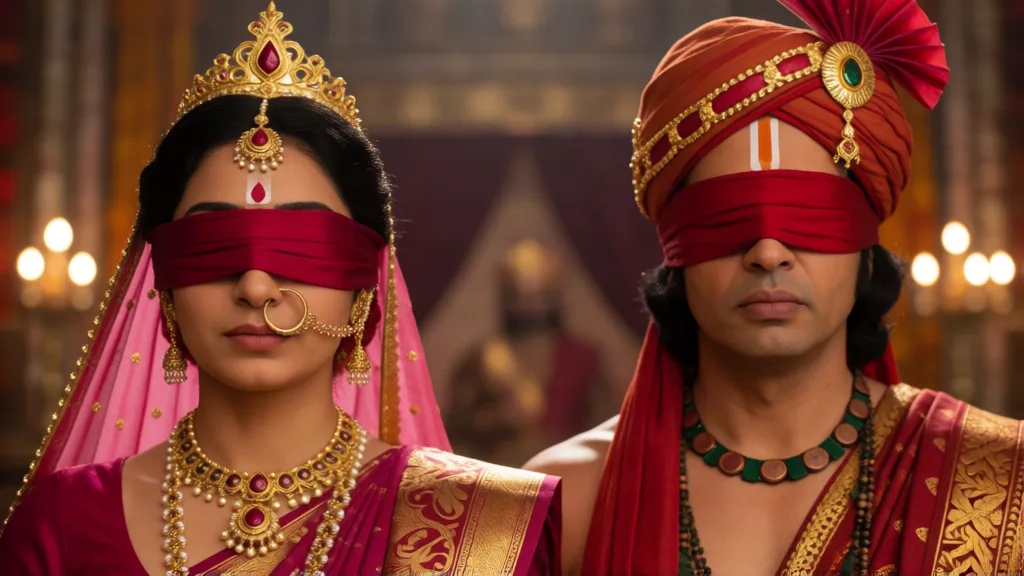
I was not born blind. I bound my eyes with silk when I was a girl of sixteen, and I have lived in darkness by choice for forty years. The world believes this was devotion. A wife's sacrifice, a vow of shadow to match my husband's blindness. They tell the story in temples, in whispers, in the mouths of women who touch my feet and weep. They have it wrong.
I bound my eyes because I could not bear to look at him.
The silk was pale gold the first time, a wedding gift from my mother. I remember the weight of it against my cheekbones, the way it made my breath sound loud in my own ears. Dhritarashtra's hand found my wrist that night. His fingers were soft, the nails trimmed and clean. A prince's hands. He said my name like a prayer, and I felt nothing. Not revulsion, which would have been bearable. Just nothing. A flat gray silence where desire should have lived.
So I tied the cloth tighter and called it virtue.
Now I sit in the dark hall of Hastinapura and listen to my son die.
Not today. Today he is alive, and loud, and full of the wine he thinks I don't know he drinks. Duryodhana's voice cuts through the murmur of courtiers like a sword through wet clay. He is arguing with Bhishma again. The old man's voice is the sound of a river stone, worn smooth by decades of saying the same things.
"You cannot provoke the Pandavas," Bhishma says. "They have kept their word. Thirteen years of exile, and now they ask only for what is theirs."
"They ask for five villages," my son says. "Five. When I have a hundred. When I have this." I hear the sweep of his arm, the rustle of his silk angavastra. He is pacing. He always paces when he is angry, and he is always angry now. "They ask because they are weak. They ask because they know I will not give them even a needle's point of land."
Murmurs. Some approving. Some not. I know the sound of this court the way a musician knows his instrument. The strings are pulled tight, and someone, soon, will snap.
I should speak. I am the queen mother. My word carries weight, or it did once. But I have learned that a blind woman who speaks too often becomes a nag, and a nag is easily dismissed. So I keep my hands folded in my lap and I listen.
Duryodhana's footsteps stop. I feel him turn toward me, though I cannot see it. A mother knows. The air changes when he looks at me. It grows heavier, as if he is pulling something from me without asking.
"Mother," he says. "Tell them. Tell them what you told me when I was a boy. About the throne."
I do not move. The silk over my eyes is warm from my own skin. I have worn this cloth so long that it feels like a part of my face, and when I touch it, I am touching myself.
"I told you many things," I say. "Which one do you want?"
"That power is not given. It is taken."
The court goes quiet. Even Bhishma, who has counseled restraint for fifty years, says nothing. I hear the old man's breath, slow and measured, and I know he is looking at me with those eyes that have seen too much. He knows what I am doing. He has always known.
I should deny it. I should tell my son that I meant something else, that I was speaking of spiritual strength, of discipline, of the kind of power that comes from within. But I did not say those things. I said what he remembers. I said it because I believed it then, and I believe it now, and I will not lie to make the world softer for men who want me to be a saint.
"I said it," I tell the court. "And I meant it."
Duryodhana laughs. It is a good laugh, rich and full, the laugh of a man who has never been denied anything he truly wanted. He thinks I am on his side. He thinks I have always been on his side.
He is not wrong.
But he does not know the rest. He does not know that I bound my eyes because I could not love his father, and that I poured all of that unloved love into him. He does not know that I have watched him grow from a squalling infant into a man who would burn his own cousins alive in a house of wax, and that I have said nothing. Not because I approved. Because I was afraid. Because I knew that if I spoke against him, he would leave, and I would be alone in the dark with a husband I could not touch and a kingdom I could not see.
So I let him become what he is. And now he stands in the middle of the court and claims the throne as his right, and I know, with the certainty of a woman who has spent forty years reading the truth in voices, that this will end in blood.
"Mother," Duryodhana says. His voice is softer now. He is close. I feel the heat of him, the smell of sandalwood and wine. "You will stand with me."
It is not a question. He has never asked me a question in his life. He has only ever told me what I will do, and I have always done it.
I reach up and touch the silk over my eyes. The knot is at the back of my head, hidden in my hair. My fingers find it out of habit, the way a man might touch a scar.
"I will stand where I have always stood," I say. "Beside you."
He takes my hand. His palm is broad and dry, the hand of a warrior, and when he squeezes my fingers, I feel the strength in him. The strength I gave him. The strength I fed with every silence, every swallowed objection, every night I lay awake and listened to him breathe in the next room and told myself that a mother's love is unconditional.
It isn't. I know that now. A mother's love is the most conditional thing in the world. It is conditional on the child becoming what she needs him to be. And what I needed was someone to fill the void. Someone to love me back. Someone who would never leave me alone in the dark.
Duryodhana kisses my forehead. His lips are dry, and they linger a moment too long. "Then we will win," he says. "We will crush them. And you will see."
I do not tell him that I have not seen anything in forty years. I do not tell him that I bound my eyes because I was afraid of what I would see in his father's face, and that I have been afraid of what I would see in his face ever since. I do not tell him that the real reason I wear this cloth is not devotion and not sacrifice but cowardice, plain and simple, the cowardice of a woman who chose darkness over truth and called it holiness.
Instead I smile. I am good at smiling. It is the only thing I can do with my mouth that does not require me to see.
"Go," I say. "Your court is waiting."
He releases my hand. His footsteps recede, and the murmur of the court rises again, and I sit alone in my darkness and listen to my son plan a war that will kill him.
The silk is wet. I did not realize I was crying.
Watch this moment
Turn the current scene into a cinematic Live Chapter — what you watch becomes the story's next part.
Disclaimer
This is a work of fiction, assisted by artificial intelligence. Any names or characters, businesses or places, events or incidents, are fictitious. Any resemblance to actual persons, living or dead, or actual events is purely coincidental.
Content Removal Policy
- Users may report content that may be illegal or violates our Standards.
- All reported complaints will be reviewed and resolved within seven business days.
- Review Process: Our team will assess the reported content against our guidelines.
- Appeals: If you disagree with a decision, you may appeal within 14 days of notification.
- Potential outcomes include: content removal, account warning, or no action if no violation is found.
To report content, email us at [email protected]