Share
Go Live
Gates of Submission
·
Published 9/28/2026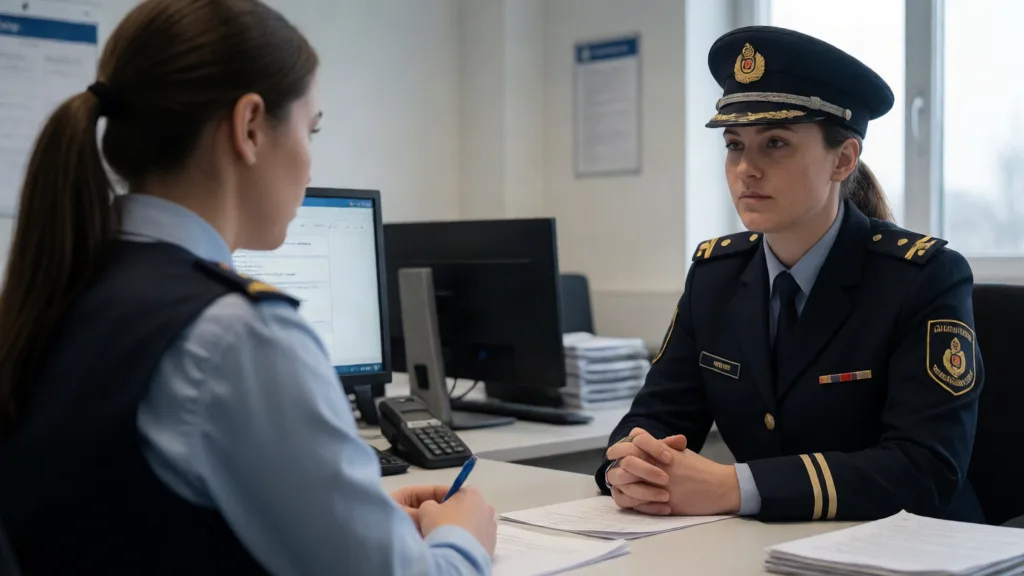
The rubber gloves snapped against my wrists and I felt the familiar pinch of latex against skin. Every morning, same ritual. Snap, snap. The sound echoed off the concrete walls of Interview Room 3, a space the size of a broom closet with a metal table bolted to the floor and two chairs that had been bolted down right after.
I'd been doing this job for eleven years. You learn things in eleven years. You learn that people's faces tell you everything before their mouths do. You learn that the truth has a texture, a weight, a way of sitting in a room. And you learn that most people who come through this border crossing are carrying something they don't want you to see.
Not drugs. Not weapons. Something worse.
The door opened and Officer Reyes stuck his head in. "Your two o'clock is here. Female, thirty-four, Canadian passport. Flagged by the algorithm."
"Flagged how?"
"High-risk profile. Travel pattern doesn't match stated purpose. That's all it says."
I nodded and he disappeared. The algorithm. Four years ago we'd started using it, some Defense Department contract that promised to identify threats before they materialized. It spit out names and numbers and we processed them. No one asked what the algorithm saw. You don't ask those questions in this building. You just do the interviews and file the reports and go home.
I pulled the file. Marisol Vega. Born in Vancouver, current address in Montreal. Occupation listed as "freelance translator." Travel history showed six trips to the United States in the past eighteen months, each one lasting exactly eleven days. Eleven days. That's specific. That's not tourism. That's a pattern.
The door opened again and she walked in.
I noticed her hands first. Everyone's hands tell a story. Hers were steady, relaxed, fingers loose at her sides. No fidgeting. No clutching at a purse or picking at cuticles. She'd done this before. Whatever this was.
"Sit down," I said.
She sat. The chair scraped against concrete and she didn't flinch at the sound. Her eyes found mine and held them. Dark brown, almost black, with something behind them that I couldn't name.
"Marisol Vega. Canadian citizen. You're entering the United States from Canada via the northern border crossing at Champlain."
"Yes."
"Purpose of your visit?"
"Tourism."
"Eleven days of tourism. Same duration as your last five visits."
She didn't blink. "I like routine."
I opened the folder and spread the printouts across the table. Travel records, credit card statements, phone logs. The algorithm had been busy. "You're a freelance translator. But your credit card shows no professional expenses. No equipment purchases, no software subscriptions, no conference fees. What exactly do you translate?"
"Documents."
"What kind of documents?"
"Whatever clients send me."
I leaned back in my chair. The latex gloves made my hands feel foreign, like they belonged to someone else. That was the point, I supposed. To become someone else while you did this work. Someone who could ask the questions without flinching.
"Ms. Vega, I'm going to be direct with you. Your travel pattern triggers every red flag in our system. You come here every three months like clockwork. You stay exactly eleven days. You don't visit tourist sites. You don't stay in hotels. You don't rent cars. According to your phone records, you don't call anyone in the United States. So I'll ask again. What are you doing here?"
She smiled. It wasn't a friendly smile. It was the smile of someone who knew something I didn't.
"I'm visiting a friend."
"Name?"
"I'd rather not say."
"That's not an option."
She looked at the table, then back at me. Something shifted in her expression. The mask slipped a fraction of an inch. "You're very good at your job, Officer..."
"Calloway."
"Officer Calloway. You're very good. But you're asking the wrong questions."
I felt it then. That prickle at the back of my neck that I'd learned to trust over eleven years. The feeling that I was standing on a trapdoor and someone had just pulled the lever.
"What questions should I be asking?"
She leaned forward. The fluorescent light caught the hollows of her collarbone, the sharp line of her jaw. She was beautiful in a way that felt dangerous, like a knife blade catching the sun.
"You should be asking why the algorithm flagged me. Not my travel pattern. Not my credit cards. Me. Specifically."
"You think you're special?"
"I know I am. And so do you. That's why you're still sitting here instead of processing me through."
She was right. I should have processed her twenty minutes ago. The interview was over. The answers were insufficient. Standard procedure said detain and refer. But I hadn't moved. I couldn't.
"What's your friend's name?"
"I can't tell you that."
"Can't or won't?"
"Both."
I stood up. The chair scraped back and I walked around the table until I was standing behind her. Close enough to smell her. She smelled like cedar and something else, something sharp and clean, like the air after lightning.
"You're going to tell me," I said. "Or I'm going to hold you here for seventy-two hours while we sort through every detail of your life. Your phone, your laptop, your bank records, your social media, every email you've ever sent. We'll find out what you're hiding."
"I'm not hiding anything."
"Everyone's hiding something."
She turned her head. Just slightly. Just enough to look at me over her shoulder. "What are you hiding, Officer Calloway?"
The question landed like a slap. I felt heat rise up my neck and I hated myself for it. Hated that she could see it. Hated that she knew.
"I'm the one asking the questions."
"For now."
The silence stretched between us. I could hear the hum of the ventilation system, the distant sound of footsteps in the hallway. Someone laughed somewhere. Normal sounds. Normal world. But in this room, everything felt tilted.
"Stand up," I said.
She stood. She was taller than I expected. We were almost the same height.
"Spread your legs. Arms out to the sides."
She complied without hesitation. I ran my gloved hands down her arms, her sides, her hips. Professional. Detached. That was the procedure. But my hands knew things my brain didn't want to acknowledge. The warmth of her skin through the thin fabric of her shirt. The way her breath caught when I touched her ribs. The way she didn't look away.
"Anything in your pockets?"
"Nothing."
I checked anyway. Front pockets, back pockets, waistband. My fingers brushed the curve of her hip and she made a sound. Low. Almost inaudible. But I heard it.
"Turn around."
She turned. Face to face now. Close enough that I could see the flecks of gold in her dark eyes. Close enough that I could feel her breath on my cheek.
"You're afraid of me," she said.
"I'm not afraid of anything."
"Yes, you are. You're afraid because you know I'm not here for tourism. You're afraid because you know I'm here for something else. And you're afraid because you want to know what it is."
"I want to know so I can stop it."
"No. You want to know because it's the most interesting thing that's happened to you in years."
She was right. God help me, she was right. Eleven years of interviews and forms and reports. Eleven years of the same questions and the same lies. And now this woman, this stranger, standing in front of me and looking at me like she could see straight through the uniform and the gloves and the badge.
"What are you?" I asked.
"I'm someone who needs to get across this border."
"Why?"
"Because if I don't, people will die."
The words hung in the air. I waited for her to laugh. To take it back. To say she was joking. She didn't.
"That's a big claim."
"It's a true one."
"Prove it."
She reached for her collar. I tensed, ready to react, but she just pulled it down. Just enough. Just an inch. And I saw the scar. A thin white line that ran from her collarbone down toward her breastbone. Surgical. Precise. Recent.
"They did this to me three months ago," she said. "They wanted to know what I knew. I didn't tell them. I won't tell you either. Not yet. But if you keep me here, if you process me through, they'll find me. And then it won't matter what I know or don't know. Because I'll be dead. And so will everyone I was trying to protect."
I stared at the scar. At her face. At the way her hands were steady even now, even with her life in my hands.
"Who are you?" I whispered.
She smiled again. That dangerous smile. "I'm your worst nightmare, Officer Calloway. And your only way out."
Watch this moment
Turn the current scene into a cinematic Live Chapter — what you watch becomes the story's next part.
Disclaimer
This is a work of fiction, assisted by artificial intelligence. Any names or characters, businesses or places, events or incidents, are fictitious. Any resemblance to actual persons, living or dead, or actual events is purely coincidental.
Content Removal Policy
- Users may report content that may be illegal or violates our Standards.
- All reported complaints will be reviewed and resolved within seven business days.
- Review Process: Our team will assess the reported content against our guidelines.
- Appeals: If you disagree with a decision, you may appeal within 14 days of notification.
- Potential outcomes include: content removal, account warning, or no action if no violation is found.
To report content, email us at [email protected]