Share
Go Live
Paint Her Doom
·
Published 11/11/2026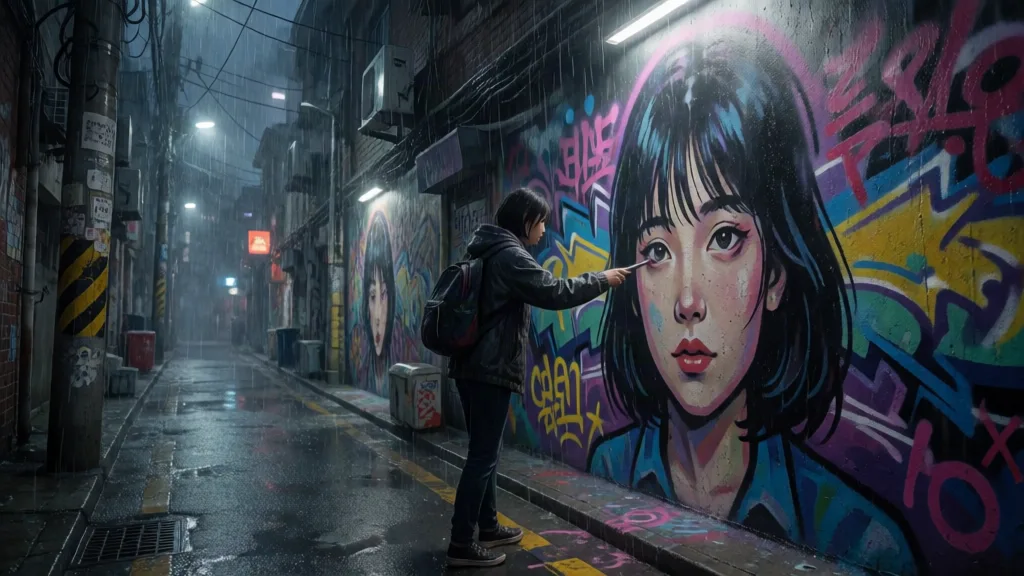
The rain had been falling for three days straight, and the alley smelled like wet brick and old kimchi and the particular rot of a city that never quite dries out. I was on my knees in a puddle that had gone past cold into something meaner, something that seeped through my jeans and settled into the bone, and I was painting a dead man's face.
Not a dead man. A man who would be dead. There's a difference, and the difference was the whole problem.
My name is Yuna Park, and I'm seventeen years old, and I see things before they happen. Not in a vision way, not in a fortune teller way with candles and cards and mysterious hand gestures. I see them in spray paint. On walls. In colors I don't remember choosing.
The man on the wall had kind eyes and a crooked nose and a scar above his left eyebrow that looked like a comma. He was wearing a delivery uniform, the kind the chicken place on the corner uses, orange with white stripes down the sleeves. In the painting, he was lying on his back on wet asphalt, and there was a halo of blood around his head that looked almost like a crown if you squinted. I hadn't painted the blood. I never painted the blood. It just showed up, blooming through the layers like a stain that wouldn't wash out.
I'd been staring at him for twenty minutes, trying to figure out what to do.
The alley was technically a dead end, which is why I used it. The buildings on either side were old, the kind of old that predates the war, with wooden beams and sagging rooflines and windows that had been painted over so many times they looked blind. Nobody came here except me and the rats and occasionally a drunk who couldn't find his way home. It was my gallery. My studio. My crime scene.
The man's eyes followed me as I shifted my weight, trying to get feeling back into my legs. That was new. Usually the faces stayed static, frozen in whatever moment I'd caught them in. But this one was watching me. I could feel it, the weight of his gaze, the way you feel someone looking at you across a crowded room even before you turn around.
I told myself it was the rain. The way it distorted things. The way it made shadows move in the corners of your vision.
I'd been telling myself things like that for two years now. It hadn't helped yet.
The first time it happened, I was fifteen and painting a mural on the underside of the Han River bridge, a place where the homeless kids sometimes slept and the graffiti writers sometimes gathered and the cops never bothered to check. I'd been working on a portrait of my mother, who'd died when I was twelve, trying to remember the exact shade of her laugh, the way her eyes crinkled at the corners. I'd painted her standing in a garden, surrounded by flowers I couldn't name, and when I stepped back to look at it, she was lying in a hospital bed with tubes in her arms.
Three days later, my aunt called to tell me that my mother's sister, the one I'd never met, had died in a hospital in Busan. Same tubes. Same flowers on the windowsill.
I hadn't painted my mother at all. I'd painted a stranger. And she'd died anyway.
After that, I started paying attention. Started keeping track. The faces I painted, the scenes that emerged from my brush without my permission, they always came true. Always within a day or two. Always exactly as I'd painted them, down to the color of the shoes, the angle of the light, the position of the hands.
I'd tried to stop. I'd thrown away my brushes, my cans, my markers. I'd lasted three weeks before the dreams started, dreams of walls that needed painting, of faces that needed to be seen, of a pressure building behind my eyes until I thought my skull would crack. When I finally picked up a can again, the relief was so intense I cried.
So I kept painting. And people kept dying. And I kept telling myself there was nothing I could do about it.
Until now.
Because the man on the wall wasn't the only thing I'd painted tonight. There was another figure, smaller, half-hidden behind a dumpster. A girl with short hair and a scar on her chin and a silver ring on her thumb. A girl I saw every time I looked in the mirror.
Me.
I was going to die tomorrow. And I had no idea how to stop it.
The rain picked up, hammering against the corrugated metal roof of the convenience store behind me, drowning out the distant hum of traffic, the occasional shout from the main street two blocks over. I should have been scared. I was scared. But underneath the fear was something else, something that felt almost like relief.
Finally. Finally, the universe had turned its attention to me.
I'd spent two years watching other people's deaths play out on concrete and brick, two years carrying the weight of knowing and not being able to change anything. I'd tried, in the beginning. I'd tried to warn people, to change the scenes, to paint over the faces with something else. It never worked. The paint would bleed through, or the person wouldn't listen, or I'd lose my nerve at the last second and watch them walk into their fate anyway.
The universe didn't like being edited.
But this was different. This was me. And I'd spent my whole life being edited by other people, shaped and reshaped by a system that didn't care what I wanted, by adults who saw me as a problem to be solved rather than a person to be understood. I'd been in three foster homes and two group homes and one juvenile detention center, and in every single one, I'd been told who I was supposed to be.
I was done being told.
I pulled a fresh can of paint from my bag, a deep crimson that I'd bought three days ago for reasons I hadn't understood at the time. Now I understood. I was going to paint over my own face. I was going to change the scene. I was going to prove that the future wasn't fixed, that fate could be rewritten, that I wasn't just a witness to the world's cruelty but a participant in my own life.
The cap came off with a satisfying click. I shook the can, the ball bearing rattling inside like a heartbeat, and I raised my hand to the wall.
And the painting moved.
Not much. Just a twitch. The girl's hand, the one with the silver ring, shifted slightly to the left. I blinked. The rain blurred my vision. I blinked again. The hand was still there, still painted, but it wasn't where I'd left it.
I took a step back, my heart hammering against my ribs. The man in the delivery uniform was still lying on the asphalt, still bleeding his crown of red. But his eyes had moved too. They were looking at me now, not past me, not through me. At me.
And his mouth was open.
I hadn't painted his mouth open.
I hadn't painted his mouth at all.
"What the hell," I whispered, and my voice sounded small and young and nothing like the person I'd been trying to become.
The paint on the wall rippled, like water disturbed by a stone. The colors shifted, blending and separating, and for a moment I saw something else underneath the image, something that looked like a door, a door made of light, a door that was opening.
Then the rain intensified, a sheet of water so thick I couldn't see the wall anymore, and when it cleared, the painting was different.
The man was still there. The blood was still there. But the girl, the girl with my face, she was standing now. She was walking. She was walking toward something I couldn't see, something beyond the edge of the wall, beyond the frame of the painting, and her hand was reaching out, reaching for a door that wasn't there.
I dropped the can. It clattered against the wet ground, rolling into a puddle, the crimson paint bleeding into the water like blood.
I should have run. Any sane person would have run. But I'd never been sane, not really, not since the first time I'd seen a future I couldn't change. And there was something about the door, something about the way the girl was walking toward it, that made me think of all the things I'd been running from my whole life.
My mother's death. My father's disappearance. The foster homes and the group homes and the detention center. The caseworker who'd told me I was unadoptable, unlovable, unreachable. The boys who'd called me crazy when I'd tried to tell them what I saw. The girls who'd called me worse.
I'd been running for so long I'd forgotten what it felt like to stand still.
The girl in the painting wasn't running. She was walking. Toward something. Toward a door that might lead anywhere.
I picked up the can. The paint was still bleeding into the puddle, but when I looked at the wall again, the girl had turned. She was facing me now, and her eyes, my eyes, were wide and scared and hopeful all at once. She was holding out her hand, the one with the silver ring, and I understood.
She wasn't walking toward a door. She was walking toward me.
And she was asking me to follow.
I don't know how long I stood there, the rain soaking through my jacket, my hair plastered to my forehead, my fingers numb around the can. The alley was dark except for the dim glow of a streetlamp at the far end, and the painting seemed to glow with its own light, a light that wasn't quite natural, wasn't quite possible.
I thought about my mother, about the way she used to sing to me when I couldn't sleep, about the way her voice had cracked on the high notes because she'd never had lessons, never had anyone to teach her. I thought about the last time I'd seen her, in the hospital, her face pale against the pillow, her hand reaching for mine. I'd been too scared to take it. Too scared of what it would mean, of what I'd feel, of what I'd lose.
She'd died three hours later, alone.
I thought about the man in the delivery uniform, the one who was going to die tomorrow. I didn't know his name. I didn't know if he had a family, if he had children, if anyone would miss him when he was gone. But I knew his face, the kindness in his eyes, the crooked nose, the scar that looked like a comma. I knew he was going to die, and I knew I couldn't stop it.
But maybe I could change it. Maybe I could paint something different. Maybe the door wasn't just a door. Maybe it was a choice.
I raised the can again, and this time I didn't hesitate. I painted over the girl's face, over my face, with broad strokes of crimson. I painted a new scene, a new future, a new ending. I painted myself walking away from the alley, walking toward the main street, walking into a life that didn't end tomorrow.
The paint resisted. It wanted to stay in its original shape, wanted to tell its original story. But I pushed harder, my arm aching, my breath coming in ragged gasps, and slowly, slowly, the image began to change.
The girl's face blurred, reformed. Her hair grew longer, then shorter, then longer again. Her clothes shifted from the ratty hoodie I was wearing to something else, something I didn't recognize. A dress. A white dress. A dress I'd never owned, never wanted, never even seen before.
And the door was gone.
In its place was a window. A window with bars on it. And behind the window, a face I knew. A face I'd been trying to forget for five years.
My father.
He was older than I remembered, grayer, thinner. But it was him. The same sharp cheekbones, the same crooked smile, the same scar on his chin from the time he'd fallen off his motorcycle when I was eight. He was looking at me through the window, and his eyes were sad, and his mouth was moving, forming words I couldn't hear.
"Yuna," he was saying. "Yuna, don't."
Don't what? Don't paint? Don't change the future? Don't come looking for him?
I hadn't seen my father since I was twelve. He'd left one morning to buy cigarettes and never come back, and my mother had cried for a week, and then she'd gotten sick, and then she'd died. I'd spent five years telling myself I hated him. Five years convincing myself I didn't care.
But I did care. I cared so much it felt like a hole in my chest, a hole that nothing could fill.
The paint was moving again, faster now, the colors swirling and blending, and I couldn't control it anymore. The window with bars was fading, replaced by something else, something darker. A room with no windows. A door with no handle. A figure in the shadows, watching.
I dropped the can again, and this time I didn't pick it up.
The rain was letting up, the sky lightening at the edges, the first hint of dawn pushing through the clouds. I had maybe an hour before the sun came up. An hour before the city woke and the alley filled with people and the painting became just another piece of graffiti, another piece of street art, another piece of nothing.
But it wasn't nothing. It was a warning. It was a map. It was a door, and I had to decide whether to walk through it.
I thought about the man in the delivery uniform. I thought about his kind eyes and his crooked nose and the scar that looked like a comma. I thought about the blood around his head, the crown of red, the way it bloomed through the layers like a stain that wouldn't wash out.
I thought about my own face on the wall, the girl with the silver ring, the girl who was walking toward something, the girl who was asking me to follow.
And I thought about my father, behind the window with bars, saying my name like a prayer, saying don't, saying please.
I didn't know what any of it meant. I didn't know if I was saving myself or damning myself. I didn't know if the future was fixed or fluid or something in between.
But I knew I couldn't walk away. Not this time. Not from this.
I pulled a fresh can from my bag, a can of black paint, the color of night, the color of endings, the color of beginnings. I shook it once, twice, three times, and I raised my hand to the wall.
And I started to paint.
The first stroke was a line, straight and true, cutting through the image like a knife. The second was a curve, a circle, a shape that might have been a moon or a sun or an eye. The third was a spiral, winding inward, winding outward, winding toward something I couldn't see.
The paint fought me. It wanted to stay in its original shape, wanted to tell its original story. But I was stronger now, or maybe I was just more desperate, and I pushed through the resistance, my arm aching, my breath coming in ragged gasps, and slowly, slowly, the image began to change.
The man in the delivery uniform faded, replaced by something else. A figure in a hoodie, a figure with a can of spray paint, a figure with a silver ring on her thumb. Me. But not me. A different version of me. A version that was smiling, that was walking, that was alive.
The girl in the painting turned to look at me, and her eyes were my eyes, and her smile was my smile, and she was holding out her hand.
I reached for her.
And the paint reached back.
It was cold, colder than the rain, colder than the puddle I'd been kneeling in, colder than anything I'd ever felt. It wrapped around my fingers, my wrist, my arm, and it pulled. Not hard. Not rough. Just enough to let me know it was there, that it was real, that it wasn't going to let go.
I could have pulled away. I could have run. I could have pretended I hadn't seen anything, hadn't felt anything, hadn't painted a door that was opening in front of me.
But I was tired of pretending. I was tired of running. I was tired of being a witness to a world that didn't care if I lived or died.
So I stepped forward.
And the alley disappeared.
I was standing in a room I'd never seen before, a room with no windows and no doors and no furniture except for a single chair in the center. The walls were covered in paintings, hundreds of them, thousands of them, faces and scenes and moments I didn't recognize but somehow knew. A woman crying over a grave. A child laughing in the rain. A man falling from a bridge. A girl, a girl with short hair and a scar on her chin, standing in front of a wall, painting her own face.
The chair was empty. But it wasn't.
There was a figure sitting in it, a figure I couldn't quite see, a figure made of shadows and light and something in between. It was watching me, I could feel it, the way you feel someone looking at you across a crowded room even before you turn around.
"Yuna Park," it said, and its voice was like the rain, like the paint, like the blood blooming through the layers. "I've been waiting for you."
I wanted to run. I wanted to scream. I wanted to wake up in my bed in the group home and pretend this was all a dream.
But I didn't. I stood my ground. I faced the figure in the chair. And I asked the only question that mattered.
"Am I going to die tomorrow?"
The figure laughed, a sound like breaking glass, like falling rain, like the first note of a song you've never heard before.
"That depends," it said. "On what you're willing to do to live."
And it held out its hand.
I looked at the hand. I looked at the walls, at the paintings, at the faces of strangers and friends and people I'd never met. I looked at the girl with the silver ring, the girl who was me, the girl who was still standing in front of the wall, still painting, still alive.
And I made a choice.
I took the hand.
The room dissolved, and I was back in the alley, back in the rain, back in the world I knew. But something was different. The painting on the wall was gone, replaced by a single word, written in a hand that wasn't mine.
RUN.
I didn't know who had written it. I didn't know if it was a warning or a command or a promise. But I knew one thing for certain.
I wasn't going to die tomorrow. Not if I could help it.
I grabbed my bag, my cans, my brushes. I wiped the rain from my face. And I ran.
Behind me, the alley was silent. The painting was gone. The door was closed.
But somewhere, in the depths of the city, in the spaces between the buildings and the shadows and the secrets, something was waking up. Something that had been sleeping for a long time. Something that knew my name.
And it was coming for me.
I ran through the streets of Seoul, my feet splashing through puddles, my breath fogging the air, my heart pounding against my ribs like a bird trying to escape its cage. The city was waking up around me, the delivery trucks rumbling down the main streets, the shopkeepers rolling up their metal shutters, the first commuters hurrying toward the subway stations with their heads down and their umbrellas up.
None of them looked at me. None of them saw the fear in my eyes, the paint on my hands, the desperation in the set of my jaw. They were too busy living their lives, too busy worrying about their jobs and their families and their futures, too busy to notice the girl running past them with death in her pocket.
I didn't know where I was going. I didn't know what I was running from, not really, not in a way I could explain. But I knew I couldn't stop. Not until I was safe. Not until I'd changed the future. Not until I'd proven that I wasn't just a witness to the world's cruelty but a participant in my own life.
I ran until my legs gave out, until my lungs burned, until I couldn't take another step. I collapsed against a wall in a neighborhood I didn't recognize, a neighborhood of narrow streets and old houses and gardens that hadn't been tended in years. The rain had stopped, and the sky was pink with dawn, and somewhere a dog was barking, and somewhere a child was laughing, and somewhere a woman was singing a song I almost remembered.
I closed my eyes. I tried to breathe. I tried to think.
The painting had changed. The future had shifted. I was still alive.
But the man in the delivery uniform was still going to die. And I still didn't know how to save him.
I opened my eyes, and I saw the wall in front of me. It was old, covered in layers of paint and posters and graffiti, the kind of wall that had been painted over so many times it had its own history, its own story, its own secrets.
And in the corner, barely visible beneath a faded advertisement for a phone company that had gone out of business years ago, there was a symbol. A circle with a line through it. A door with no handle. A mark I'd seen before, in the room with no windows, on the walls covered in paintings.
I reached out and touched it.
The paint was cold. Colder than the rain. Colder than the puddle. Colder than anything I'd ever felt.
And it was wet.
Someone had painted this symbol recently. Someone who knew what it meant. Someone who was trying to tell me something.
I looked around, but the street was empty. The dog had stopped barking. The child had stopped laughing. The woman had stopped singing.
I was alone.
But I wasn't.
I could feel it, the way you feel someone looking at you across a crowded room even before you turn around. I could feel eyes on me, watching, waiting, judging. I could feel the weight of the symbol, the door with no handle, the mark that meant something I didn't understand.
And I could feel the paint on my fingers, still wet, still cold, still alive.
I didn't know who had painted the symbol. I didn't know what it meant. But I knew one thing for certain.
I wasn't the only one who could see the future.
And whoever else was out there, whoever had painted this mark, they knew I was coming.
The sun rose over Seoul, painting the sky in shades of gold and pink and orange, and I stood in the empty street with my hand on the wall and my heart in my throat and my future uncertain. I had twenty-four hours to change my fate. Twenty-four hours to save a man I'd never met. Twenty-four hours to figure out who I was and what I was willing to do.
It wasn't enough. It was never enough.
But it was all I had.
I took a breath. I took a step. And I started to walk.
The city stretched out before me, vast and unknowable, full of people and stories and secrets I couldn't begin to imagine. Somewhere in those streets, the man in the delivery uniform was waking up, drinking his coffee, kissing his wife goodbye, heading to work. Somewhere in those streets, my father was sitting behind a window with bars, waiting for something he couldn't name. Somewhere in those streets, the figure in the chair was watching, waiting, planning.
And somewhere in those streets, a girl with a silver ring and a can of spray paint was about to discover that the future wasn't fixed. It was fluid. It was alive. It was a door, and she was the only one who could open it.
I walked. The rain had stopped. The sun was rising. And for the first time in two years, I wasn't afraid.
I was ready.
The first thing I did was find a payphone. They're hard to find these days, most of them ripped out and replaced by nothing, just empty shells with wires hanging out like guts. But there's one near the market in Dongdaemun, tucked behind a noodle shop, and I'd used it before when my phone was dead and I needed to call the group home and tell them I wasn't coming back.
I dialed the number for the chicken place on the corner, the one with the orange and white uniforms. It rang four times before someone picked up.
"Hello? Chicken Palace?"
"I need to report a delivery driver," I said, my voice steady, my heart racing. "He's in danger. He's going to be hurt today."
There was a pause. "What? Who is this?"
"His name," I said, and then I realized I didn't know his name. I didn't know anything about him except his face, his kind eyes, his crooked nose, his scar that looked like a comma. "He has a scar above his left eyebrow. He's older, maybe fifty. He drives the orange scooter with the white stripes."
Another pause. "You mean Mr. Kim? What's this about? Is this a prank?"
"It's not a prank. Please. Just tell him to be careful today. Tell him to stay inside. Tell him not to go out on his route."
"Who is this?"
I hung up. My hands were shaking. I didn't know if it would work. I didn't know if Mr. Kim would listen, if his boss would believe me, if any of it would make a difference. But I'd done something. I'd tried. That was more than I'd done in two years.
I stepped out of the phone booth and into the morning light. The market was starting to come alive, the vendors setting up their stalls, the ajummas arranging their vegetables, the smell of frying oil and garlic and ginger filling the air. I hadn't eaten since yesterday, and my stomach growled, but I didn't have money for food. I didn't have money for anything.
I had a bag full of spray paint, a head full of questions, and a future that was rewriting itself with every breath I took.
I walked through the market, past the fish stalls and the fruit stands and the old men playing go on a bench, and I tried to think. The symbol on the wall. The room with no windows. The figure in the chair. The door that was opening.
What did it all mean? Who was the figure? What did it want? And why, after two years of painting deaths I couldn't prevent, was I suddenly able to change the future?
I didn't have answers. I only had questions, and a growing sense that I was running out of time.
I found a wall in a quiet alley, a wall that was mostly blank, and I pulled out a can of paint. I didn't know what I was going to paint. I didn't know what I was looking for. But I knew I had to try.
I closed my eyes. I thought about the man in the delivery uniform. I thought about his kind eyes, his crooked nose, his scar that looked like a comma. I thought about the blood around his head, the crown of red, the way it bloomed through the layers like a stain that wouldn't wash out.
And I painted.
The image that emerged was different this time. The man was still there, still in his uniform, still on the ground. But he wasn't alone. There was someone else with him, someone kneeling beside him, someone with short hair and a scar on her chin and a silver ring on her thumb.
Me.
I was saving him. In the painting, I was saving him.
I stepped back, my heart pounding, and I watched. I waited. I held my breath.
The paint didn't move. The image didn't change. The future, for the first time in two years, stayed exactly as I'd painted it.
I'd done it. I'd changed the future. I'd saved a life.
I laughed, a sound that was half sob, half relief, and I pressed my forehead against the wall, feeling the cold concrete against my skin. I'd done it. I'd actually done it.
But then I heard the footsteps behind me.
I turned, and there was a girl standing at the entrance to the alley. She was maybe my age, maybe younger, with long black hair and dark eyes and a face that was somehow familiar. She was wearing a school uniform, the kind with the plaid skirt and the white blouse, and she was holding a can of spray paint in her hand.
"You're the one," she said. "The one who paints the deaths."
I didn't say anything. I didn't know what to say.
"I've been looking for you," she said. "For a long time."
"Who are you?"
She smiled, and it wasn't a friendly smile. It was the smile of someone who knew something I didn't, someone who had been waiting for this moment, someone who had a plan.
"My name is Minji," she said. "And I think we need to talk."
She stepped into the alley, and the shadows seemed to reach for her, to wrap around her like a cloak. She was young, younger than me, but there was something old in her eyes, something ancient and knowing and afraid.
"I know about the paintings," she said. "I know about the deaths. I know about the door."
My blood ran cold. "What door?"
The one you opened last night. The one you walked through. The one that's going to get you killed if you're not careful."
I stared at her. She stared back. And somewhere in the distance, a dog started barking, and a child started laughing, and a woman started singing a song I almost remembered.
"You're not the only one who can see the future," Minji said. "But you might be the only one who can change it."
She held out her hand, the one without the spray paint, and I saw the symbol on her palm. The circle with the line through it. The door with no handle.
"I can help you," she said. "But you have to trust me."
I looked at her hand. I looked at the symbol. I looked at the painting on the wall, the one where I was saving Mr. Kim, the one where the future was bright and hopeful and alive.
And I made a choice.
I took her hand.
The alley disappeared, and I was somewhere else. Somewhere dark. Somewhere cold. Somewhere I'd never been before.
And somewhere, in the depths of the city, in the spaces between the buildings and the shadows and the secrets, something was waking up. Something that had been sleeping for a long time. Something that knew my name.
And it was coming for me.
The room was small, windowless, lit by a single bulb that swung from the ceiling on a frayed cord. The walls were covered in paper, hundreds of pages, overlapping and layered, each one covered in handwriting so dense it looked like texture. I couldn't read any of it from where I stood, but I could feel it, the weight of all those words, all those secrets, all those stories.
Minji stood in the center of the room, her arms crossed, her eyes watching me with an intensity that made my skin prickle.
"Where are we?" I asked.
"My place," she said. "Safe. For now."
"For now?"
She didn't answer. She walked to the wall and pulled down one of the pages, handing it to me. The handwriting was small, precise, almost mechanical. It was a list of names. Dozens of them. Hundreds. With dates next to each one.
"These are the people you've painted," she said. "The ones who died."
I scanned the list, my stomach churning. I recognized some of the names, the ones I'd seen in the news, the ones whose faces I'd painted without knowing who they were. But there were others, too. Names I didn't recognize. Dates that hadn't happened yet.
"What is this?"
"It's a record," she said. "Of everyone who's died because of the paintings. Everyone you couldn't save."
"I didn't kill them."
"No. But you saw them. You knew. And you didn't do anything."
The words hit me like a slap. I wanted to argue, to defend myself, to explain that I'd tried, that I'd done everything I could, that the universe didn't like being edited. But the words died in my throat. Because she was right. I'd seen them. I'd known. And I hadn't done enough.
"Why are you showing me this?"
"Because you need to understand what's at stake. The paintings aren't just predictions. They're choices. Every time you paint a death, you're choosing not to save that person. Every time you walk away, you're choosing to let them die."
"That's not fair."
"Fair doesn't enter into it. The universe doesn't care about fair. It cares about balance. And right now, the balance is tipping."
She pulled down another page, this one covered in the same dense handwriting, but with a different list. Names. Dates. But these were different. These were people who had been saved.
"These are the ones who lived," she said. "The ones whose deaths were changed. By you. By others like you."
"Others like me?"
"You're not the only one who can see the future, Yuna. There are others. People who paint, people who dream, people who know things they shouldn't know. We've been watching you for a long time."
"Who's we?"
She smiled, and it was the same smile as before, the one that wasn't friendly, the one that knew something I didn't.
"The ones who fight back," she said. "The ones who refuse to let the future be written for them."
She walked to the wall and pulled down a third page, this one blank except for a single symbol in the center. The circle with the line through it. The door with no handle.
"This is the mark of the resistance," she said. "The ones who've sworn to change the future. The ones who've dedicated their lives to saving the people the paintings condemn."
"And you want me to join you."
"I want you to understand what you're a part of. The paintings aren't random. They're not just glimpses of what's to come. They're a map. A map of the future. And if we can read it, if we can understand it, we can change it."
I stared at the symbol. The circle. The line. The door with no handle.
"The door I walked through last night," I said. "What was it?"
"That was a gateway. A portal. A way of moving between the worlds."
"What worlds?"
"The world you know. The world you see. And the world behind it. The world where the future is written."
She paused, letting the words sink in.
"The world where the paintings come from."
I thought about the room with no windows, the figure in the chair, the walls covered in paintings. I thought about the cold paint on my fingers, the door that was opening, the voice that knew my name.
"Who was the figure?" I asked. "The one in the chair?"
Minji's face went pale. "You saw it?"
"I saw something. A shape. A shadow. It spoke to me."
"What did it say?"
"It said it had been waiting for me. It said I could live if I was willing to do what it asked."
Minji closed her eyes. When she opened them, there was fear in them, real fear, the kind that made my blood run cold.
"That wasn't a person," she said. "That was the Keeper. The one who guards the door. The one who decides who lives and who dies."
"I don't understand."
"The Keeper is the one who writes the future. The one who chooses who gets painted and who gets saved. It's been doing this for centuries, maybe longer. It's the one who gave you the power in the first place."
"I didn't ask for this power."
"No one does. But it chose you anyway. And now it's testing you."
"Testing me how?"
Minji walked to the wall and pulled down another page. This one was different. This one had a single name at the top, written in a hand I recognized. My own.
"By giving you a choice," she said. "The Keeper always gives you a choice. Save yourself, or save someone else. Live, or let someone die."
I stared at the page. My name. My date. Tomorrow.
"The painting," I said. "The one of me. It wasn't a prediction. It was a test."
"Yes."
"And if I fail?"
Minji didn't answer. She didn't have to. The answer was written on the walls, in the names, in the dates, in the hundreds of pages of people who had died because they'd chosen wrong.
I thought about my mother, alone in her hospital bed, reaching for my hand. I thought about my father, behind the window with bars, saying my name like a prayer. I thought about Mr. Kim, the delivery driver, his kind eyes, his crooked nose, his scar that looked like a comma.
And I thought about myself. The girl with the silver ring. The girl who painted deaths. The girl who was standing in a windowless room with a stranger who knew more about her than she knew about herself.
"What do I do?" I asked.
Minji smiled, and this time it was different. Softer. Sadder.
"You do what you've always done," she said. "You paint. You choose. And you live with the consequences."
She handed me a can of spray paint. Black. The color of night. The color of endings. The color of beginnings.
"Your canvas is waiting," she said. "And you don't have much time."
I took the can. I took a breath. And I started to paint.
The wall in front of me was blank, white, empty. But as I raised my hand, I saw it, the image forming in my mind, the future taking shape. The man in the delivery uniform. The girl with the silver ring. The door with no handle.
And I knew what I had to do.
I painted.
Watch this moment
Turn the current scene into a cinematic Live Chapter — what you watch becomes the story's next part.
Disclaimer
This is a work of fiction, assisted by artificial intelligence. Any names or characters, businesses or places, events or incidents, are fictitious. Any resemblance to actual persons, living or dead, or actual events is purely coincidental.
Content Removal Policy
- Users may report content that may be illegal or violates our Standards.
- All reported complaints will be reviewed and resolved within seven business days.
- Review Process: Our team will assess the reported content against our guidelines.
- Appeals: If you disagree with a decision, you may appeal within 14 days of notification.
- Potential outcomes include: content removal, account warning, or no action if no violation is found.
To report content, email us at [email protected]