Share
Go Live
Static Frequency
·
Published 11/12/2026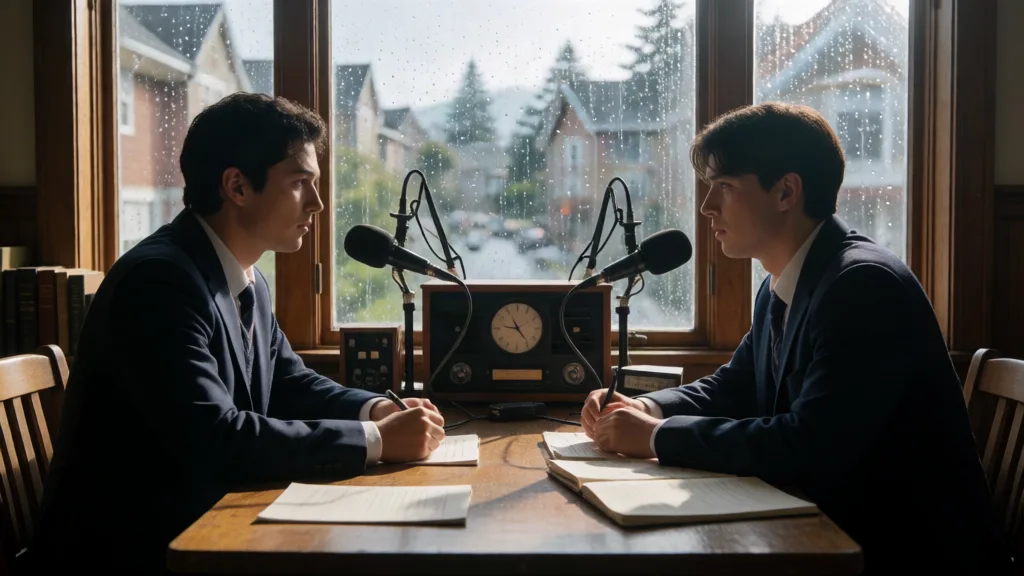
The rain had been falling for three weeks straight, and Pond had developed a personal grudge against every drop.
He stood in the doorway of the campus radio station, KCPR 640 AM, and watched water sheet down the concrete steps that led to the basement. The stairwell smelled like mildew and old paper, a smell he'd grown to tolerate, even depend on. It was the smell of order. Of things filed correctly. Of a place where the signal came through clean because someone (him) had spent four hours recalibrating the transmitter on a Sunday afternoon when everyone else was at the homecoming game.
His phone buzzed. His mother, three texts in a row, no punctuation.
*Your father's home*
*He wants to know if you're coming for thanksgiving*
*Don't bring up the thing about the boat*
Pond typed back *I have a show* and slipped the phone into his coat pocket before she could respond. The show was a rerun. He'd recorded it Tuesday. But his mother didn't know that, and the lie sat in his chest like a swallowed stone, heavy and smooth and familiar.
He descended the stairs.
The station occupied what had once been a storage room for the university's rare book collection. Someone in the seventies had decided it would make a fine broadcast booth, probably because the thick concrete walls dampened sound. They were right. The acoustics were excellent. The ventilation was not. Pond had filed three maintenance requests about the heating system. All denied. He kept a space heater under his desk and a fire extinguisher beside it, because he was not an idiot.
The station door was unlocked.
He stopped. His hand hovered over the knob. He always locked the door. He had locked it last night at 11:47 PM, after his Thursday evening slot, after he'd wiped down the console with the microfiber cloth he kept in the top drawer, after he'd checked the log book and confirmed that everything was in its place.
Someone was inside. He could hear them. A low hum, tuneless, drifting through the door. And beneath it, the click and whir of equipment being moved.
Pond pushed the door open.
The first thing he saw was the mess. Cables unspooled across the floor like spilled intestines. A microphone stand knocked over. The log book, his log book, open to a page covered in handwriting that was not his. It slanted left, cramped and hurried, with little doodles in the margins. A star. A spiral. A tiny drawing of what appeared to be a cat wearing headphones.
The second thing he saw was the person attached to the handwriting.
He was crouched beneath the mixing board, his back to the door, wearing a denim jacket that had been patched so many times it looked like a map of itself. His hair was dark and long and tied up with what appeared to be a shoelace. He was humming, and his hands were inside the guts of the mixing board, and he had somehow managed to remove the panel that Pond had spent two weeks trying to get maintenance to fix.
"Who the hell are you," Pond said.
The humming stopped. The person turned his head, not his body, just his head, and looked up at Pond with an expression of mild curiosity, as if Pond were a bird that had flown in through an open window.
"Oh," he said. "You're the schedule guy."
"I'm the station manager."
"Right. That." He turned back to the mixing board. "Give me ten minutes. I almost have it."
Pond crossed the room in four strides. He grabbed the edge of the mixing board and pulled it toward him, which was a mistake, because the panel was still off and something inside made a sound like a small animal being stepped on.
"Hey," the person said, and now there was an edge in his voice, a thin blade under the breezy tone. "Careful."
"Get away from my equipment."
"Your equipment?" He stood up. He was taller than Pond by maybe two inches, but he carried himself like someone who took up more space than he actually did, shoulders loose, chin tilted. "This is university property. I checked."
"I run this station."
"You run the schedule. I've seen it. Tuesdays and Thursdays, 6 to 9 PM. Very tidy. Very boring."
Pond felt his jaw tighten. The schedule was not boring. The schedule was the only thing keeping this place from collapsing into chaos. The schedule was the reason they still had a license, the reason the dean hadn't shut them down, the reason forty-three listeners tuned in every week to hear the jazz hour and the campus news and the late-night call-in show where students whispered their secrets into the phone like they were confessing to a priest.
"The schedule," Pond said, "is the only reason this station still exists."
"Sure." The person smiled. It was a disarming smile, the kind that made you want to trust him, which was exactly why Pond didn't. "I'm Phuwin, by the way. Sound design. Senior. I'm doing a project on analog signal degradation, and your board is a beautiful piece of junk, but it's got this one capacitor that's been making everything sound like it's underwater, and I figured I'd fix it before you noticed."
"I noticed."
"You didn't, though. That's the thing." Phuwin reached past him and tapped a dial on the board. "Listen."
He flipped a switch. The station's monitor speakers crackled to life, and suddenly the room was filled with sound. Not static. Not the muddy, distant hum that Pond had grown used to. Music. A piano, clear and bright, every note distinct, the kind of sound that made you forget you were in a basement.
Pond stood very still.
"I recorded that last night," Phuwin said. "From the practice rooms. The acoustics in there are terrible, but the signal's clean now. You're welcome."
"You broke into my station."
"I borrowed it."
"You broke in."
Phuwin shrugged. He had a way of shrugging that suggested he'd been accused of worse and survived. "The door was unlocked."
"It wasn't."
"Okay, it wasn't. But I didn't break anything. Well." He glanced at the mixing board. "I broke that capacitor, but it was already broken. That's the point. I fixed it."
Pond wanted to be angry. He was angry. His hands were shaking, which was embarrassing, and his chest felt tight, which was worse. He'd spent two years building this station into something that worked. He'd fought for funding, for equipment, for the right to keep broadcasting when the university decided it wanted to turn the basement into a server room. He'd done it alone, mostly, because no one else cared enough to stay.
And now this person, this stranger with his shoelace hair and his smug smile, had walked in and made it sound better in one night than Pond had managed in two years.
"What do you want," Pond said.
"I want to do a show."
"No."
"I want to do a show," Phuwin repeated, "and I think you should let me, because I can make this station sound like something people actually want to listen to. Not just the jazz hour and the news and whatever that thing is you do on Thursday nights where you read the campus calendar."
"The campus calendar is an important service."
"The campus calendar is a war crime." Phuwin picked up his jacket from where it had been draped over a chair. He started gathering his cables, winding them around his elbow with practiced efficiency. "I'm not asking for your slot. I'm asking for the dead air. 2 to 4 AM. Nobody's using it."
"Nobody's listening at 2 AM."
"Exactly. That's the point." He slung his bag over his shoulder. It was covered in patches, band logos and political slogans and one that just said EAT THE RICH in block letters. "I want to play things people haven't heard. I want to make them feel like they're the only person awake in the whole world. That's what radio's for, isn't it?"
Pond didn't answer.
Phuwin walked to the door. He paused with his hand on the frame and looked back. "You should come by. Tonight. I'm doing a test run. No pressure." He smiled again, and this time it was different, smaller, almost real. "You look like you could use some dead air."
He left. The door clicked shut behind him.
Pond stood alone in the station, surrounded by cables and scattered papers and the faint smell of someone else's cologne. The piano music was still playing through the monitor speakers, soft and clear, and he realized he didn't know how to turn it off. He didn't know what switch Phuwin had flipped. He didn't know anything.
His phone buzzed again. His mother.
*Are you ignoring me*
He put the phone face-down on the console. Then he picked it up and typed, *I'll come for thanksgiving.*
He didn't know why he did it. Maybe because the piano was still playing. Maybe because the station felt different now, less like a bunker and more like a room. Maybe because he'd spent three weeks hating the rain, and for the first time all month, he'd forgotten it was falling.
He sat down in his chair and stared at the log book, at Phuwin's handwriting, at the little cat with headphones.
Then he opened his schedule and found the empty slot at 2 AM.
He didn't fill it in. Not yet. But he left the page open, and he didn't close it, and when he finally left the station an hour later, he locked the door behind him, twice, the way he always did.
But he didn't check the log book again.
Watch this moment
Turn the current scene into a cinematic Live Chapter — what you watch becomes the story's next part.
Disclaimer
This is a work of fiction, assisted by artificial intelligence. Any names or characters, businesses or places, events or incidents, are fictitious. Any resemblance to actual persons, living or dead, or actual events is purely coincidental.
Content Removal Policy
- Users may report content that may be illegal or violates our Standards.
- All reported complaints will be reviewed and resolved within seven business days.
- Review Process: Our team will assess the reported content against our guidelines.
- Appeals: If you disagree with a decision, you may appeal within 14 days of notification.
- Potential outcomes include: content removal, account warning, or no action if no violation is found.
To report content, email us at [email protected]