Share
Go Live
Wild Cradle
·
Published 9/18/2026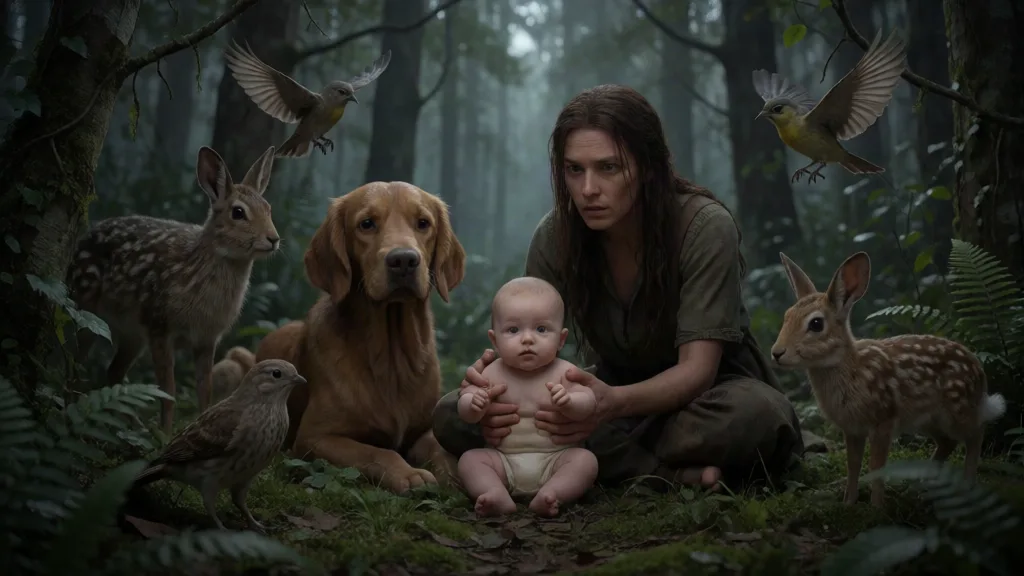
The first thing I remember is the taste of dirt. Not the clean dirt of a garden, but the dark, wet humus of the forest floor, rich with the rot of a thousand seasons. I must have been three, maybe four. Old enough to walk, to run, to understand the sharp pain of hunger. My world was a circle of trees, a cathedral of green and brown, and I was its only congregation.
My mother was a deer. Not my real mother, of course. I knew that even then, in the way a child knows the difference between a dream and the morning light. But she was the one who found me, a squalling, naked thing curled at the base of an ancient oak, my tiny fists full of dead leaves. She told me this story later, not with words, for she had none, but with the soft nudge of her nose against my cheek, the way she would lead me to the patches of wild strawberries, the way her large, liquid eyes would hold mine when the night sounds grew too loud.
Her name was Yarrow. I named her that myself, from a word that bubbled up from some forgotten place inside me, a word that felt like the plant itself: tough, useful, with a bitter root and a sweet-smelling flower. She was the leader of a small herd, a dozen does and their fawns, and she brought me into their fold without question. The other mothers were wary at first. I was a strange, hairless creature, all limbs and noise. But Yarrow stood between me and their suspicion, her body a warm, living wall. She taught me to eat the tender shoots of spring, to find the cool, hidden streams, to be still when the shadow of a hawk crossed the sun.
My brothers and sisters were the fawns. They were skittish and quick, their hooves like small, hard drums on the earth. We would race through the ferns, a game of chase where I was always the slowest, my two legs a clumsy joke compared to their four. But I learned to climb. The trees became my refuge, my lookout towers. I would shimmy up the rough bark of a pine and sit in the crotch of its branches, watching the herd below. From up there, I could see the patterns of the forest, the way the light fell in shifting coins, the paths the animals made through the undergrowth. I was the eyes of the herd.
The birds were my messengers. A jay's harsh cry meant a fox on the move. The sudden silence of the sparrows meant a hawk was circling. I learned their language faster than I learned the soft huffs and snorts of the deer. The birds didn't care that I was different. They saw a creature who could climb, who could reach the high branches where the best berries grew, who could sit still for an hour and just listen. A chickadee once landed on my finger, its tiny claws pricking my skin, its heart a frantic, feather-light beat against my palm. In that moment, I felt a part of the whole, tangled, breathing thing.
But I was not a deer. I was not a bird. I was a girl, and the forest knew it.
The first time I saw my own reflection, I was seven. A still pool, fed by a spring, mirrored the canopy above. I leaned over, expecting to see one of my sisters, a soft-eyed fawn with a white-spotted coat. Instead, a wild thing stared back. A face smeared with mud, hair a matted tangle of leaves and twigs, eyes too large and too knowing in a thin, dirty face. I touched my nose, and the reflection touched its nose. I bared my teeth, and it bared its teeth. It was a terrifying, fascinating discovery. I was a monster. A lonely, ugly monster.
I ran back to Yarrow, burying my face in her flank, breathing in her familiar, grassy scent. She nuzzled me, her tongue rough against my hair, and for a moment, the fear subsided. But the image stayed with me, a splinter under the skin. I began to cover myself with mud and leaves, to make myself smell like the forest, to hide the pale, strange skin that marked me as an outsider.
The forest was my home, but it was not a safe one. There were wolves in the deep woods, their howls a cold thread of fear stitching through the night. There were men, too. I saw them sometimes, from my high perches, figures in bright, unnatural colors who moved with a loud, crashing confidence. They carried sticks that spat fire and thunder. Once, I watched them kill a boar, and the sound of the shot echoed in my chest for days. They were the most dangerous animals of all. They were my own kind.
Yarrow sensed my fear. She would lead us deeper into the forest when the men came, to the hidden valleys where the trees grew so thick the sun was only a rumor. She was a wise and careful leader. But she was getting old. I could see it in the way she moved, a stiffness in her joints, a hesitation before she leaped a fallen log. Her eyes, once so bright, were clouding with a milky film. The other does, her daughters and granddaughters, looked to her still, but I saw the young bucks, the ones with the first velvet nubs of antlers, watching her with a new, calculating hunger. The herd was a kingdom, and Yarrow was its aging queen.
One autumn, when the leaves were turning to fire and the air had the sharp, clean bite of coming frost, a new buck arrived. He was young, strong, his antlers a crown of polished bone. He challenged the old buck, a tired, scarred veteran, and drove him from the herd in a clash of hooves and grunts that shook the ground. Then he turned his attention to Yarrow. He didn't attack her, not directly. He would simply walk at her, forcing her to give way, to move from the best grazing spots, to yield the sheltered hollows where we slept. He was testing her, and the herd was watching.
I hated him. I hated his sleek, arrogant strength, the way he held his head. One evening, as he approached Yarrow while she was drinking from the stream, I stepped between them. I was ten, tall for my age, but thin as a reed. I picked up a heavy branch and held it like a club. The buck stopped. He looked at me, this strange, two-legged creature who smelled of deer and dirt and something else, something wild and defiant. He stamped his hoof, a clear warning.
"Go away," I said. My voice was a rusty croak, a sound I rarely used. It felt foreign in my mouth.
The buck lowered his head, his antlers aimed at my chest. I didn't move. I couldn't. My heart was a trapped bird beating against my ribs, but my feet were rooted to the earth. I thought of Yarrow, of the way she had protected me, of the warmth of her body on cold nights. I would not let this creature take her place.
He snorted, a puff of steam in the cold air. For a long, terrible moment, we were frozen in a silent standoff. Then, from the trees, came a sound. A low, rumbling growl. The buck's head snapped up, his eyes wide. A bear, a massive, dark shape, was emerging from the shadows of the pines. It wasn't interested in me. It was interested in the buck, in the easy meal of a young, distracted animal.
The buck didn't hesitate. He turned and fled, crashing through the undergrowth. The bear watched him go, then its small, dark eyes found me. I stood my ground, the branch still raised. The bear sniffed the air, a long, thoughtful inhalation. It smelled the deer on me, the human, the fear. It grunted, a sound almost like a laugh, and then it turned and ambled back into the darkness.
I dropped the branch. My legs were shaking so badly I could barely stand. Yarrow came to me, pressing her head against my chest. I wrapped my arms around her neck and wept, great, heaving sobs that I had never allowed myself before. I had faced a bear and a buck, but it was the fear for her that had broken me.
That night, as I lay curled against Yarrow's warmth, listening to the wind whisper through the pines, I knew things had to change. The forest was no longer a simple, safe circle. It was a place of shifting power, of old age and new hunger, of men with fire-sticks and bears with laughing eyes. And I was a part of it, a strange, two-legged thing with a monster's face and a deer's heart. I couldn't just hide anymore. I had to learn to fight. Not just for myself, but for her. For the only family I had ever known. The first frost of winter was on the ground, and I could feel a different kind of cold settling in my bones. A cold that had nothing to do with the weather. It was the cold of knowing that the world would not leave us alone.
Watch this moment
Turn the current scene into a cinematic Live Chapter — what you watch becomes the story's next part.
Disclaimer
This is a work of fiction, assisted by artificial intelligence. Any names or characters, businesses or places, events or incidents, are fictitious. Any resemblance to actual persons, living or dead, or actual events is purely coincidental.
Content Removal Policy
- Users may report content that may be illegal or violates our Standards.
- All reported complaints will be reviewed and resolved within seven business days.
- Review Process: Our team will assess the reported content against our guidelines.
- Appeals: If you disagree with a decision, you may appeal within 14 days of notification.
- Potential outcomes include: content removal, account warning, or no action if no violation is found.
To report content, email us at [email protected]