Share
Go Live
Detroit Burn
·
Published 9/29/2026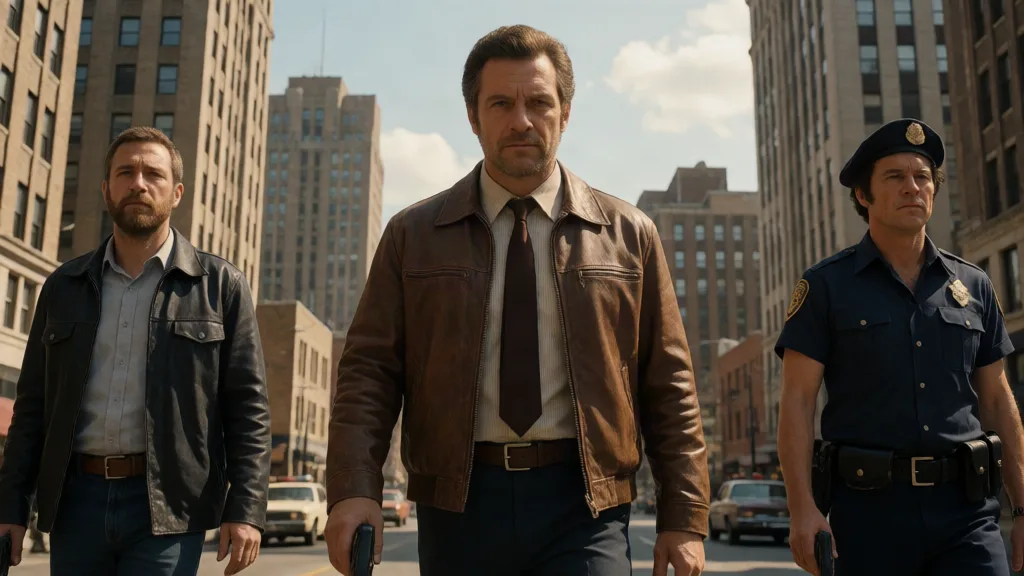
The first thing I ever stole was a loaf of bread from a Greek grocer on Woodward Avenue, and I did it because my mother told me not to. I was seven. The bread was warm and the paper bag sweated in my fist as I ran three blocks home, certain the police would materialize from the brickwork like something summoned. They didn't. My mother beat me with a wooden spoon until the spoon cracked, then held me against her chest and cried into my hair. That was 1949. By the time I was twenty-two, I could drive anything with an engine through anything resembling a road, and I'd stopped feeling the sweat on the bag.
I'm telling you this so you understand: I wasn't a bad man. I was a man who made a series of decisions, each one reasonable in its moment, and those decisions had stacked up like cars in a junkyard until I couldn't see over them anymore.
The night everything went wrong, I was sitting in a diner on Cass Avenue watching a woman eat pie.
Her name was Delia. She had hair the color of burnt sugar and hands that shook when she lifted the fork, though she'd steadied them by the third bite. She was my boss's wife, which should have been enough to keep me away, but I'd already crossed that line six months ago in a motel room in Dearborn, and neither of us had the decency to regret it properly.
"You're staring," she said without looking up.
"I'm admiring."
"Same thing, coming from you."
The diner smelled like bacon grease and burnt coffee and the particular staleness of a place that hadn't changed its menu since the war. A fluorescent light above our booth flickered every few seconds, and each time it did, Delia's face went from beautiful to tired to beautiful again. She was thirty-four, eight years younger than me, and she'd been married to Vincent Moretti for eleven of those years. Vincent ran numbers out of a bar on Michigan Avenue and had a hand in everything from stolen cigarettes to the kind of loans that got repaid in fingers. He trusted me. That was the part that kept me up at night.
Not guilt, exactly. Something closer to the awareness that I was standing on a trapdoor and could hear the hinges creaking.
"You should go," I said.
"I know."
She didn't move.
The waitress came by with a pot of coffee and filled our cups without asking. Her name tag said Flo, and she had the kind of face that had seen everything twice and wasn't impressed by any of it. She looked at me, then at Delia, then at the space between us where the truth was sitting like a third person at the table.
"Anything else?" Flo asked.
"We're good," I said.
"Mm-hmm."
She walked away. Delia smiled, just a little, just at the corner of her mouth.
"She knows."
"Flo knows everything. That's why she's still alive."
Delia set down her fork and looked at me straight on, which was something she did rarely, because looking at me straight on meant acknowledging what we were doing, and acknowledging it made it real. Her eyes were the color of whiskey in a glass held up to a window. I'd told her that once, in the motel, and she'd laughed and said I was a poet who'd taken a wrong turn.
"I have to tell you something," she said.
"Don't."
"You don't know what it is."
"I know it's going to change things. That's enough."
She reached across the table and put her hand on mine. Her fingers were cold. The fluorescent light flickered. Somewhere in the back, a man was arguing with Flo about the price of a slice of pie, and Flo was winning.
"Vincent wants you for a job," Delia said.
"I know. He told me."
"This one's different."
"He always says that."
"This one's a bank."
I pulled my hand back and wrapped it around my coffee cup, which was hot enough to hurt. I let it hurt. The pain was useful. It kept me in the room.
"I don't do banks," I said.
"I know."
"Banks have cameras. Banks have guards. Banks have the FBI."
"I know."
"So why are you telling me?"
She looked down at her pie, which was mostly crust now, a few smears of cherry filling the color of dried blood. When she spoke again, her voice was quieter, and I had to lean forward to hear her over the argument at the counter.
"Because he's not asking. He's telling. And if you say no, he's going to wonder why."
I sat back. The vinyl of the booth squeaked under me. Outside, Cass Avenue was dark and wet from an earlier rain, and the streetlights made long yellow smears on the asphalt. A city bus groaned past, mostly empty, and I watched it until its taillights disappeared around the corner. I was thinking about my daughter.
Her name was Rose. She was nine years old and she lived with her grandmother in a house in Hamtramck that smelled like cabbage and incense and the particular mustiness of old wallpaper. I saw her every Sunday. We'd walk to the park and I'd push her on the swings until my arms ached, and she'd tell me about school and the neighbor's cat and the boy who pulled her hair, and I'd listen to every word like it was scripture. She had a hole in her heart. That's not a metaphor. The doctors called it an atrial septal defect, and they said she needed surgery, and the surgery cost four thousand dollars, and I had three hundred and twelve dollars in a coffee can under my sink.
I'd been saving for eight months.
At this rate, I'd have the money in eleven years. Rose might not have eleven years.
"Four thousand," I said.
"What?"
"The surgery. That's what it costs."
Delia's face did something complicated. Pity, maybe. Or recognition. She knew about Rose. I'd told her in the motel, after, when we were lying in the dark and the truth felt safe because we couldn't see each other's faces.
"Vincent's paying ten," she said.
"Ten thousand?"
"Each."
I laughed. It came out wrong, more like a cough.
"For a bank?"
"It's not just a bank."
"What else would it be?"
She didn't answer. She picked up her fork and scraped the last of the filling off the plate, and I watched her do it, and I understood that she wasn't going to tell me, not because she didn't know but because she was afraid. Delia was afraid of her husband. That was something I'd known for a while, but knowing it and seeing it were different things, and seeing it made me want to do something stupid.
"Who else is in?" I asked.
"Leonard."
"The safecracker?"
"He prefers 'security consultant.'"
"He can prefer whatever he wants. He's still a safecracker."
"And Mickey."
"Mickey who?"
"O'Brien. Vincent brought him in from Chicago."
I didn't know the name, which meant nothing good. Vincent didn't bring people in from Chicago unless they had a particular skill set, and the particular skill set that came from Chicago usually involved a gun and a willingness to use it.
"When?"
"Friday."
"Three days."
"Three days."
I finished my coffee. It was cold now, and bitter, and I drank it anyway because I needed something to do with my hands. The fluorescent light flickered. Flo was wiping down the counter with a rag that had seen better decades. The man who'd been arguing about the pie was gone, and the diner felt emptier without him, like the argument had been holding the walls up.
"Tell Vincent I'll do it," I said.
Delia nodded. She didn't smile. She didn't look relieved. She looked like someone who'd just signed something she couldn't read.
"Jack," she said.
"Yeah."
"Be careful."
"I'm always careful."
"No, you're not. That's why I'm telling you."
She stood up and put on her coat, which was red wool and made her look like she was already leaving, even before she moved. She walked to the door without looking back. The bell above it jingled when she opened it, and then she was gone, and I was alone with Flo and the flickering light and the smell of burnt coffee.
Flo came over and picked up Delia's plate.
"Friend of yours?"
"Something like that."
"She's trouble."
"I know."
"You going to see her again?"
"I don't know."
Flo shook her head and walked away. I sat there for a while longer, watching the window, watching the street, watching the rain start up again. I was thinking about Rose. I was thinking about the hole in her heart and the hole in my life and the way the two of them seemed to be the same shape.
I paid the check and left a tip that was too big, because Flo had seen everything twice and deserved something for it.
---
The next morning, I drove to Hamtramck.
The house where Rose lived with her grandmother was a two-story brick box on a street of identical two-story brick boxes, built in the twenties for factory workers who were all dead now. The lawn was patchy and the fence was rusted and the porch sagged on one side, but the windows were clean and the curtains were white, and that was Rose's grandmother, all over. She kept things clean. It was her way of telling the world that she hadn't given up.
I parked my car, a 1967 Chevy Impala the color of dried blood, and sat for a minute before getting out. The engine ticked as it cooled. I'd stolen this car from a lot in Ferndale three years ago and retitled it through a guy who knew a guy, and it was the only thing I owned that was worth anything. I'd sold everything else. My records. My tools. My father's watch. All of it went into the coffee can, and the coffee can was still three hundred and twelve dollars, and Rose was still sick.
The door opened before I knocked. Rose's grandmother, a woman named Halina who'd survived the war in Poland and never talked about it, stood in the doorway with her arms crossed.
"You're early," she said.
"I'm always early."
"You're always something."
She stepped aside to let me in. The house smelled like cabbage and incense, same as always, and the wallpaper was the same faded floral pattern I remembered from the first time I'd come here, eight years ago, when Rose was a baby and her mother was still alive. Her mother's name was Anna. She died in a car accident on I-75, and I was driving the other car, and that's a story I'll tell you sometime when I'm drunker than I am now.
Rose was at the kitchen table, drawing.
She looked up when I came in, and her face did the thing it always did, the thing that made my chest hurt in a way I couldn't describe. She smiled. She had Anna's smile. She had Anna's everything, except the hole in her heart, which was mine, or at least I felt like it was mine, like I'd passed it down to her along with my bad eyes and my worse temper.
"Papa," she said.
"Hey, baby."
I sat down across from her. She was drawing a house with a red door and a yellow sun and a family of stick figures holding hands. Four of them. I counted.
"Who's that?" I asked, pointing to the tallest one.
"That's you."
"And that?"
"Grandma Halina."
"And the other two?"
She looked up at me, and her eyes were serious in a way that made her look older than nine.
"That's Mama. And that's the baby."
"What baby?"
"The one I'm going to have someday. I'm going to name her Anna, after Mama."
I didn't say anything. I couldn't. Halina was at the stove, stirring something in a pot, and she didn't say anything either, but I could feel her watching me, the way she always watched me, like she was waiting for me to prove her right about something.
"Papa," Rose said.
"Yeah."
"Are you sad?"
"No, baby. I'm happy."
"You look sad."
"I'm happy," I said again, and I smiled, and it felt like lying, but it also felt like the truest thing I'd done in months.
We spent the morning together. We walked to the park and I pushed her on the swings. We bought ice cream from a truck that played a song I couldn't get out of my head for the rest of the day. We sat on a bench and watched the pigeons fight over a piece of bread, and Rose laughed, and I memorized the sound, because I had a feeling I was going to need it.
At noon, Halina called us back for lunch. We ate cabbage rolls and potatoes and bread that Halina had baked that morning, and Rose told me about school and the neighbor's cat and the boy who pulled her hair, and I listened to every word like it was scripture.
After lunch, Rose went upstairs to nap. Halina and I sat at the kitchen table, and she poured us each a glass of vodka, which was her way of saying it was time to talk.
"You're in trouble," she said.
"No."
"I can see it on you. Like a coat."
"I'm fine."
"You're not fine. You haven't been fine since Anna died."
I drank the vodka. It burned going down, and I welcomed it.
"Rose needs the surgery," I said.
"I know."
"I'm going to get the money."
"How?"
I didn't answer. Halina looked at me for a long time, and her eyes were the same color as Rose's, which meant they were the same color as Anna's, which meant they were the same color as the hole in my chest.
"Don't do anything stupid," she said.
"I won't."
"You will. You're stupid. It's why Anna loved you."
She stood up and took the glasses to the sink, and I watched her wash them, her hands moving in slow circles, and I thought about all the things I'd done and all the things I was about to do and the way they were all tangled up together like the strings of a kite you'd flown too high.
"I'll be back Sunday," I said.
"You'd better be."
I kissed Rose on the forehead before I left. She was asleep, and her face was peaceful, and I stood there for a minute just looking at her, at the rise and fall of her chest, at the smallness of her hands. Then I walked out of the house and got in my car and drove back to Detroit, and the whole way, I was thinking about the bank.
---
Vincent Moretti's bar was called The Blue Room, and it was on Michigan Avenue, and it was the kind of place where you could get a drink and a loan and a beating, depending on how the conversation went. I'd been there a hundred times. I'd never been there for a job like this.
Vincent was in the back, at a table that was always reserved for him, even when he wasn't there. He was a big man, not fat but solid, like he'd been carved out of something harder than flesh. He had a face that smiled easily and eyes that didn't. When he saw me, he stood up and spread his arms like he was greeting a brother.
"Jack," he said. "Sit down. Have a drink."
I sat down. I didn't have a drink.
"You talked to Delia," he said.
"I did."
"And?"
"I'm in."
He smiled. It was a real smile, or at least it looked like one, and that was the thing about Vincent. You could never tell where the performance ended and the man began.
"Good," he said. "Good. I knew I could count on you."
"What's the job?"
"Patience. We'll get to that. First, I want you to meet the others."
He waved his hand, and two men came over from the bar. The first was Leonard, the safecracker, a thin man with glasses and a nervous twitch in his left eye. I'd worked with him before, on a jewelry store job in Grosse Pointe, and he was good, maybe the best, but he talked too much and he sweated when he was nervous, and he was always nervous.
The second man was Mickey O'Brien.
He was younger than I expected, maybe thirty, with red hair and a face that looked like it had been in a few fights and won most of them. He had a way of standing that suggested he was always ready to move, and his eyes were the color of a winter sky, and when he looked at me, I felt like I was being weighed.
"Jack," he said. "I've heard about you."
"All good things, I hope."
"All interesting things."
Vincent laughed. "Mickey's from Chicago. He's got a particular set of skills."
"I'm sure he does."
Mickey smiled. It wasn't a friendly smile. It was the kind of smile that said he knew something I didn't, and he was looking forward to the moment when I found out what it was.
"Sit down," Vincent said. "Let's talk about the bank."
We sat. Vincent pulled out a map and spread it on the table, and for the next hour, he talked. The bank was on Jefferson Avenue, near the river. It was called the First Mercantile Savings and Loan, and it had been there since the thirties, and it was, according to Vincent, a front.
"A front for what?" I asked.
"For people who don't want their money to be found."
"Whose money?"
"Does it matter?"
"It might."
Vincent looked at me, and his eyes did the thing they did, the thing that reminded you he wasn't just a bar owner, that he was a man who'd done things, terrible things, and would do them again.
"It's the mob's money," he said. "Or it was. Until last month, when the guy running the place decided to go independent."
"So we're robbing the mob."
"We're robbing a bank that happens to hold the mob's money. There's a difference."
I didn't see the difference. Neither did Leonard, judging by the way he was sweating. Mickey just sat there, watching me, his winter-sky eyes unreadable.
"What's in the vault?" I asked.
"Cash. Bonds. Some documents."
"What kind of documents?"
"The kind that make people nervous."
I leaned back. The chair creaked under me. The Blue Room was mostly empty at this hour, just a few regulars at the bar and a woman in the corner who might have been a prostitute or might have been someone's wife, waiting for someone who wasn't coming.
"When?" I asked.
"Friday. Two in the afternoon."
"Two in the afternoon? That's the middle of the day."
"That's the point. Nobody expects a robbery in the middle of the day."
"Nobody except the police."
"We'll be gone before they know we're there. That's why we need you. You're the best driver in the city."
I wasn't. I'd been the best, once, but that was years ago, before Anna died, before I started drinking, before my hands started shaking in the morning and my reflexes slowed by a fraction of a second that could mean the difference between freedom and a cell. But Vincent didn't know that. Or maybe he did, and he didn't care, because he had something on me, something that made me say yes even if I didn't want to.
Delia. He had Delia.
"Okay," I said. "I'm in."
"Good," Vincent said. "Now let's go over the plan."
---
The plan was simple. That's what Vincent kept saying. Simple. Clean. In and out in ten minutes.
The plan was not simple.
The plan involved a stolen mail truck, a fake delivery, a security guard who was on the take, and a vault that required two keys and a combination that Leonard had somehow obtained. The plan involved timing, precise timing, the kind of timing that left no room for error. The plan involved me sitting in a car outside, engine running, waiting for a signal that might never come.
I spent the next three days preparing. I studied the maps. I drove the route a dozen times, memorizing every turn, every light, every pothole. I checked my car, changed the oil, replaced the spark plugs, filled the tank. I didn't drink. I didn't see Delia. I didn't see anyone.
On Thursday night, I sat in my apartment and looked at the coffee can on the counter. Three hundred and twelve dollars. I thought about Rose. I thought about the hole in her heart. I thought about the way she'd looked at me in the park, like I was the best thing in the world, like I could do no wrong.
I thought about the bank. The mob's money. The documents that made people nervous.
I thought about Mickey O'Brien, and the way he'd looked at me, like he knew something I didn't.
And I thought about Delia, and the way she'd said be careful, and the way I'd said I'm always careful, and the way we both knew it was a lie.
I didn't sleep that night. I lay in bed and stared at the ceiling and listened to the city outside, the sirens and the traffic and the occasional gunshot, and I waited for morning.
---
Friday came.
The sun rose over Detroit like it was reluctant to be there, and the sky was the color of old dishwater, and the air smelled like rain. I got up at six. I showered. I shaved. I put on my best suit, a dark blue thing I'd bought at a thrift store for a funeral, and I looked at myself in the mirror and didn't recognize the man looking back.
"You're doing this for Rose," I said out loud.
The man in the mirror didn't answer.
I drove to the rendezvous point, a parking lot behind a warehouse on Atwater Street, and I got there early, because I was always early, because being early was the one thing I could control. Leonard was already there, sitting on the hood of his car, smoking a cigarette and shaking his leg. He looked up when I pulled in.
"Jack," he said. "You ready?"
"Yeah."
"You don't look ready."
"I don't look anything."
Mickey arrived five minutes later, driving a black sedan that looked like it had been cleaned recently and thoroughly. He got out and walked over to us, and he was wearing a suit too, a gray one, and he looked like he was going to a business meeting.
"Gentlemen," he said.
"Let's get this over with," I said.
We went over the plan one last time. Leonard would go in first, posing as a delivery man, and he'd disable the alarm. Mickey would follow, posing as a customer, and he'd handle the guard. I would wait outside, in the mail truck, and when they came out with the money, I'd drive.
Simple. Clean. In and out in ten minutes.
I got in the mail truck. It smelled like cardboard and old paper and the ghost of a thousand letters. I adjusted the mirror. I checked the clock. 1:45.
At 1:50, Leonard went in.
At 1:55, Mickey went in.
At 2:00, nothing happened.
At 2:05, nothing happened.
At 2:10, I started to worry.
At 2:15, I heard the first gunshot.
It came from inside the bank, a sharp crack that echoed off the buildings and made my heart stop. Then another. Then another. I sat there, frozen, my hands on the wheel, and I thought about Rose, and I thought about the coffee can, and I thought about all the decisions that had led me to this moment.
The bank door burst open. Leonard came running out, his face white, his glasses askew, and he was screaming something I couldn't hear. Mickey was behind him, and he was holding a gun, and he was not running. He was walking. Calm. Deliberate. Like he had all the time in the world.
I started the engine.
Leonard reached the truck and threw himself into the back, and I could smell the blood on him, could see the red stain spreading across his shirt. Mickey climbed into the passenger seat and looked at me, and his winter-sky eyes were calm, almost amused.
"Drive," he said.
I drove.
I drove like I'd never driven before, like the devil was behind us and the only way to heaven was through the streets of Detroit. I ran red lights. I cut corners. I went the wrong way down one-way streets. The city blurred past, a smear of brick and asphalt and broken glass, and behind us, I could hear sirens.
"What happened?" I shouted.
"Things went wrong," Mickey said.
"What things?"
"The guard. He wasn't on the take. He was a cop."
"A cop?"
"Undercover. Working the mob case. We walked into a sting."
I gripped the wheel. My hands were shaking. The coffee can. Rose. The hole in her heart. The hole in mine.
"The money," I said. "Did you get the money?"
Mickey looked at me. That smile again. That knowing smile.
"We got something better," he said.
"What?"
He reached into his jacket and pulled out a folder, thick with papers, and he held it up so I could see it. There was a name on the cover, a name I didn't recognize, and below it, a word that made my blood run cold.
"Project Lazarus," Mickey said. "You ever hear of it?"
"No."
"You will."
I drove. The sirens grew louder. The city burned around us, or maybe it was just the sunset, or maybe it was something else entirely, something I couldn't name, something that was waiting for me in the folder Mickey held in his hands.
I thought about Rose. I thought about the surgery. I thought about the ten thousand dollars that was supposed to save her life.
And I thought about the fact that I'd just robbed the mob, and the police were after us, and the man sitting next to me was holding something that was worth more than money, more than bonds, more than anything I'd ever stolen.
I didn't know what Project Lazarus was. But I knew it was dangerous. I knew it was the reason the bank was a front. I knew it was the reason people were going to die.
And I knew, with a certainty that settled into my bones like cold water, that I was going to be one of them.
Watch this moment
Turn the current scene into a cinematic Live Chapter — what you watch becomes the story's next part.
Disclaimer
This is a work of fiction, assisted by artificial intelligence. Any names or characters, businesses or places, events or incidents, are fictitious. Any resemblance to actual persons, living or dead, or actual events is purely coincidental.
Content Removal Policy
- Users may report content that may be illegal or violates our Standards.
- All reported complaints will be reviewed and resolved within seven business days.
- Review Process: Our team will assess the reported content against our guidelines.
- Appeals: If you disagree with a decision, you may appeal within 14 days of notification.
- Potential outcomes include: content removal, account warning, or no action if no violation is found.
To report content, email us at [email protected]