Share
Bone Song Below
·
Published 8/20/2026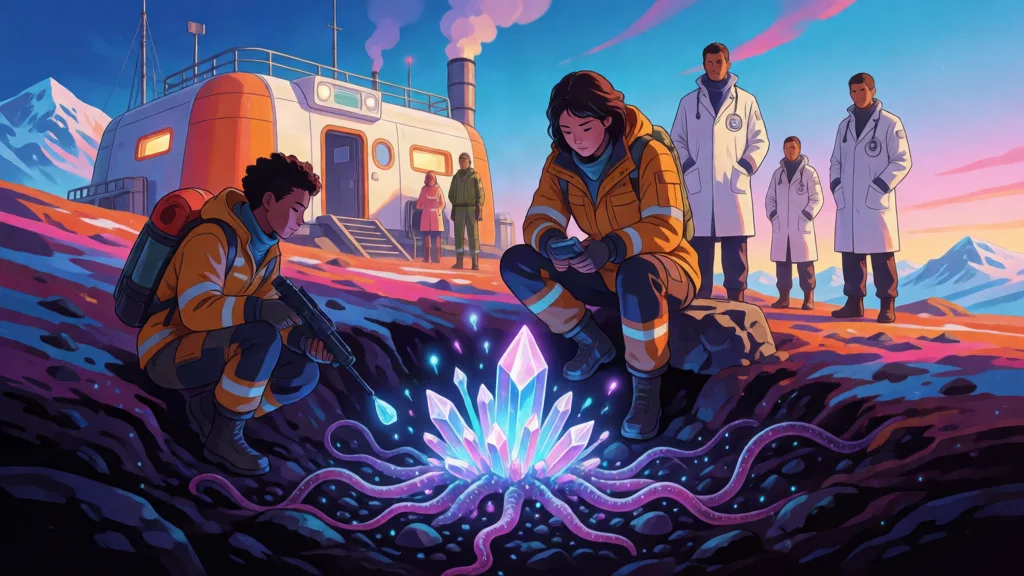
The ice didn’t groan. It screamed.
I felt it first. A vibration that crawled up through the soles of my boots, traveled my shins, settled in my chest like a second heartbeat. I pressed my palm flat against the core sample wall and waited.
Nothing human made that sound.
The permafrost here was supposed to be dead. Three hundred meters of frozen sediment, locked tight since before humans drew maps. I’d spent nine months drilling cores, cataloging isotopes, listening to the silence of a world that had stopped talking before my great-grandparents were born. That was the job. That was the point.
I pulled my hand back and checked my watch. 2:47 AM. The Arctic sun hung low and useless, a pale coin that never quite committed to rising or setting. Through the station’s reinforced window, the ice field stretched white and indifferent. No movement. No shadows. Just the endless, patient cold.
The scream came again.
This time I felt it in my teeth. A low harmonic that rattled my fillings and made the floor hum beneath my feet. I turned from the window and walked to the drill shaft, my fingers trailing along the wall. The vibration was stronger here. More focused. Like someone was calling from the other side of a very long hallway.
I grabbed my seismic reader from the bench. The display showed a pattern I’d never seen. Not random tectonic noise. Not the slow creep of glacial movement. This was structured. Rhythmic. Almost musical.
I knelt and pressed my ear to the floor. Pointless, really. I’ve been deaf since birth. But old habits die hard. The vibration traveled through my skull, down my neck, pooling somewhere behind my eyes. A pulse. A heartbeat. Something alive.
The drill had punched through something three days ago. I’d been chasing a methane pocket, following readings that made no sense. At fifty meters, the bit had hit a cavity. The core sample came up fractured, glittering with crystals I couldn’t identify. I’d logged it, bagged it, sent the data to headquarters. Standard protocol.
I hadn’t told them about the light.
It started small. A faint blue glow from the borehole, visible only when I killed the station lights. I thought it was contamination at first. Chemical residue. My own exhaustion playing tricks. But the glow grew. Spread. By last night, I could read by it.
I stood and walked to the borehole cover. The steel plate was warm to the touch. Wrong. Everything about this was wrong. The permafrost should be cold. The ground should be silent. The world should follow its rules.
I lifted the cover.
The light hit me like a wall. Blue and cold and pulsing, rising from the shaft in waves that made my skin prickle. I leaned over and looked down.
It was beautiful.
A cluster of crystals, each one the size of my fist, growing from the shaft wall. They were faceted like diamonds but translucent, shot through with veins of something that moved. Liquid light. Bioluminescence. The pulses followed a pattern, a slow rhythm that matched the vibrations in my chest.
I reached down. My fingers brushed the nearest crystal.
The world stopped.
Sound flooded in. Not through my ears. Through my bones. Through my skin. A symphony of pressure and frequency, a language written in the deep language of the earth. I felt the ice above me, the weight of centuries pressing down. I felt the magma miles below, slow and patient and hot. I felt the crystal. It was aware. It was watching me.
I pulled my hand back and fell onto my ass, heart hammering.
The light dimmed. The vibrations faded. I was alone again in the silence I’d known my whole life.
But something had changed. Something had heard me back.
I spent the next twelve hours trying to replicate the contact. I touched the crystal again. Nothing. I pressed my whole palm against it. The light flickered, but the connection was gone. I tried different times, different positions, different angles. Dead.
Then I tried singing.
Not real singing. I don’t know what real singing sounds like. I hummed, low in my throat, the way I did when I was a kid and wanted to feel the vibration in my chest. I pressed my forehead to the crystal and hummed a note. Any note.
The crystal answered.
It resonated. A frequency that matched my own, amplified and returned. The light flared, and I felt it again. That flood of sensation, that impossible hearing. The crystal was speaking. It was saying my name.
I laughed. I couldn’t help it. I laughed until my throat hurt and tears froze on my cheeks.
For thirty-three years, I’d lived in a world of surfaces. I read lips. I watched hands. I felt footsteps through floors and doors slamming through walls. I’d built a life on the edges of sound, translating the world through vibration and sight and guesswork. I was good at it. I’d made peace with it.
This was different. This was the world speaking directly to me.
The satellite phone rang three days later.
I was in the lab, cataloging crystal samples, mapping the frequency patterns I’d recorded. I’d stopped sleeping. Stopped eating properly. The crystal had grown. It had spread through the borehole, climbed the shaft walls, reached toward the surface. I’d named it. Stupid, I know. But you name things you love.
I called it Echo.
The phone kept ringing. I ignored it. Echo was singing a new pattern, something complex and layered, and I was trying to transcribe it into my notebook. The vibrations translated to numbers, to frequencies, to a language I was only beginning to understand.
The phone rang again. Then again.
I picked it up. “What?”
“Dr. Vance.” A woman’s voice. Professional. Cold. “This is Meredith Cole from Aurora Geotechnical. We’re sending a team to your station. They’ll arrive in forty-eight hours.”
I said nothing.
“Dr. Vance. Did you receive the data packet we sent?”
“I received it.”
“And your response?”
I looked at Echo. The crystal pulsed, slow and patient. It had grown another cluster overnight. The light filled the lab, casting blue shadows on the walls.
“There’s nothing here,” I said. “False reading. Methane contamination.”
“Our satellites show otherwise. We’ve detected seismic anomalies consistent with biological activity. And your power consumption has tripled in the last seventy-two hours.”
I closed my eyes. I should have been more careful. Should have hidden the readings. But I’d been too busy listening.
“The team will arrive in two days,” she said. “They have orders to extract any organic material. I trust you’ll cooperate.”
“And if I don’t?”
A pause. Long enough to mean something.
“Then they have orders to extract you as well.”
The line went dead.
I sat in the blue light and felt Echo pulse beneath my feet. The crystal was singing a new song now. Something urgent. Something that felt like fear.
I pressed my hand to the floor and let the vibration travel up my arm.
“I know,” I whispered. “I know.”
Outside, the Arctic sun hung low and useless. The ice field stretched white and indifferent. But beneath it, something was waking up. And I had two days to decide which world I belonged to.
The one that had never let me hear.
Or the one that had finally taught me to listen.
Disclaimer
This is a work of fiction, assisted by artificial intelligence. Any names or characters, businesses or places, events or incidents, are fictitious. Any resemblance to actual persons, living or dead, or actual events is purely coincidental.
Content Removal Policy
- Users may report content that may be illegal or violates our Standards.
- All reported complaints will be reviewed and resolved within seven business days.
- Review Process: Our team will assess the reported content against our guidelines.
- Appeals: If you disagree with a decision, you may appeal within 14 days of notification.
- Potential outcomes include: content removal, account warning, or no action if no violation is found.
To report content, email us at [email protected]