Share
Go Live
Vibrations of Defiance
·
Published 11/25/2026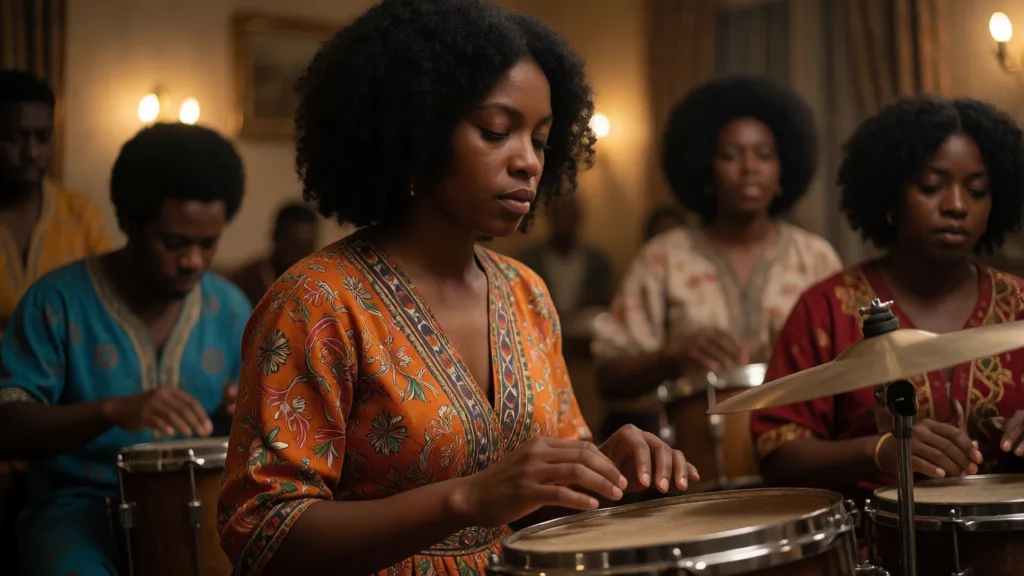
The drum skin split beneath my palm, and I felt it before I heard it. Not that I would hear anything. But a split drum has a particular vibration, a slack release that travels up your wrist and settles in your elbow, and I knew the goatskin had torn before the other musicians noticed.
I pulled my hand back. The drum was borrowed, a cheap talking drum from a stall in Mushin market, and now it was ruined. Around me, the other players kept going, lost in whatever groove they'd found, their bodies moving in that loose Sunday-afternoon way that meant nobody was paying attention to the girl in the corner.
Good. I liked being invisible.
The club was called The Shrine, though it wasn't much of a shrine. A corrugated roof, a concrete floor still tacky from last night's spilled beer, and a stage made from shipping pallets that sagged under the weight of the amplifiers. It was early, maybe four in the afternoon, and the place smelled like palm oil and dust and the particular sweetness of ganja smoke drifting in from the back alley.
I was nineteen years old and I had no business being there. But my brother had brought me here first when I was fourteen, and after he died, I kept coming. Not for the music. For the vibration. The floorboards carried it up through my sandals, through my bones, into that place behind my sternum where sound lived for me.
Fela wasn't here yet. He was never here this early. But his people were, the ones who kept the place running, and they let me sit in with the drummers because of who my brother had been.
"You broke it," said the drummer next to me. His name was Sunday and he had arms like tree branches and a smile that never reached his eyes. He spoke with his lips exaggerated, the way people did when they knew I couldn't hear.
I shrugged. "It was already weak."
He laughed, or at least his chest shook in a way that meant laughter. Then he leaned over and took the drum from me, turning it over to inspect the damage. I watched his fingers trace the torn skin, and I felt the disappointment in the set of his shoulders.
"I'll fix it," I said.
"You can't fix that."
"I can."
He shook his head and set the drum aside. Then he pointed at the stage, where a keyboard player was warming up with a slow, rolling pattern that I could feel in the soles of my feet. Sunday raised his eyebrows, a question.
Did I want to play something else?
I shook my head. The drum had been a test, a way to see if I still had it, whatever *it* was. I didn't. My hands were cold. My wrists ached from a week of hauling crates at the market. And there was a tightness in my chest that had nothing to do with music.
I stood up and walked outside.
The alley behind The Shrine was narrow and dark even in daylight, the kind of place where you didn't linger unless you had a reason. I had a reason. I always had a reason. I pulled the folded paper from my pocket and smoothed it against my thigh.
It was a page from my brother's notebook. The last page he'd written before they killed him.
I couldn't read the words. I could read, of course. I wasn't illiterate. But the words on this page weren't words, not really. They were marks, symbols, a code he'd invented when we were children, back when we still believed we could keep secrets from the world.
I traced the marks with my finger. Each one was a rhythm, a pattern of beats and rests that I could feel if I pressed hard enough, if I concentrated. My brother had taught me this. He'd place my hand on his chest and drum the patterns against his sternum, and I would feel them in my teeth, in my jaw, in the hollow behind my eyes.
He'd been dead for three months. The soldiers said he'd been caught with subversive materials. They said he'd resisted arrest. They said a lot of things, and none of them were true.
I pressed the paper against the wall and closed my eyes.
The pattern was there. I could feel it, faint but unmistakable, a syncopated rhythm that started slow and built into something urgent, something that made my heart beat faster just to keep up. It was a song. A whole song, hidden in a code that only I could read.
I didn't know what it meant. But I knew my brother had died for it.
I folded the paper and put it back in my pocket. When I turned around, a man was standing at the mouth of the alley, watching me.
He was tall and thin, with a face that looked like it had been carved from old wood. He wore a white shirt, pressed and clean, and dark trousers that didn't quite reach his ankles. He looked like a clerk, or a teacher, or someone who spent his days indoors.
He also looked like he'd been following me.
"You're Adaeze," he said. Not a question.
I didn't answer. I didn't know this man. I didn't know how he knew my name.
"Your brother was Chidi," he said. "The one they killed."
The words hit me like a physical blow. I felt them in my chest, in my throat, in the backs of my knees. Nobody said it like that. Nobody said *killed*. They said *died*. They said *passed*. They said *lost his life*. As if it had been an accident, as if he'd misplaced it somewhere and couldn't find it again.
"Who are you?" I said.
He stepped closer. I could feel his footsteps through the ground, a steady rhythm that matched the beating of my heart.
"My name doesn't matter," he said. "What matters is what your brother left you."
I touched my pocket, a reflex I couldn't control. His eyes followed the movement.
"He told me about you," the man said. "Before he died. He said you could feel things other people couldn't. He said you could read his music."
I shook my head. "I don't know what you're talking about."
"You do." He reached into his own pocket and pulled out a cassette tape, the kind you'd buy from a street vendor, the kind that held maybe forty minutes of music if you were lucky. He held it up so I could see it, but he didn't give it to me.
"This is the last thing he recorded," he said. "The soldiers are looking for it. They've been looking for it since the night they killed him. They think it's a weapon."
I stared at the tape. It was nothing. A piece of plastic and magnetic film. It couldn't hurt anyone.
"It's a song," I said.
"It's more than a song." He tucked the tape back into his pocket. "It's a call to action. It's a map. It's a promise. And it's the reason your brother is dead."
I felt the words in my bones, in that place where sound lived, where my brother had drummed secrets against my skin. I felt them and I understood, in a way I couldn't explain, that everything was about to change.
"Why are you telling me this?" I said.
The man smiled, and it was not a kind smile. It was the smile of someone who had been waiting a long time for something, and who had finally found it.
"Because you're the only one who can play it," he said. "And because the soldiers are coming. They'll be here in ten minutes. Maybe less."
He turned and walked away, disappearing into the crowd of the street beyond the alley. I stood there, frozen, my hand still pressed against my pocket, my heart beating a rhythm that wasn't mine.
Ten minutes. Maybe less.
I thought of my brother, of his hands on my chest, of the way he'd laughed when I got the pattern right. I thought of the soldiers, of their boots on the pavement, of the way they'd looked at me when they came to tell me he was dead. I thought of the tape, hidden somewhere in this man's pocket, carrying a song that could start a war.
And I thought of the drum, the one I'd broken, the one that was still sitting on the stage inside The Shrine.
I turned and walked back inside. The drummers were still playing, still lost in their groove. Sunday looked up when I came in, and I saw the question in his eyes.
I picked up the broken drum. The torn skin flapped loose, useless for making sound. But I didn't need sound. I never had.
I pressed my fingers against the rim and felt the rhythm my brother had left me, the one hidden in the code, the one that was already beating in my blood. And I began to play.
Watch this moment
Turn the current scene into a cinematic Live Chapter — what you watch becomes the story's next part.
Disclaimer
This is a work of fiction, assisted by artificial intelligence. Any names or characters, businesses or places, events or incidents, are fictitious. Any resemblance to actual persons, living or dead, or actual events is purely coincidental.
Content Removal Policy
- Users may report content that may be illegal or violates our Standards.
- All reported complaints will be reviewed and resolved within seven business days.
- Review Process: Our team will assess the reported content against our guidelines.
- Appeals: If you disagree with a decision, you may appeal within 14 days of notification.
- Potential outcomes include: content removal, account warning, or no action if no violation is found.
To report content, email us at [email protected]