Share
Go Live
Rhythm of Ruin
·
Published 11/18/2026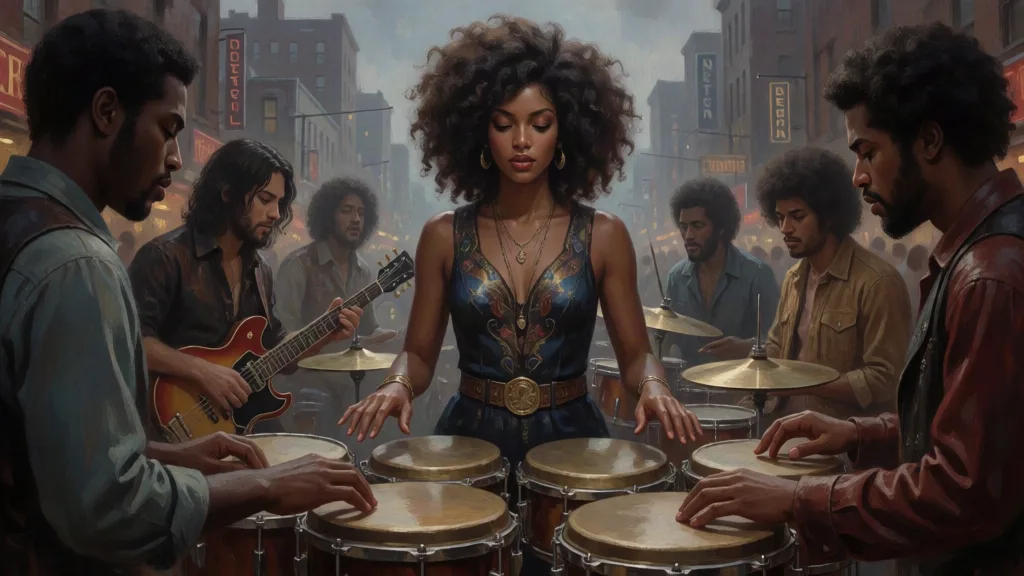
The bass hit me first, always the bass, a fist against my sternum that said *listen* in a language I'd known since I was six years old and the fever took everything else. I pressed my palm flat against the floor of the warehouse and let the vibration climb through the bones of my wrist, up the long ladder of my arm, into the hollow behind my jaw where sound still lived even if it couldn't get out. Curtis was on the kit, riding the ride cymbal like it owed him money, and I could feel that too, a shimmer at the edge of my fingertips, bright and fast, like touching a hot pan and pulling back before the pain arrives.
We were playing something that didn't have a name yet. We never named them until after.
The warehouse on East Grand Boulevard had been a furniture store once, then a church, then nothing for eleven years. Now it was ours because the rent was cheap and the landlord didn't ask questions and the ceiling was high enough that the sound didn't come back at you ugly. I'd strung Christmas lights along the exposed joists with fishing line, red and green and one string of orange that flickered when the wind got in through the loading dock. The lights didn't help me hear. But they helped me see the shape of the room, and the shape of the room mattered when you were trying to make something out of nothing.
Ray was on the upright, his left hand walking a line so low it felt like footsteps in the next apartment. He watched me the way he always did, chin down, eyes up, waiting for the signal. I gave it to him with a nod and he opened up, both hands now, chords stacked like bricks, and the whole room changed temperature. That's the only way I know how to say it. The air got warmer when the music found the right pocket. Like the building itself was leaning in to listen.
I closed my eyes and played the vibraphone.
The mallets were worn smooth at the grip, maple turned to glass by fifteen years of my hands. I didn't need to see the bars. I knew where every note lived, the way you know the light switches in your own house at midnight. E flat. G. B flat. The minor third that always felt like a question. I played it soft first, letting the motor spin the bars into that watery tremolo that sounds like memory feels, and I waited for the room to answer.
It always answered. That was the thing nobody understood.
My mother used to say I was born with my ears in my hands. She meant it as a compliment, I think. She'd put me on her lap when I was small and hum into my chest, and I'd feel the song through her ribs before I ever knew what a song was. After the fever, after the silence settled in like a tenant that never leaves, she kept doing it. Humming into my chest. Her chin on the crown of my head. The vibration of her voice a rope I could hold onto in the dark.
She's been gone nine years now. I still play the songs she hummed. That's most of what I know.
Curtis dropped into a half-time feel and I felt the shift in my knees before I heard it, which is a stupid way to say it because I don't hear anything, but that's the truth of it. The floor told me. The floor always told me first. I opened my eyes and looked at the boys, at Ray's face gone slack with concentration, at Curtis with his eyes closed and his mouth open like he was about to say something he'd regret, and I thought, *this is it, this is the one, this is the song that's going to take us somewhere.*
I didn't know how right I was.
We'd been playing for maybe forty minutes when the frequency came. It wasn't a note. It wasn't even a sound, not the way I understood sound. It was a pressure. A weight in the air, like the moment before a storm breaks, when the sky goes green and the dogs start barking and every hair on your arm stands up because your body knows something your brain hasn't figured out yet. I felt it in my teeth first. A buzz in my molars. Then in my sinuses. Then in the soft spot at the base of my skull where the spine meets the brain and everything important happens.
I stopped playing. My mallets hung in the air.
Ray kept going for two more bars before he noticed, and when he did, his hands came off the keys like they'd been burned. Curtis let the cymbals ring out and then grabbed them with his palms to kill the sound. The three of us stood there in the red and green light, breathing, not looking at each other, because looking at each other would have meant admitting that something had just happened that we couldn't explain.
"What the hell was that," Curtis said. I read his lips. I always read lips. It's exhausting and imprecise and I hate it, but it's what I have.
I shook my head. I didn't have words. I had a feeling in my chest like a door had opened somewhere in the building and something had walked through it.
Ray walked over to me. He moved slow, the way you move when there's a dog in the room you don't recognize. He put his hand on my shoulder and I felt his voice through his palm, muffled but there, the way voices are when they come through walls.
"You felt that," he said. Not a question.
I nodded.
"That wasn't us," he said. "That wasn't the room. That was something else."
I wanted to tell him he was wrong. I wanted to tell him it was just the building settling, just a truck passing on the boulevard, just the furnace kicking on in the basement. But I'd felt it in my teeth. I'd felt it in my spine. And I'd felt something else too, something I hadn't told anyone, something I'd been feeling for weeks now, ever since we started playing in this warehouse, ever since I started noticing that the music we made here didn't behave the way music was supposed to behave.
The notes lingered too long. The silences got deeper. And sometimes, when I played alone at night, I felt like I wasn't alone.
Curtis packed up his sticks and left without saying goodbye. Ray stayed a while longer, watching me, waiting for me to say something that would make it okay. I didn't have anything. So he left too, and I stood in the warehouse with the Christmas lights flickering and the vibraphone humming its last note into the dark, and I put my hand on the floor and felt the city breathing underneath me, all those cars and factories and people and pipes, and underneath all of that, underneath the noise of Detroit at midnight, I felt something else.
A pulse. Slow and steady and patient. Like a heart the size of a house.
I should have walked away then. I should have packed up my mallets and never come back. But the thing about being deaf in a hearing world is that you spend your whole life being told what you're missing. And I'd just felt something nobody else could feel. Something that belonged to me.
So I came back the next night. And the night after that. And the night after that.
And the city started to come apart at the seams.
Watch this moment
Turn the current scene into a cinematic Live Chapter — what you watch becomes the story's next part.
Disclaimer
This is a work of fiction, assisted by artificial intelligence. Any names or characters, businesses or places, events or incidents, are fictitious. Any resemblance to actual persons, living or dead, or actual events is purely coincidental.
Content Removal Policy
- Users may report content that may be illegal or violates our Standards.
- All reported complaints will be reviewed and resolved within seven business days.
- Review Process: Our team will assess the reported content against our guidelines.
- Appeals: If you disagree with a decision, you may appeal within 14 days of notification.
- Potential outcomes include: content removal, account warning, or no action if no violation is found.
To report content, email us at [email protected]