Share
Go Live
The Devil's Retainer
·
Published 10/14/2026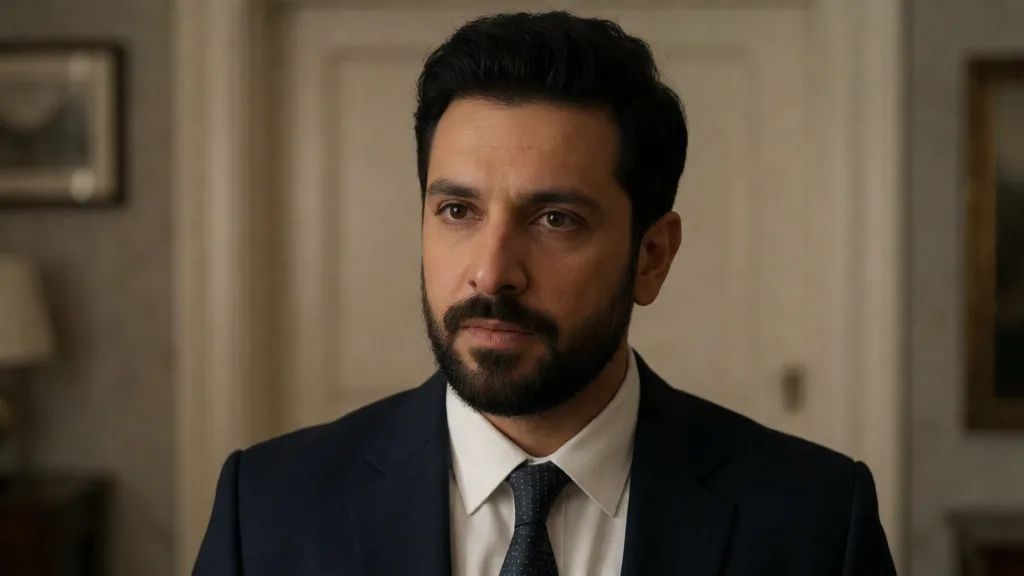
The first time I saw Hashim Kardar, he was bleeding.
Not much. A thin red line above his left eyebrow, the kind of cut you get from a ring or a knuckle, nothing that required stitches. He sat in the back of the courtroom with a handkerchief pressed to his face, and no one looked at him. Not the clerks, not the other lawyers, not the judge who was already shuffling papers for the next case. He was just a tall man in a dark suit, holding a white cloth to his head, and the entire room seemed to have agreed to pretend he wasn't there.
I noticed him because I notice everything when I'm terrified. Fear sharpens the senses. It makes you see the fly crawling on the ceiling fan, the way the prosecutor's tie is knotted too tight, the small red bloom spreading on a stranger's handkerchief.
My father was in the dock. His hands were cuffed in front of him, and he kept his eyes on me, and I kept my eyes on him, and between us sat three rows of wooden benches, a metal railing, and the entire weight of a lie I couldn't prove was a lie.
"Adhira Joseph," the prosecutor said, reading from his file. "Your father, Anthony Joseph, is accused of embezzling forty-seven lakh rupees from Meridian Textiles, where he served as accounts manager for nineteen years. Do you understand the charges?"
"Yes."
"And do you understand that if convicted, he faces a minimum of seven years in prison?"
"Yes."
My voice didn't shake. I don't know why. I was twenty years old and I had forty-two rupees in my wallet and a puppy at home who hadn't been fed since morning, and I said yes like I was answering a question about the weather.
The prosecutor smiled. He had small teeth, crowded together like he'd never had braces, and he smiled at me the way you smile at a child who's trying to explain something complicated.
"Your father's defense counsel withdrew this morning," he said. "Did you know that?"
I didn't know that. I looked at the empty chair beside the dock, the one where Mr. Sharma had sat for the past three weeks, promising us he'd find the evidence, promising us the truth would come out, promising us everything would be fine. The chair was empty. Mr. Sharma was gone.
"No," I said. "I didn't know."
The judge cleared his throat. He was old, older than my father, with glasses that magnified his eyes into something insect-like. "The court will appoint a legal aid lawyer. We'll reconvene in two weeks."
Two weeks. Two weeks for a legal aid lawyer to read through nineteen years of financial records, to find the forged signatures, to prove that the manager, Mr. Khanna, had been skimming from the company for years and had pinned it all on my father when the auditors came. Two weeks.
I stood up.
"Your Honor," I said. My legs were shaking. I could feel it in my knees, a fine tremor like a plucked string. "I request permission to speak."
The judge looked at me over his glasses. "You're the daughter?"
"Yes."
"Speak."
I had nothing prepared. I had no law degree, no training, no idea what I was doing. But I had spent three weeks watching Mr. Sharma fumble through papers, watching him miss obvious things, watching him fail. And I had spent three weeks reading. Every night, in the small flat my father and I shared, with Rio asleep on my feet, I had read through the case file. I had read until my eyes burned. I had read until I understood.
"Meridian Textiles filed their complaint on March 14th," I said. "But the audit that discovered the discrepancy was dated February 28th. The complaint is two weeks late. Why?"
The prosecutor blinked.
"If my father was stealing money, why did it take two weeks for the company to report it? Why did they conduct an internal audit first? Why did they give Mr. Khanna time to resign and move to Bangalore before they filed the FIR?"
The courtroom was very quiet. I could hear the ceiling fan clicking, a rhythmic sound like a heartbeat.
"I'm not a lawyer," I said. "I don't know the procedures. But I know my father. He worked for that company for nineteen years. He never missed a day. He never took a bribe. He never did anything wrong. And I think if you look at the dates, you'll see that someone else did."
The judge stared at me for a long moment. Then he looked at the prosecutor, who was suddenly very interested in his papers.
"Noted," the judge said. "Sit down."
I sat. My heart was pounding so hard I could feel it in my throat. My father was looking at me, and his eyes were wet, and I wanted to run to him, to hold him, to tell him it would be okay.
But I didn't know if it would be okay. I didn't know anything.
After the hearing, I stood in the corridor with my back against the wall, trying to breathe. The air was thick with dust and sweat and the smell of old paper. People walked past me, lawyers in black coats, clerks with files under their arms, a woman crying into her phone.
"You made a good point."
I looked up.
He was standing in front of me, the man from the back of the courtroom. The handkerchief was gone. The cut above his eyebrow had stopped bleeding, leaving a thin red line like a signature. He was tall, taller than anyone I'd ever seen, and his suit probably cost more than my father's monthly salary. His eyes were dark, almost black, and they looked at me like I was a puzzle he was trying to solve.
"About the dates," he said. "It's the only crack in their story."
I didn't say anything. I couldn't. He was too close, too tall, too much.
"You need a lawyer," he said. "A real one."
"I can't afford a real one."
"I know." He tilted his head, studying me. "You're Adhira Joseph. Your father is Anthony Joseph. You live in Andheri East. You study chemical engineering at VJTI. You work part-time at a bakery on Linking Road."
My mouth opened. Closed. Opened again.
"How do you know that?"
"I'm Hashim Kardar," he said, like that explained everything. And maybe it did. Maybe everyone in Mumbai knew that name. The criminal lawyer who never lost. The man who defended gangsters and businessmen and politicians, who walked into courtrooms like he owned them, who won cases that should have been impossible.
"I don't have money," I said.
"I know."
"I can't pay you."
"I know."
He reached into his pocket and pulled out a card. Black, with gold lettering. Just his name and a phone number. Nothing else.
"Come to my office tomorrow," he said. "Seven o'clock. We'll talk."
He turned and walked away before I could respond. I watched him go, watched the way people moved out of his path, watched the way he didn't look back.
I still have that card. It's in my wallet, behind my student ID, behind the photo of my father and me at Marine Drive when I was twelve. Sometimes I take it out and look at it, the gold letters catching the light.
I didn't know then what he would ask of me. I didn't know that the price of my father's freedom would be something I couldn't pay with money. I didn't know that I would spend six months in Hashim Kardar's bed, learning the shape of his silence, the weight of his hands, the taste of his anger.
I didn't know that I would fall in love with him.
But that's not the beginning. The beginning is this: a girl with a mole on her lip, standing in a dusty corridor, holding a black card, and a man walking away without looking back.
Rio was waiting for me when I got home. He was small, a brown and white mess of fur and energy, and he jumped on me the moment I opened the door, licking my face, whining with joy.
"Okay, okay," I said, laughing despite everything. "I'm happy to see you too."
I fed him. I made myself tea. I sat on the floor of our one-bedroom flat and looked at the wall where my father's certificates hung. Employee of the Year, 2018. Best Attendance, 2015. Perfect Attendance, 2012, 2013, 2014.
Nineteen years. Nineteen years of being good, of doing the right thing, of trusting the system.
And now he was in jail. And I was alone. And tomorrow I would go to Hashim Kardar's office and beg.
I closed my eyes. I thought about my mother, who left when I was five, who chose another man over her husband and daughter, who sent birthday cards for three years and then stopped. I thought about the way my father never spoke ill of her, never let me hate her, always said she was just lost.
I thought about the way he raised me alone. The way he learned to braid my hair. The way he stayed up with me when I had exams, making tea and cutting fruit. The way he cried at my school graduation, quiet tears, trying to hide them.
I thought about the prosecutor's smile. The empty chair. The two weeks.
And I thought about Hashim Kardar. The cut above his eyebrow. The way he looked at me like I was a puzzle.
I didn't know what he wanted. But I knew I would give it to him. Whatever it was. Whatever he asked.
Because my father was innocent. And I would do anything to prove it.
Anything.
Watch this moment
Turn the current scene into a cinematic Live Chapter — what you watch becomes the story's next part.
Disclaimer
This is a work of fiction, assisted by artificial intelligence. Any names or characters, businesses or places, events or incidents, are fictitious. Any resemblance to actual persons, living or dead, or actual events is purely coincidental.
Content Removal Policy
- Users may report content that may be illegal or violates our Standards.
- All reported complaints will be reviewed and resolved within seven business days.
- Review Process: Our team will assess the reported content against our guidelines.
- Appeals: If you disagree with a decision, you may appeal within 14 days of notification.
- Potential outcomes include: content removal, account warning, or no action if no violation is found.
To report content, email us at [email protected]