Share
Go Live
Crimson Brushstroke
·
Published 9/18/2026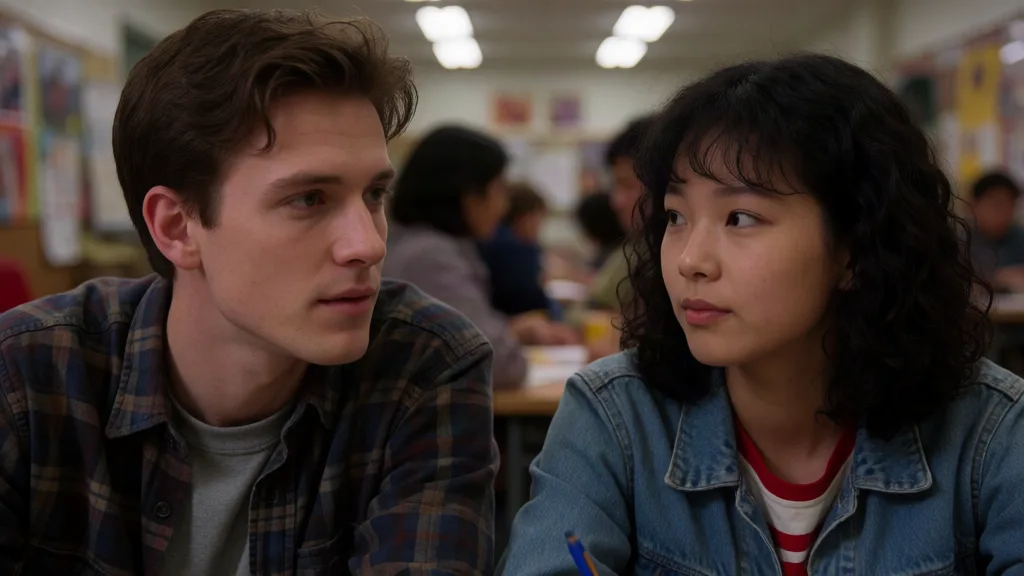
The first time I saw her, she was arguing with a vending machine.
Not a loud argument. Not the kind where you kick the glass and curse and make a scene. This was quieter than that, more deliberate, like she was trying to reason with the thing. She stood in the hallway outside the art building at six in the morning, hair pulled back with a paint-stained ribbon, hands on her hips, staring at the machine like it had personally insulted her family.
I was there because I couldn't sleep. Again. The nightmares had been getting worse since Thanksgiving, and I'd given up pretending that lying in bed with my eyes closed counted as rest. So I'd pulled on sweats and a hoodie and walked across campus in the dark, figuring I'd find some coffee somewhere, maybe sit in the rink and watch the ice until the sun came up.
Instead I found her.
"You took my dollar," she said to the machine. Her voice had an accent I couldn't place. Soft, musical, every word carefully shaped. "And you did not give me the coffee. This is theft."
The machine hummed. Unbothered.
I should've kept walking. That's what a normal person would've done. But I was tired and wired and something about the way she stood there, so serious, so genuinely offended by the injustice of a broken vending machine, made me stop.
"Those things are rigged," I said.
She turned. And I forgot how to breathe for a second.
Not because she was beautiful. I mean, she was. Dark eyes, sharp cheekbones, skin the color of tea with too much milk. But that wasn't what got me. It was the way she looked at me. Direct. Unafraid. Like she was taking my measure and didn't particularly care what she found.
"I know they are rigged," she said. "But I am hungry and I have no coffee and the dining hall does not open until seven."
"It's six fifteen."
"Yes." She said it like this was my fault somehow. "I know what time it is."
I shoved my hands in my pockets. The hallway was cold, the kind of cold that seeped through concrete and settled in your bones. "There's a place on College Street. Opens at six thirty. Better coffee than this anyway."
She looked at the machine. Then at me. Then at the machine again.
"You are offering to buy me coffee?"
"I'm offering to show you where to get coffee. You can buy your own."
Something shifted in her face. Not a smile, exactly. More like the possibility of one. "Okay," she said. "Show me."
We walked in silence. The campus was empty this early, just a few joggers and the guy who ran the grounds crew, already out with his leaf blower even though it was January and there were no leaves. The sky was that gray-purple color that meant snow later, maybe, or just more cold.
"I'm Yukina," she said.
"John."
"John." She tested the word. "Like the toilet?"
I stopped walking. "What?"
"In Japan, John is a toilet. Well, it is a company that makes toilets. Everyone knows this."
"I'm not a toilet."
"I did not say you were. I said the name is the same." She tilted her head. "You are very sensitive about this."
I wasn't sensitive. I just hadn't expected my name to be compared to plumbing fixtures within thirty seconds of meeting someone. But she said it without malice, just stating facts, and I found myself fighting a smile.
"Where are you from?" I asked.
"Tomi Village. It is in Japan."
"No shit."
"Yes. No shit." She said it perfectly, no hesitation, and I laughed. Actually laughed. It felt strange, like using a muscle I'd forgotten I had.
The coffee shop was called The Grind, which was a terrible name, but they made decent espresso and didn't ask questions. The girl behind the counter, a sophomore named Maya who I'd hooked up with once last year and then never called again, raised her eyebrows when she saw me walk in with someone.
"John," she said. "Haven't seen you in a while."
"Been busy."
"Mm." She looked at Yukina. "What can I get you?"
"Black coffee. The strongest you have."
Maya nodded, started pulling shots. I ordered the same, because it felt weird to order something fancy next to someone who'd just asked for the strongest thing on the menu.
We sat at a table by the window. Yukina wrapped her hands around her cup and stared out at the street. The first light was starting to creep over the buildings, pale and watery.
"Why are you awake so early?" she asked.
"Couldn't sleep."
"Bad dreams?"
I looked at her. "What makes you say that?"
"Your eyes." She didn't look away. "They are tired. Not just from lack of sleep. Tired from something else."
I didn't answer. I didn't know how. No one had ever said that to me before, not even the therapists my mom made me see after my dad died. They'd asked questions, sure. But they'd asked them like they were checking boxes, like they already knew what they wanted to hear.
Yukina just waited.
"I get nightmares," I said finally. "Sometimes."
She nodded. "I understand. I have them too."
"About what?"
"Home." She took a sip of coffee. "The water. The way it rose and rose and there was nothing we could do."
I didn't know what that meant. But I didn't ask, because something in her voice told me not to. Not yet.
We sat there for an hour. Maybe more. The coffee went cold, and Maya kept looking over at us, and I didn't care. Yukina told me about Tomi Village, about the mountains and the rice fields and the way the ocean sounded at night. She told me about her mother, Kumiko, who taught dance and had hands like bird wings. She told me about her father, Johnny, who'd come to Japan when he was young and never left.
"He was from Oklahoma," she said. "He ran away from home when he was sixteen. Traveled all over. Ended up in Tomi and met my mother and stayed."
"He just stayed?"
"He said there was nothing to go back to." She shrugged. "And everything to stay for."
I thought about my own father. About the way he'd left, not by choice but by circumstance, a heart attack on a Tuesday afternoon. About how I'd spent the last four years trying to figure out if I was more like him or more like my mother, and whether either option was something I wanted.
"What about you?" she asked. "Where are you from?"
"Here. Well, not here. I grew up in Michigan. Outside Detroit."
"Detroit. Cars."
"Yeah. Cars."
"Do you like cars?"
"I like hockey."
She made a face. "Hockey is violent."
"So is everything."
"True." She finished her coffee. "But hockey is especially violent. I have seen it. The men hit each other and then sit in a box and feel sorry for themselves."
"That's not what happens."
"That is exactly what happens. I have seen it."
I laughed again. Twice in one morning. That had to be a record.
We left the coffee shop at seven thirty. The sun was fully up now, weak and yellow, doing nothing to cut the cold. Yukina pulled her coat tighter around herself. It was a peacoat, navy blue, too thin for a Massachusetts winter.
"You need a better jacket," I said.
"I have a better jacket. It is in my room. I did not expect to be outside this long."
"You were arguing with a vending machine."
"Yes. And then you came along and made me walk across town for coffee. This is your fault."
"My fault?"
"You offered. I accepted. Now I am cold." She said it matter-of-factly, like this was simple logic, and I found myself wanting to argue just to keep her talking.
But we'd reached the art building, and she was already pulling open the door.
"Thank you for the coffee," she said. "Even though you did not pay for it."
"You're welcome. Even though I didn't do anything."
"You walked with me. That is something." She paused. "I am here every morning. Six o'clock. If you cannot sleep again."
Then she was gone, swallowed by the building, and I stood there in the cold like an idiot, trying to figure out what had just happened.
I didn't go to the rink. I went back to my dorm and lay on my bed and stared at the ceiling. My roommate, Garrett, was still asleep, snoring in that way he had, like a chainsaw that couldn't quite commit. I should've been tired. I should've been exhausted. But I wasn't.
I was thinking about her.
Yukina. From Tomi Village. Who compared my name to a toilet and drank her coffee black and had nightmares about water.
I didn't know anything about her. Not really. But I wanted to. And that was dangerous, because wanting things had never worked out well for me.
The next morning, I woke up at five thirty without an alarm.
I told myself it was coincidence. I told myself I was just thirsty, that I'd go get coffee because I needed coffee, not because I wanted to see if she'd be there. I told myself a lot of things.
She was there.
Same hallway. Same vending machine. But this time she wasn't arguing with it. She was sitting on the floor, back against the wall, sketchbook open on her knees. She didn't look up when I walked in.
"Good morning," I said.
"Good morning." Still not looking up. Her pencil moved across the page in quick, sure strokes.
I sat down next to her. Not too close. Just close enough. "What are you drawing?"
"You."
I blinked. "What?"
She turned the sketchbook toward me. It was me. Or a version of me. The lines were loose, impressionistic, but somehow she'd captured something. The way I stood, maybe. The way I held myself, like I was always ready for something to go wrong.
"You are not as hard to draw as you think," she said.
"You've been drawing me?"
"I saw you yesterday. Before the vending machine. You were walking across campus and you stopped and looked at the sky." She shrugged. "I remembered your face."
I didn't know what to say. No one had ever drawn me before. No one had ever looked at me long enough to remember.
"It's good," I said.
"I know."
I laughed. She didn't. She just kept drawing, her pencil moving in that steady rhythm, and I sat there and watched her and felt something shift in my chest. Something I didn't have a name for.
We went to The Grind again. Maya didn't say anything this time, just made our coffees and handed them over with a look I couldn't read. We sat at the same table. Yukina told me about her art, about how she'd been drawing since she was four, about how her mother had taught her to see the world in shapes and colors.
"My father did not understand at first," she said. "He wanted me to do something practical. Business. Medicine. Something that would make money."
"What changed his mind?"
"He saw my work. Really saw it. And he said, 'This is what you are supposed to do.'" She smiled, small and private. "He is not a man who says things like that. So I knew he meant it."
I thought about my own father. About how he'd never seen me play hockey, not once, not even when I was a kid and it was just peewee league and everyone's parents came. He'd been too busy. Too tired. Too something.
"He sounds like a good dad," I said.
"He is. He is difficult, but he is good." She looked at me. "Your father?"
"Dead."
The word hung in the air. I didn't say it to make her feel sorry for me. I said it because it was true, and because she'd asked, and because something about her made me want to tell the truth.
"I am sorry," she said.
"It was four years ago. Heart attack. I was fourteen."
"That is young."
"Yeah."
She reached across the table and put her hand on mine. Just for a second. Just long enough for me to feel the warmth of her palm, the slight roughness of her fingertips, the calluses from holding pencils and brushes.
"I was twelve when the water came," she said. "My father almost died. My mother almost died. We lost everything."
"The tsunami?"
She nodded. "We were lucky. We lived on higher ground. But the village below us, it was gone. Just water and debris and bodies." She pulled her hand back. "I still dream about it. The sound. Like a train, but worse. Like the world was ending."
"I dream about my dad," I said. "The way he looked when they found him. I wasn't there. I was at school. But I dream about it anyway."
"That is the thing about dreams," she said. "They do not care about what is true."
We sat there until the coffee went cold. Until the sun was high and the shop started to fill with other people, students and professors and the occasional townie. I didn't want to leave. I wanted to stay in that moment, in that small bubble of warmth, where the only thing that mattered was the sound of her voice.
But eventually we had to go. She had a drawing class. I had practice.
"Same time tomorrow?" I asked.
She looked at me. That same direct look, the one that made me feel like she could see right through me.
"If you want," she said.
"I want."
She nodded. And then she was gone.
Practice was brutal. Coach made us skate suicides until I thought I was going to puke. Garrett kept asking me why I was smiling, and I told him to shut up, and he told me I was acting weird, and I told him he was acting weird, and we went back and forth like that until we were both laughing and I forgot, for a few minutes, to be nervous about tomorrow.
But I was nervous. I was nervous all night. I lay in bed and stared at the ceiling and thought about her. About the way she said my name. About the way she looked at me, like I was worth looking at.
I'd never felt like that before. Like someone saw me. The real me. Not the hockey player, not the guy with the dead dad, not the asshole who hooked up with girls and never called them back. Just me.
It was terrifying.
And I wanted more.
The next morning, I got there before she did.
I sat on the floor by the vending machine and waited. The hallway was cold and quiet and smelled like paint thinner and old coffee. I checked my phone. Checked it again. Considered leaving, because what if she didn't come, what if she'd changed her mind, what if I'd imagined the whole thing.
Then the door opened and she walked in.
"You are early," she said.
"Couldn't sleep."
She sat down next to me. Closer this time. Her shoulder brushed mine and I felt it like a shock.
"I brought you something," she said. She pulled a small package out of her bag. Wrapped in newspaper, tied with string.
I unwrapped it. It was a sketch. Me, again, but different this time. I was laughing. Actually laughing, head thrown back, eyes crinkled. I didn't recognize myself.
"This is from yesterday," she said. "When you laughed at the thing about the toilet."
"I don't remember laughing that hard."
"You did. You just do not remember what you look like when you are happy."
I stared at the sketch. At this version of me that I'd never seen before. Happy. Carefree. Like someone who hadn't spent the last four years carrying a weight he couldn't put down.
"Thank you," I said. My voice came out rough.
"You are welcome."
We went to The Grind. We sat at our table. She told me about her roommate, a girl from California who didn't understand why Yukina didn't have a TV. I told her about Garrett, about how he snored and left his dirty socks everywhere and was somehow still the best friend I'd ever had.
"You love him," she said.
"He's my best friend."
"That is not what I said."
I looked at her. She was smiling, that small private smile, and I felt my face get hot.
"I don't... I mean, not like that."
"I know. But you love him. Like a brother."
"Yeah," I said. "I guess I do."
She nodded. "I have a friend like that. Her name is Mika. She lives in Tokyo now. We write letters."
"Letters?"
"Email is too fast. Letters make you think about what you want to say."
I thought about that. About the difference between typing something out and writing it by hand. About the way words could mean more when you had to work for them.
"I've never written a letter," I said.
"Then you should start."
The next day, she brought me a notebook. Leather-bound, small enough to fit in my pocket. "For your letters," she said.
I didn't know who I'd write to. But I took it anyway.
The days started to blur together. Every morning, six o'clock, the hallway by the vending machine. Every morning, coffee at The Grind. Every morning, she told me something new about herself and I told her something new about me.
I learned that she hated the cold. That she loved the smell of rain. That she had a scar on her knee from falling off a bike when she was eight. That she couldn't swim, which was funny, given where she grew up, but also not funny at all.
I learned that she was afraid of forgetting. Of losing the memories of home, of the way things used to be, of the people she'd left behind.
"I am here," she said one morning, "but I am also there. Always. Part of me is always standing on that hill, watching the water come."
I didn't know what to say to that. So I just sat with her. And that seemed to be enough.
She learned things about me too. That I couldn't stand silence. That I still slept with the lights on sometimes, even though I was nineteen years old. That I'd never told anyone about the nightmares, not really, not the details.
"What are they about?" she asked.
"The usual. My dad. The funeral. The way my mom cried." I paused. "And sometimes other things. Things I don't understand."
"Like what?"
"I don't know. Just... darkness. Being trapped. Not being able to move."
She nodded. "I have those too. The trapped ones."
"What do you do?"
"I draw. I draw until I can't see the darkness anymore. Until all I can see is the paper."
I thought about that. About the way she turned her pain into something beautiful. About the way she didn't let it consume her.
"I don't have anything like that," I said.
"You have hockey."
"Hockey is different. Hockey is... I don't know. It's just what I do."
"Then maybe you need something else. Something that is not just what you do."
I didn't know what that would be. But I wanted to find out.
Two weeks after we met, she kissed me.
We were sitting on the floor by the vending machine, like always. I was telling her about a fight I'd gotten into with one of the guys on the team, some stupid thing about a girl, and she was listening, really listening, her head tilted, her eyes on my face.
"You are angry," she said.
"I'm not angry."
"You are. I can see it. Here." She touched my forehead. "And here." She touched my chest.
"I'm fine."
"You are not fine. You are never fine." She leaned closer. "But that is okay. I am not fine either."
And then she kissed me.
It was soft. Gentle. Like she was asking a question. And I answered by kissing her back, by pulling her closer, by forgetting everything else in the world except the feel of her lips on mine.
When we broke apart, she was smiling. That real smile, the one I'd only seen a few times.
"I have wanted to do that for a while," she said.
"How long?"
"Since the first day. When you offered to show me the coffee shop."
"That was two weeks ago."
"Yes. I am patient."
I laughed. "You could've said something."
"I could have. But I wanted to see if you would say something first."
"I didn't."
"No. You are not very good at saying things." She kissed me again, quick this time. "But you are good at other things."
We stayed there for a long time. Just kissing. Just holding each other. The vending machine hummed above us, indifferent, and the cold seeped through the walls, and I didn't care about any of it.
I was happy. Actually happy. For the first time in years.
It didn't last.
The next morning, she wasn't there.
I waited. An hour. Two. The hallway stayed empty, the vending machine stayed broken, and I stayed on the floor, telling myself she was just late. That she'd overslept. That something had come up.
But she didn't come.
I went to The Grind alone. Maya looked at me with something like pity. "She's not with you?"
"No."
"Everything okay?"
"I don't know."
I sat at our table and drank my coffee and stared at the door, waiting for her to walk in. She didn't.
I went to the art building. Asked around. No one had seen her. Her roommate said she'd left early that morning, before dawn, and hadn't come back.
I called her phone. No answer. Called again. Nothing.
By noon, I was panicking. By evening, I was terrified. I walked back to my dorm and sat on my bed and tried to breathe. Garrett asked what was wrong. I told him I didn't know.
"She's gone," I said. "I don't know where."
"Who?"
"Yukina."
"Who's Yukina?"
And I realized I'd never told him. I'd never told anyone. She was my secret, my private thing, the one good thing in my life that I'd kept to myself.
"She's... she's the girl I've been seeing."
Garrett sat down next to me. "Since when?"
"Two weeks."
"Two weeks and you're this messed up?"
I didn't answer. I couldn't explain it. Couldn't explain how two weeks with her had felt like a lifetime. How she'd seen me in a way no one else ever had. How I'd started to believe that maybe, just maybe, I could be something other than what I'd always been.
"Did you check the hospital?" Garrett asked.
"No."
"Then let's go."
We went to the hospital. They wouldn't tell us anything, because we weren't family. We went to the police. They said they'd look into it, but she was an adult, and she'd only been gone for a few hours, and there was no evidence of foul play.
We went back to campus. I sat in my room and stared at the wall and felt something inside me crack.
The next morning, I was at the vending machine at five thirty. I told myself she'd be there. That it had all been a mistake, a misunderstanding, that she'd walk through the door and explain everything and everything would be okay.
She didn't come.
I went to The Grind. Maya made my coffee without asking. I sat at our table and drank it and tried not to cry.
She didn't come.
I went to the art building. To her dorm. To every place I could think of. I asked everyone I could find. No one knew anything.
She was gone.
Three days passed. Four. Five. I stopped sleeping. Stopped eating. Stopped going to practice. Coach benched me. Garrett tried to help, but I pushed him away. I didn't want help. I wanted answers.
On the sixth day, I got a letter.
It was in my mailbox, a plain white envelope with my name on it. No return address. I opened it with shaking hands.
The paper inside was covered in her handwriting. Small, neat, careful. Every letter perfectly formed.
John,
I am sorry. I know you are angry. I know you are confused. I know you deserve an explanation, and I am going to give you one.
My father is sick. He has been sick for a long time, but he did not tell me. My mother called me six days ago and said he was in the hospital. That he might not make it. I left that night. I did not have time to say goodbye.
I am in Japan now. I am with my family. My father is still alive, but the doctors say it is not good. I do not know how long I will be here. I do not know when I will come back.
I did not tell you because I did not know how. I did not want to say goodbye. I did not want to lose you.
But I have lost you anyway, I think. I have lost you because I did not trust you. Because I did not believe that you would understand.
I am sorry.
I am enclosing something. It is not much. But it is all I have.
Please do not forget me.
Yukina
I read the letter three times. Then I opened the second envelope, the one I hadn't noticed, and pulled out what was inside.
It was a drawing. A sketch. Me and her, sitting on the floor by the vending machine. She was leaning against me, her head on my shoulder, her eyes closed. I was looking at her, my face soft in a way I'd never seen before.
At the bottom, she'd written a date. The day we met.
I sat on my bed and held the drawing and cried. Not the way I'd cried when my dad died, all shock and numbness and tears that came from somewhere else. This was different. This was grief. Real grief. The kind that came from losing something you'd only just found.
I didn't know if I'd ever see her again. I didn't know if she'd come back. I didn't know if her father would live or die or something in between.
But I knew one thing. I knew that I loved her. And I knew that I would wait.
I wrote her back that night. I didn't know if the letter would reach her. I didn't know if she'd read it. But I wrote it anyway.
Yukina,
I'm not angry. I'm scared. I'm scared that you're gone and I'm scared that you won't come back and I'm scared that even if you do, things won't be the same.
But I'm not angry.
Your father is going to be okay. He has to be. Because you need him, and he needs you, and the world needs more people like you in it.
I'm not going anywhere. I'll be here. Every morning. Six o'clock. By the vending machine.
When you come back, I'll be there.
John
I mailed the letter the next day. No return address, because I didn't have one. Just her name and the village and the country. I didn't know if it would get there. I didn't know if it would matter.
But I sent it anyway.
And then I waited.
The weeks passed. I went back to practice. I started eating again. I talked to Garrett, really talked to him, told him everything. He didn't understand, not really, but he listened. And that was enough.
I wrote her every week. Letters, like she'd taught me. I told her about practice, about Garrett, about the way the campus looked in the snow. I told her about my nightmares, about the way they'd changed since she left, about how sometimes I dreamed of her instead.
I didn't know if she was reading them. I didn't know if she was alive, or if her father was alive, or if any of it mattered. But I kept writing.
Because that was all I could do.
And then, on a Tuesday in March, six weeks after she'd left, I walked into the hallway by the vending machine at six o'clock in the morning.
And she was there.
She was thinner. Tired. Her eyes were red, like she'd been crying. But she was there.
"You came back," I said.
"I came back."
I crossed the hallway in three steps and pulled her into my arms. She was shaking. Or maybe I was shaking. I couldn't tell.
"Your father?" I asked.
"He is alive." Her voice was muffled against my chest. "He is going to live."
"Good."
"He wants to meet you. My mother too. They want to meet the boy who wrote me all those letters."
I pulled back. Looked at her. Really looked at her.
"You read them?"
"Every one." She reached up and touched my face. "Every single one. I read them in the hospital, in the waiting room, in the middle of the night when I couldn't sleep. I read them and I cried and I thanked whatever god was listening that I had you."
"I thought I lost you."
"You did not lose me. You will never lose me." She kissed me. Soft. Gentle. Like the first time. "I am here now. And I am not going anywhere."
We stood there for a long time. Holding each other. The vending machine hummed above us, indifferent, and the cold seeped through the walls, and none of it mattered.
She was back. That was all I needed to know.
The next morning, we went to The Grind. Maya made our coffees and didn't say anything, just smiled. We sat at our table and she told me about her father, about the hospital, about the way he'd held her hand and told her he was proud of her.
"He said he was sorry," she said. "For not telling me sooner. For keeping it from me."
"He was trying to protect you."
"I know. But I did not need protection. I needed the truth."
I thought about that. About all the things I'd kept from her, all the things I'd never said. About the way I'd spent years hiding from myself, from everyone, from the truth of who I was.
"I need to tell you something," I said.
"What?"
"I love you."
She went still. Her coffee cup hovered halfway to her lips. "What?"
"I love you. I've loved you since the first day, since you called my name a toilet, since you made me laugh when I hadn't laughed in years. I love you, Yukina. And I'm sorry it took me so long to say it."
She set down her cup. Her eyes were wet.
"I love you too," she said. "I think I have loved you since the moment you offered to show me where to get coffee. Even though you did not pay for it."
I laughed. She laughed. And then we were kissing, right there in the coffee shop, and Maya was rolling her eyes and some guy in the corner was clapping, and I didn't care about any of it.
I had her back. I had everything.
The spring semester passed in a blur. We spent every morning together, every free hour we could steal. She drew me, over and over, and I started to see myself the way she saw me. Not as a hockey player, not as a guy with a dead dad, but as someone worth looking at. Someone worth loving.
She told me about her parents. About Kumiko, who'd been a dancer, who'd taught her to move with grace. About Johnny, who'd been a greaser in Tulsa, who'd run away from home and never looked back.
"They are coming to visit," she said one day. "In May. They want to meet you."
I felt my stomach drop. "They want to meet me?"
"Yes. I told them about you. Everything."
"Everything?"
"Everything important." She smiled. "Do not worry. They will like you."
"How do you know?"
"Because I like you. And they trust my judgment."
I wasn't so sure. But I nodded anyway.
May came. The snow melted. The campus turned green. And on a Friday afternoon, I stood in the lobby of the art building and waited to meet the people who'd raised the girl I loved.
They were smaller than I expected. Kumiko, with her bird-wing hands and her quiet smile. Johnny, with his graying hair and his sharp eyes, the kind of eyes that had seen things, survived things.
"So you're John," he said.
"Yes, sir."
"Yukina tells me you're a hockey player."
"Yes, sir."
"She also tells me you write letters." He paused. "Good letters."
"I try."
He looked at me for a long moment. Then he nodded. "She's my only daughter. My only child. You understand what that means?"
"Yes, sir."
"Good." He clapped me on the shoulder. "Then we're going to get along just fine."
Kumiko hugged me. Tight. Like she'd known me my whole life.
"Thank you," she said. "For taking care of her. For waiting for her."
"I didn't do anything."
"You did everything." She pulled back and looked at me. "You loved her. That is everything."
We went to dinner. All of us. Garrett came, and Yukina's roommate, and Maya from The Grind. We sat around a big table and ate and laughed and told stories. Johnny told me about the time he'd gotten into a fight with a guy twice his size and won. Kumiko told me about the time she'd danced in a competition and fallen flat on her face. Yukina told me about the time she'd tried to teach her father to draw and he'd ended up with charcoal all over his face.
I told them about my dad. About the way he'd died, about the way I'd spent years trying to figure out who I was without him. About the way Yukina had helped me see that I didn't have to be anyone but myself.
"He would have liked you," I said to her, later, when we were alone. "My dad. He would have liked you."
"I would have liked him too."
We were sitting on the roof of my dorm, looking up at the stars. The night was warm, the first warm night of the year, and the sky was clear and full of light.
"I used to think I wasn't meant for this," I said. "For happiness. For love. I used to think I was just... broken. And that nothing could fix me."
"And now?"
"Now I think maybe I was just waiting. Waiting for someone to see me. To really see me."
She leaned her head on my shoulder. "I see you."
"I know."
"I love you."
"I know."
We sat there for a long time. The stars turned overhead. The campus slept below us. And I felt something I hadn't felt in years.
Peace.
The summer came. We stayed in Briar, both of us, working jobs and taking classes and spending every free moment together. She painted. I played hockey. We went to The Grind every morning and sat at our table and talked about everything and nothing.
Her parents came back in August. They stayed for a week. Johnny helped me fix my car. Kumiko taught me how to make miso soup. Yukina drew all of us, together, a family portrait that she hung on the wall of her dorm.
"You are part of this now," she said. "Part of us."
I didn't know what to say. So I kissed her. And that was enough.
The fall semester started. We were juniors now. Things were different. Better. I'd stopped having nightmares, mostly. She'd stopped being afraid of forgetting, mostly. We were learning, both of us, how to be people who'd been through things and come out the other side.
"This is what it means to be alive," she said one morning. "To keep going. Even when it hurts."
I thought about my dad. About the way he'd left me, not by choice, but by circumstance. About the way I'd carried that loss for years, letting it define me, letting it hold me back.
"I used to think I was cursed," I said. "Like, everything I touched turned to shit. Like I wasn't allowed to be happy."
"And now?"
"Now I think maybe I was just scared. Scared of losing someone else. Scared of getting close to anyone because I knew how much it would hurt if they left."
She took my hand. "I am not going to leave."
"You don't know that."
"I do know that. I know it because I chose you. I chose to come back. I chose to love you. And I will keep choosing you, every day, for as long as you let me."
I looked at her. At this girl from Tomi Village, with her paint-stained fingers and her quiet strength and her ability to see me in a way no one else ever had.
"I'm going to hold you to that," I said.
"Good."
We kissed. The vending machine hummed. The sun rose over the campus, pale and golden, and I knew, for the first time in my life, that I was exactly where I was supposed to be.
The story wasn't over. It was just beginning.
Watch this moment
Turn the current scene into a cinematic Live Chapter — what you watch becomes the story's next part.
Disclaimer
This is a work of fiction, assisted by artificial intelligence. Any names or characters, businesses or places, events or incidents, are fictitious. Any resemblance to actual persons, living or dead, or actual events is purely coincidental.
Content Removal Policy
- Users may report content that may be illegal or violates our Standards.
- All reported complaints will be reviewed and resolved within seven business days.
- Review Process: Our team will assess the reported content against our guidelines.
- Appeals: If you disagree with a decision, you may appeal within 14 days of notification.
- Potential outcomes include: content removal, account warning, or no action if no violation is found.
To report content, email us at [email protected]