Share
The Hour Thief
·
Published 8/19/2026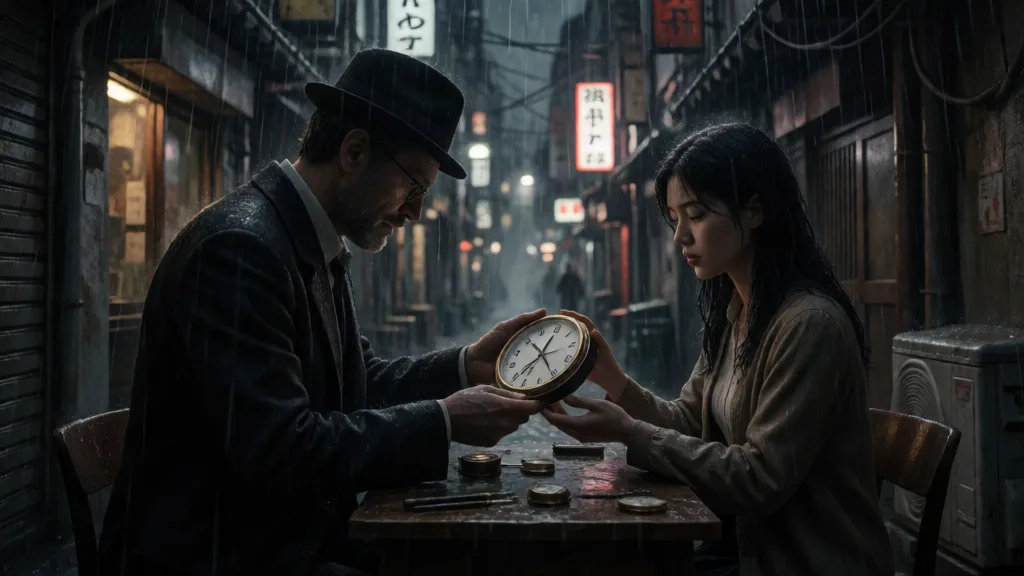
The rain had been falling for seventeen days when she found my door.
Not that I was counting. Not that the rain mattered, either. In Tokyo, the wet season does what it pleases, and you learn to live with the damp in your bones and the mildew in your heart. My shop sits at the end of a narrow alley in Ueno, where the neon from the main street bleeds pink and green across the puddles but never quite reaches my windows. The sign above my door reads *Matsuda Clock Works* in kanji so faded you'd need a lamp to read it after dark. I keep the lamp off.
I was wrist-deep in the guts of a grandfather clock when the bell above my door chimed. A cheap bell. Tinny. I'd fixed it a hundred times and it still sounded like a dying bird. I didn't look up. Customers were rare, and the ones who found their way here usually left disappointed. I don't sell timepieces. I don't repair them for the public. I build them. One at a time. For people who understand what they're buying.
"Are you Matsuda?"
Her voice was thin. Reedy. The kind of voice that gets lost in crowds.
I wiped my hands on a rag and looked up. She stood in the doorway with the rain behind her, a black umbrella dripping onto my floorboards. Young. Maybe twenty-five. Her face was sharp, all angles and shadows, and her skin had that pale, almost translucent quality you see in people who haven't seen sunlight in months. She wore a gray coat that hung loose on her frame, the kind of coat that used to fit someone else.
"I'm Matsuda," I said.
She stepped inside and closed the umbrella. The bell chimed again, weaker this time, like it was apologizing for the interruption. She looked around my shop with the careful attention of someone cataloging details for later. The shelves of half-built clocks. The workbench cluttered with gears and springs. The wall of photographs I never showed anyone.
"I need a clock," she said.
I went back to the grandfather clock. Its heart was a mess. Someone had tried to fix it with glue and hope, and neither had held. "I don't take commissions."
"I was told you do."
"By who?"
She didn't answer. I heard her shoes on the floorboards, stepping around the piles of spare parts, the stacks of old newspapers I kept meaning to throw out. She stopped near my workbench. Close enough that I could smell the rain on her coat and something else underneath. Something chemical. Hospital-clean.
"The man at the antique shop in Ginza," she said. "He said you make clocks that keep perfect time. That you never miss a second."
"Most clockmakers keep perfect time."
"He said yours are different."
I set down my tweezers and turned to face her. She was watching me with dark eyes that didn't blink enough. Her hands were tucked into her coat pockets, and I could see the outline of something small and square pressing against the fabric. A prescription bottle, maybe. Or a compact mirror. The kind women used to carry when they wanted to check their faces without being obvious.
"Different how?" I asked.
"He didn't say. He just said you were the one to see."
I picked up my rag again and wiped my fingers. The oil had settled into the cracks of my knuckles, permanent now, like the smell of metal and dust that clung to everything I owned. "I don't know what he told you, but I'm not taking new work. Try the shop in Shinjuku. The one with the cat in the window."
"I don't want a clock from Shinjuku."
"Then you don't want a clock at all."
She didn't leave. She stood there, dripping onto my floor, and I could feel the weight of her waiting. Not impatient. Not demanding. Just present, like a stone in a river. The kind of presence that wears things down through sheer persistence.
"How much?" she asked.
"Not for sale."
"Everything is for sale."
I laughed. It came out dry, cracked, like something I hadn't used in a while. "You've been reading too many American novels."
"I've been reading the obituaries."
The words hung in the air between us. I looked at her again, really looked this time. The sharp angles of her face. The hollows under her cheekbones. The way her coat bunched at the shoulders where it used to fit. She wasn't thin from dieting. She was thin from something else. Something that ate you from the inside.
I turned back to the grandfather clock. "I'm sorry. I can't help you."
"You haven't even asked what I want."
"I know what you want." I picked up my tweezers and reached into the clock's mechanism. My fingers found a gear that had been forced into place, its teeth stripped and useless. Someone had tried to make this clock run faster than it was meant to. Someone had wanted to rush time. "You want a clock that measures the time you have left. You want to watch it tick down, day by day, hour by hour, until there's nothing left. You want to hold death in your hands and pretend you're in control."
Behind me, she was silent.
"I've seen a hundred people like you," I said. "They come to my shop with their terminal diagnoses and their quiet desperation. They want a clock that tells them how long they have, as if knowing will make it easier. As if the counting down will somehow prepare them for the end. It won't. It will drive you mad. You'll watch every second like a miser counts coins. You'll stop living because you're too busy measuring the life you have left."
"That's not why I'm here."
I stopped. The tweezers hovered over the broken gear. "Then why?"
"I want a clock that tells me how long I have," she said. "But not so I can watch it. So I can forget it."
I turned around. She had taken her hands out of her pockets. In one palm, she held a prescription bottle. In the other, a photograph. She set both on my workbench, side by side, like offerings at an altar.
The photograph showed a man. Late thirties. Strong jaw. Kind eyes. He was smiling at someone off-camera, the way people smile when they've just been told something wonderful. A wedding ring glinted on his finger.
"My husband," she said. "He doesn't know I'm here."
"And the bottle?"
She picked it up and held it out to me. I took it. The label was from Tokyo University Hospital. The patient's name was Sato, Yuki. The medication was for pain management, end-stage. The dosage was high enough to make my stomach turn.
"Pancreatic," she said. "Stage four. They gave me three months at the start. That was six weeks ago."
I handed the bottle back. "I'm sorry."
"Don't be. I'm not asking for your pity. I'm asking for your work."
She put the bottle in her pocket and picked up the photograph. Her fingers traced the edge of it, following the curve of her husband's smile. "Kenji doesn't know how bad it is. I told him it was treatable. I told him I was getting better. He believes me because he wants to believe me. Because the alternative is too much for him to carry."
"And the clock?"
"When I'm gone, I want him to have something. Something that tells him how much time we had. Not the time we lost. Not the time we wasted. The time that mattered." She looked at me, and for the first time, I saw something crack in her composure. A tremor in her lip. A wetness in her eyes that she blinked away before it could fall. "I want him to look at that clock and remember the good minutes. The ones that were worth living. Not the ones I spent in hospitals, not the ones I spent throwing up in the bathroom. The good ones."
I stared at her. The rain kept falling outside. The grandfather clock kept ticking, its rhythm off by a fraction of a second, something I would have to fix before I could let it leave my shop.
"You're asking me to build you a clock that measures your life," I said. "And you want it to lie."
"I want it to tell the truth I choose."
"That's not how clocks work."
"That's not how your clocks work."
She was right. She didn't know how right she was. She didn't know that the clocks I build don't just measure time. They spend it. Every tick of a Matsuda clock is a second taken from the owner's life, a second that will never come back. The mechanism doesn't just record. It consumes. I had spent years perfecting the craft, learning the precise arrangement of gears and springs that could bind a life to a machine. I had built clocks for dying men who wanted to feel their remaining hours like a weight in their hands. I had built clocks for the grieving, for the desperate, for the ones who wanted to pour their sorrow into something that would outlast them.
I had never built one for someone who wanted to forget.
"I can't do it," I said.
"Yes you can."
"I won't."
She picked up the photograph and slid it back into her coat pocket. Her movements were slow, deliberate, as if each one cost her something. "The man in Ginza told me you were the best. He said you built a clock for his wife, before she passed. He said it was the most beautiful thing she ever owned. He said it kept perfect time until the very end."
"He shouldn't have told you that."
"He said you don't take commissions anymore. He said you stopped after your wife died."
The room went cold. Not the cold of the rain or the draft from the door. The cold that comes from inside, from a place you thought you'd sealed off years ago.
I set down my tweezers. I stood up from my workbench. I walked to the wall of photographs, the ones I never showed anyone, and I pulled one down. A woman with long black hair and a smile that could stop traffic. She was standing on a bridge in Kyoto, the cherry blossoms falling around her like snow, her hand raised to block the sun from her eyes. I had taken that picture. I had loved that woman. I had built her a clock that counted down the days of her illness, and I had watched it tick until the moment she stopped breathing.
"Her name was Aiko," I said. "She had ovarian cancer. The doctors gave her six months. She lasted four."
I put the photograph back on the wall. I didn't look at it. I couldn't.
"The clock I built for her was perfect. It counted every second. It never missed a beat. And when she died, I was holding her hand, and the clock stopped at the exact moment her heart did." I turned to face Yuki. "Do you know what that felt like? To hold a machine that had just consumed the last seconds of the woman I loved? To feel it go cold in my hands, knowing that I had built it, that I had chosen every gear and spring, that I had designed it to take everything she had?"
Yuki didn't flinch. "I know what it feels like to watch someone you love die by inches. I'm living it."
"This is different."
"Is it?"
I wanted to throw her out. I wanted to grab her by the shoulders and shake her until she understood what she was asking. But I couldn't. Because I saw something in her eyes that I recognized. Not desperation. Not fear. Acceptance. The quiet, terrible acceptance of someone who has already made peace with the end and is just trying to arrange the furniture before she leaves.
"How long?" I asked.
"Two months. Maybe less."
"And you want a clock that measures every second of it."
"I want a clock that measures the good ones."
I walked back to my workbench. I picked up the broken gear from the grandfather clock and turned it over in my hands. The teeth were stripped, the metal bent. Someone had tried to force it to do something it wasn't designed for. Someone had wanted it to run faster than it should.
I could build her a clock that lied. I could build her a clock that skipped the bad hours, the hospital visits, the nights spent crying in the bathroom. I could build her a clock that only ticked when she was happy. But that wasn't what she was asking. She was asking for something else. Something I had never built before.
A clock that would stop when she wanted it to.
Not when her body gave out. Not when the cancer finally took her. But when she decided she had enough. When she looked at the time she had left and said, *This is the moment. This is the one I want to last forever.*
That kind of clock would require a different mechanism. A different arrangement of gears. A different understanding of how time and life connect. It would require me to break the curse I had spent years perfecting. To build something that didn't consume but preserved. To give her the one thing I had never been able to give Aiko.
A choice.
"I'll need your watch," I said.
"My watch?"
"Whatever you wear. The thing that measures your days. I need to study it. To understand how you experience time."
Yuki reached into her coat and pulled out a small silver watch on a chain. A vintage piece. Art Deco. The kind of thing a grandmother might leave to a granddaughter. She set it on my workbench, next to the broken gear.
"It was my mother's," she said. "She gave it to me when I got married. She said time was the only thing you couldn't buy more of."
I picked up the watch. It was warm from her body. The crystal was scratched, the silver tarnished in places. I opened the back and looked at the movement. A Japanese mechanism from the 1960s. Reliable. Simple. The kind of watch that would keep running long after its owner stopped.
"I'll need a week," I said.
"You have three days."
"That's not enough."
"It's all I have."
I looked at her. The rain had stopped, or maybe I just stopped noticing it. The shop was quiet except for the ticking of the clocks on the walls, each one counting down someone else's life, each one a promise I had made and kept.
"Three days," I said. "Come back at midnight."
"I'll be here."
She turned and walked to the door. The bell chimed as she opened it, weaker than before, like it was dying. She stepped out into the alley, and the rain started again, a sudden downpour that soaked through her coat before she could open her umbrella.
"Sato," I said.
She stopped. Turned.
"Why did you really come here?"
She looked at me through the rain. Her face was unreadable, a mask of composure that she had spent months perfecting. But her eyes. Her eyes were the eyes of someone who had already said goodbye to everything she loved.
"Because the man in Ginza told me something else," she said. "He told me you build clocks that take time. That every second your clocks tick is a second the owner never gets back. He said you build death into every gear."
I didn't answer.
"I came here because I want to give my time to someone who deserves it," she said. "I want to take the hours I have left and pour them into something that will outlast me. I want my husband to have my seconds. All of them. Even the bad ones."
She opened her umbrella and walked away.
I stood in the doorway of my shop and watched her go. The rain fell in sheets, washing the neon from the puddles, turning the alley into a river of light and shadow. I watched until she turned the corner and disappeared into the city.
Then I went back inside and locked the door.
I picked up her watch and held it to my ear. The mechanism was clean, well-maintained, ticking with the steady rhythm of a life that still had time left. I could hear her in it. The way she breathed. The way she moved. The way she held herself together when everything inside her was falling apart.
I opened the back of the watch again and studied the movement. The gears were small, precise, arranged in a pattern I had seen a thousand times. But there was something else. Something I hadn't noticed before. A small inscription on the inside of the case, worn almost smooth by years of wear.
*For Yuki. May your time be long and full of love.*
I set the watch down and walked to the wall of photographs. Aiko smiled at me from the bridge in Kyoto, the cherry blossoms falling around her like snow. I touched her face through the glass.
"I don't know if I can do this," I said.
The photograph didn't answer.
I went back to my workbench and started building.
The first night, I disassembled her watch completely. I laid out every gear, every spring, every pin on a white cloth and studied them under my magnifying lamp. The mechanism was standard for its era. A Seiko 62A movement, reliable and unremarkable. But the wear patterns told a story. The mainspring was slightly stretched, indicating years of overwinding. The balance wheel had been replaced at some point, the new one slightly heavier than the original. Someone had repaired this watch with whatever parts they had on hand, not caring about precision, only about keeping it running.
That was love. Someone had loved this watch enough to keep it going, even when the right parts weren't available. Someone had held it in their hands and said, *You're not allowed to stop.*
I worked through the night. I measured every gear, calculated every ratio, mapped every connection. I drew diagrams of the mechanism I would need to build, the one that would bind her life to the clock without consuming it. The math was difficult. The physics was worse. I was trying to build something that went against everything I had spent my life learning.
By dawn, I had a plan.
By noon, I had a prototype.
By evening, I had a failure.
The mechanism I built was too efficient. It drew time too quickly, pulling seconds from her life like water from a well. If I installed it in a clock, she would lose weeks in a single day. She would be gone before the clock was finished.
I threw the prototype in the trash and started over.
The second night, I tried a different approach. I used larger gears, slower rotations, a mechanism that barely moved. The idea was to stretch her time, to make each second last longer, to give her more life than she had started with. But the mechanism couldn't sustain itself. It ground to a halt after six hours, the gears locked in place, the spring too weak to push them forward.
I threw that one in the trash too.
The third night, I stopped trying to be clever.
I sat at my workbench with her watch in my hands and I listened to it tick. Tick. Tick. Each second a heartbeat. Each heartbeat a second. The watch didn't know she was dying. It didn't care. It just kept going, measuring time the same way it had for fifty years, indifferent to the tragedy unfolding around it.
That was the answer. Indifference.
I couldn't build a clock that took her time or gave her time. I couldn't build a clock that chose which seconds to count. But I could build a clock that didn't care. A clock that measured time the way a river measures water. Without judgment. Without preference. Without love.
I could build a clock that would stop when she wanted it to because it wouldn't know the difference.
I started building.
The mechanism was simple. A standard pendulum clock with a modified escapement. The gears were brass, the springs steel, the case oak from a tree that had stood for two hundred years before it was cut down. I carved the face by hand, painting the numbers in black lacquer, the hands in gold leaf. I installed a mechanism that would allow her to adjust the rate of the pendulum, speeding it up or slowing it down as she chose. A small dial on the back, hidden from view, that would let her decide how fast time moved.
It wasn't a clock that lied. It was a clock that obeyed.
I finished it at eleven-fifty on the third night. The clock stood two feet tall, its oak case polished to a deep, warm glow. The face was simple, elegant, the numbers clean and unadorned. The pendulum swung with a steady, hypnotic rhythm, each tick a heartbeat, each tock a breath.
I set it to the correct time and watched it run.
At midnight, the bell chimed.
I opened the door.
Yuki stood in the rain, her umbrella closed, her coat soaked through. She looked worse than she had three days ago. The hollows under her eyes were deeper, her skin grayer, her shoulders more hunched. She was holding herself together with willpower and stubbornness, and neither one was going to last much longer.
"It's done," I said.
She stepped inside. The bell chimed again, softer this time, almost silent. She walked past me to the workbench and stood in front of the clock. She didn't touch it. She just looked at it, her breath catching in her throat.
"It's beautiful," she said.
"It's functional."
She reached out and touched the oak case. Her fingers traced the grain, following the lines of the wood like she was reading a map. "What does it do?"
"It measures time. That's all. It doesn't take anything from you. It doesn't give anything back. It just ticks."
"But?"
I picked up the clock and turned it around, showing her the small dial on the back. "This adjusts the pendulum. You can speed it up or slow it down. If you want time to move faster, you turn it this way. If you want it to slow down, you turn it the other way."
"Like a dimmer switch."
"Something like that."
She turned the dial. The pendulum slowed, the ticks stretching out, the seconds becoming longer. She turned it the other way, and the pendulum sped up, the ticks coming faster, the time accelerating.
"It doesn't feel any different," she said.
"It's not supposed to. The clock doesn't control your perception of time. It controls its own measurement. You decide how fast the seconds pass. The clock just follows."
She looked at me. "And it won't hurt me?"
"It won't take anything from you. It won't consume your life. It's just a clock. A clock that obeys."
She set the dial back to neutral and turned the clock to face her. The pendulum swung at its natural rhythm, steady and calm. She watched it for a long time, her face unreadable, her hands at her sides.
"How much?" she asked.
"Nothing."
"I can't accept that."
"You can. And you will."
She looked at me, and I saw something shift in her eyes. Not gratitude. Something else. Something that looked like recognition.
"Why?" she asked.
"Because I spent three days trying to build a clock that would give you what you wanted. A clock that would choose the good seconds and ignore the bad. A clock that would lie to you and your husband and make you both believe that the time you had was enough." I picked up her mother's watch from the workbench and held it out to her. "I couldn't do it. I don't know how to build a clock that loves. But I can build one that obeys. And maybe that's enough."
She took the watch and slipped it back into her coat pocket. "It's more than enough."
She picked up the clock. It was heavy, but she held it like it weighed nothing. She cradled it against her chest, her arms wrapped around it, her cheek pressed against the oak.
"Thank you," she said.
"Don't thank me yet. You haven't used it."
She smiled. It was a small smile, barely a curve of her lips, but it was real. "I will. And when I do, I'll think of you."
She walked to the door. The bell chimed as she opened it, a single, clear note that hung in the air like a question. She stepped out into the rain, and I watched her go, the clock in her arms, her coat dripping, her footsteps splashing through the puddles.
She turned the corner and disappeared.
I stood in the doorway for a long time. The rain fell. The neon bled pink and green across the puddles. The clocks on my walls kept ticking, each one a life, each one a promise.
I closed the door and locked it.
I walked to the wall of photographs and looked at Aiko. She was still smiling, still standing on that bridge in Kyoto, the cherry blossoms falling around her like snow. I touched her face through the glass.
"I think I did something good," I said.
The photograph didn't answer.
But I could have sworn, for just a moment, that her smile got a little wider.
The next morning, I woke to a phone call.
I don't get phone calls. I don't have a phone in my shop. The only number anyone has for me is the payphone at the end of the alley, and I only check it when I'm expecting something. Which is never.
But that morning, the payphone rang.
I walked to the end of the alley in my slippers, the wet concrete cold against my feet. The rain had stopped, finally, and the sky was a pale, washed-out gray that promised nothing. I picked up the receiver.
"Matsuda."
"Mr. Matsuda. This is Kenji Sato."
I didn't say anything.
"I'm Yuki's husband. She told me about the clock. She told me everything."
I leaned against the wall of the alley. The brick was cold and wet, and I could feel the damp seeping through my shirt. "I see."
"She died this morning. At 4:23 AM. She was holding the clock. It was still ticking when I found her."
I closed my eyes. The world went dark behind my lids. "I'm sorry."
"Don't be." His voice was steady. Too steady. The kind of steady that comes from shock. "She left a note. She said the clock was the only thing that made sense to her in the end. She said it didn't lie. She said it just kept time, the way she wanted it to."
"That's what it was built for."
"She also said something else." He paused. I heard him breathing, the sound of a man trying to hold himself together. "She said you would know what she meant. She said to tell you that the good seconds were worth it. All of them."
I opened my eyes. The sky was still gray. The alley was still wet. The world was still the same world it had been before I answered the phone.
"Thank you for telling me," I said.
"Mr. Matsuda. The clock stopped. At 4:23. Right when she did."
I didn't answer.
"I thought you should know."
He hung up.
I stood in the alley with the receiver in my hand, the dial tone buzzing in my ear. The rain started again, a light drizzle that barely wet my face. I hung up the phone and walked back to my shop.
I unlocked the door. I stepped inside. I closed it behind me.
The clocks on my walls were still ticking. Each one a life. Each one a promise.
I walked to my workbench and sat down. The grandfather clock was still there, its broken gear still waiting for me to fix it. I picked up my tweezers and reached into its mechanism.
My hands were shaking.
I set down the tweezers and looked at the wall of photographs. Aiko smiled at me from the bridge in Kyoto. Yuki's face appeared in my memory, sharp and pale, her dark eyes watching me with that quiet acceptance.
I had built her a clock that obeyed.
But it had stopped anyway.
I picked up the broken gear and turned it over in my hands. The teeth were stripped, the metal bent. Someone had wanted it to run faster than it should.
I set it down and walked to the door.
I unlocked it and opened it wide.
The rain fell into my shop, spotting the floorboards, misting the clocks on the walls. I stood in the doorway and let it hit me.
The bell chimed.
I didn't close the door.
I didn't go back inside.
I stood there, in the rain, and I waited for the next person who would find their way to my shop. The next person who would ask me to build them a clock. The next person who would want to hold their time in their hands.
I didn't know if I would build it.
I didn't know if I could.
But I knew one thing.
The good seconds were worth it.
All of them.
Disclaimer
This is a work of fiction, assisted by artificial intelligence. Any names or characters, businesses or places, events or incidents, are fictitious. Any resemblance to actual persons, living or dead, or actual events is purely coincidental.
Content Removal Policy
- Users may report content that may be illegal or violates our Standards.
- All reported complaints will be reviewed and resolved within seven business days.
- Review Process: Our team will assess the reported content against our guidelines.
- Appeals: If you disagree with a decision, you may appeal within 14 days of notification.
- Potential outcomes include: content removal, account warning, or no action if no violation is found.
To report content, email us at [email protected]