Share
Go Live
Hum Beneath the Wheat
·
Published 9/20/2026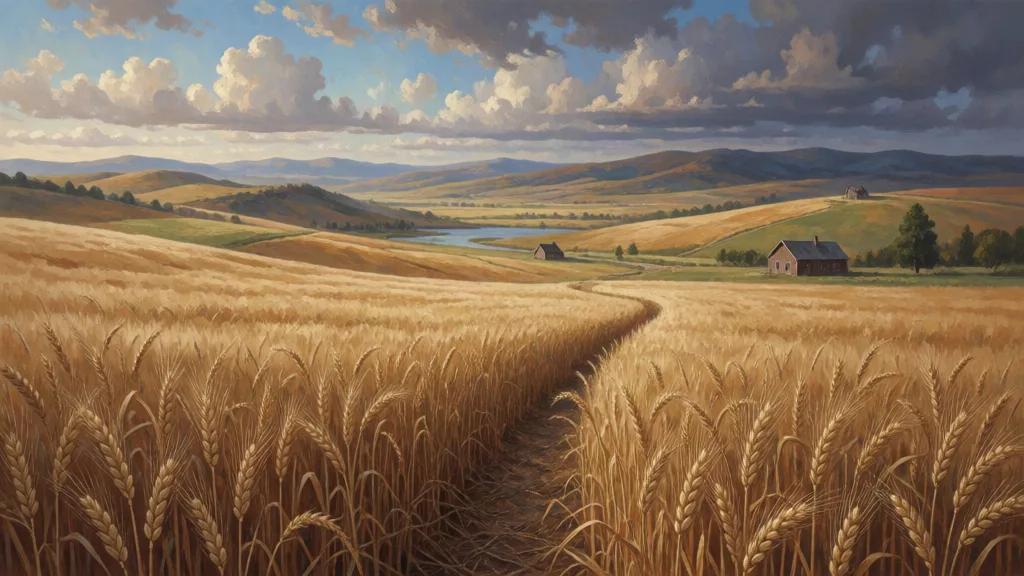
The wheat talked to me before I knew it was wheat.
I was fourteen that summer, barefoot in the field behind the house, and the stalks came up past my waist. My mother hated when I went in without shoes. Rattlesnakes, she'd sign, sharp and fast, her hands like two birds fighting. But the dirt was cool that evening and the sun had gone soft, and I wanted to feel the ground the way I always felt it, through my feet, through the bones.
That's how I found it.
Not with my ears. I haven't heard a sound since I was three years old, since the fever took it. I found it with my heels. A hum. A low, steady pulse coming up through the soil, like someone had buried a heart down there and forgotten to stop it.
I stopped walking.
The wheat kept swaying, but the hum didn't come from the wind. It came from below. I crouched and pressed both palms flat against the dirt, and the pulse climbed my arms, into my chest, into my teeth. My fillings buzzed. I'd never felt anything like it, and I'd felt plenty. I knew the rumble of the tractor from two fields over. I knew the thud of my brother's boots on the porch. This was different. This had a rhythm. A pattern. Like someone tapping a code on the other side of a wall.
I dug with my hands. The soil was soft and dark and smelled like rain even though it hadn't rained in weeks. Six inches down my fingers hit something smooth and warm. Not a rock. Rocks don't hold heat like that, not after sundown. I scraped the dirt away until I could see it: a curve of stone the color of a bruise, purple and gray, no bigger than a dinner plate.
When I touched it, the whole field went quiet.
Not silent. I don't know silence. Quiet the way a room goes quiet when someone walks in who everyone's been waiting for. The wheat stopped swaying. The hum sharpened into something almost like words, if words could be shapes, if shapes could press against your skin and mean something.
I pulled my hand back. The field breathed again. The hum went soft.
I sat there in the dirt for a long time, my heart going hard, and I understood two things at once. One: nobody else could feel this. Two: I was going to come back tomorrow.
---
My father slept in the barn.
Not in the house, not in the spare room, not on the couch where he'd spent the first year after Mom left. The barn. He'd dragged an old mattress out there and set it between the tractor and the wall of rusted tools, and that's where he'd been for eight months, and nobody talked about it. My brother Jesse called it "Dad's office." My mother, when she called on Sundays, called it nothing at all. She'd ask about school and the goats and whether I was eating, and I'd type my answers into the phone and she'd read them and say That's good, honey, and neither of us would mention the man in the barn.
He used to be somebody. That's what people in town said, in the way people say things they want you to overhear. He used to work for the university. He used to study earthquakes. He used to have his name on papers.
Now he had a mattress in a barn and a bottle he thought nobody knew about, tucked behind the seed drill.
I went to him the next morning because I didn't know who else to tell. Jesse would've laughed. My mother was three states away. And the hum had followed me into my sleep, had woven itself into my dreams, and I woke up with my jaw aching from clenching it.
The barn door groaned when I pulled it open. Dust hung in the light like it had been waiting there for years. My father was sitting on the mattress with his back against the wall, a mug of cold coffee in his hand, staring at nothing in particular.
He looked up when he felt me coming. He always felt me coming. That was one thing the fever hadn't taken from us, the way we could read each other through the floor.
"Morning," he said. His voice was gravel. I watched his lips, the shape of the word.
I signed: Something's in the field.
He blinked. Took a drink. "Something's always in the field. Gophers. Rocks. Jesse's lost tools."
Not a gopher, I signed. I found something. It hums.
His hand stopped halfway to his mouth.
I kept going, fast, because I didn't want to lose my nerve. It's warm. It's under the wheat, near the creek line. When I touch it, the whole field changes. It's like the ground is talking. I don't know how else to say it.
He set the mug down. For a second, something moved behind his eyes, something that had been asleep a long time. Then it went away, the way it always did, and he shook his head.
"You've been reading too much," he said. "Or you're bored. It's summer. Go help Jesse with the fence."
I'm not bored, I signed. I'm not lying.
"I didn't say you were lying." He picked the mug back up. "I said you're bored."
I stood there in the dust and the light and watched him decide to be nobody again. That was the thing about my father. He didn't stop being smart. He just stopped using it. Like a man who owned a good horse and let it starve in the yard.
Fine, I signed. I'll dig it up myself.
"Don't," he said, but he said it to his coffee, not to me.
---
I went back that afternoon with a garden trowel and a bucket, and I dug the whole thing out.
It took two hours. The sun was mean by noon and the sweat ran into my eyes and the wheat itched my arms, but I didn't stop. I scraped and lifted and scraped again, and the stone came free inch by inch, and when I finally had it in my hands it was heavier than it looked. Maybe twenty pounds. The color of a storm cloud. Smooth in some places, pitted in others, and warm. Always warm. Like it had a furnace inside.
I carried it to the edge of the field and set it down in the grass and put both hands on it.
The hum came up through my palms and into my elbows and into my spine, and this time it didn't stop at my teeth. It went into my skull. It filled the space behind my eyes. And it wasn't a hum anymore. It was a language. I don't know how else to say it. It was a language made of pressure and pulse and heat, and I understood it the way you understand a hand on your shoulder, the way you understand a look across a room.
The ground is tired, it said. The ground is tired and the water is moving wrong and something is coming that will not be gentle.
I sat back on my heels. My hands were shaking.
The wheat around me had gone still. Every stalk, still. The whole field, waiting.
And down the road, past the creek, past the fence line, I saw dust rising. A truck. Two trucks. Coming slow, the way people come when they don't want you to know they're coming.
I looked at the stone in my hands.
I looked at the barn, where my father was sleeping through the only thing that had ever mattered.
The ground is tired, the stone said again. And I knew, the way you know a storm is coming, that I had maybe a day. Maybe less.
Watch this moment
Turn the current scene into a cinematic Live Chapter — what you watch becomes the story's next part.
Disclaimer
This is a work of fiction, assisted by artificial intelligence. Any names or characters, businesses or places, events or incidents, are fictitious. Any resemblance to actual persons, living or dead, or actual events is purely coincidental.
Content Removal Policy
- Users may report content that may be illegal or violates our Standards.
- All reported complaints will be reviewed and resolved within seven business days.
- Review Process: Our team will assess the reported content against our guidelines.
- Appeals: If you disagree with a decision, you may appeal within 14 days of notification.
- Potential outcomes include: content removal, account warning, or no action if no violation is found.
To report content, email us at [email protected]