Share
Go Live
Dance of the Pulse
·
Published 11/28/2026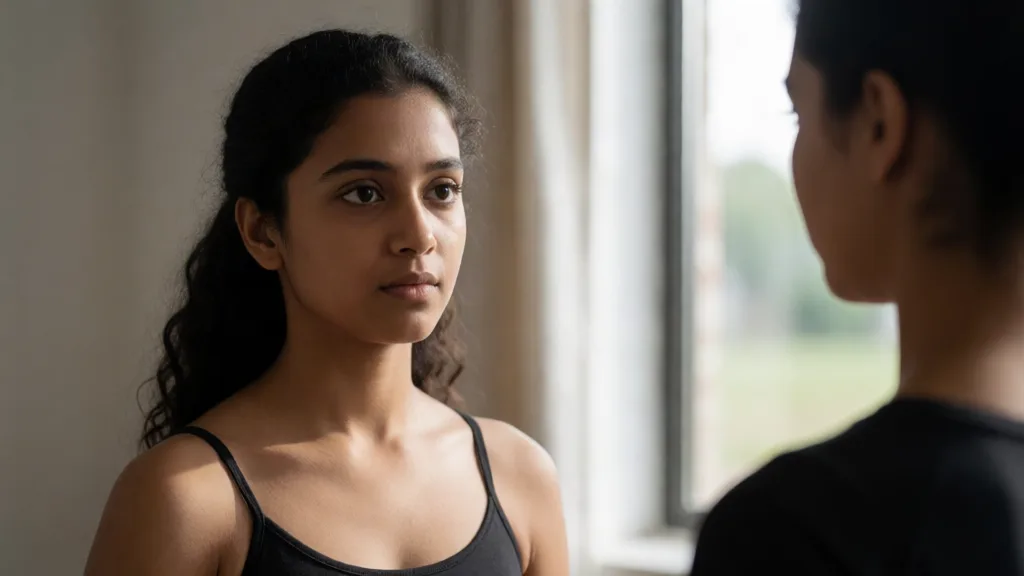
The paper on the examination table has a coffee ring on it, and I can't stop staring at it. A perfect brown circle, like a monocle for a very small man. The nurse left me here eleven minutes ago. I know because I counted the seconds between the hum of the fluorescent light and the thud of my own heart, and eleven minutes is six hundred and sixty seconds, which is a number I can hold in my head because I've been holding numbers in my head all week. Numbers and turns and the exact angle of my left ankle when I land a double pirouette. That's what I do. I hold things so I don't have to feel them.
The room smells like rubbing alcohol and something older underneath, something like wet paper. I'm sitting on the edge of the table with my feet dangling because my feet always dangle. Five foot one on a good day, and today is not a good day. My mother's voice is in my head, saying, *You'll be fine, kanna, you're just like your grandmother, strong bones, strong heart.* But my grandmother never had to lie on a table with her chest exposed under a paper gown while a stranger listened to her breathe.
I brought the letter with me. The one from the Shriram Bharatiya Kala Kendra. It's folded in the pocket of my jeans, which are folded on the chair across the room, which means I can't reach it now. The letter says I've been provisionally accepted into the dance program. Provisionally. That word sits in my stomach like a swallowed stone. All I have to do is pass the physical examination. A formality, the letter calls it. A standard medical clearance for all incoming students.
But nothing about this feels standard.
The door opens. A woman in blue scrubs walks in, not the nurse from before. This one is older, maybe fifty, with gray hair pulled back so tight it stretches the skin at her temples. She doesn't look at me. She looks at the clipboard in her hand, flipping pages, and I notice her nails are bitten down to the quick.
"Anjali Menon?" she says.
"Yes." My voice comes out smaller than I want it to.
She finally looks up. Her eyes are pale, almost colorless, and they move over me the way you'd read a label on a jar you're not sure you want to open. "I'm Dr. Fernandes. I'll be conducting your examination today."
Conducting. Like an orchestra. Like a train.
"Okay," I say.
She sets the clipboard on the counter and washes her hands at the small sink in the corner. The water runs for a long time. Too long. I watch her reflection in the mirror above the sink. She's watching me back.
"Your file says you're a dancer," she says, drying her hands with a paper towel.
"I want to be."
"Want to be." She turns around, and there's something in her voice I can't name. Not unkind. Not kind either. "You've been dancing how long?"
"Since I was four. Bharatanatyam first. Then I added contemporary when I was twelve."
She nods, but it's the kind of nod that means she's already moved past what I said. She picks up the clipboard again and makes a note. I try to see what she's writing, but the angle is wrong.
"Any history of fainting? Dizziness? Shortness of breath during exertion?"
"No."
"Any medications?"
"No."
"Any family history of heart conditions?"
I hesitate. My mother's brother, my uncle Ravi, died at forty-two. A heart attack, they said. But he also smoked two packs a day and ate fried food like it was a religion. My mother says it doesn't count. She says the heart condition skipped the women in our family, and I'm a woman now, aren't I? Eighteen last month.
"No," I say.
Dr. Fernandes looks at me for a long moment. Then she sets the clipboard down and walks to the examination table. She's close enough now that I can smell her soap, something floral and cheap, the kind you buy at a government store. She reaches for the blood pressure cuff hanging on the wall.
"Lie back," she says.
I lie back. The paper crinkles under me, and I feel the cold of the table through the thin cotton gown. She wraps the cuff around my arm, and it tightens until I can feel my pulse in my fingertips. The machine beeps. She writes.
"One twenty over eighty. Good."
Good. I exhale.
She moves to the next part without pause. The stethoscope is cold on my chest, and I flinch. She tells me to breathe in, breathe out. I do. She moves the stethoscope to my back. Breathe in. Breathe out. The fluorescent light hums. I count the seconds.
"Your heart sounds fine," she says, but she doesn't take the stethoscope off. She keeps it pressed to my back, just below my left shoulder blade, and I feel her listening to something I can't hear. A long breath. Then another.
"Is something wrong?" I ask.
She doesn't answer. She moves the stethoscope again, lower this time, and I feel a small cold circle travel down my spine like a drop of water. She's listening to my kidneys now. Or my arteries. I don't know what she's listening for.
"Dr. Fernandes?"
She straightens up. Her face is blank, but her jaw is tight. "Just routine," she says. "Sometimes I hear things that aren't there. It's an old woman's ears."
She's lying. I know she's lying because her hands are shaking. Just a little. Just enough that the earpieces of the stethoscope click together when she pulls them out.
"I need to take some blood," she says. "Just a small amount."
"Okay."
She walks to the cabinet and opens it. The vials inside clink, glass against glass. She takes one, then another, then a third. Three vials. That's not a small amount. That's not routine.
"What are the blood tests for?" I ask.
"Standard panel. Iron levels. Vitamin D. Thyroid."
She's lying again. Her voice has gone flat, the way my mother's does when she's telling my father she's fine, she's just tired, she doesn't need to see a doctor about the lump in her breast that she found three weeks ago and hasn't mentioned to anyone but me.
I sit up. The paper gown crinkles. "I think I should call my mother."
Dr. Fernandes turns around. The vial in her hand catches the light, and for a second it looks like it's full of something dark, something that isn't blood. But then she shifts, and it's just glass, just empty glass waiting to be filled.
"That won't be necessary," she says. "We're almost done."
She walks toward me with the needle. I hate needles. I've always hated needles. When I was seven, I kicked a nurse in the shin during a vaccination, and my mother made me apologize and then bought me a mango lassi and told me that fear is just a thought you can choose to put down. I've been trying to put it down for eleven years. It hasn't worked yet.
"I'd like my mother," I say. "Please."
Dr. Fernandes stops. The needle hovers between us. Her pale eyes meet mine, and for a moment, just a moment, I see something in them. Not impatience. Not frustration. Fear. She's afraid of something, and I don't know what, and that scares me more than the needle.
"Your mother can't help you," she says quietly. "No one can help you if the results come back the way I think they will."
The room goes very still. The fluorescent light hums. My heart beats. One. Two. Three.
"What do you mean?"
She sets the needle down on the tray. It makes a small metal sound, like a spoon against a cup. "I mean," she says, "that I need to ask you some questions about your family. Not the ones on the form. The real ones."
I pull the paper gown tighter around myself. My hands are cold. My whole body is cold. "What kind of questions?"
"The kind," she says, "that don't have easy answers."
She sits down on the stool in the corner, and she looks at me like I'm a puzzle she's already solved, like she knows what's inside me better than I do. And I realize, with a lurch in my stomach that feels like missing a step in the dark, that I don't know what's inside me. I never have. I've spent eighteen years learning to move my body in perfect lines, and I've never once stopped to ask what's moving underneath.
"Start with your grandmother," Dr. Fernandes says. "Start with the one who had strong bones."
But my grandmother died when I was six. I barely remember her. Just her hands, soft and wrinkled, and the way she sang to me in a language I've almost forgotten.
"I don't know what you want me to say," I whisper.
"I want you to tell me the truth," she says. "Before it's too late."
Watch this moment
Turn the current scene into a cinematic Live Chapter — what you watch becomes the story's next part.
Disclaimer
This is a work of fiction, assisted by artificial intelligence. Any names or characters, businesses or places, events or incidents, are fictitious. Any resemblance to actual persons, living or dead, or actual events is purely coincidental.
Content Removal Policy
- Users may report content that may be illegal or violates our Standards.
- All reported complaints will be reviewed and resolved within seven business days.
- Review Process: Our team will assess the reported content against our guidelines.
- Appeals: If you disagree with a decision, you may appeal within 14 days of notification.
- Potential outcomes include: content removal, account warning, or no action if no violation is found.
To report content, email us at [email protected]