Share
Go Live
Neon Strings
·
Published 10/5/2026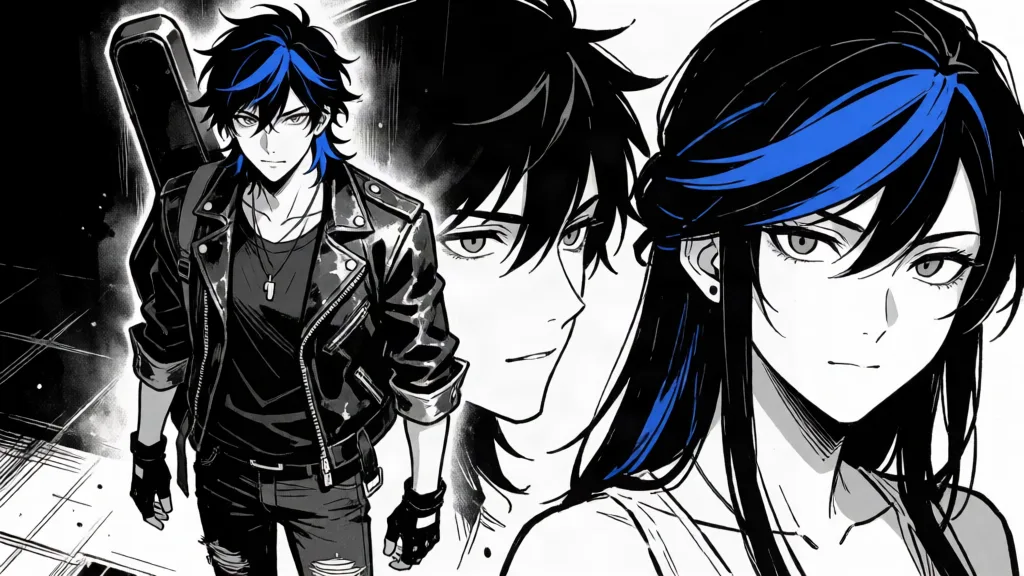
The rain hit the corrugated roof of the market like a drum solo played by someone who hated music.
I was wedged between a stall selling counterfeit neural implants and one hawking something that smelled like fermented fish, my guitar case open at my feet, and I'd made exactly forty-two credits in three hours. Forty-two. That's two bowls of synth-noodles and a recharge for my deck. Not enough to pay off Vikram, who owned the building where I slept, and definitely not enough to keep the kind of low profile I needed in the Lower Sprawl.
My fingers moved over the strings without me thinking about it. Some old blues progression, something my mother used to hum while she worked the fabricators. The notes fell into the wet air and got swallowed by the noise of the market: vendors shouting, kids running, the sizzle of oil in a hundred different pans.
Nobody was listening. That was fine. I wasn't playing for them.
I was playing for the woman at the end of the row.
She'd been there for maybe twenty minutes, standing under the awning of a tea shop, a sketchbook pressed against her chest like a shield. Dark wavy hair pulled back in a bun that had given up hours ago. Oversized grey sweater slipping off one shoulder. She was watching me, not the way people usually watched street performers, with that mix of pity and mild curiosity, but like she was trying to figure something out. Like I was a puzzle she'd seen before and couldn't quite place.
I switched to something slower. Something with more space between the notes.
Her head tilted. Just a fraction. But I caught it.
The rain picked up. People scattered, ducking under awnings and into shops. The market's rhythm stuttered and shifted. I kept playing, water dripping off the edge of the roof onto my shoulder, soaking through the leather. The cold bit at my fingers but I didn't stop. I wanted her to keep looking at me. I wanted to see what she'd do if I didn't break eye contact.
She didn't look away either.
That was the first thing I noticed about Priya. She didn't flinch.
She crossed the wet stones between us, stepping around puddles like they were personal insults, and stopped in front of my case. Up close, her eyes were more gold than brown, flecks of something brighter catching the neon glow from the noodle stall across the way. A small silver ring pierced one nostril. Her left wrist was covered in woven bracelets, red and blue and yellow, the kind you make at summer camp or buy from kids on the street.
"You're good," she said.
"Thanks."
"I'm not complimenting you. I'm stating a fact." She crouched down, balancing on the balls of her feet, and studied my case. The forty-two credits. The cracked leather. The sticker on the side that said THIS MACHINE KILLS FASCISTS. "You're also starving."
"Not yet. Give me another day."
She laughed. It was a short sound, more breath than voice, but it was real. "I'm Priya."
"Ashu."
"I know. I've seen you around." She stood up, brushing rain off her knees. "You play at the transit hub on Tuesdays. And outside the noodle place on Fifth on weekends. You're consistent."
"You've been tracking me?"
"Don't flatter yourself. I notice things. It's a professional hazard."
I set the guitar down, leaning it against the stall behind me. The vendor gave me a dirty look but didn't say anything. He knew I'd move if he asked. I always did. "What's your profession?"
"Graphic design. Freelance. Mostly corporate stuff, logos, branding, the kind of work that makes me want to claw my own eyes out." She said it cheerfully, like it was a joke, but I heard the edge underneath. "And you? Besides the music?"
"Odd jobs."
"Odd jobs." She repeated it like she was tasting the words. "That's vague."
"I'm a vague kind of guy."
"No, you're not." She met my eyes again, and this time there was something sharper in her gaze. Assessment. Calculation. "You're careful. There's a difference."
The rain had slowed to a mist. The market was coming back to life around us, vendors emerging from their shelters, customers shaking off umbrellas. The smell of fish was winning the war against the smell of noodles. I should have packed up and moved on. I had a meeting with Vikram in two hours and I needed to figure out how to convince him to give me another week.
But I didn't move.
"Buy me a drink," I said.
Priya raised an eyebrow. "Why would I do that?"
"Because you're curious. And because I know a place that doesn't water down their soju."
She considered this. The rain dripped from the edge of the awning behind her, catching the light. "One drink. And you're paying."
"I have forty-two credits."
"Then you better hope they take IOUs."
They didn't take IOUs. But Priya bought the first round anyway, sliding a crumpled bill across the counter before I could argue. The bar was called The Rusted Antenna, a hole in the wall three levels down from the market, tucked between a pawn shop and a place that sold nothing but outdated circuit boards. The kind of place where nobody asked questions and the music was always too loud.
We found a booth in the back. The vinyl was cracked and patched with duct tape. The table had initials carved into it, some of them fresh, some of them old enough to have been there before the Sprawl was even called the Sprawl.
Priya sat across from me, her back to the wall, her eyes on the door. I noticed that. I noticed a lot of things about her, the way she held her glass with both hands, the way she kept her sketchbook on the table between us like a barrier, the way her shoulders were just a little too tense for someone who was supposed to be relaxing.
"You don't trust me," I said.
"I don't trust anyone."
"Smart."
"Usually." She took a sip of her soju. "But here I am, in a bar I've never been to, with a guy I've never talked to, because he played a song that reminded me of something."
"What something?"
She shook her head. "Doesn't matter."
We sat in silence for a minute. Not the awkward kind. The kind where both people are deciding how much to say. I finished my drink and signaled the bartender for another. Priya was still nursing hers, taking tiny sips like she was rationing it.
"You're a hacker," she said.
I almost choked on my soju. "What?"
"You heard me."
"I'm a musician."
"You're a musician who makes forty-two credits in three hours and doesn't seem worried about it. You're a musician who wears fingerless gloves in the rain. You're a musician who noticed every exit in this bar within ten seconds of walking in." She ticked the points off on her fingers. "Either you're a hacker or you're paranoid. And you don't seem paranoid."
I stared at her. She stared back.
"How'd you figure it out?"
"The gloves. You type, don't you? A lot. The calluses on your fingertips aren't just from guitar strings." She shrugged. "I told you. I notice things."
The bartender brought my drink. I wrapped my hands around the glass, letting the cold seep into my palms. The bar's neon sign flickered, casting red and blue shadows across Priya's face. She looked like she belonged in a painting. One of those old ones, the kind with too much darkness and one bright spot of color.
"You're not going to turn me in?"
"To who? The corp cops?" She laughed, that same short breath of a sound. "I'm a freelance designer in the Lower Sprawl. Half my clients are people who don't legally exist. I don't care what you do with your deck."
"Then why bring it up?"
"Because I want to know what you're capable of."
The words hung in the air between us. I took a long drink. She watched my throat move. I watched her watch me.
"I'm capable of a lot of things," I said.
"I bet you are."
We left the bar at midnight. The rain had stopped, leaving the streets slick and shining, reflecting the neon signs above like a second city built upside down. Priya walked beside me, her hands shoved in the pockets of her jeans, her sketchbook tucked under her arm. She was shorter than I'd realized. The top of her head barely reached my shoulder.
"Where are you going?" she asked.
"Home. Or what passes for it."
"Where's that?"
"Above a laundromat on Seventh. The machines run all night. It's like white noise."
She nodded like that made perfect sense. We walked in silence for a few blocks, past the closed stalls and the shuttered shops, past the people sleeping in doorways and the kids still running deliveries on hoverboards. The Lower Sprawl never really slept. It just shifted from one kind of awake to another.
"I'm not ready to go home," she said.
"Okay."
"I mean, I don't want to be alone tonight."
I stopped walking. She stopped too, a half-step ahead of me, her back still turned. The neon from a nearby sign, something advertising synthetic hair, painted her silhouette in shades of green and gold.
"Why me?" I asked.
She turned around. Her eyes were tired, the kind of tired that had nothing to do with sleep. "Because you played that song. And because you didn't ask me for anything. And because..." She trailed off, shaking her head. "I don't know. Because I want to."
"That's not an answer."
"It's the only one I have."
I thought about Vikram. About the forty-two credits. About the fact that I had a meeting in two hours that I was definitely going to miss. About the way Priya's hands were shaking, just slightly, like she was cold or scared or both.
"Okay," I said.
She lived in a studio apartment on the twelfth floor of a building that had seen better decades. The elevator didn't work. We climbed the stairs in the dark, her ahead of me, her sneakers squeaking on the concrete. By the time we reached her door, both of us were breathing hard.
The apartment was small but clean. A futon against one wall. A desk covered in papers and tablet styluses. A kitchenette with a hot plate and a kettle. The window looked out over the Sprawl, a wall of lights and shadows stretching to the horizon. She didn't turn on the overhead light, just a lamp on the desk, casting everything in a warm yellow glow.
"Sorry it's a mess," she said, kicking off her shoes.
"It's not."
"It is. I've been working on a deadline. I haven't done dishes in three days."
I looked at the sink. There were exactly two mugs and one bowl. "You should see my place."
She smiled. It was the first real smile I'd seen from her, not the sharp, assessing look she'd given me at the market, not the tight, controlled expression she'd worn at the bar. This one reached her eyes. "You want tea?"
"Sure."
She filled the kettle and set it on the hot plate. I stood by the window, looking out at the city. From up here, you couldn't see the grime. You couldn't see the people sleeping in doorways or the kids running deliveries. It all just looked like light.
"Beautiful, isn't it?" she said, coming to stand beside me.
"Depends on how you look at it."
"How do you look at it?"
I turned to face her. She was close, closer than I'd expected, her shoulder almost touching mine. The lamp behind her turned her hair into a halo of dark waves. The silver ring in her nose caught the light.
"I look at it and see everything that's wrong," I said. "The corps. The cops. The way the rich live up in the Spire and the rest of us fight over scraps. I see a system that's designed to keep us down and a bunch of people who are too tired to fight back."
"That's bleak."
"That's honest."
She studied me for a long moment. Then she reached up and touched my face, her fingers cool against my cheek. "You're not as cynical as you pretend to be."
"Neither are you."
The kettle whistled. She turned away to pour the water, and I felt the absence of her touch like a physical thing. She handed me a mug. The tea was cheap, some kind of herbal blend that tasted like grass, but it was warm and it gave my hands something to do.
"Why did you bring me here?" I asked.
"I told you. I didn't want to be alone."
"That's not the whole reason."
She sat down on the futon, tucking her legs under her. "You're right. It's not." She took a sip of her tea. "I've been in the Sprawl for six years. I came here for school, thought I'd get a degree, get a job, get out. But the degree took longer than I expected and the jobs never paid enough and now I'm twenty-six and I'm still here, still freelancing, still living in a studio apartment with a broken elevator."
"That's not so bad."
"It's not. But it's not what I wanted either." She looked up at me. "And then tonight I saw you playing in the rain, and you looked so... free. Like you didn't care about any of it. Like you'd already figured out something I hadn't."
"I haven't figured out anything."
"Maybe not. But you're not pretending either." She set her mug on the floor. "That's more than most people."
I sat down next to her. Not too close. Close enough. The futon creaked under my weight. She didn't move away.
"I'm not free," I said. "I owe money to a guy named Vikram. I live above a laundromat because it's the only place I can afford. I play music in the market because it's the only thing I'm good at that doesn't require a license or a permit or a bribe."
"You're good at other things."
"How do you know?"
She smiled again. That real smile. "I told you. I notice things."
The lamp flickered. Outside, a siren wailed in the distance, fading as it moved away. The Sprawl was always moving, always humming, always alive. But in this room, with the yellow light and the cheap tea and the woman sitting beside me, it felt like the world had paused.
"I don't do this," she said.
"Do what?"
"This. Invite strangers into my apartment. Tell them things I don't tell anyone." She pulled her knees up to her chest, wrapping her arms around them. "I'm usually more careful."
"Me too."
"So why aren't we being careful?"
I didn't have an answer. Or maybe I did, but it wasn't the kind of thing you said out loud. Not yet. Not when the night was still young and the tea was still warm and the woman beside me was looking at me like I was something worth figuring out.
"I don't know," I said.
"That's not an answer."
"It's the only one I have."
She laughed. The same short breath of a sound, but softer now. Warmer. She leaned her head back against the wall and closed her eyes. The curve of her throat was a line of gold in the lamplight. I wanted to touch it. I didn't.
"I'm tired," she said.
"You should sleep."
"I should." She opened her eyes and looked at me. "Stay."
"Ashu."
"Stay."
I stayed.
She gave me a blanket and a pillow and told me I could take the futon while she slept on the floor. I told her that was stupid. She told me I was a guest. I told her guests didn't kick their hosts out of bed. She told me to shut up and take the futon.
We compromised. Both of us on the futon, a careful distance between us, the blanket pulled up to our chins like a wall. The lamp was off. The only light came from the window, the endless glow of the Sprawl, casting long shadows across the ceiling.
"Tell me something true," she said.
"Like what?"
"Anything. Something you've never told anyone."
I thought about it. The ceiling was cracked, a long jagged line running from one corner to the other, like a river on a map. I traced it with my eyes.
"I used to have a sister," I said.
"Used to?"
"She died. When I was twelve. Fever. We couldn't afford the meds."
The silence stretched. I could hear her breathing, slow and steady. I could feel the warmth of her body through the blanket, close but not touching.
"I'm sorry," she said.
"It was a long time ago."
"That doesn't make it better."
"No. It doesn't."
She reached out and found my hand under the blanket. Her fingers were cold. I laced mine through them anyway.
"Tell me something else," she said.
"Like what?"
"Something you want."
I turned my head. She was looking at me, her eyes dark in the dim light. The silver ring in her nose glinted. Her hair had come completely loose from its bun, spilling across the pillow like ink.
"I want to kiss you," I said.
She didn't answer. She just moved closer, the blanket rustling between us, until her face was inches from mine. Her breath was warm on my lips. She smelled like tea and rain and something else, something sweet, like vanilla or honey.
"Then do it," she said.
I kissed her.
It started soft. Tentative. The kind of kiss you give someone when you're not sure if you're allowed. Her lips were warm and dry and they parted under mine like they'd been waiting. I felt her hand tighten around mine. I felt her breath catch. I felt the world narrow to the space between us.
And then it wasn't soft anymore.
She pulled me closer, her free hand finding the back of my neck, her fingers tangling in my hair. I rolled onto my side, the blanket falling away, and she came with me, her body pressing against mine, her legs tangling with mine. The kiss deepened, turned hungry, turned desperate. Like we'd both been starving and hadn't known it until now.
She tasted like soju and tea and something underneath that was just her. I wanted more of it. I wanted all of it. I slid my hand up her back, under her sweater, feeling the warmth of her skin, the curve of her spine. She made a sound, low in her throat, and it went through me like electricity.
"Ashu," she breathed.
"I'm here."
"Don't stop."
I didn't.
The sweater came off. Then my jacket. Then her jeans, peeled down her legs while she watched me with those gold-flecked eyes, her chest rising and falling, her lips parted. The neon light from the window painted her in shades of green and gold, her skin glowing, her hair spread across the pillow like a dark river.
"You're beautiful," I said.
"So are you."
"I'm a mess."
"So am I."
She pulled me down and kissed me again, and I stopped thinking about anything else. Her hands were on my chest, my shoulders, my back, learning the shape of me. My hands were on her hips, her waist, her breasts, learning the shape of her. The world outside the window kept spinning, the Sprawl kept humming, but in this room, in this bed, time had stopped.
She arched beneath me, her head thrown back, her throat exposed. I kissed it. I kissed the hollow where her pulse beat, the curve of her collarbone, the soft skin below her ear. She gasped and her nails dug into my shoulders.
"More," she said.
I gave her more.
Her body was a map and I was learning it by touch. The dip of her waist. The swell of her hips. The soft inside of her thigh. She was warm and wet and ready, and when I slid my fingers inside her, she moaned, a sound that was half pleasure and half relief.
"Please," she said.
"Please what?"
"Don't make me beg."
"I want to hear you beg."
She laughed, breathless, and pulled my face up to hers. "You're a bastard."
"You like it."
"I do." She kissed me hard. "Now stop teasing and fuck me."
I did.
The first thrust was slow. Careful. I wanted to feel every inch of her, wanted to memorize the way she tightened around me, the way her breath hitched, the way her eyes fluttered closed. She wrapped her legs around my waist and pulled me deeper.
"Harder," she said.
I gave her harder.
The futon creaked beneath us. The window rattled. The city outside kept moving, indifferent to the two people tangled together in a studio apartment on the twelfth floor. I buried my face in her neck and breathed her in. Tea and rain and vanilla. Her hands were in my hair, on my back, pulling me closer, closer, closer.
"Don't stop," she said again. "Don't stop, don't stop, don't stop."
I didn't.
She came first. I felt it in the way her body clenched around me, the way her nails raked down my back, the way she cried out, a sound that was almost a sob. I followed a moment later, burying myself in her, my release shuddering through me like a wave.
Afterward, we lay tangled together, sweaty and breathless, the blanket somewhere on the floor. She traced patterns on my chest with her fingers. I played with her hair.
"That was..." she started.
"Yeah."
"I don't usually..."
"Me neither."
She propped herself up on one elbow and looked at me. Her face was flushed, her lips swollen, her eyes bright. "What happens now?"
"I don't know."
"Are you going to disappear?"
"No."
"Are you going to stay?"
I thought about Vikram. About the forty-two credits. About the meeting I'd missed and the life I'd left behind. None of it seemed real. Not here. Not now.
"I don't know," I said again.
She nodded. She didn't look disappointed. She looked like she understood. "Okay."
"Okay?"
"Okay." She lay back down, her head on my chest. "We'll figure it out in the morning."
The morning came too fast. The light through the window was grey and flat, the Sprawl waking up to another day of noise and struggle. Priya was still asleep, her face peaceful, her hair a mess, her arm thrown across my chest. I watched her for a long time. I memorized the way her eyelashes rested against her cheeks. The way her breath caught every few seconds, like she was dreaming about something.
I should have left. That's what I do. I don't stay. I don't get attached. I don't let people in.
But I didn't leave.
She woke up slowly, blinking against the light. When she saw me, she smiled. That real smile. The one that reached her eyes.
"You're still here," she said.
"I'm still here."
"Good."
She kissed me, morning breath and all, and I kissed her back. The world outside was still broken. The Sprawl was still cruel. Vikram was still waiting. But for a few more minutes, none of that mattered.
"I have to go," I said.
"I know."
"I'll come back."
"Will you?"
"Yes."
She studied my face. Looking for the lie. I didn't blame her. I would have looked too.
"Okay," she said. "I'll be here."
I got dressed. She watched me from the bed, the sheet pulled up to her chin. I wanted to stay. I wanted to crawl back under the covers and forget about everything else. But I couldn't. Not yet.
"Priya."
"Yeah?"
"Thank you."
"For what?"
"For last night. For this morning. For not asking me to be something I'm not."
She smiled. "You're welcome."
I left.
The stairs were still dark. The elevator was still broken. The market was already busy when I got there, vendors shouting, customers haggling, the smell of fish and noodles and oil filling the air. I walked past my usual spot and kept going. I had a meeting with Vikram. I was late. He was going to be pissed.
But I couldn't stop thinking about her. The way she tasted. The way she felt. The way she looked at me like I was something worth seeing.
I didn't know what was going to happen next. I didn't know if I'd see her again. I didn't know if I wanted to.
But I knew one thing.
I wasn't going to disappear.
Not this time.
Watch this moment
Turn the current scene into a cinematic Live Chapter — what you watch becomes the story's next part.
Disclaimer
This is a work of fiction, assisted by artificial intelligence. Any names or characters, businesses or places, events or incidents, are fictitious. Any resemblance to actual persons, living or dead, or actual events is purely coincidental.
Content Removal Policy
- Users may report content that may be illegal or violates our Standards.
- All reported complaints will be reviewed and resolved within seven business days.
- Review Process: Our team will assess the reported content against our guidelines.
- Appeals: If you disagree with a decision, you may appeal within 14 days of notification.
- Potential outcomes include: content removal, account warning, or no action if no violation is found.
To report content, email us at [email protected]