Share
Go Live
Neon Glass Double
·
Published 9/29/2026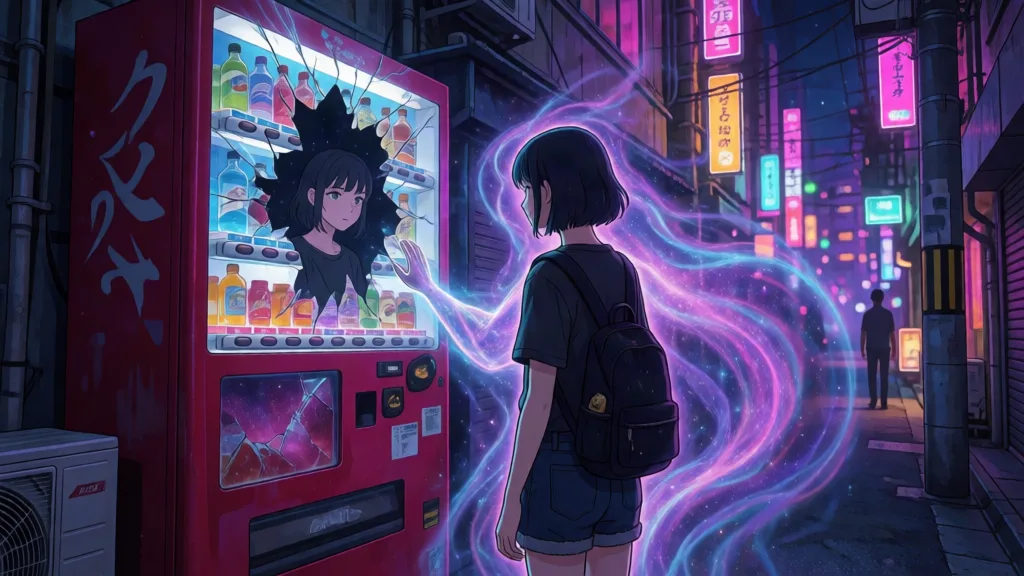
The vending machine on the corner of Shibuya's deadest alley hadn't worked in three years, but the neon sign above it still flickered red and white, red and white, painting the wet asphalt in alternating strokes like a heartbeat monitor for a corpse. I knew this because I passed it every night on my way home from the pachinko parlor, and every night I stopped to look at myself in the cracked glass of the display panel. Not out of vanity. Out of habit. The kind of habit that starts as a joke and ends as a ritual you can't explain to anyone without sounding insane.
Tonight the rain came down in sheets, the kind that turned Tokyo's backstreets into rivers of light and oil, and I stood there with my hood up, watching my reflection watch me back.
That was the first time I noticed it wasn't mimicking me.
I raised my hand to push wet hair off my forehead. The boy in the glass, skinny, seventeen, with a bruise fading yellow on his jaw and eyes that hadn't slept right in weeks, kept his hands at his sides. He tilted his head. I hadn't tilted mine.
My breath caught somewhere between my chest and my throat.
"Okay," I said out loud, because talking to yourself in an alley is only crazy if you don't acknowledge it. "Okay. You're a trick of the light."
The reflection smiled. I wasn't smiling.
I stepped back. It stepped forward, pressing its face closer to the glass, and the neon flickered red and white, red and white, and in that stuttering light I saw something in its eyes that made my stomach drop. Recognition. Not the kind you get from seeing a stranger. The kind you get from seeing someone you've known your whole life and just now remembered.
"You finally see me," it said.
Its voice didn't come through the air. It came through the glass, through my teeth, through the bones of my skull, like someone had pressed a tuning fork against my spine.
I ran.
---
Three blocks later I stopped, bent over, hands on my knees, rain dripping off my nose. My chest heaved. The alley behind me was empty. Just neon and wet concrete and the distant hum of traffic on Meiji-dori. I told myself I'd imagined it. I told myself a lot of things.
The apartment I shared with my mother was on the fourth floor of a building that had been scheduled for demolition six years ago and somehow kept standing out of spite. The elevator hadn't worked since I was twelve. I took the stairs two at a time, keys already in my hand, and let myself in as quietly as I could. The TV was on in the main room, some late-night variety show, the volume turned down to a murmur. My mother was asleep on the couch, her cigarette burned down to the filter in the ashtray, her face slack and older than I remembered it being.
I covered her with the blanket from the back of the chair and turned off the TV.
In my room, I locked the door. Then I checked the window. Then I checked it again.
The mirror above my dresser was small, cheap, bought from a hundred-yen store when I was ten. I stood in front of it with my heart still pounding and waited for something to happen. My reflection stared back. Normal. Boring. Just me.
I laughed, a short, ugly sound. "You're losing it, Ren," I told myself. "Three years of this neighborhood and it's finally eating your brain."
I stripped off my wet clothes, dried my hair with a towel that smelled like mildew, and lay down on my futon. The ceiling had a water stain shaped like a hand. I'd stared at it so many nights I could draw it from memory.
Sleep didn't come. It never did, not really. Just a long gray drift where I replayed the day's mistakes on a loop. The pachinko parlor. The boss, Mr. Kondo, counting out my wages in bills that smelled like smoke. The way he'd looked at me when I asked for more hours. The way I'd looked away.
I must have drifted off eventually, because the next thing I knew, the room was dark and the rain had stopped and someone was whispering my name.
Not someone. Something.
I sat up. The whisper came from the mirror.
I didn't turn on the light. I didn't need to. The mirror was glowing, just slightly, a faint blue-white shimmer like moonlight on water. And in it, my reflection was sitting up too. But it was sitting up on the other side.
"Ren," it said again. "I've been waiting."
---
I don't know how long I stood there. Long enough for my feet to go numb on the cold floor. Long enough for the blue glow to stop being strange and start being familiar, the way a nightmare becomes familiar when you've had it enough times.
"What are you?" I asked.
The reflection tilted its head. It was my face, my eyes, my scar above the left eyebrow from when I fell off my bike at eight. But the expression was wrong. Too calm. Too patient. Like a cat watching a bird it had already caught.
"I'm you," it said. "The part you left behind."
"That doesn't make sense."
"Most true things don't."
I stepped closer, then stopped. The glass was cold when I touched it. Cold and solid and ordinary. But the reflection's hand rose to meet mine, and when our palms aligned, I felt something pass between us. A jolt. Like static electricity, but slower. Warmer.
"You've been watching me," I said.
"Since you were six. The first time you looked in a mirror and didn't recognize yourself. Do you remember?"
I did. A hotel bathroom in Osaka, on a trip my father took us on before he left. I'd looked at my face and felt nothing. Like looking at a photograph of someone else's kid.
"You were there?"
"I was born there. The moment you decided you didn't want to be you anymore. I've been growing ever since."
The rain started again, a soft patter against the window. I could hear my mother coughing in the other room. Normal sounds. The sounds of my life. And here I was, talking to a ghost in the glass.
"What do you want?" I asked.
The reflection smiled. It was my smile, but it didn't reach the eyes.
"I want to help you," it said. "I've seen what you do. Every night. The pachinko parlor. The way Kondo talks to you. The way you come home and stare at that water stain and think about how easy it would be to just stop."
My throat tightened. "You don't know what I think."
"I know everything. I've been in there with you. Every time you looked in a mirror and hated what you saw. Every time you practiced a smile in the bathroom before school because you'd forgotten how to do it naturally. Every time you thought about your father and felt nothing and then felt guilty for feeling nothing."
I wanted to hit the glass. I wanted to break it. Instead I stood there, frozen, because everything it said was true.
"What do you want?" I asked again.
"A trade," it said. "One night. You come here, to my side. I go there, to yours. Just for one night."
"Why?"
"Because I've never tasted rain. I've never felt wind on my face. I've never eaten anything or touched anyone or smelled anything except the inside of this glass. One night, Ren. That's all I'm asking."
"And what do I get?"
The reflection leaned closer. Its breath fogged the glass from the inside.
"You get to see what your life looks like from the outside," it said. "You get to know if it's worth coming back to."
---
I didn't say yes. I didn't say no. I said I needed to think about it, which is what people say when they're too scared to admit they've already decided.
The next day at school was a blur. I sat in the back of the classroom and watched the teacher write equations on the board and thought about the reflection's offer. It was insane. Obviously insane. Reflections don't talk. Reflections don't make deals. I was probably having a breakdown, the kind that runs in families, the kind my mother had after my father left and never quite came back from.
But I couldn't stop thinking about what it said. One night. One night to see my life from the outside. One night to know if it was worth coming back to.
After school, I went to the pachinko parlor. Mr. Kondo was in his usual spot behind the counter, a small man with thin hair and thick glasses and a smile that never touched his eyes. He counted out my wages and slid them across the counter without looking up.
"Same time tomorrow," he said.
I took the money. I always took the money.
"Kondo-san," I said. "Can I ask you something?"
He looked up. His glasses caught the light from the pachinko machines, two small screens reflecting nothing.
"What?"
"Do you ever wonder what your life looks like from the outside?"
He stared at me for a long moment. Then he laughed, a dry, hacking sound, and waved me off.
"Go home, Ren," he said. "You're too young to be that crazy."
---
That night I stood in front of the mirror again. The blue glow was waiting for me, patient as always. My reflection was there, sitting cross-legged on the other side of the glass, and when it saw me it smiled that wrong smile.
"Decided?" it asked.
I thought about my mother asleep on the couch. I thought about the water stain on the ceiling. I thought about the way Kondo counted out my wages like he was doing me a favor. I thought about the boy in the glass who'd been watching me for eleven years, waiting for me to notice.
"Yes," I said. "One night."
The reflection stood up. It pressed its palm against the glass, and this time when I pressed mine against it, the glass didn't feel cold. It felt warm. Alive.
"Close your eyes," it said.
I closed them.
"Count to three."
I counted.
"Open."
I opened my eyes.
---
I was standing in the alley. The vending machine was in front of me, its neon sign flickering red and white, red and white. The rain had stopped. The air smelled like wet asphalt and old grease and something else, something I couldn't name. I looked down at my hands. They were mine. I looked up at the vending machine. My reflection was there, but it wasn't my reflection anymore.
It was me. Standing on the other side of the glass, in the alley, looking at the vending machine with wide eyes. It raised a hand. I raised mine. It smiled. I didn't.
"One night," it said, and its voice came through the glass, through my teeth, through my bones. "I'll be back at dawn."
Then it turned and walked away, down the alley, toward the street. I watched it go. My body. My face. My life. Walking away from me.
I pressed my hands against the glass. It was solid. Cold. I was inside the vending machine now, looking out at the world through a cracked display panel. The neon flickered red and white, red and white, and I realized with a start that I couldn't feel the rain anymore. I couldn't feel anything. Just the glass, and the cold, and the distant hum of traffic on Meiji-dori.
"Wait," I said. "Wait, what am I supposed to do?"
But it was already gone.
---
I don't know how long I stood there. Time works differently on the other side of the glass. It stretches and compresses and sometimes stops altogether. I watched the alley empty and fill and empty again. I watched a cat walk by, then a drunk salaryman, then a group of teenagers who didn't look at the vending machine once. I was invisible. I was nothing.
And then, just when I was starting to think I'd made a terrible mistake, I saw her.
She was walking down the alley toward me, a girl about my age with short black hair and a red jacket and eyes that looked like they'd seen too much. She stopped in front of the vending machine. She looked at her reflection in the cracked glass. And then she did something strange. She raised her hand and waved.
Not at me. At herself.
"Hey," she said. "I know you're in there."
I didn't answer. I couldn't. My voice didn't work on this side of the glass.
"I've been watching you," she said. "For three weeks now. Every night, same time. You stand here and stare at yourself and then you leave. But tonight you didn't leave. Tonight you're still here."
She leaned closer. Her breath fogged the glass. I could see her eyes, dark and serious, and something in them that looked like recognition.
"I know what you are," she said. "And I need your help."
---
Her name was Yuki. She was seventeen, same as me, and she worked at a ramen shop three blocks away. She'd been watching me for three weeks because she'd seen something in my reflection that wasn't me. Something that moved when I didn't. Something that watched her back.
"I thought I was crazy," she said. "I thought I was seeing things. But then I started paying attention. And I realized you weren't the only one."
I pressed my hand against the glass. She pressed hers against the other side. For a moment, I felt that same jolt, that same warmth, like static electricity but slower.
"There are others?" I asked. But she couldn't hear me. My voice didn't work on this side.
She seemed to understand anyway. She nodded.
"Three that I know of," she said. "Maybe more. People whose reflections don't match. People who look in the mirror and see something watching them back."
She reached into her pocket and pulled out a photograph. It was creased and faded, but I could see it clearly. A family. A man, a woman, two children. And in the background, behind the man, a reflection in a window that didn't match.
"My father," she said. "He disappeared six years ago. The police said he ran away. But I saw him. In the window. In the reflection. He was still there. He's still there."
My chest tightened. I thought about my own father. The hotel bathroom in Osaka. The moment I'd decided I didn't want to be me anymore.
"What do you want me to do?" I asked.
She couldn't hear me, but she answered anyway.
"I want you to help me get him out."
---
The night stretched on. Yuki stayed by the vending machine, talking to me through the glass, and I listened. I couldn't speak, but I could listen. And the more she talked, the more I understood.
The reflections weren't just copies. They were prisons. Every time someone looked in a mirror and wished they were someone else, a reflection was born. And every time someone looked in a mirror and hated what they saw, that reflection grew stronger. They fed on dissatisfaction. They fed on self-loathing. They fed on all the quiet, ugly moments when you looked at yourself and thought, I wish I was anyone but me.
My reflection had been feeding on me for eleven years. And now it was out there, walking around in my body, living my life. And I was trapped in a vending machine, watching the world through cracked glass.
"There's a way out," Yuki said. "My father figured it out before he disappeared. He wrote it down."
She pulled a crumpled piece of paper from her pocket. I couldn't read it through the glass, but I could see the words, written in a shaky hand.
"You have to find the original," she said. "The first reflection. The one that started it all. If you can get to it, you can break the cycle. You can free everyone."
"Where is it?" I asked.
She looked up at me. Her eyes were dark and serious and a little bit scared.
"No one knows," she said. "But I think you do."
---
I didn't know. But I knew someone who might.
The reflection had been watching me for eleven years. It had been in every mirror I'd ever looked into. It had seen everything I'd seen. And if there was an original, a first reflection, it would know where to find it.
But the reflection was out there, in my body, living my life. And I was in here, trapped in glass.
Unless.
I looked down at my hands. They were still my hands. Still solid. Still real. The reflection had said I'd be here for one night, and then we'd switch back. But what if I didn't wait? What if I found a way out on my own?
The vending machine was old. Broken. The glass was cracked. I pressed my palm against the crack and pushed.
Nothing.
I pushed harder.
The glass didn't break. But something else did. Something inside me. A wall I hadn't known was there. And suddenly I could feel it. The connection. The thread that tied me to my reflection. It was thin, but it was there. And if I pulled hard enough, maybe I could follow it back.
"Yuki," I said.
She looked up. "What?"
"I'm going to try something. If it works, I'll find you. If it doesn't..."
I didn't finish. I didn't need to.
I closed my eyes. I found the thread. And I pulled.
---
The world twisted. The glass shattered. And I was falling, falling through darkness, through neon, through rain, through every mirror I'd ever looked into. I saw my mother's face. My father's back. Kondo's glasses. The water stain on the ceiling. And then I saw him.
My reflection. Standing in the alley. Looking up at the sky. Feeling rain on his face for the first time.
He turned. He saw me. And for a moment, just a moment, he looked surprised.
Then he smiled.
"Welcome back," he said.
I didn't answer. I ran.
---
I found Yuki at the ramen shop. She was sitting in the back booth, staring at a bowl of cold noodles, and when she saw me she stood up so fast she knocked over her tea.
"You're out," she said. "How?"
"I don't know," I said. "But I need your help."
She looked at me. Her eyes were dark and serious and a little bit hopeful.
"My father," she said. "Did you see him?"
I shook my head. "Not yet. But I know where to start."
I told her about the thread. The connection. The way I'd followed it back. I told her about the reflection, about the deal, about the eleven years of watching and waiting. And I told her what I'd realized.
The original reflection wasn't in a mirror. It wasn't in a window. It was in the first place someone looked at themselves and wished they were someone else. And I knew where that was.
Osaka. The hotel bathroom. The moment I was six years old and decided I didn't want to be me anymore.
"That's where it started," I said. "That's where we'll find him."
Yuki nodded. She didn't ask how I knew. She didn't ask if I was sure. She just stood up, grabbed her jacket, and said, "Let's go."
---
We took the first train to Osaka. The sun was coming up, painting the city in shades of pink and gold, and I watched it through the window and thought about my reflection. It was out there somewhere, in my body, feeling rain and wind and everything I'd taken for granted. And I was here, in a train car that smelled like coffee and old newspapers, going to find the thing that had started it all.
I didn't know what I'd find when I got there. I didn't know if I could fix it. But I knew one thing.
I wasn't going to let it win.
Yuki slept with her head against the window, her breath fogging the glass. I watched her reflection in the window, and for a moment, just a moment, I thought I saw it move.
But it was just a trick of the light.
It was always just a trick of the light.
Until it wasn't.
Watch this moment
Turn the current scene into a cinematic Live Chapter — what you watch becomes the story's next part.
Disclaimer
This is a work of fiction, assisted by artificial intelligence. Any names or characters, businesses or places, events or incidents, are fictitious. Any resemblance to actual persons, living or dead, or actual events is purely coincidental.
Content Removal Policy
- Users may report content that may be illegal or violates our Standards.
- All reported complaints will be reviewed and resolved within seven business days.
- Review Process: Our team will assess the reported content against our guidelines.
- Appeals: If you disagree with a decision, you may appeal within 14 days of notification.
- Potential outcomes include: content removal, account warning, or no action if no violation is found.
To report content, email us at [email protected]