Share
Go Live
Chasing Ginny
·
Published 9/17/2026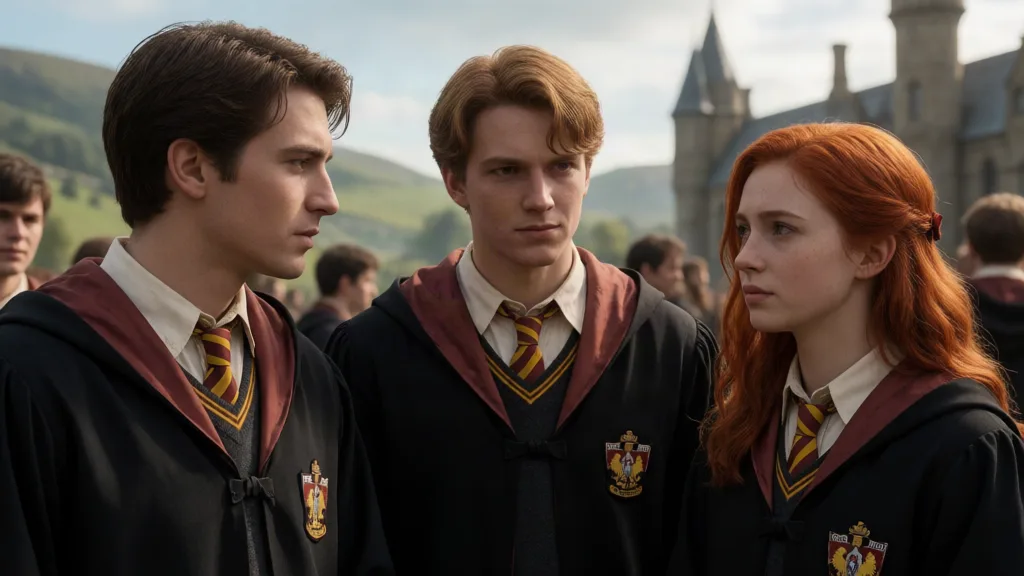
The goblin at the ledger desk didn't look up when I walked in.
"You're late."
"I'm aware."
"Name."
"Harry Potter."
That got his attention. It always did. His quill stopped scratching and he squinted at me through spectacles that sat too low on his nose, like he was trying to determine whether I was the real one or just another wizard with a scar and a story. I'd met three of those in the past year alone. Two were con artists. One genuinely believed it.
"Identification."
I slid my wand across the counter. Holly and phoenix feather, eleven inches. He didn't touch it. He just looked at it the way a pawnbroker looks at a ring that might be gold or might be brass. Then he pulled a brass instrument from under the desk, some kind of tuning fork with runes etched along its handle, and held it over the wand. It hummed. He grunted.
"Verified. You're in the East Tower. Third floor. Classes start in twenty minutes."
Twenty minutes. I'd been in the country for six hours. My trunk was still at the station. My head still felt like it was stuffed with cotton from the Portkey, and my ribs ached from where the security troll had patted me down at the border. The goblin slid a brass key across the counter. It was cold when I picked it up.
"Don't lose it. Replacements cost six Galleons."
"What happens if I do lose it?"
"You sleep in the courtyard."
I pocketed the key and walked out of the administration building into the sharp October air. The university sprawled in front of me, a patchwork of towers and bridges and courtyards that looked like someone had taken the best pieces of every magical school in Europe and stitched them together without bothering to make them match. That's more or less what had happened, from what I understood. After the war, when the old institutions were half in ruins and half in disgrace, someone had the bright idea to build something new. One school. All of Europe. No houses, no pureblood quotas, no ancient feuds carved into the stonework.
It was a nice idea. It was also a mess.
The East Tower was a hundred yards away, across a courtyard where students in mismatched robes clustered in groups, arguing about something. I caught fragments as I passed. A girl with silver hair was gesturing angrily at a boy holding a book. "You can't cite Grundel's third theorem without accounting for the temporal displacement factor, it's first-year material, honestly." The boy looked like he wanted to be swallowed by the cobblestones.
I kept walking.
The East Tower had no lift. I climbed three flights of spiral stairs that got narrower with every turn, until I was sure the architect had been having a laugh at the expense of anyone who lived above the second floor. By the time I reached the third-floor landing, my ribs were complaining louder than they had been at the border.
The door to my room was already open.
I stopped in the doorway. A girl was sitting on the bed that wasn't mine, her legs crossed, a book open on her knee. Red hair, the kind of red that doesn't come from a bottle. Freckles scattered across her nose like someone had flicked a paintbrush at her face. She was wearing a Harpies jersey under an open robe, and she didn't look up when I walked in.
"You're in my light," she said.
"Sorry?"
She turned a page. "The window's behind you. You're blocking it. I was reading."
I stepped to the side. She kept reading. I stood there with my trunk still at the station and my key still cold in my pocket, and I tried to figure out what was happening.
"That's my bed," I said.
"I know."
"You're sitting on it."
"I'm aware." She turned another page. "There's a draft from the window. The other bed's closer to the radiator. I was here first, so I picked the good one."
"That's not how it works."
She finally looked up. Her eyes were brown, almost amber in the light from the window, and they had the flat, unimpressed quality of someone who'd already decided you weren't worth the effort of being polite to. "How does it work, then?"
I didn't have an answer. She went back to her book.
I dropped my bag by the door and walked to the other bed, the one closer to the radiator, which was cold and clanked when I sat on it. The room was small. Two beds, two desks, a wardrobe that looked like it predated the school by a century, and a window that faced the courtyard. My side of the room was bare. Hers wasn't. Books stacked on the desk, a cauldron with a cracked handle, a broom leaning against the wall, a photo on the nightstand of a family that kept moving in and out of frame, waving.
I recognized the family. Everyone did. The Weasleys were famous the way the Potters were famous, which is to say they'd been in the papers for things they didn't ask for.
"You're Ginny Weasley," I said.
"Yes."
"I'm Harry."
"I know."
She didn't say anything else. She just kept reading, and I sat on my cold bed and stared at the wall, and that was the first conversation I ever had with the girl I'd end up falling in love with.
---
The first week was a blur of getting lost.
The university didn't have a proper map. It had a map, technically, but the map was drawn by a committee of ghosts who'd been dead for three centuries and had strong opinions about which corridors were important and which weren't. The result was that the map showed eleven different ways to get to the library and no way at all to get to the potions laboratory, which was in the basement of the North Tower and only accessible through a door that looked like a wall until you said the password, which changed every Tuesday.
I spent forty minutes on Tuesday trying to find the potions lab. I ended up in a greenhouse full of screaming mandrakes and had to be rescued by a sixth-year who thought it was hilarious.
"You're the new one," she said. "The Potter kid."
"I'm not a kid."
"Everyone's a kid here. I'm nineteen and I'm a kid." She was tall and had a nose ring and a tattoo of a rune on her wrist that I didn't recognize. "You'll figure it out. Or you won't. Either way, you'll graduate eventually."
She walked off before I could ask her name.
The classes were harder than I expected. I'd done my N.E.W.T.s, barely, after a year of fighting a war and a year of trying to pretend I wasn't, but the university didn't care about N.E.W.T.s. It cared about entrance examinations, which I'd taken in a rented room in Diagon Alley with a proctor who watched me like I might cheat. I hadn't cheated. I'd passed. Barely.
The first Defense Against the Dark Arts lecture was in a hall that seated three hundred. I sat in the back, near the door, because old habits die hard. The professor was a thin woman with grey hair and a voice like a blade. She didn't introduce herself. She just started talking about the theory of counter-curses, the mathematics of them, the way you could model a hex as a function and invert it if you knew the variables.
I understood maybe half of it. The rest of the class was scribbling notes like their lives depended on it, and maybe they did, because the entrance exam for the advanced track was in six weeks and half of us wouldn't make it.
Ginny was in that class. I didn't notice her at first. She was sitting three rows ahead of me, on the aisle, her quill moving fast. When the professor asked a question about the inverse of a binding curse, she answered before anyone else could. The professor nodded. Ginny didn't look pleased. She just looked like she'd done the obvious thing and was waiting for the rest of us to catch up.
After class, I caught up to her in the corridor.
"You're good at that," I said.
She glanced at me. "At what?"
"The theory stuff. The math."
"I've had practice." She kept walking.
"Where'd you learn it? Hogwarts didn't teach that."
She stopped. Turned. Looked at me with those amber eyes, and for a second I thought she was going to tell me to get lost. Then she shrugged.
"My brother's a curse-breaker. He used to send me his textbooks when I was a kid. I read them for fun."
"For fun."
"Is that a problem?"
"No. It's just. Not what I expected."
"What did you expect?"
I didn't have an answer for that either. She waited a beat, then turned and kept walking, and I stood in the corridor with students flowing around me and felt like I'd failed some test I hadn't known I was taking.
---
The thing about Ginny was that she didn't care who I was.
I'd spent most of my life being Harry Potter. The Boy Who Lived, then the Chosen One, then the one who died and came back and killed the darkest wizard of the century. People looked at me and saw the scar, or the story, or the body count. They wanted something from me. Reassurance, or gratitude, or a piece of the legend they could carry home and tell their kids about.
Ginny didn't want anything. She treated me like I was furniture. Useful furniture, sometimes, when she needed someone to hold a ladder or pass her a book, but furniture. It was the most relaxing thing that had happened to me in years.
We fell into a routine without meaning to. We shared a room, so we shared space. She woke up early and went for a run before breakfast. I woke up late and stumbled to the dining hall half-asleep. She studied in the library until midnight. I studied in our room, on my bed, with the lamp turned low. We didn't talk much. We didn't need to.
But sometimes, late at night, when she came back from the library and I was still awake, we'd sit in the dark and talk about nothing.
"The food here is terrible," she said one night, lying on her bed with her feet on the wall.
"It's not that bad."
"It's terrible. The house-elves are from three different countries. None of them agree on what a proper breakfast is. I had kippers and rice porridge this morning. Together."
"That's not a breakfast. That's a punishment."
"Thank you." She sat up and pointed at me. "That's what I've been saying. No one listens."
"I'm listening."
"You're the only one." She lay back down. "You're all right, Potter."
"Thanks. I think."
"Don't let it go to your head."
I didn't. But I smiled in the dark, where she couldn't see it.
---
The dueling club met on Thursday nights in the old amphitheater behind the West Tower.
It wasn't an official club. The university didn't have official dueling, because dueling was considered barbaric and outdated and a relic of the blood-feud culture that had nearly destroyed magical Britain. But students dueled anyway, in the amphitheater, with wards up and a rotating cast of upperclassmen refereeing, and the faculty pretended not to notice.
I went because I needed to hit something.
The war had left me with a lot of things. Nightmares. A tendency to flinch at loud noises. A scar that still ached when the weather changed. And a restlessness that I couldn't shake, a feeling that if I stopped moving I'd have to think about everything I'd done and everything I'd lost, and I wasn't ready for that yet.
So I dueled.
The first night, I beat three people in a row. The second night, five. By the fourth week, people had started to notice. The upperclassmen watched me when I walked into the amphitheater. The first-years whispered. I heard the word "Chosen" more than once, and I hated it, but I didn't stop.
Ginny showed up on the fifth week.
I was in the middle of a bout with a sixth-year named Marcus, a big guy with a shield charm that took me three tries to break. I won, eventually, with a disarming jinx that caught him off guard, and when I turned to find my water bottle I saw her sitting on the stone steps, watching.
"You're good," she said.
"Thanks."
"You're also predictable."
I stopped with the bottle halfway to my mouth. "What?"
"You always open with a Stunner. Every time. And you favor your left side when you're tired. If I were dueling you, I'd feint right and hit you with a Body-Bind before you could reset."
I stared at her. She stared back.
"That's. Specific."
"I pay attention." She stood up and walked down the steps, pulling her wand from her sleeve. "Want to test it?"
The amphitheater went quiet. People turned to watch. A Weasley dueling the Potter kid, on a Thursday night, with no warning. This was the kind of thing that would be all over the school by morning.
"Sure," I said.
We faced each other. Marcus, who'd recovered from the disarming, stepped between us and raised his hand. "Standard rules. No Unforgivables, no lethal curses, no permanent damage. First to yield or disarm wins. Ready?"
We nodded.
"Begin."
She moved before I did.
I opened with a Stunner, like always, and she sidestepped it without looking, already casting. A jinx I didn't recognize caught my wand arm and twisted it, and I had to drop into a roll to avoid the follow-up. She was fast. Faster than anyone I'd dueled in months. Her footwork was clean, her casting was tight, and she wasn't wasting a single movement.
I got back to my feet and threw a shield up just in time. Her next spell hit it and cracked it. I reinforced it, and she circled, looking for an opening.
"You're favoring your left," she said.
I wasn't. I was favoring my right, because my left shoulder still ached from the war, and she'd noticed, and she was using it against me. I shifted my stance and she smiled, just a little, and I realized she'd been baiting me. The shift opened my guard, and she took it.
Her disarming charm hit me square in the chest. My wand flew out of my hand and clattered across the stone floor.
The amphitheater was silent.
I stood there, disarmed, breathing hard, and Ginny lowered her wand and walked over to pick mine up. She handed it back to me, handle first.
"You're good," she said. "But you're not as good as you think you are."
I took the wand. My hand was shaking, just a little. "Where'd you learn to duel like that?"
"Same place I learned the theory. My brother's textbooks. And practice." She turned and walked back up the steps. "Same time next week?"
"Sure."
She didn't look back. The crowd parted for her like water, and I stood in the middle of the amphitheater with my wand in my hand and my heart doing something complicated in my chest.
---
We dueled every Thursday after that.
She won the first three. I won the fourth, barely, with a feint she didn't see coming. She won the fifth. I won the sixth. By the end of October, we were the best duelists in the club, and everyone knew it.
It wasn't just dueling, though. It was everything. We studied together, ate together, walked to class together. People started to assume we were a couple, and we weren't, we were just. Us. Two people who shared a room and a schedule and a habit of not talking about the things that mattered.
But sometimes, late at night, the things that mattered came out anyway.
"My brother died in the war," she said one night. We were sitting on the floor between our beds, backs against the frames, a candle burning on the windowsill because the lamp had burned out and neither of us had bothered to fix it.
"I know," I said. "Fred. I was there."
"I know you were." She pulled her knees up to her chest. "I don't blame you. I never did. But sometimes I wonder if he'd still be alive if things had gone differently. If you'd been faster, or smarter, or if Dumbledore had told you more, or if Snape had. If any of a hundred things had been different."
"I wonder that too."
She looked at me. In the candlelight, her face was all shadows and freckles, and her eyes were wet but she wasn't crying.
"I used to hate you," she said. "After the war. Not because of Fred, not exactly. Because you got to be the hero and he got to be dead. Because everyone talked about what you lost and no one talked about what we lost. Because you were the Boy Who Lived and he was just a name on a list."
"I'm sorry."
"I know. That's why I stopped." She rested her chin on her knees. "You're not the Boy Who Lived. You're just Harry. And Harry's all right."
"Thanks."
"Don't let it go to your head."
I laughed. She laughed too, a little, and we sat there in the dark and didn't say anything else for a long time.
---
November came in cold.
The university was in the mountains, somewhere in the Alps, and the first snow fell on the second of the month, covering the courtyards and the towers in white. The heating charms in the East Tower were old and unreliable, and our room was cold enough that I could see my breath in the mornings.
Ginny stole my blanket on the third night.
"You have your own," I said, when I woke up and found her wrapped in both.
"Mine's thinner."
"They're the same blanket."
"Yours is warmer."
"That's not how blankets work."
She didn't answer. She just rolled over and pulled the blanket tighter, and I lay there in the cold and tried to be annoyed and couldn't manage it.
I got her back the next night by hiding her running shoes. She spent twenty minutes looking for them, cursing under her breath, while I pretended to study. When she finally found them, in the wardrobe, she threw one at my head.
"You're a child," she said.
"You stole my blanket."
"I was cold."
"So was I."
She glared at me. I grinned at her. She threw the other shoe.
---
The advanced track exam was on the fifteenth.
Six weeks of preparation, six weeks of studying until midnight, six weeks of dueling and practicing and reading textbooks that made my head spin. I'd never worked so hard for anything in my life. Not for the Triwizard Tournament, not for the war, not for anything.
Ginny studied with me. Every night, in our room, we sat across from each other at our desks and quizzed each other on counter-curse theory and defensive transfiguration and the twelve uses of dragon's blood. She was better than me at the theory. I was better at the practical. We balanced each other out.
"You're going to pass," she said the night before the exam. "You know that, right?"
"I don't know anything."
"You passed the entrance exam. You passed your N.E.W.T.s. You killed Voldemort. You can pass a written test."
"That's different."
"How?"
I didn't have an answer. She reached across the gap between our desks and put her hand on mine. Just for a second. Just long enough for me to feel the warmth of her palm against my knuckles.
"You're going to pass," she said again. "And so am I. And then we're going to celebrate by eating something that isn't kippers and rice porridge."
"Deal."
She pulled her hand back and went to bed. I sat at my desk for a long time after, staring at the wall, feeling the ghost of her touch on my skin.
---
The exam was three hours long.
I finished in two. I checked my work, twice, and then sat there with my quill in my hand and watched the other students scribble. Ginny was three rows over, her head bent, her quill moving fast. She finished with ten minutes to spare and spent the rest of the time staring at the ceiling, which I took to mean she was either confident or resigned.
We walked out together.
"How'd you do?" I asked.
"Fine. You?"
"Fine."
We looked at each other. Then we both started laughing, because "fine" was the most useless word in the language and we both knew it.
"Celebration dinner?" she said.
"Celebration dinner."
We went to the village at the base of the mountain, a little place called Altdorf that had one pub and one restaurant and a bakery that sold pastries the size of my head. We ate until we couldn't move, and then we walked back up the mountain in the dark, the snow crunching under our boots, the stars sharp and cold overhead.
"The results come out next week," she said.
"I know."
"Are you nervous?"
"No." I thought about it. "Yes. A little."
"Me too." She stopped walking and looked up at the sky. "I've never been good at waiting. My whole family's like that. We're doers. We don't sit around. Fred used to say that waiting was just another word for wasting time."
"Fred sounds like he was smart."
"He was an idiot." She smiled. "But he was right about that."
We stood there in the snow, looking at the stars, and I felt something shift in my chest. Something that had been there for weeks, maybe months, and that I'd been ignoring because I didn't know what to do with it.
"Ginny," I said.
"Yeah?"
"I. Nothing. Never mind."
She looked at me. Her breath fogged in the cold air. "You're weird, Potter."
"I know."
"Come on. It's freezing."
We walked the rest of the way in silence.
---
The results came out on a Tuesday.
I passed. Ginny passed. We both made the advanced track, which meant harder classes, more work, and a future that I hadn't let myself think about until now. The advanced track led to a mastery. A mastery led to a career. A career led to a life, a real one, the kind I'd never expected to have.
I didn't know what to do with that.
Ginny did. She celebrated by buying a bottle of firewhisky from the pub and dragging me up to the roof of the East Tower, where we sat on the cold stone and passed the bottle back and forth and watched the stars.
"We did it," she said.
"We did."
"First step. Then the next. Then the next." She took a drink and handed me the bottle. "My mum always says that life is just a series of small steps. You don't get to skip any. You just take them, one at a time, and eventually you look back and you're somewhere you never expected to be."
"Where do you expect to be?"
She was quiet for a moment. "I don't know. Somewhere good. Somewhere I chose." She looked at me. "What about you?"
"I don't know either." I took a drink. "I spent so long just trying to survive that I never thought about what came after. And now here I am, after, and I don't know what to do with it."
"You'll figure it out."
"How do you know?"
She smiled. It was a real smile, not the sharp one she used in dueling, not the polite one she used with strangers. Just a smile, warm and a little sad.
"Because you're Harry," she said. "And Harry figures things out."
I didn't know what to say to that. So I didn't say anything. I just sat there with her on the cold roof, passing the bottle back and forth, and watched the stars until the firewhisky was gone and the cold had seeped into my bones.
---
The advanced track started in December.
The classes were harder. The professors were stricter. The work was relentless, and I loved it. I loved the challenge, the focus, the way it demanded everything I had and then asked for more. For the first time since the war, I felt like I was doing something that mattered. Something I'd chosen.
Ginny was in most of my classes. We studied together, practiced together, dueled together. We were the top of the track, the ones the professors pointed to when they wanted to show the first-years what hard work looked like. It was strange, being a role model. Strange and uncomfortable and, sometimes, exactly what I needed.
The other students were different here. There were no houses, no factions, no old grudges. Just people from all over Europe, from all kinds of families, all kinds of backgrounds, all trying to learn the same things. It was what Hogwarts could have been, maybe, if things had gone differently. If there'd been no war, no Voldemort, no decades of fear and suspicion.
I made friends. Real friends, for the first time in years. There was Luca, a quiet Italian who was brilliant at potions and terrible at dueling. There was Mira, a Bulgarian girl who could cast a Patronus so bright it hurt to look at. There was Tomas, a Czech boy who'd grown up in a magical orphanage and had a chip on his shoulder the size of a mountain.
And there was Ginny.
Always Ginny.
---
The first snow of December was heavier than the first.
It fell for three days straight, burying the courtyards and the bridges, closing the mountain pass and cutting us off from the village. The university went into lockdown, which meant no classes, no dueling club, no escape from the East Tower and the people in it.
I didn't mind. I had books to read, notes to review, and a roommate who didn't talk much. It was peaceful. Almost perfect.
Then the power went out.
Not the lights, the wards. The heating charms failed, and the whole tower went cold, and the students clustered in the common rooms with blankets and candles and a growing sense of unease. The faculty said it was a temporary malfunction. The older students said it was the mountain, that the mountain had moods, that sometimes it pushed back against the magic that had been built on top of it.
Ginny didn't believe any of it.
"It's the wards," she said, when we were huddled in our room with every blanket we owned. "They're old. They're failing. And the faculty doesn't want to admit it because if the wards fail, the whole university is in trouble."
"You don't know that."
"I know enough." She pulled her blanket tighter. "My dad's an expert on wards. He used to talk about them at dinner. The old ones, the ones built on natural magic, they need maintenance. They need to be fed. And this place was built in a hurry, after the war, with whatever they could find. It's a miracle it's held up this long."
"So what do we do?"
"We wait. We stay warm. We don't panic." She looked at me. "And we don't tell anyone else. Panic is worse than cold."
I nodded. We sat there in the dark, wrapped in blankets, and listened to the wind howl outside the window.
"I hate this," she said, after a while.
"The cold?"
"The waiting. The not knowing. The feeling that something's wrong and there's nothing I can do about it."
"You're not the only one."
"I know." She shifted, and her shoulder pressed against mine. "That's why I'm glad you're here."
I didn't say anything. I just sat there, feeling the warmth of her against my side, and watched the snow fall.
---
The wards came back the next morning.
The faculty never explained what had happened. They just said it was a temporary malfunction, that everything was fine, that classes would resume as normal. The students accepted it. Most of them, anyway. Ginny didn't, but she didn't push it either. She just watched the professors with those sharp amber eyes and filed away everything they said.
I watched her watch them. It was what I did, by then. Watched her. Noticed her. The way she moved, the way she talked, the way she held her wand when she was thinking. The way she laughed, rare and bright, like a light coming on in a dark room.
I was falling in love with her. I knew it, by then. I'd known it for weeks, maybe months, and I'd been ignoring it because I didn't know what to do with it. She was my roommate. My friend. My dueling partner. She was the first person in years who'd treated me like a person instead of a symbol, and I didn't want to ruin that.
So I didn't say anything. I just watched her, and waited, and hoped that someday I'd figure out what to do.
---
The Yule Ball was on the twenty-first.
The university held it every year, in the Great Hall, which was really just the dining hall with the tables pushed to the sides and a band brought in from somewhere. It wasn't like the Yule Ball at Hogwarts. There were no champions, no Triwizard Tournament, no formal obligations. Just a party. A chance to dress up and dance and forget about exams for one night.
I didn't want to go.
"You're going," Ginny said. She was standing in front of the mirror, trying to pin up her hair, and failing. "Everyone's going. It's tradition."
"I don't like parties."
"You don't like anything."
"That's not true."
"Name one thing you like."
I looked at her. She was wearing a dark green dress that brought out the red in her hair, and her freckles stood out against her pale skin, and she was beautiful, and I couldn't say any of that.
"Books," I said. "I like books."
She rolled her eyes. "You're hopeless. Come here. Help me with this."
I walked over and took the pin from her hand. Her hair was soft, and it smelled like lavender, and my fingers brushed against her neck as I pinned it up. She didn't flinch. She just watched me in the mirror, her eyes steady.
"There," I said. "Done."
"Thanks." She turned to face me. "Now go get dressed. You're not going in your school robes."
"I don't have anything else."
She stared at me. Then she walked to the wardrobe and pulled out a set of dress robes that I'd never seen before.
"These are my brother's," she said. "Bill's. He sent them last week. Said I should make sure you looked presentable."
"Bill sent me dress robes?"
"Bill's like that." She handed them to me. "Go. Change. I'll wait."
I changed in the bathroom. The robes fit, more or less. They were dark blue, with silver trim, and they made me look like someone who belonged at a party. Someone who knew how to dance. Someone who wasn't a war orphan with a scar and a habit of ruining things.
I looked at myself in the mirror and didn't recognize the person looking back.
---
The Great Hall was packed.
Hundreds of students, all in their best robes, all laughing and talking and drinking punch that someone had spiked with firewhisky. The band was playing something fast and loud, and the floor was already crowded with dancers.
Ginny found me by the punch table.
"You look good," she said.
"So do you."
"Thanks." She took a glass of punch and sipped it. "This is terrible. Someone put too much firewhisky in it."
"Is that a problem?"
"Not for me." She grinned. "Come on. Let's dance."
"I don't dance."
"Everyone dances."
"I don't."
She grabbed my hand and pulled me onto the floor.
The music was fast, and I was clumsy, and I stepped on her feet more than once. But she didn't seem to care. She just laughed and spun and pulled me along, and after a while I stopped thinking about how I looked and started thinking about how she felt in my arms. Warm. Solid. Real.
The song ended. Another started, slower this time. She didn't let go of my hand.
"One more," she said.
"I really don't dance."
"I know. One more."
I danced. I held her close, and she rested her head against my shoulder, and we moved together in the crowd of students, and for a few minutes I forgot about everything else. The war. The scars. The future. It was just her, and me, and the music.
"Harry," she said.
"Yeah?"
"Thank you."
"For what?"
"For being here. For being you. For not being the Boy Who Lived." She lifted her head and looked at me. "For being my friend."
I wanted to say something. Something real. Something that would tell her how I felt, that would bridge the gap between us and make her see what I saw. But the words wouldn't come. They never did.
So I just nodded. And she smiled. And we kept dancing.
---
The ball ended at midnight.
We walked back to the East Tower together, through the snow, our breath fogging in the cold air. The mountain was quiet. The stars were out. The world felt small and safe and full of possibility.
At the door to our room, she stopped.
"Harry," she said.
"Yeah?"
"I. Nothing. Never mind." She shook her head. "Goodnight."
"Goodnight."
She went inside. I stood in the corridor for a long time, staring at the closed door, feeling like I'd missed something important. Something that might not come again.
---
The spring term started in January.
The snow melted. The days got longer. The advanced track got harder, and I threw myself into it, because it was easier than thinking about Ginny, easier than lying awake at night and wondering what would have happened if I'd said something at the ball.
We were still friends. Still roommates. Still dueling partners. Nothing had changed, and everything had changed, and I didn't know how to fix it.
Then, in February, the wards failed again.
This time, it wasn't a temporary malfunction. This time, it was an attack.
I was in the library when it happened. The lights flickered, then went out. The wards, the ones that protected the university from the outside world, the ones that kept the mountain's wild magic at bay, collapsed. And through the windows, I saw something moving in the dark.
Something big.
Someone screamed. Then everyone was screaming, and the library was chaos, students running in every direction, books flying off shelves, the air thick with panic and the smell of ozone.
I ran.
I ran through the corridors, past the screaming students, past the professors trying to restore order, past everything. I ran to the East Tower, to our room, to Ginny.
She was already there. Wand out. Face calm.
"Took you long enough," she said.
"What's happening?"
"I don't know. But we're not staying here to find out." She grabbed my arm. "Come on. We need to get to the amphitheater. It's warded. It's the safest place in the school."
We ran together, through the dark corridors, past the panic and the chaos. The thing outside was getting closer. I could feel it, a pressure in the air, a weight on my chest, something old and angry and hungry.
We reached the amphitheater just as the first wave hit.
It wasn't a creature. It was magic, raw and wild, the mountain's own power, unleashed by the failing wards. It crashed against the amphitheater's defenses, and the stone shook, and the students inside screamed.
Ginny didn't scream. She raised her wand and started casting.
I raised mine and joined her.
We fought together, side by side, the way we'd fought in the dueling club a hundred times. She was fast, precise, brilliant. I was strong, stubborn, relentless. We complemented each other. We always had.
The wave broke against our defenses and receded. Then another came. Then another. We held, barely, and the professors arrived, and together we pushed the wild magic back, and the wards came up, and the night was over.
In the morning, the university announced that the attack had been contained. That everything was fine. That classes would resume as normal.
Ginny didn't believe it. Neither did I.
"It's not over," she said, when we were alone in our room. "The wards are failing. The mountain is angry. And someone, somewhere, is making it worse."
"How do you know?"
"I don't. But I'm going to find out." She looked at me. "Are you with me?"
I looked at her. Red hair, freckles, amber eyes. The girl who'd stolen my blanket and thrown her shoe at my head. The girl who'd disarmed me in a duel and then handed my wand back. The girl who'd held my hand in the dark and told me I was going to be okay.
"I'm with you," I said.
She smiled. It was the real smile, the one I'd been waiting for.
"Good," she said. "Because I have a plan."
---
The plan was simple. Break into the faculty tower. Steal the ward schematics. Figure out what was wrong and how to fix it. Save the university.
It was also insane. The faculty tower was the most heavily warded building on campus, protected by enchantments that would make a Gringotts vault look like a garden shed. Getting in would be impossible. Getting out would be worse.
But Ginny had a plan for that too.
"My brother Bill," she said, "is a curse-breaker. He taught me a few things. Things the faculty don't know about. Ways to get past wards without triggering them."
"Ways that work?"
"Ways that work." She pulled a piece of parchment from her desk and unrolled it. It was a map of the faculty tower, hand-drawn, covered in notes. "I've been working on this for weeks. Ever since the first ward failure. I knew something was wrong. I just didn't know how wrong until last night."
"You've been planning this for weeks?"
"Since December." She looked at me. "I didn't want to drag you into it. But now I don't have a choice."
"You always have a choice."
"Not anymore." She rolled up the map. "We go tonight. After curfew. Are you in?"
I should have said no. I should have told her it was too dangerous, that we should go to the professors, that there had to be another way. But I looked at her, and I saw the fire in her eyes, and I knew there was no other way. Not for her. Not for me.
"I'm in," I said.
---
We left the East Tower at midnight.
The corridors were empty. The castle was quiet. The only sound was our footsteps, soft on the stone, and the wind outside the windows.
Ginny moved like a shadow. She knew the corridors, the shortcuts, the hidden passages that the faculty didn't know about. She'd spent weeks mapping them, memorizing them, preparing for this night.
I followed her. I trusted her. It was that simple.
The faculty tower was on the other side of the campus, past the library, past the greenhouses, past the amphitheater where we'd fought the wild magic. It was a tall, narrow building, all stone and shadows, with a single door at the base and a single window at the top.
"The schematics are in the archive room," Ginny whispered. "Third floor. I need you to keep watch while I get them."
"What if someone comes?"
"Then you deal with them."
"Deal with them how?"
She looked at me. "You're Harry Potter. Figure it out."
She turned and pressed her hand against the door. I saw her lips move, silent words, a spell I didn't recognize. The door clicked. She pushed it open and slipped inside.
I followed.
The tower was dark. The stairs were narrow. We climbed in silence, our wands lit, our footsteps muffled by a charm Ginny had cast at the door. The archive room was on the third floor, behind a door that was locked and warded and probably cursed.
Ginny dealt with it in thirty seconds.
"Where'd you learn that?" I whispered.
"Bill," she said. "He's very good at breaking into things."
The archive room was full of shelves, and the shelves were full of scrolls. Thousands of them, organized by year and subject, covered in dust and protective charms. Ginny went straight to the back, to a shelf marked "Wards and Defenses," and started pulling scrolls.
"Keep watch," she said.
I kept watch. The corridor was empty. The tower was quiet. But I could feel something, a prickling at the back of my neck, a sense that we weren't alone.
"Ginny," I said. "Hurry."
"I'm hurrying."
"No. I mean hurry."
She looked up. She saw my face. She shoved the scrolls into her bag and ran.
We made it to the stairs before the door at the bottom of the tower opened.
"Who's there?" a voice called. Professor Vane, the Defense Against the Dark Arts teacher, the one with the voice like a blade.
Ginny didn't answer. She grabbed my hand and pulled me up the stairs, to the window at the top of the tower, the single window that looked out over the campus.
"We're trapped," I said.
"No, we're not." She pointed her wand at the window. "I've been working on this too."
She cast a spell I didn't recognize. The window shattered, and the pieces hung in the air, and she pulled me through the gap and onto the roof.
We ran across the rooftops, jumping from building to building, the wind cold on my face, the stars bright overhead. Ginny was fast, faster than me, and she kept looking back to make sure I was following.
We made it to the East Tower. We climbed through our window. We collapsed on the floor, breathing hard, laughing.
"We did it," she said.
"We did it."
She pulled the scrolls from her bag and spread them on the floor. Dozens of them, covered in diagrams and notes and spells I didn't understand.
"Now," she said, "we figure out what's wrong."
We stayed up all night, reading the scrolls, comparing them to the notes Ginny had made. The wards were old, older than the university, older than the mountain. They'd been built on a foundation of natural magic, the kind that came from the earth itself, and they needed to be renewed every century by a ritual that no one had performed in two hundred years.
"The faculty doesn't know," Ginny said. "They inherited the wards from the people who built the school, and they've been maintaining them the way they were taught, but the way they were taught was wrong. They've been patching the wards instead of renewing them. And now the wards are failing."
"Can we fix them?"
"I think so. But we need to perform the ritual. And the ritual needs to be done at the heart of the mountain, in the place where the natural magic is strongest."
"Where's that?"
She looked at me. "The Forbidden Cave. Under the university. The one the faculty says is off-limits."
"Of course it is."
"We go tomorrow night. Are you in?"
I looked at her. Tired, disheveled, covered in dust, and beautiful. The girl who'd stolen my blanket and thrown her shoe at my head. The girl who'd held my hand in the dark. The girl I loved.
"I'm in," I said.
She smiled. And for the first time, I let myself hope that maybe, just maybe, she felt the same way.
---
The cave was dark and cold and full of things I didn't want to think about.
We climbed down through a passage behind the library, a passage that wasn't on any map, a passage that Ginny had found in the scrolls. The walls were wet. The air smelled like iron and old magic. The deeper we went, the stronger the pressure got, the weight on my chest, the sense that we were walking into something ancient and angry.
"The heart of the mountain," Ginny whispered. "We're close."
We reached a chamber. It was huge, bigger than the Great Hall, with a ceiling that disappeared into darkness and a floor that glowed with a faint, pulsing light. In the center was a pool of water, black and still, and around the pool were stones carved with runes.
"This is it," Ginny said. "This is where the ritual has to happen."
"How do you know?"
"I can feel it." She looked at me. "Can't you?"
I could. The pressure, the weight, the sense of something old and powerful and waiting. It wasn't angry. It was patient. It had been waiting for someone to come, for someone to remember, for someone to renew the bond between the mountain and the magic that lived on it.
"What do we do?" I asked.
Ginny pulled a scroll from her bag and unrolled it. "The ritual has three parts. First, we cleanse the pool. Second, we renew the runes. Third, we offer something of ourselves to the mountain. A memory. A feeling. Something true."
"Something true."
"Something that matters." She looked at me. "Are you ready?"
I wasn't. But I nodded anyway.
We started the ritual.
The cleansing was simple. A spell, a gesture, a word. The pool rippled, and the black water turned clear, and the light from the floor got brighter.
The runes were harder. We had to trace them with our wands, one by one, and each one took something out of us, a little bit of energy, a little bit of magic. By the time we finished, I was exhausted, and Ginny was pale, and the chamber was glowing like a sunrise.
The third part was the hardest.
"Something true," Ginny said. "Something that matters."
She stepped to the pool and looked into the water. "I offer the memory of my brother. Fred. The way he laughed. The way he made everyone around him laugh. The way he died, and the way I've carried him with me every day since."
The water rippled. The light pulsed. The mountain accepted her offering.
Then it was my turn.
I stepped to the pool. I looked into the water. And I thought about what mattered. Not the war. Not the scar. Not the legend. Something true. Something real.
"I offer the memory of the first time I felt safe," I said. "It was in a room in the East Tower. I was sitting on a cold bed, and a girl with red hair was reading a book, and she didn't care who I was. She just cared that I was blocking her light."
I heard Ginny laugh, soft and surprised.
"I offer the memory of the first time I felt seen," I said. "It was in the amphitheater, when she disarmed me and handed my wand back. She didn't tell me I was great. She told me I was predictable. And it was the best thing anyone had ever said to me."
The water rippled. The light pulsed. The mountain accepted my offering.
"And I offer the memory of the first time I knew I was in love," I said. "It was on a rooftop, in the snow, passing a bottle of firewhisky back and forth. She said I'd figure things out. She said Harry figures things out. And I knew, right then, that I'd figure out anything as long as she was there."
The chamber went silent.
I turned to look at Ginny. She was staring at me, her eyes wide, her face pale.
"Harry," she said.
"Yeah."
"Did you mean that?"
"Every word."
She took a step toward me. Then another. Then she was standing in front of me, close enough that I could see the freckles on her nose, close enough that I could feel her breath on my skin.
"I love you too," she said. "I've loved you since the first night, when you didn't argue with me about the bed. I've loved you since the dueling club, when you didn't get angry that I beat you. I've loved you since the ball, when you held me close and didn't say anything, because you didn't have to."
"Ginny."
"I love you, Harry. And I'm tired of waiting for you to figure it out."
She kissed me.
The mountain pulsed. The light flared. The wards, the old wards, the ones that had been failing for months, came back to life. I felt them rise, felt them settle, felt them lock into place. The university was safe. The mountain was calm. And I was kissing Ginny Weasley, and nothing else mattered.
We broke apart. She was smiling. I was smiling. The chamber was bright with light.
"Did we do it?" I asked.
"We did it."
"Good." I kissed her again. "Because I have a lot more true things to offer."
She laughed. "You're weird, Potter."
"I know."
"Come on. Let's go home."
We climbed out of the cave, through the passage, into the library. The sun was rising. The corridors were empty. We walked back to the East Tower, hand in hand, and when we got to our room, she didn't let go.
"Harry," she said.
"Yeah?"
"I'm keeping the good bed."
I laughed. "Fine."
"And I'm keeping you."
I looked at her. Red hair, freckles, amber eyes. The girl who'd stolen my blanket and thrown her shoe at my head. The girl who'd disarmed me and handed my wand back. The girl who'd held my hand in the dark and told me I was going to be okay.
"Fine," I said. "You can keep me too."
She smiled. And we stayed there, in the doorway of our room, as the sun rose over the mountain and the university woke up around us.
It was the beginning of something. Something real. Something I'd chosen.
And for the first time in my life, I was ready for it.
Watch this moment
Turn the current scene into a cinematic Live Chapter — what you watch becomes the story's next part.
Disclaimer
This is a work of fiction, assisted by artificial intelligence. Any names or characters, businesses or places, events or incidents, are fictitious. Any resemblance to actual persons, living or dead, or actual events is purely coincidental.
Content Removal Policy
- Users may report content that may be illegal or violates our Standards.
- All reported complaints will be reviewed and resolved within seven business days.
- Review Process: Our team will assess the reported content against our guidelines.
- Appeals: If you disagree with a decision, you may appeal within 14 days of notification.
- Potential outcomes include: content removal, account warning, or no action if no violation is found.
To report content, email us at [email protected]