Share
Go Live
Pale Shadow Tribe
·
Published 9/21/2026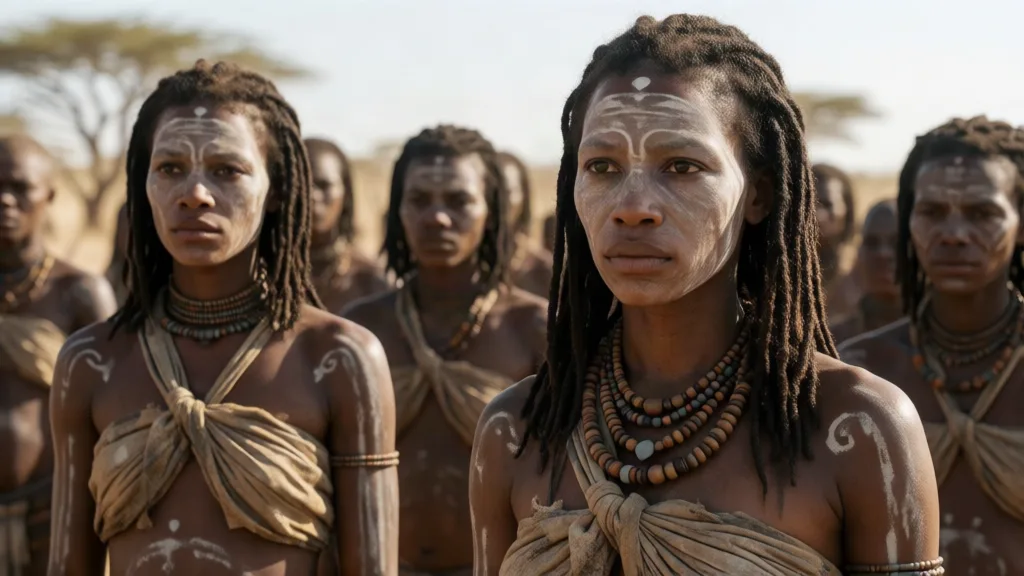
The flies have learned my name. They call it in the language of small helicopters, circling the wound on my calf where the thorn went in three days ago. I have stopped swatting at them. It takes too much energy, and energy is a currency I am running out of.
The boy who watches me is called Eze. He is maybe eleven, maybe older. Time moves differently here, measured not by clocks but by the angle of light through the acacia branches and the smell of rain that never comes. He sits on a flat rock at the edge of the clearing, a slingshot in his hand, and he watches me the way you watch a snake that might be dead or might not be. His eyes are the color of river stones, gray and patient and unreadable.
I have been here for nineteen days. I know this because I have been scratching marks into the wall of the hut with a splinter of wood. Nineteen vertical lines. The woman who brings me food, a broad-faced matriarch named Nkiru, saw my scratches yesterday and laughed. Not a cruel laugh. The kind of laugh you give a child who has built a sandcastle too close to the tide.
"You think time is something you can hold," she said. Her English is broken but functional, learned from a missionary school somewhere in her past. "Time holds you."
I wanted to argue. I am, or was, a professor of anthropology at a university in Ohio. I have written two books on the subject of temporal cognition in non-Western societies. I know all the arguments about cyclical versus linear time, about the colonial imposition of the clock, about the violence of chronology. I know them the way you know a song you've heard a thousand times. But knowledge and understanding are different animals. They sleep in different cages.
I didn't argue. I ate the yam porridge she gave me and I watched the light move across the mud wall and I thought about my daughter.
Her name is Sophie. She is seven years old and she has my mother's chin and her father's stubbornness. When I left, she was building a model of the solar system out of papier-mâché. She had painted Jupiter with a swirl of red and cream, and she was so proud of it that she made me promise to come home before it dried completely. The planets are dry now. They have been dry for a long time.
The thorn wound throbs. I should have let Nkiru treat it with the paste she offered, a green mash that smelled of roots and something animal. But I refused. I don't know why. Some stubbornness of my own, some need to keep one small piece of my body under my own jurisdiction. The infection is spreading. I can feel it in the heat of my skin, the way the edges of the wound have gone tight and shiny.
Eze stands up. He does this sometimes, abruptly, as if he has heard a sound I cannot hear. He walks to the edge of the clearing and stares into the trees. The trees here are not like the trees at home. They are taller, darker, more indifferent. They do not welcome you. They allow you to pass.
"There is a car on the road," he says.
My heart does something complicated. It has been doing this for nineteen days. Every sound, every shift in the wind, every distant engine, and my heart leaps and then falls and then settles back into its dull rhythm of waiting.
"What kind of car?" I ask. My voice sounds foreign to me. It has been worn down by disuse, by the heat, by the long hours of silence.
Eze doesn't answer. He is already gone, slipped into the trees like a fish into water.
I try to stand. The wound screams. I sit back down on the mat and I breathe through my nose and I wait. This is what I have learned to do here. Wait. The waiting is not passive. It is active, a kind of work, a labor of the spirit. You wait with your whole body. You wait with your ears and your skin and your gut. You wait until waiting becomes a form of prayer.
The sun is moving toward the horizon. The shadows are stretching. I can hear voices now, distant, carried on the wind. Not English. Not the language of the village either, which I have learned to recognize if not understand. This is something else. Something harder.
I think about the last time I saw Sophie. It was in the airport, at the gate, and she was holding a stuffed rabbit that had lost one of its button eyes. She didn't cry. That was the worst part. She just looked at me with her father's eyes and said, "You always come back."
I promised her I would. I promised her with the kind of promise you make when you don't know what you're promising. And then the plane took off and the world got smaller and smaller and then it disappeared entirely, swallowed by clouds, swallowed by distance, swallowed by the great indifferent sky.
The voices are closer now. I can hear footsteps, the crack of twigs, the rustle of leaves. Eze reappears at the edge of the clearing. His face is different. Something has changed in it, some calculation, some decision.
"They are asking for you," he says.
"Who?"
"The men from the city. They have papers."
Papers. The word lands in my chest like a stone. Papers mean bureaucracy. Papers mean officialdom. Papers mean that whatever is happening has moved beyond the realm of the personal, the intimate, the human. Papers mean that I am no longer just a woman lost in a village. I am a case. A file. A problem to be solved.
I stand up. The wound protests. I ignore it. I have been ignoring it for days. I walk toward Eze, and he watches me with those river-stone eyes, and I realize that I don't know what I want. I have been waiting for rescue for nineteen days, and now that it might be here, I am not sure I want to be rescued. Not like this. Not by men with papers who will ask me questions I cannot answer and write things down that will become part of a record I cannot control.
"What do they want?" I ask.
Eze shrugs. It is a gesture I have seen him make a hundred times, but this time it carries weight. This time it means something.
"They want to take you back," he says. "To the place you came from."
The place I came from. Ohio. The university. The house with the yellow door and the overgrown garden. Sophie's papier-mâché planets, dry and dusty on the kitchen table. My husband, who I left without explanation, without a note, without anything but the silence that had grown between us like a wall.
I think about the word "back." It implies a return, a restoration, a circle completed. But I am not the same person who left. I have been unmade and remade by this place, by the heat, by the waiting, by the flies that have learned my name. Going back would not be going back. It would be going somewhere new.
The men are here now. I can see them through the trees, two of them, in khaki uniforms, holding a folder and a bottle of water. They look tired. They look like they have been driving for a long time. They look like they have seen things they would rather forget.
One of them raises a hand. A greeting. A signal. A question.
I don't raise my hand back. I stand at the edge of the clearing, at the edge of my nineteen days, and I feel the weight of the decision pressing down on me. Sophie's face. The yellow door. The dry planets. And behind me, the hut, the mat, the scratches on the wall, the woman who laughed at my counting, the boy with river-stone eyes.
The flies are still circling. They are patient. They know I will have to move eventually. Everyone moves eventually. Even the ones who think they can stay.
I take a step forward. Then another. The wound burns. The sun is setting. And somewhere, in the distance, a car engine turns over, ready to carry me back to a world I no longer recognize.
Watch this moment
Turn the current scene into a cinematic Live Chapter — what you watch becomes the story's next part.
Disclaimer
This is a work of fiction, assisted by artificial intelligence. Any names or characters, businesses or places, events or incidents, are fictitious. Any resemblance to actual persons, living or dead, or actual events is purely coincidental.
Content Removal Policy
- Users may report content that may be illegal or violates our Standards.
- All reported complaints will be reviewed and resolved within seven business days.
- Review Process: Our team will assess the reported content against our guidelines.
- Appeals: If you disagree with a decision, you may appeal within 14 days of notification.
- Potential outcomes include: content removal, account warning, or no action if no violation is found.
To report content, email us at [email protected]