Share
Go Live
Starlight Sabotage
·
Published 8/18/2026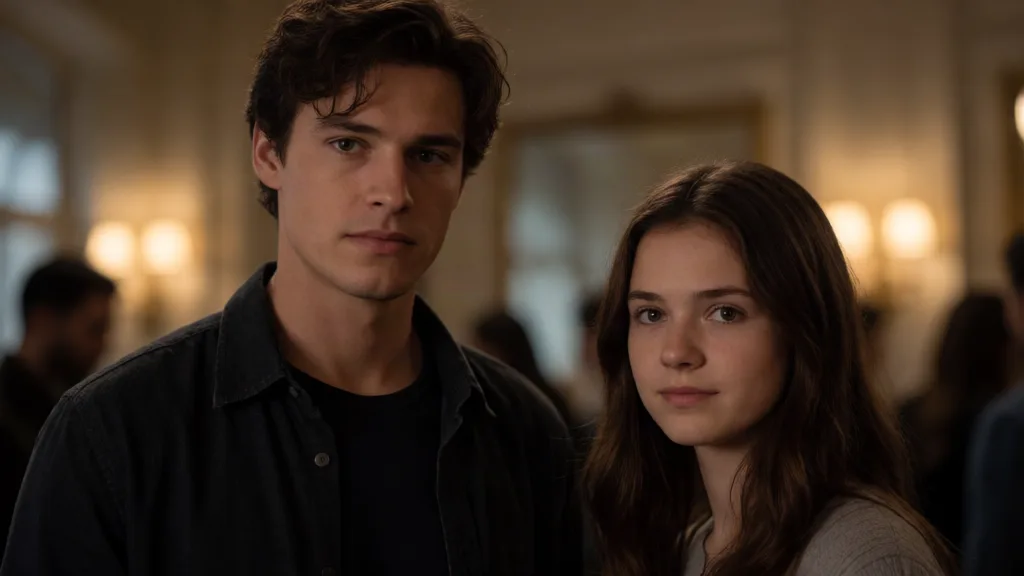
The first time I saw him, I thought someone had Photoshopped a professor.
He stood at the front of the lecture hall like he owned the room, which I guess he did. Tall. Dark hair that curled just a little at the collar, like he’d run his hand through it one too many times and given up. Wire-rimmed glasses that should have made him look like a librarian but instead made him look like the kind of guy who would ruin your life and then apologize so sincerely you’d thank him for it.
I was twenty minutes late. Not my fault. The coffee cart on campus had a new girl who didn’t know how to work the espresso machine, and I’d stood there watching her struggle like a nature documentary. *The barista in her natural habitat. Note how she avoids eye contact with the angry customer. Watch as she pretends the machine is broken.*
By the time I pushed through the double doors of Arch 201, the only seats left were in the front row. Right in front of his podium. Perfect.
I slid into the chair, dropped my bag, and pulled out my laptop without looking at him. The room smelled like old books and desperation. A few heads turned. I ignored them.
“Nice of you to join us.”
His voice was low. Warm. The kind of voice that could read a grocery list and make it sound like poetry. I hated him immediately.
“Traffic,” I said, not looking up.
“From the coffee cart?”
I did look up then. He was smiling. Not a nice smile. A knowing one. The kind that said he’d already filed me away as *that student* and was looking forward to the game.
“I don’t drink coffee,” I said.
“Then what were you doing there for fifteen minutes?”
The class laughed. A few people turned around in their seats to get a better look at me. I felt heat crawl up my neck but kept my face flat.
“Moral support,” I said. “The new girl looked like she needed it.”
He tilted his head. The overhead lights caught his glasses, and for a second I couldn’t see his eyes, just two bright circles of reflection. “That’s very noble of you. I’m sure she appreciates your commitment to caffeine justice.”
“Someone has to fight the system.”
Another laugh. This one was smaller, more nervous. The class wasn’t sure if they were supposed to be on my side or his. Neither was I, honestly.
He turned back to the board and picked up a piece of chalk. “As I was saying before we were so gracefully interrupted, the structural integrity of a building depends not on the materials you use, but on how you distribute the load. You can have the strongest steel in the world, but if you put all the weight on one point, it will fail. Every time.”
He wrote something on the board. His handwriting was neat, almost architectural. Each letter precise. No wasted motion.
“Architecture is about balance,” he said. “Pressure and release. Tension and support. You have to understand what’s pushing against what, or the whole thing comes down.”
I opened my laptop and typed *Professor Hot Nerd* in a blank document. Then I deleted it and wrote *Dr. Ethan Vance, Architectural Theory, MWF 9am.*
I’d read his bio on the department website before registering. Youngest professor in the program. Published at twenty-six. Two teaching awards. A list of publications that went on longer than my arm. The kind of resume that made other academics hate him and students either worship or resent him.
I was leaning toward resent.
The lecture continued. He talked about Gothic cathedrals and flying buttresses and the way medieval architects had figured out how to make stone float. I took notes because I was supposed to, but mostly I watched him. The way he moved when he talked. The way his hands shaped the air when he described a vaulted ceiling. The way he’d push his glasses up his nose when he paused to think.
He caught me looking once. Twice. The third time, he stopped mid-sentence and stared right at me.
“Something on your mind, Ms. Calloway?”
I hadn’t told him my name. He’d read it off the roster. That shouldn’t have bothered me, but it did. It meant he’d already memorized the seating chart. It meant he was paying attention.
“Just wondering how you expect us to apply medieval construction techniques to modern urban design,” I said. “Seems like a stretch.”
A few people shifted in their seats. Someone coughed.
He set down his chalk and folded his arms. The movement pulled his shirt tight across his shoulders. I did not notice that. I absolutely did not.
“You think there’s nothing to learn from the past?”
“I think the past is the past. We have different materials now. Different problems. Different budgets.” I smiled, sweet as sugar. “Unless you’re planning to build a cathedral in downtown Chicago.”
“I’m planning to teach you how to think,” he said. “Whether you learn is up to you.”
The class went quiet. Even the kid in the back who always had his phone out stopped scrolling. I could feel everyone waiting for my next move, like we were in a tennis match and I’d just been served.
I held his gaze. “I learn fine. I just don’t like being told that one way is the only way.”
“Neither do I. But some ways have been tested for a thousand years. Some ways have only been tested for a decade. You tell me which one I should trust.”
“The one that works.”
“And how do you know what works without understanding what came before?”
I opened my mouth. Closed it. The bastard had a point.
He turned back to the board and kept writing. “We’ll continue this discussion during office hours if you’d like, Ms. Calloway. I’m free Tuesdays and Thursdays from two to four. Bring your skepticism. I’ll bring the receipts.”
The class laughed again. This time it was warmer, almost friendly. I was being handled. Professionally, efficiently, and with enough charm that I couldn’t even be mad about it.
I hated him more.
---
The next week, I showed up early.
Not because I wanted to prove anything. Not because I’d spent the weekend replaying that exchange in my head and coming up with better comebacks. I showed up early because I had a gap in my schedule and nowhere else to go.
That’s my story and I’m sticking to it.
I took a seat in the third row this time. Middle of the row. Invisible. I pulled out my laptop and pretended to review notes while the room filled in around me.
He came in at 8:58. Same glasses. Same slightly-too-long hair. Same walk that said *I belong here and you don’t.* He was carrying a travel mug and a stack of papers, and he set them down on the podium with the kind of care that suggested he’d organized his entire life in color-coded folders.
He looked up, scanned the room, and found me immediately.
“Ms. Calloway. Early today. No coffee cart emergencies?”
“I’m reforming,” I said. “Trying to be a better person.”
“That’s ambitious for a Tuesday.”
“I aim high.”
He smiled. That same knowing smile. But this time there was something else in it. Something almost like approval.
“Let’s see if you can make it through a full lecture without starting a debate.”
“No promises.”
He laughed. Actually laughed. A short, surprised sound that made a few people look up from their phones.
The lecture was on tension structures. Suspension bridges. The way cables and steel could create spans that seemed to defy gravity. He drew diagrams on the board with quick, confident strokes, and I found myself actually paying attention. Not because I wanted to, but because he made it interesting. He talked about the Brooklyn Bridge like it was a person. He talked about the Golden Gate like it was a love story.
“Every great structure is a negotiation,” he said near the end. “Between what you want and what the materials will allow. Between beauty and function. Between cost and vision. You can’t have everything. You have to choose.”
He looked at me when he said it. Just for a second. Just long enough for me to wonder if he was talking about buildings or something else.
I looked away first.
---
Office hours were on Thursday.
I told myself I was going because I had questions about the midterm. Which was true. I did have questions. I also had a fully formed opinion about the reading that I wanted to argue with him about, but that was secondary.
His office was on the third floor of the architecture building, at the end of a hallway lined with student projects. Models of buildings I’d never seen. Renderings of cities that didn’t exist. A few of them were good. Most of them were trying too hard.
I knocked.
“Come in.”
He was sitting behind a desk covered in papers. Actual papers. Physical copies, like it was 1995. A laptop sat open to one side, but he wasn’t looking at it. He was reading something in a blue folder, and he marked his place with a finger when I walked in.
“Ms. Calloway. I was wondering if you’d show.”
“You said Tuesdays and Thursdays.”
“I did. But most students don’t actually come. They just like knowing the option exists.”
“I’m not most students.”
He set down the folder. “I’m aware.”
I sat in the chair across from his desk. It was lower than his chair, which I assumed was intentional. Power dynamics in furniture design. I made a mental note to sit on the edge of the seat so I wasn’t looking up at him.
“I have questions about the midterm.”
“You mean you have objections to the reading list.”
“That too.”
He leaned back. The chair creaked. “Alright. Hit me.”
I pulled out my laptop and opened the document I’d prepared. It was three pages long. Single-spaced.
He looked at it. Looked at me. “You wrote a manifesto.”
“I wrote a critique.”
“A manifesto.”
“A very polite critique.”
He laughed that same surprised laugh. Then he leaned forward and read the first page in silence. I watched his eyes move across the screen. Watched his expression shift from amused to interested to something I couldn’t quite read.
When he finished, he looked up. “You’re not wrong.”
“I know.”
“But you’re not entirely right, either.”
“I know that too.”
He smiled. “Then why are you here?”
I hadn’t expected that question. I’d expected a debate. A back-and-forth. A chance to prove I was smarter than he thought I was. But he’d skipped straight to the heart of it, and I didn’t have an answer.
“I want to understand,” I said finally. “Why you teach it this way. Why you think the past matters more than the present.”
“I don’t think it matters more. I think it matters differently.” He turned the laptop around so I could see the screen. “You’re arguing that we should prioritize innovation over tradition. That’s a valid position. But you’re assuming tradition and innovation are opposites. They’re not. Tradition is just innovation that survived long enough to become a habit.”
I stared at him.
“What?”
“That’s actually a good point.”
“I have them occasionally.”
“Don’t let it go to your head.”
He laughed again. I was starting to like the sound of it, which was dangerous. I was supposed to hate him. That was the plan. Hate him and argue with him and prove him wrong at every opportunity.
But he kept being interesting. Kept being funny. Kept being tall and good-looking in that annoying way that made me want to run my hand through his hair and see if it was as soft as it looked.
I shoved that thought into a box and locked it.
“Okay,” I said. “You’ve made your point. But I still think the reading list is too narrow.”
“Noted. I’ll consider adding a few contemporary sources for the final project.”
“You will?”
“If you write me a proposal.”
I raised an eyebrow. “You want me to do your job for you?”
“I want you to prove you’re serious. Write me a proposal. Three sources. Explain why they matter and how they connect to the course material. If it’s good, I’ll add them.”
“And if it’s not?”
“Then you’ll have wasted an afternoon, and I’ll have a good story to tell at faculty parties.”
I should have said no. Should have told him I didn’t need to prove anything to him. But the challenge was already burning in my chest, and I could feel the competitive part of my brain clicking into gear.
“Fine,” I said. “You’ll have it by Monday.”
“I look forward to it.”
I stood up. He stood up too, which was polite but also annoying because it meant I had to look up at him. Way up. He was taller than I’d realized. At least six-two. Maybe six-three.
“One more thing,” he said.
I turned at the door.
“You don’t actually hate me.”
“Excuse me?”
“You keep saying you do. But you showed up to office hours. You wrote a three-page critique. You’re going to write a proposal.” He shrugged. “People don’t do that for people they hate.”
“Maybe I’m just competitive.”
“Maybe. But I don’t think that’s the whole story.”
I held his gaze for a long moment. The air between us felt thick, charged with something I couldn’t name. I wanted to say something sharp. Something that would put him back in his place.
Instead, I said, “See you Monday, Dr. Vance.”
“See you Monday, Ms. Calloway.”
I walked out of his office and down the hallway, past the student models and the renderings of impossible cities. My heart was beating faster than it should have been. My palms were sweaty.
I told myself it was adrenaline. The thrill of competition. The satisfaction of a good argument.
I did not tell myself the truth.
---
The proposal took me six hours.
Not because it was hard. Because I wanted it to be perfect. I wanted him to read it and have nothing to criticize. I wanted him to look at me the way he’d looked at that folder in his office, like whatever was inside mattered.
I submitted it by email on Sunday night. Three sources. A paragraph on each. A concluding section that tied them to his course material and argued for their inclusion.
He replied in fifteen minutes.
*Accepted. See you in class.*
No compliments. No feedback. Just four words and a period.
I stared at the email for a full minute. Then I closed my laptop and went to bed, annoyed that I was annoyed.
---
Monday morning, I was early again.
Not because of him. Because I had a quiz in my history class and I wanted to review my notes before it started. That’s the reason I’m giving you.
I was sitting in the third row when he walked in. Same routine. Same travel mug. Same stack of papers. But this time, he stopped at my desk on the way to the podium.
“Good proposal.”
“Thanks.”
“The third source was a stretch.”
“It was relevant.”
“Barely.”
“But you accepted it.”
He smiled. “I did. Because you made the argument well. Even if I don’t agree with all of it.”
“That’s all I ask.”
“No, it’s not.” He said it quietly. Just loud enough for me to hear. “You want me to agree with you. You want me to admit you’re right. That’s why you wrote the critique. That’s why you came to office hours. You don’t just want to win the argument. You want me to concede.”
My mouth went dry.
“I’m not going to,” he said. “Not yet. But I respect the effort.”
He walked to the podium and started the lecture like nothing had happened. Like he hadn’t just read me like a blueprint and found every weakness in the design.
I spent the next hour not taking notes. I spent it trying to figure out how he’d seen through me so easily.
---
The next few weeks became a pattern.
I’d show up early. He’d make a comment. I’d fire back. He’d smile that infuriating smile and turn it into a lesson about structural engineering or architectural history or the way light moved through a space.
I started going to his office hours every week. Not because I had questions. Because I liked the way he argued with me. The way he pushed back when I pushed. The way he looked at me when I made a point he hadn’t considered.
It was a game. I knew it was a game. What I didn’t know was whether we were playing the same one.
One Thursday, I showed up and found him packing his bag early.
“Leaving already?”
“Site visit. New development downtown. They’re breaking ground next week and the client wants to walk the lot one more time.”
“Can I come?”
The question came out before I could stop it. I felt heat rush to my face.
He looked at me. “You want to come to a construction site?”
“I want to see how theory translates to practice. You keep talking about it in class. I want to see it.”
He considered me for a long moment. Then he shrugged. “Fine. But you’re wearing a hard hat.”
“I look good in hard hats.”
“I’m sure you do.”
The construction site was chaos.
Cranes and bulldozers and men in orange vests shouting at each other over the sound of engines. The ground was mud and gravel and half-formed foundations. I stepped in something wet and decided not to think about what it was.
Dr. Vance walked ahead of me, pointing out features I would have missed. The way the foundation was reinforced. The placement of the load-bearing walls. The reason the steel beams were arranged the way they were.
“See that?” He pointed to a section of the frame. “That’s where the tension is highest. If they’d used a different connection method, the whole thing would be unstable.”
“But they didn’t.”
“No. They used the right one. Because someone did the math.”
“You?”
“Partly. Mostly the structural engineer. I just told him what I needed the building to do.”
“And he made it happen.”
“That’s the job. You have a vision. You find people who can make it real.”
I looked at him. He was standing with his hands on his hips, looking up at the steel frame like it was a work of art. The hard hat sat slightly crooked on his head. There was a smudge of dirt on his cheek.
He was beautiful. I hated that I thought that.
“What?” He caught me staring.
“Nothing.”
“You’re doing that thing again.”
“What thing?”
“The thing where you’re thinking too loud.”
I laughed. “That’s not a thing.”
“It is. You get this look on your face. Like you’re solving a puzzle. Or trying to figure out how to win an argument you haven’t started yet.”
“Maybe I’m just thinking about the building.”
“You’re not.”
“How do you know?”
“Because you’ve been looking at me for the last thirty seconds, and the building is behind me.”
I opened my mouth. Closed it. He was right. He was completely right, and I had no defense.
“You’re insufferable,” I said.
“I know.”
“And arrogant.”
“Also true.”
“And you have dirt on your face.”
He reached up and wiped his cheek. Missed the spot entirely.
“Other side.”
He wiped again. Still missed.
I sighed. Stepped forward. Reached up and wiped the dirt off his cheek with my thumb.
The moment my skin touched his, everything went quiet.
The construction noise faded. The wind stopped. The whole world narrowed to the point where my thumb met his jaw, the slight roughness of stubble, the warmth of his skin.
He didn’t move. Didn’t breathe. His eyes were locked on mine, and I could see something flickering in them. Something that matched the thing flickering in my chest.
I pulled my hand back.
“There,” I said. “Got it.”
“Thanks.” His voice was rough.
“No problem.”
We stood there for a long moment. The air between us felt like it was holding its breath.
Then someone shouted his name from across the site, and the moment shattered.
He stepped back. Cleared his throat. “We should head back. I have a meeting in an hour.”
“Right. Yeah. Let’s go.”
We walked back to his car in silence. The whole drive to campus, neither of us said a word. But I could feel him looking at me when he thought I wasn’t paying attention. And I could feel myself looking back.
---
The next week, I sat in the front row.
Not the third row. Not the middle. The front row, directly in front of his podium.
He noticed. Of course he noticed. He looked at me when he walked in, and something passed between us that I couldn’t name.
“Ms. Calloway. Front row. Should I be worried?”
“Depends. Are you planning to say something stupid?”
“I try not to.”
“Then you should be fine.”
He laughed. The class laughed. But there was something different in his laugh this time. Something softer.
The lecture was on cantilevers. The way a beam could extend beyond its support and still hold weight. The way tension and compression worked together to create something that seemed to float.
“A cantilever is about trust,” he said. “You have to believe that the support will hold. That the materials will do what they’re supposed to do. That the math is right.”
He looked at me when he said it.
I looked back.
“What happens when the trust is broken?” I asked.
“Then everything falls.”
“So you have to be sure.”
“You have to be certain. There’s a difference.”
“What’s the difference?”
He set down his chalk. “Certainty is knowing. Trust is choosing to act on that knowledge even when you can’t see the outcome.”
The room was silent. Everyone was watching us. I could feel their eyes, but I couldn’t look away from him.
“And if you’re wrong?” I asked.
“Then you learn. And you rebuild.”
He held my gaze for a beat longer. Then he turned back to the board and kept talking.
But I knew. I knew what he was saying. And I knew what I was saying back.
---
After class, I waited.
I sat in my seat while everyone filed out. He stood at the podium, organizing his notes, taking his time.
When the last student left, he looked up.
“Can I help you, Ms. Calloway?”
“I think you know what you’re doing.”
He raised an eyebrow. “Enlighten me.”
“You’re flirting with me.”
He didn’t deny it. Didn’t laugh it off. He just looked at me, and I watched the mask slip. Watched the professor become a person.
“I’m aware,” he said.
“That’s against the rules.”
“I know.”
“You could get in trouble.”
“I could.”
“So why are you doing it?”
He set down his notes. Walked around the podium until he was standing in front of me. Close enough that I could smell his cologne. Something woodsy. Something warm.
“Because I can’t seem to stop,” he said.
I looked up at him. The glasses. The hair. The eyes that saw through every wall I’d built.
“I’m not going to make this easy,” I said.
“I wouldn’t expect you to.”
“And if anyone finds out, I’ll deny everything.”
“That’s fair.”
“And I’m still going to argue with you in class.”
“I’d be disappointed if you didn’t.”
I smiled. He smiled back.
“Okay,” I said. “Then I guess we’re doing this.”
“I guess we are.”
Neither of us moved. The space between us was barely a foot, and I could feel the pull of it. The tension. The weight of everything we weren’t saying.
Then someone walked into the lecture hall, and the moment broke.
He stepped back. I grabbed my bag. By the time the student reached the front row, we were two people who had definitely not just agreed to something dangerous.
But we had.
And I could feel the ground shifting beneath my feet.
A cantilever, I thought. All about trust.
I just hoped the support would hold.
Watch this moment
Turn the current scene into a cinematic Live Chapter — what you watch becomes the story's next part.
Disclaimer
This is a work of fiction, assisted by artificial intelligence. Any names or characters, businesses or places, events or incidents, are fictitious. Any resemblance to actual persons, living or dead, or actual events is purely coincidental.
Content Removal Policy
- Users may report content that may be illegal or violates our Standards.
- All reported complaints will be reviewed and resolved within seven business days.
- Review Process: Our team will assess the reported content against our guidelines.
- Appeals: If you disagree with a decision, you may appeal within 14 days of notification.
- Potential outcomes include: content removal, account warning, or no action if no violation is found.
To report content, email us at [email protected]