Share
Go Live
Painted Doom
·
Published 9/22/2026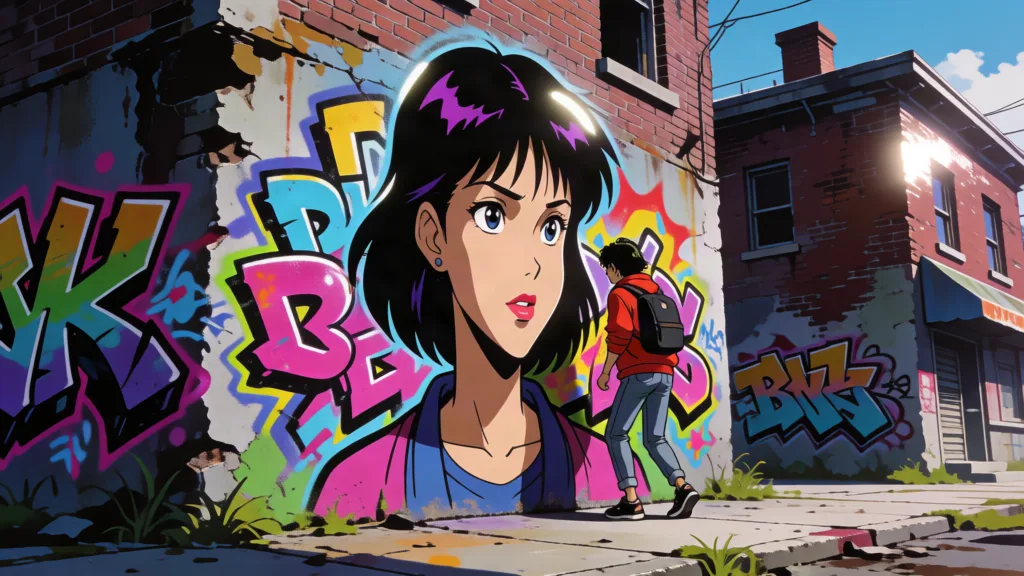
The paint was still wet when I saw my own face.
I hadn't put it there. That's the thing I need you to understand before anything else, before you decide what kind of person I am or what kind of story this is. I had spent three hours on that wall, three hours in the cold with my fingers going numb inside my gloves, and I knew every inch of what I'd painted. The dead boy's hands. The empty lot behind him. The way his shadow stretched wrong, too long for the angle of the streetlight, like something was pulling it toward the gutter. I knew that wall the way you know your own skin.
But I didn't know the girl.
She was small, maybe seven or eight, with braids that stuck out in every direction and a jacket that was too big for her. She stood at the edge of the mural, near the bottom right corner, where the concrete had crumbled away and left a rough patch I'd been avoiding all night. Her face was turned toward the dead boy, and her mouth was open like she was about to say something, and her eyes, her eyes were the exact shade of brown I see every morning in the bathroom mirror.
I dropped my brush.
The sound it made hitting the pavement was too loud for 2 a.m. in a neighborhood where nobody wanted to be seen looking out their windows. I crouched down and picked it up, and when I looked back at the wall, the girl was still there. Still watching. Still me.
"Fuck," I said, out loud, because sometimes saying it makes it more real and sometimes it makes it less, and I wasn't sure which one I needed.
The dead boy in the mural was named Marcus Webb. He'd been seventeen when he died, shot twice in the chest outside a corner store on Gratiot, and I'd known him since we were kids running through the alleys behind the Fisher Body Plant, pretending the rusted-out shells of old cars were spaceships. He used to steal cigarettes from his uncle and sell them at school for a dollar each. He used to walk me home when the streetlights came on, even though his house was in the opposite direction. He used to laugh like something was breaking inside him, and I guess something was.
I painted him because I missed him. That's all. I painted him because I couldn't sleep and I couldn't cry and I couldn't do anything except hold a can of spray paint and make something that would outlast the memory of his face on a cold metal table at the morgue.
But the girl. The girl wasn't part of the plan.
I stepped back from the wall and looked at the whole thing, the way you're supposed to look at a piece when you're deciding if it's finished. The mural covered most of the west-facing wall of an abandoned laundromat on Chene Street, a building that had been empty since before I was born. I'd been painting there for two years, ever since I figured out that the security guard who was supposed to patrol the block only came by on Tuesdays and Thursdays, and that the rest of the time, the wall was mine.
Marcus took up the center of the piece. I'd painted him in shades of gray and blue, the colors of a bruise, with his hands shoved in his pockets and his head tilted back like he was looking at something in the sky. The empty lot behind him was full of weeds and broken glass and a single shopping cart that had been there so long the vines had grown through its wheels. I'd painted all of it from memory, from the thousands of times I'd walked past that lot on my way to school, on my way home, on my way anywhere.
And now there was a girl.
I hadn't painted her. I knew I hadn't. But there she was, rendered in the same colors as Marcus, the same bruised grays and blues, like she'd been part of the composition all along. Her braids were the same style I'd worn when I was eight, before I decided that looking like a little kid was a liability in a neighborhood where you needed to seem older than you were. Her jacket was the same puffy red monstrosity my mother had bought me from the Goodwill on Michigan Avenue, the one I'd hated because it made me look like a stop sign, the one I'd worn every day for a year because it was warm and we couldn't afford anything else.
I touched the wall. The paint was dry where the girl was. Dry and slightly raised, like it had been there for days, weeks, maybe longer. Like it had been waiting for me to notice.
My phone buzzed in my pocket. I pulled it out and saw a text from my best friend, Dani, who was supposed to be meeting me here an hour ago but had texted some excuse about her mom needing her to watch her little brother. The text said: *u still out there?*
I typed back: *yeah. something weird.*
*weird how*
I looked at the girl again. Her eyes were still on Marcus, but I had the sudden, sick feeling that if I looked away and looked back, she'd be looking at me instead.
*just weird,* I typed. *come when u can.*
I pocketed the phone and started gathering my supplies, the cans of spray paint, the brushes, the roll of paper towels I used to wipe my hands. The mural was finished. I'd been planning to come back tomorrow night to add some details, maybe touch up the shadows, but now I just wanted to leave. I wanted to go home and take a shower and pretend I hadn't seen what I'd seen.
But I couldn't stop looking at her.
The thing about painting is that it changes how you see the world. After a while, you start noticing the way light falls on things, the way colors bleed into each other, the way a shadow can make or break a composition. You start seeing the bones of things, the structure underneath the surface. And once you see it, you can't unsee it.
I saw the girl. And I knew, the way you know things in dreams or in the moments before you fall asleep, that she wasn't supposed to be there. That something had gone wrong. That the wall was telling me something I didn't want to hear.
I walked home the long way, past the empty lot where Marcus died, past the corner store where his blood had stained the sidewalk for a week before someone finally hosed it off. The streetlights were flickering, the way they always did on this block, and the wind was picking up, carrying the smell of garbage and exhaust and something else, something sweet and rotten, like fruit left too long in the sun.
My apartment was on the third floor of a building that should have been condemned years ago. The elevator didn't work, the stairs creaked like they were about to give way, and the radiator in my bedroom made a sound like a dying animal every time the heat came on. But it was home. It was where my mother and I had lived since my father left, since before I could remember, and I knew every crack in the ceiling, every stain on the carpet, every draft that came through the windows in winter.
My mother was asleep on the couch when I walked in, the TV still on, some infomercial about a blender that could crush rocks. She worked double shifts at the hospital, cleaning rooms, emptying bedpans, doing the work nobody else wanted to do. She was forty-three but looked fifty, and sometimes when I looked at her, I felt like I was looking at my own future, like there was a version of me already living in that body, already tired, already worn down.
I covered her with a blanket and turned off the TV. She didn't stir. She never did.
In my room, I pulled out my sketchbook and started drawing the girl from memory. The braids. The jacket. The way she stood at the edge of the mural like she was about to step out of it. My pencil moved fast, faster than I could think, and when I was done, I had a face that looked more like mine than I wanted it to.
I closed the sketchbook and shoved it under my bed. Then I lay down and stared at the ceiling and tried not to think about what it meant.
I didn't sleep. I never slept, not really, not since Marcus died. I just lay there in the dark and listened to the sounds of the building, the pipes groaning, the neighbors fighting, the rats scurrying in the walls. And I thought about the girl.
The next morning, I went back to the wall.
I told myself I was just checking on the mural, making sure nobody had tagged over it, making sure the paint had dried okay. But I knew the truth. I wanted to see if she was still there. I wanted to see if I'd imagined her.
She was still there.
But she was different.
The girl in the mural had moved. Not much, just a few inches to the left, but enough that I noticed. Her hand was raised now, reaching toward Marcus, and her mouth was open wider, like she was screaming or singing or trying to warn him about something. And her eyes, her eyes were looking straight at me.
I felt something cold crawl down my spine. It was the same feeling I'd had when I was a kid and I'd wake up in the middle of the night convinced someone was in my room, watching me, waiting for me to move. The feeling that something was wrong, that something was coming, that I needed to run but I didn't know which direction.
I took out my phone and called Dani.
She answered on the second ring. "Hey. You okay?"
"No." I stared at the wall. "Can you come meet me? Right now?"
"Where are you?"
"The laundromat. Chene Street."
There was a pause. I could hear her breathing, could hear the sound of her little brother yelling in the background, could hear the TV playing some cartoon I didn't recognize.
"I'll be there in twenty minutes," she said. "Don't do anything stupid."
I didn't answer. I just hung up and kept staring at the girl, at her raised hand, at her open mouth, at her eyes that were the exact shade of brown I saw every morning in the bathroom mirror.
Twenty minutes later, Dani pulled up in her mother's beat-up Honda, the one with the bumper held on by duct tape and the radio that only played AM stations. She got out and walked over to me, her breath fogging in the cold air, her hands shoved deep in the pockets of her coat.
"What's going on?" she asked. "You look like you've seen a ghost."
"Maybe I have."
She looked at the mural. Then she looked at me. Then she looked at the mural again.
"I don't get it," she said. "It's beautiful. You painted Marcus. That's what you said you were going to do."
"Look at the corner. Bottom right."
She looked. She was quiet for a long time. Then she said, "Who's the girl?"
"I don't know."
"You didn't paint her?"
"No."
She turned to face me, her eyes narrow, her mouth tight. Dani had been my best friend since third grade, since the day she'd punched a boy in the nose for calling me a bitch, and she knew me better than anyone. She knew when I was lying. She knew when I was scared.
"Okay," she said. "Start from the beginning."
I told her. The whole thing. The way I'd felt when I was painting, the way the wall had seemed to breathe under my hands, the way I'd turned around and seen the girl, the way she'd moved between last night and this morning. I told her about the sketch I'd made, the one that looked like me. I told her about the feeling I'd had, the one that wouldn't go away, the one that said something was coming.
When I was done, she was quiet again. Then she said, "You need to paint over it."
"I can't."
"Why not?"
"Because I tried. Last night, after I got home, I tried to think about what I would paint over it with, and every time I closed my eyes, I saw her face. I saw her looking at me. I saw her mouth moving, like she was trying to tell me something."
Dani shook her head. "This is crazy. You know that, right? This is actually crazy."
"I know."
"So what are we going to do?"
I looked at the mural. The girl was still reaching for Marcus, still screaming or singing or whatever she was doing. But now I noticed something else. Something I hadn't seen before. There was a date painted in the corner of the mural, near the girl's feet, in small numbers that I hadn't put there.
*March 15.*
Today was March 10.
Five days.
I didn't know what was going to happen on March 15. I didn't know if the girl in the mural was me or someone else or something else entirely. But I knew, with a certainty that went deeper than logic, deeper than reason, deeper than anything I'd ever felt before, that I had five days to figure it out.
And that if I didn't, the girl in the mural would stop being a painting.
She would become real.
---
The days that followed were a blur of paint and panic and the kind of sleeplessness that makes you see things that aren't there. I went to school because my mother would kill me if I didn't, but I couldn't focus on anything. I sat in the back of my classes and drew the girl over and over, trying to understand what she was trying to tell me, trying to figure out how to change the ending before it was too late.
Dani stuck with me. She brought me coffee and cigarettes and sat with me while I stared at the wall, trying to will the girl into stillness. But every time I looked, she had moved a little more. Her hand was closer to Marcus now. Her mouth was wider. Her eyes were darker, more desperate, like she was running out of time.
On March 12, I saw the first sign that something was really wrong.
I was walking home from school, taking the long way past the empty lot, when I saw a crowd gathered on the corner. Police cars. An ambulance. The red and blue lights flashing against the gray sky like something out of a nightmare.
I pushed through the crowd and saw a body on the ground, covered by a sheet, blood pooling on the asphalt. I didn't know who it was. I didn't need to. I knew, the way I knew everything now, that this was connected to the mural. That the girl was trying to tell me something. That the deaths were going to keep happening until I figured out how to stop them.
I ran home and pulled out my sketchbook. I drew the girl again, but this time I drew her with her hand down, with her mouth closed, with her eyes looking away. I drew her the way I wanted her to be. The way I needed her to be.
Then I went back to the wall and painted over the original girl with white paint, covering her completely, erasing her from the mural. I painted a tree in her place, a dead tree with bare branches and no leaves, something that couldn't move, something that couldn't change, something that couldn't predict anything.
When I was done, I stepped back and looked at the wall. The tree was there. The girl was gone. Marcus was still in the center, still looking at the sky, still dead.
I felt something loosen in my chest. Maybe I'd fixed it. Maybe I'd changed the ending.
Then I saw the paint start to move.
It was slow at first, just a ripple, like water when you drop a stone into it. But then it got faster, and the white paint began to peel away, curling at the edges like it was being pushed from underneath. And the girl came back.
She came back different.
She was bigger now, taller, older. Her braids were gone, replaced by long hair that hung down past her shoulders. Her jacket was gone, replaced by a hoodie the same color as the one I was wearing. And her face, her face was mine. Not the face of a seven-year-old girl. My face. The face I saw in the mirror every morning, the face I'd been trying to hide from for years.
She was looking at me. And she was smiling.
I felt something break inside me. Something I'd been holding together for a long time, something I'd been pretending wasn't there. I fell to my knees on the cold pavement and I screamed, and the sound echoed off the buildings and disappeared into the night.
When I looked up, the girl was still there. Still smiling. Still me.
And I knew, with a certainty that went beyond fear, beyond hope, beyond anything I'd ever felt before, that I had four days to figure out how to save myself.
Or I would become the thing I'd been painting all along.
---
The next morning, I woke up to a text from a number I didn't recognize.
*I know what you're going through,* it said. *I can help.*
I stared at the screen for a long time, my heart pounding in my chest. Who was this? How did they know? Was this some kind of joke, some kind of trap, some kind of trick?
I typed back: *Who is this?*
The response came immediately: *Someone who's been where you are. Someone who knows about the murals. Someone who can teach you how to change them.*
I didn't know what to say. I didn't know what to think. But I knew I couldn't do this alone. I knew I needed help.
*Where do you want to meet?*
*The old train station. Tonight at midnight. Come alone.*
I should have been scared. I should have been suspicious. But all I felt was something I hadn't felt in days.
Hope.
---
The old train station was on the edge of the neighborhood, a crumbling building that had been abandoned since before I was born. The windows were broken, the roof was caving in, and the tracks that led to it were overgrown with weeds and rust. Nobody went there anymore. Nobody except the people who had nowhere else to go.
I got there at 11:45, because I've never been good at being late. I stood in the shadows and waited, watching the entrance, listening for footsteps. The wind was cold and sharp, and I could hear the distant sound of a train horn, the kind that used to wake me up at night when I was a kid.
At midnight, a figure appeared in the doorway.
It was a woman, older than me, maybe thirty or thirty-five, with dark skin and short hair and eyes that seemed to see right through me. She was wearing a long coat and boots that looked expensive, and she moved like someone who was used to being in charge.
"You're the one who painted the mural," she said. It wasn't a question.
"Yes."
"The one with the girl."
"Yes."
She nodded, like she'd expected that answer. Then she said, "My name is Adia. I've been watching you for a while. I've been watching a lot of people. But you're different. You're the first one who's seen the girl before it was too late."
"Too late for what?"
She looked at me, and her eyes were sad, and I knew, before she said anything, that I wasn't going to like the answer.
"Too late to save yourself," she said. "Too late to change the ending. Too late to do anything except watch it happen."
I felt something cold settle in my chest. "What do you mean?"
She reached into her coat and pulled out a photograph. It was old, faded, creased at the edges, but I could see the image clearly. It was a mural, painted on a wall I didn't recognize, and in the center of the mural was a man with a gunshot wound to his chest.
"I painted that ten years ago," she said. "I painted it because I missed my brother. I painted it because I couldn't sleep and I couldn't cry and I couldn't do anything except hold a can of spray paint and make something that would outlast the memory of his face."
I stared at the photograph. Then I stared at her.
"The next day," she said, "he was dead. Shot in the chest. Just like I'd painted him."
I felt the world tilt under my feet. "You're saying the murals come true."
"I'm saying the murals show you what's already happening. They show you what's coming. And if you're not careful, they show you what you can't stop."
I thought about Marcus. I thought about the girl. I thought about the date in the corner of the mural, the one that was getting closer every day.
"Can you teach me how to change it?" I asked. "Can you teach me how to save myself?"
She looked at me for a long time. Then she said, "I can teach you how to try. But I can't promise it will work. I can't promise anything."
"That's okay," I said. "I don't need promises. I just need a chance."
She nodded, slow, like she was deciding something. Then she said, "Come with me. There's something I need to show you."
She turned and walked into the darkness of the train station, and I followed her, because I didn't have a choice, because I was running out of time, because the girl in the mural was getting closer to me every day and I didn't know how to stop her.
We walked through the abandoned station, past rusted ticket booths and broken benches and walls covered in graffiti that was older than I was. Adia didn't say anything, and I didn't ask any questions. I just followed her, deeper and deeper into the building, until we reached a door that was locked with a chain and a padlock.
She pulled out a key and unlocked it. The door creaked open, and I saw a room filled with paintings. Dozens of them. Hundreds of them. Murals and canvases and sketches, all of them depicting people, all of them with dates in the corners, all of them with the same bruised gray and blue colors I'd used for Marcus.
"This is what happens," Adia said. "This is what we become. We paint, and we paint, and we paint, and we can't stop, because if we stop, we have to feel. And we can't feel. Not anymore."
I looked at the paintings. I saw faces I recognized, people from the neighborhood who had died, people I'd known, people I'd loved. I saw Marcus. I saw the boy from the corner, the one who'd been shot two days ago. I saw a girl with braids and a red jacket and eyes the exact shade of brown I saw every morning in the bathroom mirror.
"This is my life now," Adia said. "This is what I've become. And if you're not careful, it's what you'll become too."
I turned to face her. "How do I stop it?"
She looked at me, and her eyes were sad, and I knew, before she said anything, that the answer wasn't going to be easy.
"You have to paint something you can't bear to paint," she said. "You have to paint the thing you're most afraid of. And then you have to let it go."
"I don't understand."
"You will," she said. "When the time comes, you will."
She turned and walked out of the room, and I stood there, surrounded by the dead, surrounded by the paintings, surrounded by the evidence of everything I was afraid of becoming.
And I knew, with a certainty that went beyond fear, beyond hope, beyond anything I'd ever felt before, that I had three days to figure out what she meant.
Three days to save myself.
Three days to change the ending.
---
I didn't sleep that night. I couldn't. Every time I closed my eyes, I saw the girl, my face, my eyes, my smile. I saw her reaching for Marcus, reaching for me, reaching for something I couldn't understand. I saw the date in the corner of the mural, the one that was getting closer every second.
March 15.
Three days away.
I got up before dawn and went to the wall. The girl was still there, still smiling, still me. But she was different now. She was closer. She was almost touching Marcus, almost touching the edge of the mural, almost touching the world outside.
I took out my spray paint and started working.
I didn't know what I was doing. I didn't have a plan. I just started painting, letting my hands move, letting the colors speak, letting something deeper than thought guide me. I painted over the girl, covering her with white, covering her with black, covering her with every color I had. I painted until my fingers were numb and my arms were sore and the sun was rising over the buildings.
When I was done, I stepped back and looked at the wall.
The girl was gone. The mural was empty. Just Marcus, just the lot, just the shadows.
I felt something loosen in my chest. Maybe I'd done it. Maybe I'd changed the ending.
Then I saw the paint start to move.
It was slow at first, just a ripple, like water when you drop a stone into it. But then it got faster, and the colors began to swirl, and the girl came back.
She came back different.
She was older now, my age, my height, my face. She was wearing my clothes, my jacket, my shoes. And she was holding something in her hand.
A paintbrush.
She was painting me.
I watched as she painted my face, my eyes, my mouth. I watched as she painted my body, my hands, my feet. I watched as she painted me into the mural, into the wall, into the world she was creating.
And I knew, with a certainty that went beyond fear, beyond hope, beyond anything I'd ever felt before, that I had two days to figure out how to stop her.
Two days to save myself.
Two days to change the ending.
Or I would become the thing I'd been painting all along.
I would become the girl in the mural.
I would become the death that was coming for me.
And there was nothing I could do to stop it.
Watch this moment
Turn the current scene into a cinematic Live Chapter — what you watch becomes the story's next part.
Disclaimer
This is a work of fiction, assisted by artificial intelligence. Any names or characters, businesses or places, events or incidents, are fictitious. Any resemblance to actual persons, living or dead, or actual events is purely coincidental.
Content Removal Policy
- Users may report content that may be illegal or violates our Standards.
- All reported complaints will be reviewed and resolved within seven business days.
- Review Process: Our team will assess the reported content against our guidelines.
- Appeals: If you disagree with a decision, you may appeal within 14 days of notification.
- Potential outcomes include: content removal, account warning, or no action if no violation is found.
To report content, email us at [email protected]