Share
Go Live
Inkbound Descent
·
Published 9/28/2026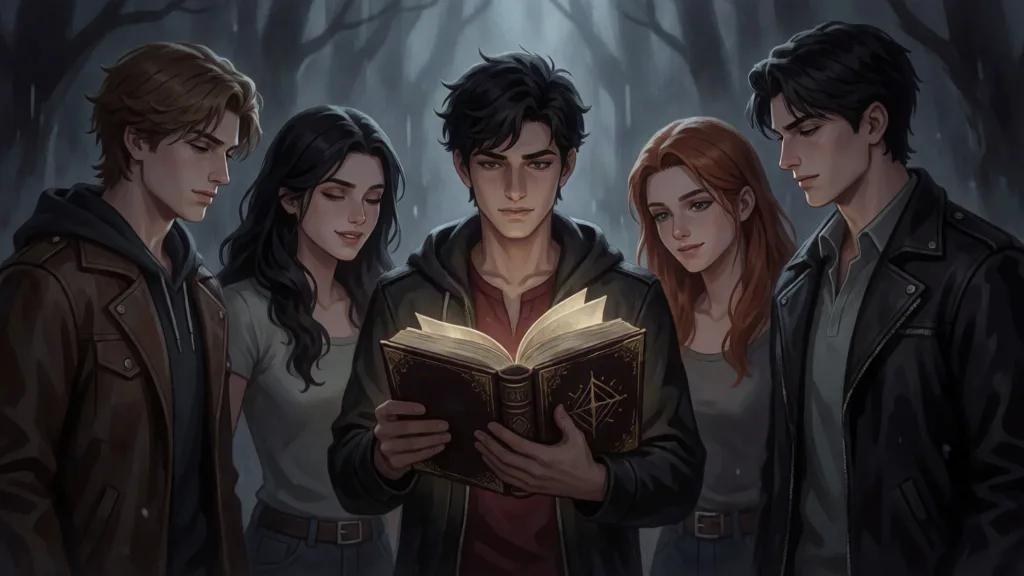
The book was already open when I found it.
That's the thing I keep coming back to. Not that we found a book in a dead man's house, not that it was bound in something that wasn't quite leather, not even the symbols that moved when you weren't looking directly at them. It was already open. Like someone had been reading it and just stepped away. Like it was waiting.
But I'm getting ahead of myself. I do that now. Jump to the ending before the beginning, because the beginning feels like a lie. It feels like a story about other people, people I used to know, people who hadn't done the things we did.
I'll start with the house, because that's where it actually starts. Not with the book. With the house.
---
Dorian found the listing on a Wednesday. He called me at work, which he never did, because Dorian didn't believe in phone calls. He believed in showing up unannounced and standing in your doorway until you acknowledged him, like a cat.
"You need to see this place," he said.
"I'm at work."
"It's on Magnolia. Behind the old cemetery."
"I'm at work, Dorian."
"Four bedrooms. Two baths. Original hardwood. And the price, Marcus. The price is insane."
I was balancing my phone between my ear and shoulder, trying to finish a spreadsheet that my supervisor needed by noon. The fluorescent lights in the office were doing that thing where they buzzed just loud enough to make you feel like you were losing your mind slowly. I'd been at that job for three years. I hated it with a passion that was almost religious.
"How insane?"
"Insane enough that I already called the agent. We're seeing it tomorrow at four."
"I have work tomorrow at four."
"You have work every day at four. That's the problem."
He hung up before I could argue. That was Dorian's way. He'd already decided, and my job was to catch up.
---
The four of us had been friends since college, which is a thing people say like it explains something. It doesn't. It just means we'd known each other long enough to stop being polite and start being honest, which is either the foundation of real friendship or the beginning of the end, depending on how you look at it.
Dorian was the one who found things. Jobs, apartments, women, opportunities. He had a nose for it, a kind of low-grade hustler's intuition that made him the most interesting person in any room and the least reliable. He'd dropped out of school sophomore year to start a company that sold artisanal candles online. It failed. Then he started a company that sold artisanal dog treats. That failed too. By the time we graduated, he was working at a bar and talking about his next big idea like it was already happening, like reality just needed to catch up with his vision.
Priya was the one who kept us together. She was a lawyer, or almost a lawyer, finishing her last year of law school and working at a firm that treated her like furniture. She was the responsible one, the one who remembered birthdays and sent cards and called to check in when you went quiet. She had this way of looking at you, steady and patient, that made you want to tell her the truth. I never could. None of us could, not completely. But she tried.
And then there was Jonah.
Jonah was the one who scared me. Not in a bad way, not then. In a way that made me feel like I was standing next to something I didn't understand. He was a musician, or he wanted to be, and he had this intensity that burned off him like heat. When he played guitar, which he did constantly, he'd close his eyes and disappear into it, and when he came back, he'd look at you like he'd just woken up from a dream he couldn't quite remember. He was the most talented person I'd ever met and the most lost. He'd been in and out of rehab twice by the time he was twenty-five. Nothing serious, he said. Just pills. Just a little too much of everything.
I was the one who watched. That's what I did. I watched Dorian charm his way through life, watched Priya hold everything together, watched Jonah burn. I watched and I took notes and I told myself I was the stable one, the reliable one, the one who'd never lose control.
I was wrong about that. But we'll get there.
---
The house on Magnolia Street had been empty for eleven years.
That's what the agent told us, standing on the front porch with a key that looked older than she was. Her name was Carol, and she had the kind of forced cheerfulness that made you want to apologize for existing. She kept saying things like "lots of potential" and "great bones" and "priced to sell," and I kept nodding and thinking about how the windows looked like eyes.
"It belonged to a professor," Carol said, fitting the key into the lock. "English literature, I think. He passed away a few years back. No family, no will. The state finally got around to selling it."
"Passed away in the house?" Dorian asked.
Carol's smile flickered. "I believe so. Peacefully, though. In his sleep."
She pushed the door open, and the smell hit us first. Old paper and dust and something else, something underneath, like the air in a basement or a church that's been closed for a long time. The kind of smell that makes you think of things that happened before you were born.
The living room was enormous. High ceilings, crown molding, a fireplace that looked like it could swallow a person whole. The furniture was still there, covered in white sheets like ghosts. Bookshelves lined every wall, floor to ceiling, packed with volumes that looked like they hadn't been touched in decades.
"See?" Dorian said, spreading his arms like he was presenting a prize. "It's perfect."
"It's creepy," Priya said.
"It's character."
"It's a dead man's house."
"Everything's a dead man's house if you think about it."
I walked past them, into the room. The floorboards creaked under my feet, and the sound echoed in a way that felt wrong, too loud and too quiet at the same time. The sheets on the furniture were gray with dust, and when I pulled one back, the couch underneath was velvet. Deep green velvet, worn smooth in places where someone had sat for hours.
I sat down. I don't know why. My body just did it, like it had decided before my brain could catch up. The couch was softer than it looked, and I sank into it, and for a moment I felt something I couldn't name. Not peace, exactly. Something older than peace. Something like recognition.
"Marcus?" Priya's voice came from the doorway. "You okay?"
"Yeah." I stood up quickly, too quickly, and the room spun a little. "Just tired."
She looked at me for a long moment, that steady look of hers, and I could see her deciding whether to push. She didn't. She never did, not about the small things. Only the big ones.
"Come see the kitchen," she said. "It's actually kind of amazing."
---
We explored the house for an hour. It was bigger than it looked from the outside, rooms leading into rooms leading into rooms, like a maze that someone had built for reasons they never explained. There was a study on the second floor, small and dark, with a desk that faced the window and a chair that looked like it had been sat in until the cushion wore through. There was a bedroom with a four-poster bed and curtains that turned the light gold. There was a bathroom with a claw-foot tub and a mirror that was clouded with age.
And there was the library.
It was in the back of the house, past the kitchen, through a door that looked like it led to a pantry. But it didn't. It led to a room that was maybe fifteen feet by fifteen feet, with no windows and shelves on every wall and a single reading chair in the center, surrounded by stacks of books that rose like towers.
Dorian found it first. I heard him say "holy shit" from somewhere ahead of me, and when I caught up, he was standing in the doorway with his mouth open.
"Guys," he said. "You need to see this."
We crowded in behind him. The air was thick, almost solid, and it smelled like old paper and candle wax and something sweet underneath, like fruit that had been left to rot. The books on the shelves were old, older than anything I'd seen outside of a museum. Leather bindings and yellowed pages and titles in languages I didn't recognize.
"This is incredible," Priya said. "These could be worth something."
"They're not going anywhere," Dorian said. "They come with the house."
"The house doesn't come with anything. We haven't bought it."
"Details."
I moved past them, into the room. The floor was cold through my shoes, and the cold felt wrong for summer, wrong for any season. I ran my finger along the spine of a book on the nearest shelf. The leather was rough, cracked, and warm in a way that had nothing to do with the temperature.
And then I saw it.
The book was on the reading chair, not on the shelf. It was open, pages facing up, like someone had set it down mid-sentence and walked away. The cover was dark, so dark it seemed to absorb the light around it, and there were symbols on it that I couldn't quite focus on. Every time I tried to look directly at them, my eyes would slide away, like they were trying to protect me from something.
"Marcus?" Priya was beside me. "What is it?"
"I don't know." I picked up the book.
It was heavier than it should have been. That was the first thing I noticed. It weighed more than any book I'd ever held, more than its size could explain, like it was made of something denser than paper and leather. And it was warm. Not the warmth of a room or a body, but something else. Something that felt like it was coming from inside.
The pages were covered in handwriting. Small, precise, the kind of handwriting that belonged to someone who'd spent their whole life writing and never learned to do it any other way. But the words weren't English. They weren't any language I recognized. They looked like symbols, like the ones on the cover, and they seemed to shift when I looked at them, rearranging themselves into patterns that almost made sense.
"Can you read it?" Dorian asked.
"No."
"Let me see."
I handed it to him, and the moment it left my hands, I felt something I can only describe as loss. A hollow ache in my chest, like I'd put down something I needed to hold. I shook it off. It was a book. Just a book.
Dorian flipped through the pages, frowning. "It's gibberish. Some kind of code, maybe."
"Or a different language," Priya said. "The professor was an English literature teacher. Maybe it's Old English? Or Latin?"
"It's not Latin." Jonah spoke for the first time since we'd entered the room. He'd been standing in the corner, quiet, watching. That was his way. He'd go silent for hours and then say something that made you realize he'd been paying more attention than anyone.
"How do you know?" Dorian asked.
"I took Latin in high school. This isn't it." He reached for the book, and Dorian gave it to him. Jonah held it like he was holding something alive, something that might bite. His eyes moved across the pages, and I watched his face change. The way his jaw tightened. The way his breathing slowed.
"Jonah?" Priya's voice was careful. "What is it?"
"I don't know." But he did. I could see it in his eyes. He knew something, or he felt something, and he wasn't telling us. "It's just... weird."
"Weird how?"
He didn't answer. He just kept looking at the pages, and the pages kept shifting, and I felt the room get colder, or maybe that was just me.
---
We didn't buy the house.
That's what I tell myself, anyway. We didn't buy it, we didn't sign anything, we didn't make any commitments. We just... stayed. Dorian convinced the agent to let us "think about it," which meant he convinced her to give us the key for a few days, which meant we had access to a dead man's house and everything inside it.
It started as a joke. We'd hang out there after work, bring beers and takeout, pretend we were rich people who could afford a place like that. Priya would study in the library, surrounded by books she couldn't read. Dorian would pace around the living room, talking about how he could flip the place, make a fortune. Jonah would sit in the study with the guitar he'd brought from his apartment, playing songs that didn't have names.
And I would read the book.
I don't know when it started. I don't know when "hanging out" became "research," when curiosity became something else. All I know is that one night, I found myself in the library alone, the book open on my lap, and I was reading.
Not understanding. Not yet. But reading. The symbols were still symbols, still shifting, but they were shifting in a way that felt familiar now. Like a language I'd heard in a dream and was starting to remember.
The first word I understood was "fire."
I don't know how I knew it meant fire. I just did. The symbol on the page, the one that looked like a flame that had been twisted into a knot, I looked at it and I knew. Fire. The word was fire.
And then I knew another one. "Blood."
And another. "Door."
And another. "Open."
I sat there for hours, turning pages, collecting words like stones. The room got darker, and I didn't turn on a light. The cold got deeper, and I didn't put on a jacket. I just read, and the words piled up in my head, and somewhere in the back of my mind, a voice that sounded like mine but wasn't was saying something I couldn't quite hear.
When I finally looked up, it was past midnight. The house was silent. My friends had gone home without saying goodbye.
I closed the book and held it against my chest, and I felt that warmth again, that sense of something coming from inside. And I thought, for the first time, that maybe I didn't want to give it back.
---
The next morning, I woke up with a headache that felt like someone had driven a nail through my skull.
I was in my apartment, in my bed, still wearing the clothes from yesterday. I didn't remember coming home. I didn't remember leaving the house on Magnolia. I just remembered the book, and the words, and the cold.
My phone was on the nightstand, blinking with messages. Dorian: "Where'd you go last night?" Priya: "You okay?" Jonah: "I need to talk to you."
I ignored them all. I got up, took four ibuprofen, and stood in the shower for twenty minutes, letting the hot water wash over me. It didn't help. The headache was still there, a dull throb behind my eyes, and there was something else, something underneath it. A feeling I couldn't name.
I got dressed. I went to work. I sat at my desk and stared at my computer and tried to remember what I was supposed to be doing.
And then I saw it. On the spreadsheet, in the corner of the screen, a symbol. The one that meant fire. It was there for a second, just a flicker, and then it was gone.
I blinked. I rubbed my eyes. I told myself I was tired, that I hadn't slept enough, that I was seeing things. But I knew what I'd seen. And I knew, somehow, that it wasn't a hallucination.
It was a message.
---
Jonah called me that night. I was sitting on my couch, staring at the wall, trying not to think about the book. My head still hurt. The symbol hadn't come back, but I could feel it there, waiting, like a word on the tip of my tongue.
"Marcus." His voice was rough, like he'd been smoking or screaming. "I need you to come over."
"Now?"
"Now."
He lived in a studio apartment on the other side of town, a place so small it felt like a closet. I'd been there a hundred times, but it felt different that night. The air was thick, electric, like the moment before a storm. Jonah was sitting on his bed, guitar in his lap, but he wasn't playing. He was just staring at the wall.
"What's going on?" I asked.
He didn't answer. He just pointed at the notebook on his desk.
I picked it up. It was one of those cheap composition notebooks, the kind you buy at a drugstore for a dollar. But the pages were covered in symbols. The same symbols from the book. The ones I'd been reading.
"Jonah." My voice came out strange, tight. "What is this?"
"I don't know." He finally looked at me, and his eyes were red, like he'd been crying or not sleeping. "I woke up this morning and I couldn't stop writing. I didn't even know what I was writing. It just... came out."
I flipped through the pages. There were dozens of them, maybe hundreds, all covered in the same shifting script. And in the middle of one page, circled three times, was a symbol I recognized.
"Fire," I said.
Jonah's head snapped up. "What?"
"That symbol. It means fire."
He stared at me. "How do you know that?"
"I don't know. I just do."
We sat there in silence for a long time. The city hummed outside his window, cars and sirens and people living their lives, and none of them knew what we knew. None of them had seen what we'd seen.
"It's the book," Jonah said finally. "It has to be."
"It's just a book."
"No. It's not." He stood up, started pacing, his hands shaking. "I've been clean for eight months, Marcus. Eight months. And last night, after I left that house, I felt something I haven't felt since I was using. This... hunger. This need. I wanted to go back. I wanted to read more. I wanted to understand."
"Jonah..."
"I'm not crazy." He stopped pacing, looked at me. "I know how it sounds. But I'm not crazy. Something's happening. Something real."
I wanted to tell him he was wrong. I wanted to tell him it was stress, or lack of sleep, or the weirdness of the house messing with our heads. But I couldn't. Because I felt it too. The hunger. The need. The sense that something was waiting for us, something that had been waiting for a long time.
"Okay," I said. "Okay. We'll figure it out."
"How?"
"I don't know. But we'll figure it out."
He nodded, and for a moment, he looked like the old Jonah. The one who laughed and played guitar and didn't have shadows under his eyes. But then the moment passed, and the shadows came back, and I knew we were in something we couldn't get out of.
---
The next week was a blur.
We went back to the house. Of course we did. We told ourselves we were just checking on it, making sure nothing had been stolen, but we all knew the truth. We were going back for the book.
Dorian was the one who suggested it. "We should catalog everything," he said, like he was talking about a business plan. "Figure out what's valuable. Maybe there's something we can sell."
"You want to sell the books," Priya said. She didn't sound convinced.
"Some of them. Not all of them."
"The book stays," Jonah said. His voice was flat, final. "The one with the symbols. That stays."
Dorian looked at him, then at me. I didn't say anything. I didn't need to. We all knew the book wasn't going anywhere.
We spent the day in the library, going through the shelves. Most of the books were old, but ordinary. Novels, histories, collections of poetry. The professor had eclectic taste. But there were others, hidden in the back, behind the ordinary books. Books with the same dark covers, the same shifting symbols. Books that felt heavy and warm and alive.
"How many are there?" Priya asked.
"I don't know." I pulled one off the shelf, opened it. The symbols swam before my eyes, rearranging themselves, and I understood a word. "Light."
"What?"
"Nothing." I closed the book, put it back. "There's a lot of them. That's all."
We didn't talk about what we were doing. We didn't say, "Hey, maybe we shouldn't mess with books that seem to be teaching us a language we don't know." We just... kept going. Kept reading. Kept collecting words.
By the end of the week, I knew fifty words. By the end of the month, I knew two hundred.
And I could do things.
---
The first time it happened, I was alone in my apartment.
I was sitting on my couch, reading one of the smaller books I'd taken from the house. It was a thin volume, bound in black, with pages that were almost transparent. The symbols on them were simpler than the ones in the main book, more like a primer than a textbook. I'd been working through it for days, learning the basics, and I'd just figured out a phrase that I thought meant "small flame."
I said it out loud. Just to hear it. Just to see what it sounded like.
And the candle on my coffee table lit.
I hadn't touched it. I hadn't even looked at it. But there it was, burning, a small steady flame that hadn't been there a second before. I stared at it, my heart pounding, and I thought, I did that. I did that.
I blew out the candle. I said the phrase again. It lit.
I did it ten more times, twenty, thirty, until I lost count. Each time, the flame appeared. Each time, I felt something inside me shift, like a muscle I hadn't known I had was getting stronger.
And then I felt the headache. Worse than before. A spike of pain behind my eyes, so sharp I had to close them, had to press my palms against my temples and wait for it to pass. When it did, I was sweating, shaking, and the candle was still burning.
I blew it out. I put the book on the shelf. I told myself I was done for the night.
But I wasn't. I knew I wasn't. Because even through the pain, even through the fear, I felt something else. Something that scared me more than anything.
I felt happy.
---
I didn't tell the others.
I don't know why. Maybe I wanted to keep it for myself. Maybe I was afraid of what they'd say. Maybe I was afraid of what they'd do. But I didn't tell them, and I kept practicing, and the headaches got worse, and I didn't care.
I learned to light candles. Then I learned to light fires. Small ones, in my sink, in a bowl, places where they couldn't spread. I learned to make the flames dance, to make them change color, to make them burn without heat. I learned to put them out with a thought.
And then I learned other things.
I learned to move objects. Small ones at first, a pencil, a cup, a book. Then bigger ones. I learned to make the air cold, to make it warm, to make it move. I learned to hear things from far away, to see things in the dark. I learned to make people forget.
That one was an accident. I was at work, and my supervisor was yelling at me about something, something that didn't matter, and I just wanted her to stop. I said a word, one of the words I'd learned, and she stopped. She looked at me, confused, and then she said, "What were we talking about?" And I said, "Nothing." And she nodded and walked away.
I didn't do it again for a week. I was scared. But the fear faded, like it always does, and I started to wonder what else I could do.
---
Priya found out first.
She showed up at my apartment on a Saturday morning, unannounced, which wasn't like her. Priya always called first. Priya always made plans. But she was standing at my door with a look on her face that I'd never seen before, something between fear and excitement.
"I need to show you something," she said.
She came inside, sat on my couch, and pulled a book out of her bag. One of the books from the house. I recognized the cover, the dark leather, the symbols that shifted when you looked at them.
"I've been reading," she said. "I know you have too. Don't pretend."
"I wasn't going to."
She opened the book to a page she'd marked. "I found this. It's a spell. A real spell. I tried it last night, and it worked."
"What did it do?"
She looked at me, and I saw something in her eyes that I didn't recognize. Something hard. Something hungry.
"It made someone tell me the truth," she said. "Someone at work. Someone who's been lying to me for months. I said the words, and he just... told me everything. Everything he'd been hiding."
"Priya..."
"I know how it sounds." She closed the book, held it against her chest. "But it felt good, Marcus. It felt right. Like I'd been waiting my whole life for something like this."
I wanted to tell her to stop. I wanted to tell her it was dangerous, that we didn't know what we were dealing with. But I couldn't. Because I felt the same way. Because I'd been doing the same thing.
"Okay," I said. "Okay. We'll figure it out together."
She nodded, and we sat there in silence, two people who'd found something they couldn't give up, and neither of us said what we were both thinking.
What else can we do?
---
Dorian found out a week later.
He didn't come to me. He went to Jonah. And Jonah came to me.
We met at a diner, the three of us, at two in the morning. The place was empty except for a waitress who looked like she'd rather be anywhere else. Dorian was pale, shaking, and Jonah looked like he hadn't slept in days.
"He did something," Jonah said. "Something bad."
"I didn't mean to." Dorian's voice was high, desperate. "It was an accident."
"What happened?"
Dorian looked at me, and I saw something in his eyes that I'd never seen before. Fear. Real fear.
"I was at the bar," he said. "This guy, this asshole, he was giving me a hard time. Saying things, pushing me. And I just... I wanted him to stop. I said something, I don't even know what, and he... he fell. He just fell. Like something pushed him. And he hit his head, and there was blood, and I ran. I ran, Marcus."
"Is he dead?"
"I don't know. I don't know."
We sat there in silence. The waitress brought coffee, and we didn't touch it. The world outside the window kept moving, cars and lights and people who didn't know what we knew.
"We have to stop," Priya said. She'd been quiet until now, listening, watching. "This is getting out of control."
"Stop?" Dorian laughed, a broken sound. "How do we stop? This is part of us now. It's in us."
"We can choose not to use it."
"Can we?" He looked at her, and there was something ugly in his eyes. "Can you? Really?"
She didn't answer. None of us did.
---
The thing about magic is that it doesn't care what you want.
I learned that the hard way. I tried to stop. I put the books away, I locked them in a drawer, I told myself I was done. But the words were still in my head, and the power was still in my blood, and every time I felt something I didn't want to feel, every time I wanted something I couldn't have, the words were there. Waiting.
I lasted three days. Three days of headaches, of shaking, of feeling like I was missing a part of myself. And then I gave in. I opened the drawer, took out the book, and read.
The relief was immediate. The pain went away. The emptiness filled. And I felt whole again, for the first time in days.
That's when I knew. That's when I understood what we were dealing with.
It wasn't a tool. It wasn't a gift. It was a hunger. And we were feeding it.
---
Jonah was the first to go too far.
He'd been quiet for weeks, disappearing into his apartment, not answering calls. We knew he was reading. We knew he was practicing. But we didn't know how much until the night he called us, his voice barely a whisper, and asked us to come over.
His apartment was a mess. Papers everywhere, covered in symbols. Candles burning on every surface, their flames the wrong color, blue and green and purple. And Jonah was sitting in the middle of it all, his eyes wide, his hands shaking.
"I can hear them," he said.
"Hear who?"
"Everyone." He looked at me, and his eyes were wrong. Too bright, too focused. "I can hear everyone. All the time. Their thoughts. Their feelings. Their secrets. I can't make it stop."
"Jonah, you need to calm down."
"I can't calm down!" He stood up, knocking over a candle. The flame caught a piece of paper, and I stamped it out with my foot. "I can't sleep. I can't eat. I can't think. It's like there's a thousand voices in my head, and they won't shut up."
Priya stepped forward, her hands raised. "Let us help you. There has to be a way to reverse it."
"There's no reverse." He laughed, a sound that made my skin crawl. "There's no going back. Once you open the door, it stays open. That's what the book says. That's what it's been telling me all along."
"What else does it say?"
He looked at me, and for a moment, I saw the old Jonah. The one who laughed and played guitar and didn't have shadows under his eyes.
"It says we're not the first," he said. "It says there have been others. Hundreds of others. Thousands. And they all thought they could control it. They all thought they were special."
"What happened to them?"
He didn't answer. He just sat back down, pulled his knees to his chest, and started rocking.
"Jonah?"
"They burned out," he said. "Or they burned up. Same thing, in the end."
---
We took him to the hospital the next day.
He didn't want to go. He fought us, screamed at us, told us we were betraying him. But we didn't have a choice. He was hurting himself, scratching at his skin, trying to get the voices out. We couldn't watch him destroy himself.
They kept him for observation. They said it was exhaustion, stress, maybe a psychotic break. They didn't know about the book. They didn't know about the magic. They just saw a young man who'd lost his mind, and they gave him pills and a quiet room and told him he'd be okay.
He wasn't okay. We knew that. But we didn't know what else to do.
Priya stopped using after that. She packed up her books, put them in a box, and sealed it with tape. She said she was done. She said she'd rather be ordinary than end up like Jonah.
I wanted to believe her. I wanted to believe we could all walk away. But I knew better. I knew the hunger. I knew the way it whispered to you in the quiet moments, promising you things you couldn't have, things you shouldn't want.
And I knew that Dorian was still using. I could see it in his eyes, the same brightness I'd seen in Jonah's. The same hunger.
---
The thing about power is that it changes you.
Not all at once. Not in a way you can point to and say, "That's when it happened." It's gradual, cumulative, like water wearing away stone. You start with small things, things that don't matter. A candle lit with a thought. A door unlocked without a key. And then you move on to bigger things, because the small things don't satisfy you anymore. You need more. You always need more.
Dorian needed more.
He started with money. Small amounts at first, just enough to pay his rent, to keep the bar job he hated. Then bigger amounts, from people who wouldn't miss it, from companies that had plenty to spare. He told himself it was fine, that he was just leveling the playing field, that the world owed him something.
Then he started with people.
He could make them like him. That was the first thing. He'd say a few words, and suddenly everyone wanted to be his friend, to help him, to give him what he wanted. It was intoxicating, that power. It was addictive.
And then he started with worse things.
I found out by accident. I was at his apartment, looking for a book he'd borrowed, and I found a notebook. It was filled with names, dates, details. People he'd manipulated. People he'd hurt. People he'd... I couldn't even think the word.
"Dorian." I confronted him that night, the notebook in my hand. "What is this?"
He looked at me, and there was nothing in his eyes. No guilt, no shame, no recognition. Just a blank, flat stare.
"It's business," he said.
"Business? You're controlling people. You're making them do things."
"I'm making them do what they should have done anyway. I'm helping them."
"You're hurting them."
He laughed. "Hurting them? Marcus, I'm saving them. I'm giving them purpose. I'm giving them direction. Without me, they'd just be wandering through their lives, not knowing what they want, not knowing what they need."
"That's not your decision to make."
"Isn't it?" He stepped closer, and I felt something press against my mind, something cold and probing. "I have the power, Marcus. I have the ability. Why shouldn't I use it?"
"Because it's wrong."
"Wrong?" He laughed again, and the sound was ugly, broken. "There's no wrong. There's no right. There's just power. And I have it. And you have it too, whether you admit it or not."
I left. I walked out of his apartment and didn't look back. But I could feel him watching me, and I knew, somehow, that this wasn't over.
---
Priya called me the next week. Her voice was shaking.
"Dorian's been arrested," she said.
"What?"
"I don't know the details. Something about fraud, manipulation. Someone found out what he was doing and reported him."
I thought about the notebook. The names. The dates.
"Did you...?"
"No." Her voice was firm. "I didn't. But someone did. And I think... I think he knows it was one of us."
I didn't say anything. I just stood there, the phone pressed to my ear, and felt the world shift under my feet.
---
Dorian got out on bail. He didn't call me. He didn't call anyone. He just disappeared, into the city, into the shadows, and we didn't hear from him for weeks.
And then, one night, I woke up to find him standing in my bedroom.
He was thinner than I remembered, his eyes sunken, his clothes rumpled. But there was something in his face that scared me more than anything. Something cold. Something final.
"You did this," he said.
"I didn't do anything."
"You told them. You gave them the notebook."
"I didn't."
"I know it was you." He stepped closer, and I felt that pressure again, that cold probing against my mind. "I can see it in your thoughts. You've been afraid of me. You've been jealous. You wanted to take me down."
"That's not true."
"Isn't it?" He smiled, and it was the worst smile I'd ever seen. "It doesn't matter. It's done. But I want you to know something, Marcus. I want you to know that this isn't over."
"What do you mean?"
"I mean I'm going to find the source," he said. "The source of all of this. The thing that made the book. And when I do, I'm going to make sure you never hurt me again."
He turned and walked out, and I stood there in the dark, shaking, and I knew that whatever came next, it would be worse than anything we'd faced before.
---
I went to the house on Magnolia Street the next day.
I don't know why. Maybe I was looking for answers. Maybe I was looking for a way out. Maybe I just wanted to feel close to something that had once felt like possibility.
The house was empty. The books were gone. All of them, every shelf, every stack. Just empty shelves and dust and the smell of old paper fading into nothing.
Except for one.
The main book. The one I'd found on the reading chair. It was sitting on the floor in the middle of the library, open to a page I'd never seen before. And on that page, in handwriting I recognized as my own, were three words.
"Close the door."
I stared at them for a long time. I thought about everything that had happened. The power, the hunger, the way it had changed us. I thought about Jonah, lost in his own mind. I thought about Dorian, consumed by his need for control. I thought about Priya, trying to hold on to who she used to be.
And I thought about myself. About the things I'd done, the things I'd wanted, the things I was still capable of.
I picked up the book. It was warm, like always. Heavy, like always. And I felt that hunger stir inside me, that need, that desire for more.
I could close the door. I could walk away. I could try to be ordinary again.
But I knew, even as I thought it, that I wouldn't. Because the hunger was part of me now. Because the power was part of me now. Because I'd tasted something that most people never get to taste, and I couldn't go back to plain water.
I closed the book. I put it in my bag. I walked out of the house and didn't look back.
And somewhere, in the back of my mind, a voice that sounded like mine but wasn't was laughing.
Watch this moment
Turn the current scene into a cinematic Live Chapter — what you watch becomes the story's next part.
Disclaimer
This is a work of fiction, assisted by artificial intelligence. Any names or characters, businesses or places, events or incidents, are fictitious. Any resemblance to actual persons, living or dead, or actual events is purely coincidental.
Content Removal Policy
- Users may report content that may be illegal or violates our Standards.
- All reported complaints will be reviewed and resolved within seven business days.
- Review Process: Our team will assess the reported content against our guidelines.
- Appeals: If you disagree with a decision, you may appeal within 14 days of notification.
- Potential outcomes include: content removal, account warning, or no action if no violation is found.
To report content, email us at [email protected]