Share
Ticking Embers
·
Published 9/6/2026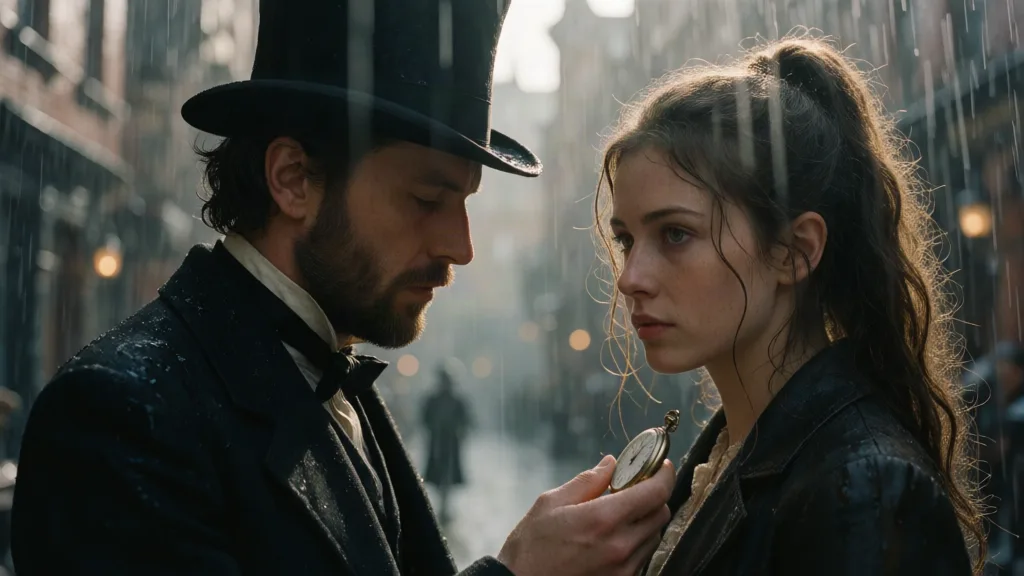
The rain doesn't fall in London. It seeps. It finds the cracks in your collar, the gap between your glove and your sleeve, the thin leather of your shoes where the sole has worn through. I've lived in this city my whole life and I've never once been dry.
My workshop sits at the end of a cul-de-sac that most people mistake for an alley. The sign above the door reads *Thorne & Son, Clockmakers* in gold leaf that hasn't been touched up since my father died. The son is me. The son is all that's left.
I was hunched over my bench when she walked in, the bell above the door chiming a perfect G sharp. I didn't look up. I never look up. Customers come to me broken and desperate, carrying dead things in their pockets, hoping I can give them back a piece of their lives. The rain has taught me that hope is just another kind of damp.
"Mr. Thorne?"
Her voice cut through the tick of a dozen clocks like a blade through silk. I kept my eyes on the escapement wheel I was filing, the tiny teeth catching the lamplight.
"Mr. Thorne, I know you can hear me."
I could. Every syllable landed in my chest like a stone in still water. I set down my file and looked up.
She stood in the doorway with the rain streaming off her umbrella, a black lacquered thing with a silver handle shaped like a swan. Her coat was expensive, dark wool that drank the light, but she wore it open over a dress the color of dried blood. Her hair was pinned up, dark and severe, with a single curl escaping to trace her jaw. She had the kind of face that belonged on a coin, sharp and cold and worth something.
I reached for the pad of paper I keep beside my bench. I wrote: *The shop is closed.*
She didn't even glance at the words. "I didn't come to buy a clock."
I wrote again, pressing the pencil hard enough to leave grooves in the paper. *Then you've wasted your time.*
She stepped forward, her heels clicking on the worn floorboards. The sound was wrong. Too solid. Too certain. Most people who enter my shop walk like they're apologizing for existing. She walked like she owned the ground.
"You're the one who fixed the Abernathy chronometer," she said. "The one that had been underwater for three days."
I felt something cold settle in my stomach. The Abernathy job was six months ago. I'd done it as a favor to a man who'd once saved my father's life. I'd told no one how I'd done it. The watch had been dead, truly dead, the mainspring corroded, the gears frozen with rust. I'd taken it apart and put it back together with parts that shouldn't have fit, shouldn't have worked, but did. The customer had wept when I handed it back to her. She'd said it was her grandmother's. She'd said it had stopped the exact moment her grandmother died.
I wrote: *I don't know what you're talking about.*
She smiled. It wasn't a kind smile. It was the smile of someone who has just watched you lie and found it amusing.
"You're a terrible liar, Mr. Thorne. It's one of the things I like about you already." She pulled off her gloves, finger by finger, slow and deliberate. Her hands were pale, the nails painted the same red as her dress. "My name is Cordelia Ashworth. I represent a client who has a very particular interest in your... unconventional methods."
I wrote: *I'm a clockmaker. I don't have methods. I have tools and patience.*
"You have a gift." She said it flatly, like a fact. "You can fix things that shouldn't be fixable. You can make timepieces that do things timepieces aren't supposed to do. The Abernathy chronometer wasn't just repaired. It was improved. It keeps perfect time now. Better than perfect. It keeps *true* time."
I felt my hand tighten around the pencil. The Abernathy watch didn't keep true time. It kept *my* time. It ran on the hours I'd poured into it, the nights I'd spent hunched over the bench while the rain hammered the roof, the days I'd gone without eating because I couldn't stop working. Every clock I touch takes something from me. Every repair costs a piece of my life.
I wrote: *What do you want?*
She walked to my bench and ran her finger along the edge, trailing through the fine metal dust that coated everything. She looked at the residue on her fingertip like it was something precious.
"I want you to build something new. Not a repair. A creation." She met my eyes and held them. "A pocket watch that doesn't measure time. A pocket watch that moves through it."
The air in the room changed. The clocks seemed to slow, their ticking becoming a single heartbeat. I stared at her, my mind racing through the possibilities, the impossibilities. She couldn't know. No one knew. The watch in my own pocket, the one I'd built in secret over three years, the one I'd never shown anyone, the one that could rewind a single moment if you knew how to wind it just right. She couldn't know about that.
I wrote: *That's not possible.*
"Don't insult me." Her voice sharpened. "I know what you carry in your waistcoat pocket. I know what it does. And I know you've never told anyone about it."
My blood went cold. I reached for my pocket instinctively, my fingers brushing the smooth silver case of the watch I'd built in the dark hours of the night, the watch I'd never shown another living soul. The watch that had brought my father back for three minutes and seventeen seconds before the moment ran out and he died again in my arms.
"I'm not here to expose you," she said, softer now. "I'm here to offer you a deal. My client wants a watch that goes forward. A watch that can show the future. Not predict it. *Show* it. And he's willing to pay whatever it takes."
I wrote: *I can't do that.*
"You can." She leaned in, close enough that I could smell her perfume, something floral and dark, like night-blooming jasmine. "You just don't want to. But consider this, Mr. Thorne. If you can rewind time, you know what happens when the wrong person finds out. You know what they'll do to you. What they'll take from you."
She knew about my father. She knew about the three minutes and seventeen seconds. She knew everything.
I wrote: *Who is your client?*
She smiled again, and this time there was something almost human in it. "You'll meet him when the first prototype is ready. You have one month."
She turned and walked toward the door, her heels striking the floor like a countdown. At the threshold, she paused and looked back over her shoulder.
"One more thing, Mr. Thorne. My client is not a patient man. And neither am I."
The door closed behind her. The bell chimed its perfect G sharp. I sat in the silence, surrounded by the ticking of a hundred clocks, and I felt the weight of the watch in my pocket like a stone around my neck.
I didn't sleep that night. I sat at my bench and stared at the watch I'd built, the one that could rewind a single moment, and I thought about what it would mean to go forward. What it would cost. What I'd have to give up.
The rain kept falling. It always does.
---
I started the next morning before the sun rose. Not because I wanted to. Because I had no choice. Cordelia Ashworth knew too much. She'd found me, found my work, found the watch I'd hidden for years. If I refused, she'd expose me. The authorities would take everything. The workshop. The clocks. The memories of my father that still lived in the smell of oil and brass.
I'd be left with nothing. Less than nothing.
So I worked.
The design came slowly at first, like water seeping through stone. I sketched in charcoal on butcher paper, covering sheet after sheet with gear ratios and escapement calculations that shouldn't exist, that violated every principle of horology I'd ever learned. The watch I'd built to go backward worked by exploiting a flaw in time itself, a crack in the fabric of reality that I'd stumbled onto by accident. Going forward was different. Going forward meant creating a crack where none existed. It meant breaking something fundamental.
I worked for three days straight. I didn't eat. I barely drank. The rain kept falling, and I kept drawing, and somewhere around the fourth night, I started to see her face every time I closed my eyes.
Cordelia Ashworth. The way she'd smiled. The way her voice had cut through the ticking of my clocks. The way she'd known things about me that no one should know.
I hated her. I hated her for finding me, for threatening me, for forcing me to build something I knew was dangerous. But I couldn't stop thinking about her.
On the fifth day, she came back.
I heard the door open, heard the bell chime, and I didn't look up. I was deep in the guts of a prototype, my fingers covered in oil, my eyes burning from lack of sleep. The watch I was building sat in a brass cradle on my bench, its back open, its gears exposed like ribs.
"You've started," she said. I could hear the satisfaction in her voice.
I wrote without looking up: *You didn't give me a choice.*
"No. I didn't." She walked to my bench and stood beside me, close enough that I could feel the heat of her body. "May I?"
I gestured with my chin. She picked up one of my sketches, holding it to the light. I watched her eyes move across the page, saw the moment she understood what she was looking at.
"This is impossible," she breathed.
*It's not impossible,* I wrote. *It's just never been done.*
"How?"
I set down my tools and turned to face her fully. She was wearing a different dress today, deep green like the Thames on a cloudy day. Her hair was down, falling in dark waves past her shoulders. She looked softer than before. More human. I hated that I noticed.
I wrote: *Time isn't linear. It's a river with currents and eddies. Going backward is easy. You just let the current carry you. Going forward means fighting it. It means building something that can swim upstream.*
She read the words slowly, her lips moving slightly. When she finished, she looked up at me with something I hadn't seen before. Respect.
"You really are a genius," she said. "A broken, reclusive genius who lives in a damp shop and talks to no one. But a genius."
I wrote: *Flattery won't make me work faster.*
"No. But it might make you trust me." She set down the sketch and looked at me directly. "I know you hate me. I know you think I'm manipulating you. And I am. But I'm also the only person in this city who understands what you can do. The only person who won't call you a madman or a heretic or worse."
I stared at her. The clocks ticked. The rain fell.
I wrote: *What do you get out of this?*
She was quiet for a long moment. When she spoke, her voice was different. Softer. Almost vulnerable.
"I get to see something that's never been seen before. I get to touch the edge of what's possible." She paused. "I get to matter."
I didn't know what to say to that. I still don't.
She left a few minutes later, but the space she'd occupied stayed warm. I could still smell her perfume. I could still feel the weight of her gaze.
I went back to work, but something had shifted. The hatred was still there, sharp and clean. But underneath it, buried deep where I didn't want to look, something else was growing. Something like curiosity. Something like hunger.
I worked through the night. The prototype took shape under my hands, a thing of brass and silver and stolen moments. The gears I was cutting had teeth so fine they looked like hair. The springs I was winding had tensions that defied physics. Every piece I added felt like a betrayal of everything I'd ever believed about my craft.
But I kept going. Because I had to. Because Cordelia Ashworth had made sure I had no other choice.
And because, somewhere in the dark heart of me, I wanted to see what would happen when I wound the watch for the first time. I wanted to see the future. I wanted to know if there was anything out there worth waiting for.
---
Two weeks in, I hit a wall.
The watch was almost complete. The mainspring was wound. The gears were aligned. The escapement was calibrated to a precision I'd never achieved before. But every time I tried to close the case, something went wrong. The hands would spin. The gears would seize. The whole mechanism would shudder and stop.
I spent three days trying to fix it. I slept in my chair, woke up with oil on my face, and went back to work. Nothing helped.
On the fourth day, Cordelia found me staring at the wreckage of my latest attempt, my hands shaking with exhaustion and frustration.
"You look terrible," she said.
I wrote: *I feel worse.*
She pulled up a stool and sat beside me. "Tell me what's wrong."
I stared at her. She was the last person I wanted to confide in. She was the reason I was in this mess. But she was also the only person who understood what I was trying to do.
I wrote: *The watch needs a power source. Something beyond the mainspring. Something that doesn't exist in this world.*
She read the words and nodded slowly. "You need a piece of time itself."
I nodded.
She was quiet for a long moment. Then she reached into her pocket and pulled out a small velvet pouch. She held it out to me.
"What's this?"
"Open it."
I untied the drawstring and poured the contents into my palm. A single gear, no bigger than my thumbnail, made of a metal I didn't recognize. It shimmered in the lamplight, catching colors that weren't there, shifting between silver and gold and something in between.
"Where did you get this?"
"It belonged to my mother." Her voice was flat, controlled. "She was a clockmaker too. A better one than you'll ever be."
I looked at the gear, at the impossible precision of its teeth, at the way it seemed to hum in my hand. "This isn't clockwork."
"No. It's timework. She called it a temporal resonator. It stores moments the way a battery stores electricity." She met my eyes. "She built it to save my father. It didn't work."
I wanted to ask more. I wanted to know everything about the woman who had built this impossible thing, about the father who had died anyway, about the daughter who had carried this gear for years without using it. But I could see the walls going up behind her eyes, the same walls I'd built in myself. I knew better than to push.
I wrote: *Thank you.*
She nodded once, sharp and final. Then she stood and walked to the door.
"Don't thank me yet, Mr. Thorne. You haven't finished the watch. And even if you do, you have no idea what you're about to unleash."
She left. The door closed. The bell chimed.
I looked at the gear in my hand and felt it pulse with something that wasn't quite life. I fitted it into the watch. It clicked into place like it had always belonged there.
The watch began to tick.
---
Three nights later, I finished it.
The watch sat in the center of my bench, perfect and terrible. Its case was silver, engraved with patterns that seemed to shift when you looked at them directly. Its face was crystal, clear as water. Its hands were black, sharp as razors.
I didn't wind it. I was afraid to. I knew that once I started it, I couldn't stop it. I knew that whatever it showed me would change everything.
I sat and stared at it for an hour. Two hours. The rain kept falling. The clocks kept ticking. The watch sat there, patient and hungry, waiting for me to make the first move.
I reached for it.
The door burst open.
Cordelia stood in the doorway, her dress soaked, her hair wild, her eyes wide with something I'd never seen in them before. Fear.
"Don't wind it," she said. "Please. Don't."
I pulled my hand back. I wrote: *Why?*
"Because my client isn't who I said he was. Because this watch isn't for him. It's for me." She stepped forward, water dripping from her clothes onto the floor. "Because I lied to you. About everything."
I felt the world tilt. I wrote: *Explain.*
She took a breath. Her hands were shaking.
"My mother didn't build that gear to save my father. She built it to destroy him. He was a monster, Mr. Thorne. A man who collected timepieces the way other men collect trophies. He killed her when she refused to build him a watch like this one. He killed her and he took her work and he's been hunting for someone who can finish it ever since."
I stared at her. The words didn't make sense. They couldn't make sense.
I wrote: *You're his daughter.*
"I'm his prisoner." Her voice broke. "He sent me to find you. To make you build the watch. To bring it back to him so he could use it to see the future, to control it, to own it." She swallowed. "But I can't do it. I can't let him have it. I've seen what he does with power. I've seen what he's done to everyone who's ever helped him."
She reached into her pocket and pulled out a photograph. She held it out to me. I took it.
It showed a woman who looked just like Cordelia, younger and softer, with the same dark hair and sharp cheekbones. She was smiling. She was holding a baby. She looked happy.
"My mother," Cordelia said. "Three days before he killed her."
I looked at the photograph. I looked at the watch. I looked at Cordelia, standing in my shop, soaked and terrified and more beautiful than I wanted to admit.
I wrote: *What do you want me to do?*
She met my eyes. "Destroy it. Destroy the watch. Destroy everything you've built. And then run. Run with me. Because if we stay here, he'll find us. And he'll take the watch. And he'll use it to make the future into his own personal hell."
I looked at the watch. Three weeks of work. Three weeks of sleepless nights and impossible calculations. Three weeks of hating Cordelia Ashworth and falling in love with her in a way I didn't want to name.
I picked up my hammer.
I brought it down.
The watch shattered. Gears flew across the room. The crystal cracked into a thousand pieces. The silver case bent and broke.
Cordelia let out a breath I didn't realize she'd been holding. She sagged against the doorframe, her hand over her heart.
"Thank you," she whispered. "Thank you."
I wrote: *We need to go. Now.*
She nodded. She grabbed my hand. Her fingers were cold and wet and they fit perfectly against mine.
We ran.
The rain hit us like a wall. The streets were empty, the gaslights flickering in the wind. We ran through alleys and across squares, past sleeping houses and shuttered shops, our footsteps splashing in the puddles.
We ran until we couldn't run anymore. We stopped in a doorway, gasping for breath, our clothes soaked through, our hearts pounding.
Cordelia looked at me. Her hair was plastered to her face. Her mascara was running. She was the most beautiful thing I'd ever seen.
"I'm sorry," she said. "I'm sorry I lied. I'm sorry I dragged you into this. I'm sorry I made you build something that almost destroyed you."
I wanted to tell her it was okay. I wanted to tell her I understood. I wanted to tell her that I'd known, somewhere deep down, that she was hiding something. That I'd built the watch anyway because I wanted to see her again. Because I wanted to be near her, even if she was lying to me.
Instead, I reached into my pocket and pulled out the watch.
Not the one I'd just destroyed. The other one. The one I'd built years ago, the one that could rewind a single moment. The one I'd never shown anyone.
I held it out to her.
She stared at it. "What is that?"
I wrote: *A way out. If we can find the right moment. If we can go back and change things. If we can save your mother before your father kills her.*
She looked at me. Her eyes were wet, but she wasn't crying. Not yet.
"You'd do that? For me?"
I nodded.
She took the watch. Her fingers brushed mine. The touch was electric, a spark that jumped between us, hot and alive.
"Why?" she asked.
I didn't write an answer. I couldn't. The words didn't exist.
Instead, I leaned in and kissed her.
Her lips were cold from the rain. Her mouth tasted like salt and copper and something sweet I couldn't name. She made a sound, a small broken thing, and then she was kissing me back, her hands in my wet hair, her body pressed against mine.
We stood in that doorway, in the rain, in the dark, and we kissed like the world was ending. Maybe it was. Maybe it had already ended, and this was just the aftermath, the quiet before the next disaster.
When we finally pulled apart, she was crying. Tears mixing with rain, streaming down her face.
"I don't deserve this," she said. "I don't deserve you."
I wrote: *Neither of us gets to decide that.*
She laughed. It was a broken sound, but it was real. She took my hand again.
"Come on," she said. "We have a mother to save."
We ran again. The watch was in her pocket. The future was uncertain. The past was waiting to be rewritten.
And somewhere behind us, in the rain-soaked streets of London, Cordelia's father was waking up to find his prize destroyed, his daughter gone, and a mute clockmaker who had just become his most wanted enemy.
I should have been terrified.
I was.
But I was also alive. Truly alive, for the first time since my father died in my arms, three minutes and seventeen seconds after I'd brought him back.
We ran through the rain, and I held Cordelia's hand, and I let myself hope.
---
We found a room above a pub in Whitechapel. The landlady was a stout woman with kind eyes who asked no questions and accepted cash without counting it. The room was small, a bed and a washstand and a window that looked out over the rooftops. It was perfect.
Cordelia sat on the edge of the bed, the watch in her hands. She turned it over and over, studying it like it might bite her.
"Tell me how it works," she said.
I sat beside her. I took the watch and opened the case, revealing the gears inside. I pointed to the mainspring, the escapement, the tiny gear she'd given me that now sat at the heart of the mechanism.
I wrote: *You wind it to the moment you want to return to. The gear holds the memory of that moment. When you press the crown, the watch rewinds everything. You, me, the world. Everything goes back.*
"Everything?"
*Everything except the person who winds it. They remember. They carry the knowledge of what happened. They get a second chance.*
She was quiet for a long time. The rain drummed against the window. The pub below us hummed with voices and laughter.
"My mother died when I was seven," she said. "I remember everything about that day. The way she smelled. The sound of her voice. The way the light came through the window." She paused. "The way my father's hands looked when he was done."
I didn't write anything. I just sat there, letting her talk.
"If we go back," she said, "if we save her, everything changes. I change. I might not even exist. The person I am now, the person who found you, who kissed you, who loves you..." She trailed off.
I took her hand. I wrote: *I don't care about the person you are now. I care about the person you could be. The person you could become if you had a mother who loved you, if you had a childhood that wasn't stolen.*
She looked at me. Her eyes were bright, fierce, full of something that made my chest ache.
"You really mean that."
I nodded.
She leaned in and kissed me again. Slower this time. Deeper. A kiss that said everything we couldn't put into words.
When she pulled back, she was smiling. A real smile. The first one I'd seen from her.
"Let's do it," she said. "Let's go back. Let's save her."
She wound the watch.
The gears clicked. The hands spun backward. The room began to blur.
I felt myself being pulled, stretched, torn apart and put back together. I saw Cordelia's face, her eyes wide, her lips moving, saying something I couldn't hear.
Then everything went white.
And then everything went still.
I opened my eyes. I was standing in my workshop. The rain was falling. The clocks were ticking. The bell above the door chimed a perfect G sharp.
And Cordelia Ashworth was standing in the doorway, her umbrella dripping, her dress the color of dried blood, her eyes full of a recognition that shouldn't exist.
"Mr. Thorne," she said. "I think we've done this before."
I stared at her. I felt the weight of the watch in my pocket. I felt the memory of her kiss on my lips.
I wrote: *Yes. We have.*
She smiled. It was the same smile from before, sharp and knowing. But now there was something else in it. Something soft. Something hopeful.
"Then let's do it right this time," she said.
She stepped into my shop. The door closed behind her. The rain kept falling.
And for the first time in my life, I didn't mind being wet.
Disclaimer
This is a work of fiction, assisted by artificial intelligence. Any names or characters, businesses or places, events or incidents, are fictitious. Any resemblance to actual persons, living or dead, or actual events is purely coincidental.
Content Removal Policy
- Users may report content that may be illegal or violates our Standards.
- All reported complaints will be reviewed and resolved within seven business days.
- Review Process: Our team will assess the reported content against our guidelines.
- Appeals: If you disagree with a decision, you may appeal within 14 days of notification.
- Potential outcomes include: content removal, account warning, or no action if no violation is found.
To report content, email us at [email protected]