Share
Go Live
Hollow Dawn
·
Published 10/13/2026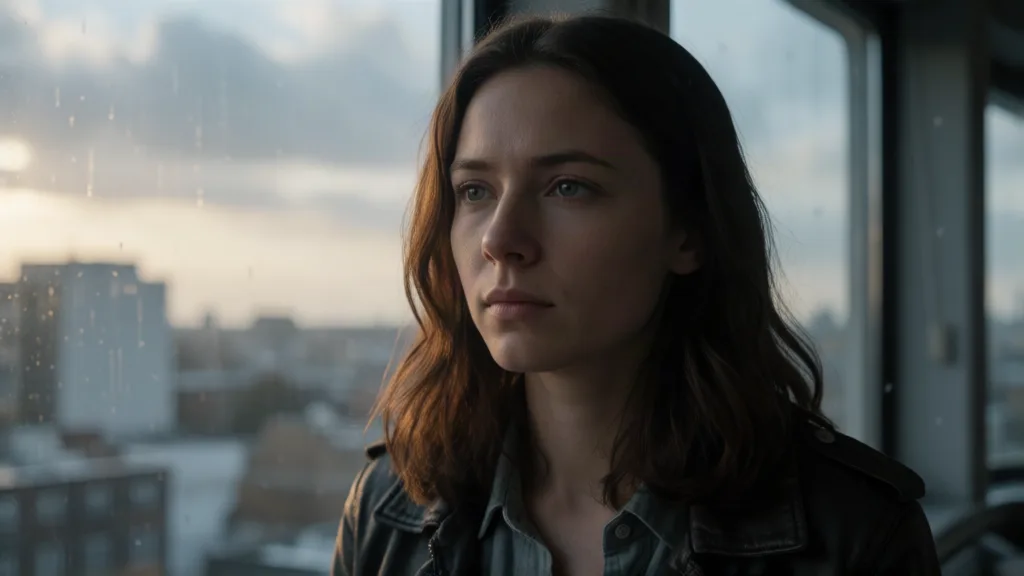
The knife slipped on the onion and caught the meat of my thumb, a clean white line that filled red before I even felt it. I watched the blood bead and swell, then run down into the crease of my palm. The onion sat there, half-mooned, reeking. My mother kept dicing.
"You're bleeding on the carrots," she said.
I looked down. I was.
"Sorry." I turned to the sink, ran the tap cold, stuck my thumb under it. The water went pink and swirled away. Behind me the knife kept its rhythm on the board, that patient knock of steel against wood that had been the sound of every evening of my childhood. She could do it with her eyes closed. She could do it while watching the small television propped on the counter, the one with the antenna wrapped in foil that got two channels on a good night. Tonight it was the news, a woman in a blue blazer talking about a bridge somewhere, a collapse, a number of dead I didn't catch.
"Get the tape," my mother said. "The blue box."
The blue box was in the drawer with the batteries and the rubber bands and the takeout menus from a restaurant that had closed before I was born. I wrapped my thumb, one-handed, clumsy, the tape sticking to itself. My mother never turned around. She had her back to me, the same back I'd stared at for eighteen years, broad and still in the flowered housedress she wore around the house. She moved like the kitchen was an extension of her body. She knew where everything was without looking. She knew where I was, too, at all times, the way she knew when I came in late, when I hadn't eaten, when I was lying.
I was lying about a lot of things that spring.
"There's someone coming," I said.
The knife stopped. Just for a second. Then it started again.
"Who."
"A man. About the land."
She scraped the onions into the pot. They hit the oil and hissed. She still hadn't looked at me.
"What man."
"I don't know his name. He called the house. I took the message." I hadn't, but she didn't know that. The phone had rung three days ago and I'd let it ring, and then I'd gone to the library and looked up the number, and then I'd called it back from the payphone outside the gas station because I didn't want her to hear. That part I kept to myself. "He said he'd come by. About the boundary. The far field."
Now she turned. Her face was the face she used for the bank and the tax office and the men who came to read the meter. Flat. Careful. A door closed and locked from the inside.
"When."
"Tomorrow. Maybe. He didn't say exactly."
"You should have told me."
"I'm telling you now."
She looked at me for a long moment. I could feel her deciding something, the way she decided things, silently, completely, so that by the time she spoke the decision had already hardened into fact. "You'll stay home tomorrow," she said. "You'll be here when he comes."
"I have class."
"You'll be here."
She turned back to the stove. The conversation was over. That was how it worked with her. You didn't argue, you didn't raise your voice, you just watched the door close and then you stood there in the hall with your hands empty. I had spent my whole life in that hall.
I went out to the porch. The evening was coming down slow and orange over the fields, the way it did in late March, the air still cold enough to sting your ears but the light warm, a trick of the season. Our land ran out to the tree line and then kept going, the far field, the one nobody farmed anymore, gone to weeds and the skeletons of old fence posts. My grandfather had worked it. My father had worked it, for a while, before he left. Now it just sat there, doing nothing, holding the boundary between us and whoever was on the other side. I had never met the neighbors on that side. I had never even seen their house. There was a road that went around, and a gate with a chain, and that was all I knew.
The man on the phone had a voice like gravel in a paper bag. He'd said the word "survey" and my stomach had dropped, and I'd said yes, tomorrow, fine, and hung up before he could say anything else. I didn't know why it scared me. It was just a field. It was just dirt and dead grass and a fence that had fallen down before I was born.
But my mother's face when I'd said the word. That was what stayed with me. That flat careful door. She knew something about that field. She'd known it for a long time, and she'd kept it from me the way she kept everything, folded and put away, out of reach.
I sat on the porch steps until the light went and the cold came up through the wood. Inside, the television muttered. My mother moved around the kitchen, and the smell of onions and oil came out through the screen door, and I thought about the man with the gravel voice, and the far field, and the chain on the gate, and the way my mother had said *you'll be here* like it was a sentence and not a request.
I didn't know yet what was buried out there. I didn't know about the papers in the tin box under her bed, or the name she'd stopped using, or the reason my father had left in the middle of a Tuesday and never come back. I only knew that something was coming, and that my mother was afraid of it, and that for the first time in my life I wanted to know what she was hiding more than I wanted to leave.
The screen door creaked. She stood behind me, a shape in the dark.
"Come eat," she said.
I didn't move.
"Come eat," she said again, and this time her voice did something I'd never heard it do. It cracked. Just a little. Just at the edge. And then she went back inside, and the door slapped shut, and I sat there in the cold with my bandaged thumb and the smell of onions, listening to the fields go quiet.
Watch this moment
Turn the current scene into a cinematic Live Chapter — what you watch becomes the story's next part.
Disclaimer
This is a work of fiction, assisted by artificial intelligence. Any names or characters, businesses or places, events or incidents, are fictitious. Any resemblance to actual persons, living or dead, or actual events is purely coincidental.
Content Removal Policy
- Users may report content that may be illegal or violates our Standards.
- All reported complaints will be reviewed and resolved within seven business days.
- Review Process: Our team will assess the reported content against our guidelines.
- Appeals: If you disagree with a decision, you may appeal within 14 days of notification.
- Potential outcomes include: content removal, account warning, or no action if no violation is found.
To report content, email us at [email protected]