Share
The Attentive Healer
·
Published 8/20/2026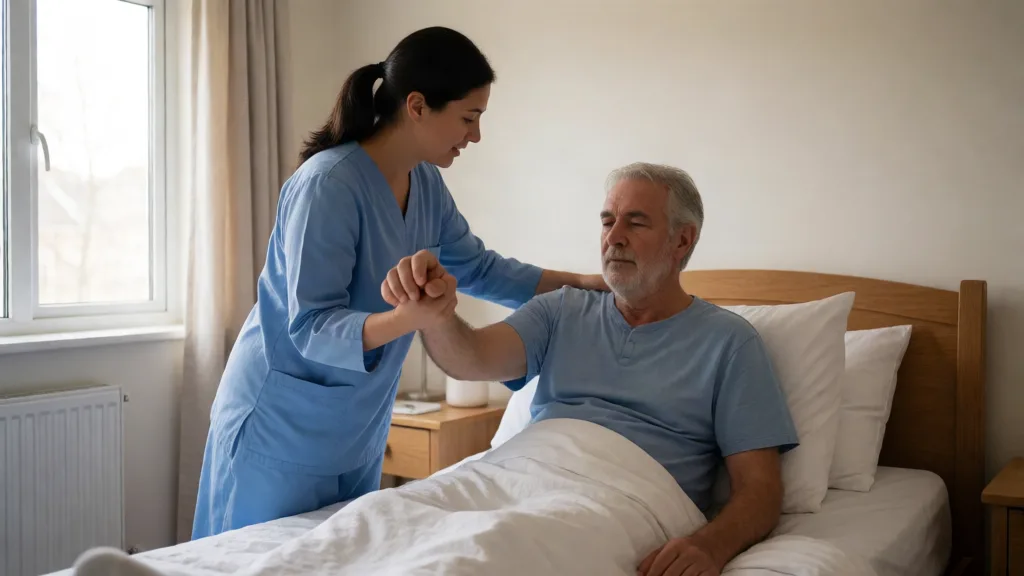
The first thing you learn is how to touch without flinching. How to press your palm against a body that is slowly forgetting itself without letting your face show what your hand knows. I learned this at twenty-two, standing over my uncle’s bed with a tube of Voltaren and a towel, telling myself this was just mechanics. Angles and pressure points. The body as a system of pulleys.
He was my mother’s brother. The one who taught me to bait a fishing hook when I was seven, who let me drink warm Coke from a can on his porch and never told my mother. Now he lay in a hospital bed that we’d rented from a medical supply company, the frame bolted into the floor of what used to be his living room. The television played old Westerns on mute. John Wayne galloped across a canyon while my uncle watched his own ceiling.
“Ready?” I said.
He nodded. That was all he could do now. The nod was a small thing, a tilt of the chin, but it cost him. I saw it in the way his jaw tightened, the way his breath caught before the motion finished.
I pulled back the sheet. His legs were pale and thin, the muscles gone soft, the skin mottled at the shins where circulation had given up. I started with the feet. Always the feet. You work from the outside in, from the parts that still remember what they’re supposed to do toward the parts that have forgotten. That’s what the physio manual said. I’d read it three times. I’d watched the YouTube videos. I’d practiced on my own body, lying on my bedroom floor at midnight, moving my own ankle through its full range of motion while I whispered the instructions aloud.
The left foot was cold. I cupped the heel in my palm and rotated it gently, feeling the joint creak. The ankle. The toes. The arch of the foot. Each movement deliberate, professional, the way the videos showed. I kept my back straight, my breathing even. I was not his niece right now. I was a technician performing a task.
“How’s the pressure?” I said.
He blinked once. That meant fine.
We had a whole language built from blinks and nods and the slight turn of his left hand when he could manage it. His right hand was gone now. The stroke had taken it first, then the leg on that side, then most of the speech. What remained was a man who watched John Wayne ride through Monument Valley and blinked at me when I asked if he needed to be turned.
I moved to the right foot. The bad side. The joint was stiffer here, the resistance more pronounced. I worked it slowly, feeling for the limit, backing off before I reached it. That was another thing the manual said. Never push past resistance. You’re not breaking a horse. You’re reminding a body it still has joints.
The room smelled like rubbing alcohol and the faint sweetness of the nutritional supplement he drank through a straw. The blinds were half-drawn. Dust floated in the light that came through, a slow dance of particles that never settled. I’d been coming here for six months, every Tuesday and Thursday after my shift at the pharmacy. Six months of learning the geography of a man’s decline.
“Knees now,” I said.
He blinked.
I bent his left knee, supporting the thigh with one hand while the other guided the shin. The joint moved through its arc with a grinding sensation I could feel through my palms. The sound was worse. A dry, clicking noise like pebbles shifting in a bag. I counted to ten in my head. That was the trick. Count to ten, hold, release. Don’t think about what you’re hearing. Don’t think about the fact that this man used to carry you on his shoulders, that he once lifted a refrigerator onto a dolly by himself, that he built the porch you’re standing on with his bare hands and a level he’d owned since 1987.
Don’t think.
The right knee was worse. It barely bent at all. I worked it slowly, feeling the muscle resist, the joint refuse. I could have pushed harder. The manual said to respect the body’s limits, but the manual didn’t say what to do when the body’s limits got narrower every week. When the range of motion shrank like a tide pulling back from a shore.
“We’re going to try something different,” I said.
He blinked. Twice. That meant what.
“I want to sit you up. Just for a minute. Just to shift the weight.”
The home health aide did this twice a day, but she was stronger than me, had better technique. I was a pharmacy tech with a YouTube certification in physiotherapy. But I’d watched her do it. I knew the sequence. Roll him toward you, swing his legs over the edge, use your body as a counterweight.
I locked the bed brakes. I lowered the rail. I slid my arm behind his shoulders, feeling the bones through the hospital gown, the way they seemed sharper than they had last week. His head lolled against my shoulder. His breath was warm and sour.
“On three,” I said. “One. Two.”
I pulled. He tried to help. I felt the effort in his body, the way his left arm twitched, the way his core tried to engage and failed. We made it halfway up before his weight became too much. I eased him back down, my arms shaking, my breath coming hard.
“Sorry,” I said.
He blinked. Three times. That wasn’t a word in our language. Three blinks meant nothing, or it meant something I couldn’t translate. Maybe it meant I’m tired. Maybe it meant stop trying so hard. Maybe it meant I used to be able to do this myself and now I can’t even sit up without my niece’s arm behind my neck.
I went back to the feet. The routine was the routine. You finish what you start. You don’t leave a joint half-mobilized. You don’t stop because it’s hard.
The television flickered. John Wayne had won the gunfight. He was riding away from the camera, his silhouette sharp against a red sky. My uncle watched. I watched him watch. The dust motes danced.
I thought about what my mother said last week. Put him in a home, she said. You can’t do this forever. But she wasn’t the one who came twice a week. She wasn’t the one who learned to read blinks. She wasn’t the one who stood in this room with the smell of rubbing alcohol and the sound of joints grinding and the weight of a man who used to carry her on his shoulders.
“We’re done for today,” I said.
He blinked once.
I covered his legs with the sheet. I lowered the bed rail. I put the tube of Voltaren back in the drawer and the towel in the hamper and the manual on the shelf where it lived between a framed photo of his wedding and a ceramic bird his wife had painted before she left.
I stood at the door. He was looking at the ceiling again. John Wayne was gone. Some other movie had started, something with cars and explosions and no horses at all.
“Same time Thursday,” I said.
He didn’t blink. He didn’t nod. He just lay there, breathing, while the dust settled around him like snow that never melted.
And I walked out into the hallway, into the light, into the life that was still mine to live, and I could feel the shape of his body in my hands long after I’d washed them clean.
Disclaimer
This is a work of fiction, assisted by artificial intelligence. Any names or characters, businesses or places, events or incidents, are fictitious. Any resemblance to actual persons, living or dead, or actual events is purely coincidental.
Content Removal Policy
- Users may report content that may be illegal or violates our Standards.
- All reported complaints will be reviewed and resolved within seven business days.
- Review Process: Our team will assess the reported content against our guidelines.
- Appeals: If you disagree with a decision, you may appeal within 14 days of notification.
- Potential outcomes include: content removal, account warning, or no action if no violation is found.
To report content, email us at [email protected]