Share
Forbidden Freshman
·
Published 8/16/2026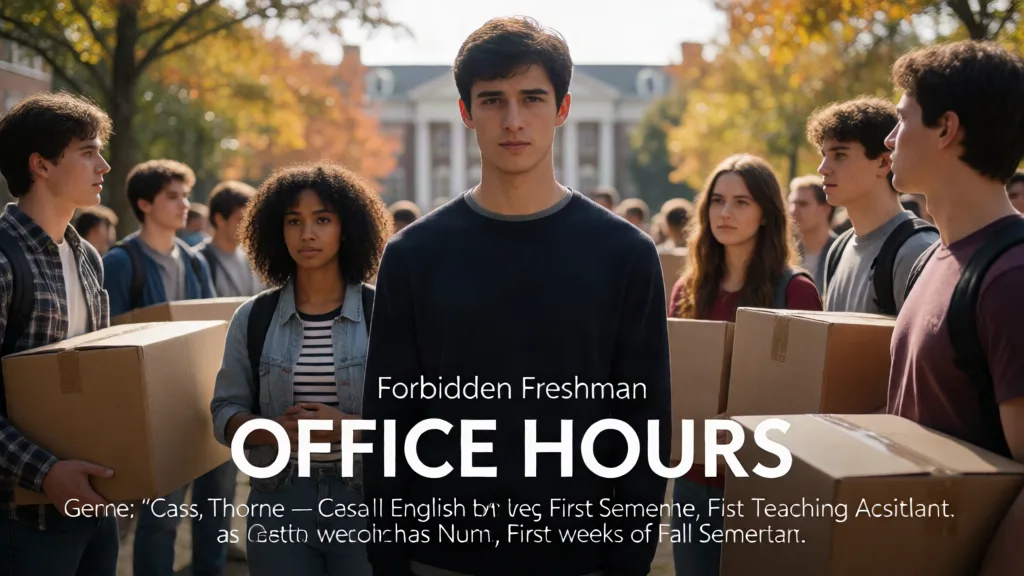
The summer before everything fell apart, I spent my nights selling poetry to people who would never read it.
That’s not fair. The Hollow wasn’t that kind of place. It was a bookstore with a café attached, the kind of independent shop that survived on the loyalty of people who still believed in physical books and the desperation of graduate students who needed rent money. I worked the evening shift, six to close, and I had it down to a science. Restock the new arrivals. Brew the last pot of coffee. Count the register. Lock the door at exactly ten-oh-seven, because the manager’s instructions said ten and the regulars knew they had seven minutes of grace.
I liked the precision of it. The predictability. After a day of deconstructing dead poets and arguing about narrative theory, there was something clean about a job where the tasks didn’t change and the customers didn’t expect you to be brilliant.
Then he started showing up.
Nine-fifty-three on a Tuesday in late June. I was already wiping down the espresso machine, mentally cataloguing the things I needed to do before I could go home and drink alone. The bell above the door chimed and I didn’t look up. I’d learned that trick early. If you don’t make eye contact, the stragglers usually take the hint.
“You’re closing.”
Not a question. A statement, delivered in a voice that had the audacity to sound amused.
I looked up.
He was standing in the doorway with the streetlight behind him, backlit like he’d rehearsed the entrance. Young. That was my first thought. Younger than me by a margin I could feel in my bones. He had a mess of auburn-brown hair that looked like he’d been running his hands through it all day, and a face that belonged on a magazine cover if magazines still did that sort of thing. Green eyes. Freckles scattered across his nose like someone had flicked paint. A smile that was already testing my patience.
“We close in seven minutes,” I said.
“Perfect.” He walked past me like he owned the place. “That’s exactly how long I need.”
I watched him disappear into the poetry section. The poetry section. Of course. The one corner of the store that required the most maintenance because nobody bought it and everyone touched it. I’d straightened those shelves three times that week.
Seven minutes passed. Then eight. Then ten.
I found him sitting on the floor between two shelves, legs crossed, a book open in his lap. He looked up when my shadow fell across the page and gave me that smile again, the one that suggested he knew something I didn’t.
“This one’s good,” he said, holding up the book. “You read it?”
“I’ve read most of them.”
“Which one’s your favorite?”
I should have told him to leave. Should have pointed at the door and used the voice I’d perfected for drunk students and pushy sales reps. Instead, I heard myself say, “The one about the dog.”
He tilted his head. “The dog?”
“The dog that waits for its owner to come home. Even though the owner died in the war.”
“That’s depressing.”
“It’s honest.”
He looked at me for a long moment, and something shifted in his expression. The playfulness didn’t disappear exactly, but it got quieter. More focused.
“I’m Rory,” he said.
“I’m closing.”
“You said that already.”
“And you’re still here.”
He closed the book and stood up, brushing dust off his jeans. He was shorter than me by a few inches, but the way he held himself made it feel like we were eye to eye. “I’ll buy it,” he said. “Consider it a late fee for my trespassing.”
I rang him up in silence. He paid in cash, which I respected, and left with a wave that was just casual enough to feel deliberate. The bell chimed behind him and the store felt emptier than it had before he walked in.
I told myself I wouldn’t think about him again.
He came back the next night.
Nine-fifty-seven this time. I heard the bell and didn’t bother hiding my sigh. He was already heading for the poetry section, and I was already calculating how many minutes of overtime I’d have to justify to my manager.
“You know we close at ten,” I said, loud enough to carry.
“I know.” His voice floated back from between the shelves. “I’m getting faster.”
Nine minutes that time. He bought a collection by someone I’d never heard of and asked if I’d read it. I said no. He said I should. I said I’d add it to the list.
“You have a list?”
“Everyone has a list.”
“What else is on it?”
“Books I’ll never have time to read.”
He laughed. It was a good laugh, warm and unguarded, and I hated how much I wanted to hear it again.
He came back the night after that. And the night after that. It became a routine without either of us acknowledging it. He’d show up at the edge of closing, browse for exactly as long as it took me to finish my tasks, and then buy something. Always a book. Always poetry. Always with that look that said he was waiting for me to ask why.
I never asked.
I told myself it was professional courtesy. He was a customer. I was an employee. The boundaries were clear and I had no interest in testing them.
I was lying.
By the third week, I knew the shape of his shoulders. The way his hair curled at the nape of his neck. The specific shade of green his eyes turned under the fluorescent lights, like sea glass after the tide went out. I knew that he smelled like cigarettes and something sweet, honey maybe, and that he bit his lower lip when he was thinking about which book to buy.
I knew that I was in trouble.
The night it happened, I don’t remember what he bought. Something by Rilke, maybe. Or Neruda. The poets who made love sound like a religious experience and heartbreak sound like a natural disaster. He paid and I handed him his change and our fingers touched and neither of us pulled away.
“You know my name,” he said.
“You told me.”
“You haven’t said it once.”
I looked at his hand. At the place where his skin met mine. At the pulse I could see beating in his wrist, fast and steady.
“Rory,” I said.
His breath caught. Just barely. A hitch so small I might have missed it if I hadn’t been watching his chest rise and fall, cataloguing every detail like I was studying for an exam I hadn’t signed up for.
“There it is,” he said.
“There what is?”
“The sound of you giving in.”
He didn’t wait for me to deny it. He just smiled, took his book, and walked out. The bell chimed. The door swung shut. And I stood there with my hand still hovering in the air, feeling the ghost of his skin against mine.
I locked up early that night. Ten-oh-two. A new record.
The next Tuesday, he came in at nine-forty-five and I didn’t bother pretending to work.
“You’re early,” I said.
“I’m testing a theory.”
“What theory?”
He set the book on the counter. Not a poetry collection this time. A novel. Something contemporary, with a cover that showed two men standing close together in a doorway.
“That you don’t actually care about the closing time,” he said. “You just need an excuse to say no.”
“I don’t need an excuse.”
“Then say yes.”
I looked at him. At the challenge in his eyes, the curve of his mouth, the way his hands were planted on the counter like he was bracing for impact. He was beautiful and reckless and exactly the kind of complication I had spent my entire adult life avoiding.
“Yes to what?” I said.
“To whatever happens next.”
I should have said no. Should have rung him up, sent him on his way, and spent the rest of the summer pretending he didn’t exist. It would have been the smart choice. The safe choice. The choice that didn’t end with me breaking every rule I’d ever made for myself.
Instead, I said, “I get off at ten.”
He grinned. “I know.”
We went to my apartment because his place was a sublet that smelled like mildew and regret. That’s what he said. I didn’t ask for details. I didn’t ask for anything. I just opened the door and let him walk inside and watched him take in the bookshelves, the single armchair, the bed that was unmade because I hadn’t expected company.
“You live like a monk,” he said.
“I live like someone who can’t afford furniture.”
“Same thing.”
He turned to face me and the playfulness was still there but something else was underneath it. Something hungry. Something that made my skin feel too tight and my lungs feel too small.
“So,” he said. “What now?”
I crossed the room in three steps. Caught his face in my hands. Kissed him like I’d been thinking about it for weeks, which I had, like I’d been dreaming about the taste of his mouth and the sound of his breath catching, which I had, like I was already lost and didn’t care to be found.
He made a sound against my lips. Not a word. Something softer. A surrender.
His hands found my waist. My hips. The hem of my shirt. He pulled me closer and I let him, because letting him was easier than pretending I had any control left.
“Cass,” he said, my name breaking apart in his mouth.
I kissed him harder.
The summer became a blur of nights like that. He’d come to The Hollow at closing time and I’d take him home and we’d spend hours learning each other’s bodies, each other’s rhythms, each other’s quiet sounds. He was bold in ways I wasn’t. He’d say things that made me blush, things I’d never let anyone else say to me, and he’d laugh when I tried to pretend they didn’t affect me.
“You’re so easy,” he said one night, sprawled across my sheets with his hair a disaster and his chest still heaving.
“I’m not easy.”
“You’re blushing.”
“I’m warm.”
“You’re blushing because I told you I like the way you say my name.”
“I’m not having this conversation.”
“Yes you are.” He propped himself up on his elbows, grinning. “You’re having it right now. You’re having it while lying naked in bed with me. This is definitely happening.”
I threw a pillow at his head.
He caught it and pulled it to his chest, still laughing. And I watched him, this stranger who had somehow become a habit, and felt something crack open in my chest. Something I didn’t have a name for.
“What happens when August ends?” I asked.
The laughter stopped. His eyes found mine and held them.
“What do you want to happen?”
“I don’t know.”
“Then don’t ask.”
I didn’t ask again.
We kept the rules unspoken because speaking them would have made them real. We didn’t talk about the future. We didn’t talk about what we were. We didn’t exchange numbers because he showed up at the same time every night and I was always there. It was simple. It was temporary. It was exactly what I needed it to be.
I told myself that until I almost believed it.
The last week of August, he came to The Hollow at nine-thirty. Earlier than usual. He wasn’t carrying a book.
“I’m leaving tomorrow,” he said.
I felt the words land like a punch to the chest. “Where?”
“Somewhere. I don’t know yet. I’ve been putting it off.”
“Putting what off?”
“The thing I’m supposed to do next.”
I wanted to ask what that meant. I wanted to demand details. I wanted to grab him by the shoulders and shake the truth out of him. But we didn’t do that. We didn’t ask questions. We didn’t make demands.
So I just said, “Okay.”
He looked at me for a long moment. Then he smiled, soft and sad, and said, “Walk me out?”
I locked up early. Ten-oh-one. A record that would never be broken.
We stood on the sidewalk outside The Hollow, under the flickering streetlight that had been broken since May. The air smelled like summer, like heat and asphalt and the magnolia trees that lined the street. He was leaving. He was leaving and I didn’t know where he was going or when I’d see him again and I had no right to ask.
“Goodbye, Cass,” he said.
“Goodbye, Rory.”
He kissed me. Quick and soft, a promise I didn’t know how to keep. Then he turned and walked away, hands in his pockets, shoulders straight, not looking back.
I watched until he disappeared around the corner.
Then I went back inside and finished my closing checklist like nothing had happened.
The next day was September first.
Move-in weekend at Bellweather University.
I didn’t think about him during the drive to campus. Didn’t think about him while I parked my car and grabbed my bag and walked toward the English department building, where I had a TA orientation I’d been dreading for weeks. Didn’t think about him while I sat through presentations about academic integrity and classroom management and the importance of maintaining professional boundaries with students.
Professional boundaries.
The phrase stuck in my head. Rattled around. Made a home there.
I was a teaching assistant now. A real one. Not just a graduate student who graded papers and led discussion sections, but someone with actual authority. Someone who would stand at the front of a classroom and have students call me Mr. Thorne. Someone who had signed a contract that said I would uphold the standards of the university and conduct myself with professionalism at all times.
I was twenty-seven years old and I had never felt less qualified for anything in my life.
Orientation ended at four. I spent the next hour wandering campus, trying to remember where my office was. The English department was in Old Main, a building that looked like it had been designed by someone who hated natural light. Narrow windows. Dark hallways. Fluorescent fixtures that hummed like they were plotting something.
My office was a closet on the third floor. Shared with three other TAs. I had a desk, a chair, and a filing cabinet that wouldn’t lock. It was perfect.
I was testing the filing cabinet when my phone buzzed. A text from my advisor, reminding me about the department reception that evening. Mandatory attendance. Free wine. Don’t be late.
I sighed and texted back: Wouldn’t miss it.
The reception was in the faculty lounge, which was just a conference room with better furniture. I arrived early because I didn’t know anyone and wanted to stake out a corner before the room filled up. I grabbed a plastic cup of wine that tasted like regret and found a spot near the window, where I could watch the door and plan my escape route.
The room filled slowly. Professors I recognized from the department website. Fellow TAs I’d seen at orientation. Administrators in blazers who moved through the crowd with the practiced ease of people who had never been nervous in their lives.
I sipped my wine and waited for an acceptable time to leave.
That’s when I heard my name.
Not from inside the room. From outside. Through the open window, carried on the September air, clear as a bell.
“Cass!”
I froze.
The voice was familiar. Impossiblely familiar. A voice I had heard in the dark of my apartment, breathless and broken. A voice I had memorized without meaning to.
I turned toward the window.
The faculty lounge overlooked the main quad, which was currently overrun with freshman move-in activities. Parents carrying boxes. Students with ID lanyards. A table with free T-shirts and a banner that said WELCOME CLASS OF 2027.
And there, standing in the middle of it all, was Rory.
He was wearing a Bellweather T-shirt. A Bellweather T-shirt and a Bellweather lanyard with a Bellweather ID that I could see from here, swinging against his chest as he waved at me with both arms.
He was grinning.
He was grinning and he was here and he was a freshman.
I set down my wine. Very carefully. Very slowly. Like the cup might explode if I moved too fast.
“Who’s that?”
I turned. One of the other TAs, a woman named Jenna who had introduced herself during orientation, was standing beside me with her own cup of wine and a curious expression.
“No one,” I said.
She raised an eyebrow. “He seems to know you.”
“He doesn’t.”
I walked out of the room before she could ask follow-up questions. Down the hall. Down the stairs. Out the front door of Old Main and onto the quad, where the September sun was still hot and the air was full of the sound of parents saying goodbye.
Rory was waiting for me. Arms crossed. That smile on his face. The one that had been testing my patience since June.
“Surprise,” he said.
“What are you doing here?”
“Going to college.” He gestured at the lanyard. “Freshman. Late start. I deferred for a few years to work and travel, but I finally decided to get my shit together.”
“You’re a freshman.”
“That’s what I said.”
“At Bellweather.”
“It’s a good school.”
“You didn’t tell me.”
His smile flickered. Just barely. “Neither did you.”
I opened my mouth. Closed it. Opened it again.
He was right. I hadn’t told him I was a graduate student here. I hadn’t told him anything about my life beyond the walls of The Hollow. That was the deal. That was the rule. We didn’t ask questions and we didn’t share details and we definitely didn’t make plans.
But this. This was different.
“I’m a TA,” I said.
His eyes widened. “For what?”
“English. Intro to Literary Studies.”
“That’s not my class.”
“It doesn’t matter. I’m a teaching assistant. I have authority over students. If anyone finds out that we—”
“That we what?” He stepped closer. Close enough that I could smell him. Cigarettes and honey. Same as always. “That we spent the summer together? That’s not against the rules. I’m not in your class. You don’t have any power over me.”
“It doesn’t work like that.”
“Then how does it work?”
I ran a hand through my hair. I was already sweating. Already regretting every decision that had led me to this moment.
“It’s over,” I said.
“What is?”
“This. Us. Whatever we were doing. It’s over.”
He stared at me. The smile was gone now. In its place was something I couldn’t read, something that made my chest ache in ways I didn’t have words for.
“You’re serious,” he said.
“I have to be.”
“Cass.”
“Don’t.” I held up a hand. “Don’t say my name like that. Don’t look at me like that. This is already complicated enough.”
“It doesn’t have to be.”
“Yes it does.”
I turned and walked away. Back toward Old Main. Back toward the faculty lounge and the wine that tasted like regret and the job I had worked too hard to throw away.
He didn’t call after me.
I didn’t look back.
That should have been the end of it.
Bellweather has thirty thousand students. Thirty thousand. The odds of running into one person on a campus that size are astronomical. I told myself that. Repeated it like a mantra. I would never see him again. He would find his own friends, his own life, his own summer fling to forget. And I would go back to my routine, my books, my carefully controlled existence.
I was wrong.
I saw him the next day. In the dining hall. He was sitting with a group of freshmen, laughing at something on someone’s phone, and he looked up exactly as I walked past. Our eyes met for half a second. Then he looked away.
I didn’t eat dinner that night.
I saw him two days later. Outside the library. He was walking with a guy who had his hand on Rory’s lower back, and I felt something twist in my stomach that I refused to name. I took the long way to my office.
I saw him four days after that. In the English department hallway. He was coming out of the bathroom and I was coming out of my advisor’s office and we nearly collided.
“Sorry,” he said.
“It’s fine.”
We stood there. Two feet apart. The fluorescent lights humming above us.
“I’m not in your class,” he said.
“I know.”
“So there’s no rule.”
“There are other rules.”
“Like what?”
I didn’t answer. Couldn’t answer. Because the truth was I didn’t know where the rules ended and my own fear began.
He nodded. Like he understood something I hadn’t said. Then he walked past me, down the hall, around the corner, gone.
I stood there for a full minute before I could move again.
The worst part was the library.
I studied there. Every day. Same table in the corner of the second floor, near the window, where the light was good and the noise was minimal. I had been doing it for a year. It was routine. It was predictable. It was mine.
Then Rory got a job there.
I found out on a Tuesday. I was sitting at my table, halfway through a chapter on postcolonial theory, when I heard someone laugh. A laugh I knew. A laugh that had been in my apartment, in my bed, in my ears while I was trying not to fall asleep because I didn’t want to miss a second of him being there.
I looked up.
He was behind the circulation desk. Wearing a Bellweather polo. Smiling at a girl who was checking out a stack of romance novels.
He saw me. His smile didn’t change. But his eyes did. They got darker, sharper, more focused.
“Welcome to the library,” he said, loud enough for me to hear. “Let me know if you need anything.”
I buried my face in my book and didn’t look up for an hour.
He didn’t approach me that day. Or the next day. Or the day after that. But he was always there. Behind the desk. Shelving books. Walking through the stacks. He never acknowledged me beyond a polite nod, and I returned the favor with equal professionalism.
It was torture.
I started going to the library later. After his shift ended. I checked the schedule on the door and planned my visits around it. It worked for a week. Then his schedule changed and I walked in at six to find him standing at the front desk, looking at me with that familiar, infuriating smile.
“Missed you,” he said.
“I was here yesterday.”
“I know.”
I felt my face heat. Grabbed the first book I saw and headed for the stairs.
He laughed behind me. Soft. Warm. The sound followed me all the way to the second floor.
It went on like that for three weeks.
We played a game neither of us admitted we were playing. He’d find reasons to walk past my table. I’d find reasons to look up. He’d say something provocative, just loud enough for me to hear. I’d pretend I hadn’t. He’d leave a book on my table, open to a poem about longing, and I’d read it twice before closing it and putting it back.
I was losing.
I knew I was losing.
The night it broke, I was in the library until close. Reading the same paragraph over and over, unable to make the words mean anything. The lights flickered. The intercom announced that the building would be closing in fifteen minutes.
I didn’t move.
“Cass.”
I looked up. He was standing at the end of my table, arms crossed, expression unreadable.
“We’re closing,” he said.
“I know.”
“You’ve been here for six hours.”
“I know.”
“You’ve read the same page for the last forty-five minutes.”
I closed the book. “You’ve been watching me?”
“Somebody has to.”
The words hung between us. Heavy. Charged. I could feel the heat rising in my chest, the pulse beating in my throat.
“Rory.”
“Don’t.” He held up a hand. “Don’t tell me this is complicated. Don’t tell me we can’t. I’ve heard it. I’ve respected it. I’ve given you space.” He stepped closer. “But I’m done pretending I don’t see you looking at me.”
“I’m not looking at you.”
“You’re looking at me right now.”
He was right. I was. I couldn’t stop.
“What do you want from me?” I asked.
“I want you to stop lying.”
“About what?”
“About this.” He gestured between us. “About what we were. About what we still are, even though you keep trying to pretend we’re not.”
“We’re not anything.”
“Then why are you still here?”
I didn’t have an answer.
He walked around the table. Slow. Deliberate. His hand found my chin, tilted my face up to meet his eyes.
“I’m not in your class,” he said. “I’m not your student. I’m not anyone you have authority over. The only thing keeping us apart is you.”
“It’s not that simple.”
“It is exactly that simple.”
He kissed me.
I should have pulled away. Should have reminded him of the rules, the risks, the reasons I had ended this in the first place. Instead, I kissed him back. Hard. Desperate. Like I had been starving for weeks and he was the first real meal I’d had.
His hands found my waist. Mine found his hair. We stumbled backward until my back hit the bookshelf and he pressed against me, warm and solid and real.
“I missed you,” he said against my mouth.
“I missed you too.”
“Say it again.”
“I missed you.”
He kissed me like he was trying to memorize the shape of my lips. I let him. I let him do whatever he wanted, because fighting it was pointless and pretending was exhausting and I was tired of being the person who said no.
We left the library together.
His apartment was smaller than mine. A dorm room, technically, but he’d gotten a single, which meant no roommate and no questions. The walls were bare. The bed was unmade. There were books stacked on the floor, poetry collections I recognized from The Hollow.
“You kept them,” I said.
“I kept everything.”
I looked at him. At the mess of his hair, the freckles on his nose, the smile that had been haunting me since June.
“We need rules,” I said.
“I know.”
“Your friends can’t know. My department can’t know. This stays between us.”
“Okay.”
“And if anyone asks, we’re strangers.”
“Cass.”
“I’m serious.”
“I know you are.” He stepped closer. “But I’m not a stranger.”
“You know what I mean.”
“I know.” He put his hand on my chest. Felt my heartbeat. “But I’m not going to pretend I don’t know you. I’m not going to pretend this summer didn’t happen. I can be discreet. I can be careful. But I won’t pretend you’re nothing to me.”
I closed my eyes. Breathed. Let the words settle somewhere deep in my chest.
“Okay,” I said.
“Okay?”
“Okay. We’ll figure it out.”
He smiled. That smile. The one that had been my undoing from the very beginning.
“Good,” he said. “Because I have plans for you.”
He kissed me again, and I let myself fall.
We fell into a rhythm. A secret rhythm. He’d text me when his shift ended and I’d text him when I was done with class. We’d meet at his dorm or my apartment, never the same place twice in a row. We’d spend hours together, talking and laughing and doing all the things we’d done over the summer, and then I’d leave before the sun came up.
It was careful. It was controlled. It was exactly what I needed.
Until it wasn’t.
The first time I saw him with someone else, I was walking past the student union. He was sitting on a bench with a guy from his floor, some architecture major with broad shoulders and an easy laugh. They were sitting close. The guy’s hand was on Rory’s knee.
I kept walking.
I didn’t text him that night.
The second time, I saw him at a party. A house party off campus, the kind I usually avoided. I’d only gone because a fellow TA had dragged me there, insisting I needed to socialize. I was nursing a beer in the corner when I saw Rory across the room, dancing with someone I didn’t recognize.
He was laughing. He was having fun. He was living his life.
I left without saying goodbye.
The third time, he told me about it.
We were in my apartment. Post-sex, tangled in sheets, the way we always ended up. He was tracing patterns on my chest, and I was trying not to think about the fact that I had seen him with someone else.
“There’s this guy in my history class,” he said.
I went still. “Yeah?”
“He asked me out.”
“Did you say yes?”
He looked up at me. His eyes were green in the dim light. Unreadable.
“I told him I was seeing someone.”
“You’re not seeing someone.”
“I’m seeing you.”
“That’s not the same thing.”
He sat up. The sheet fell away from his chest and I tried not to look at the marks I’d left on his skin.
“Why isn’t it the same thing?” he asked.
“Because we’re not—”
“We’re not what?”
I didn’t have an answer.
He stared at me. The silence stretched. I could feel something shifting between us, something I didn’t have a name for.
“What am I to you, Cass?”
The question landed like a blow.
“You’re—” I started. Stopped. Started again. “You’re someone I care about.”
“That’s not what I asked.”
“I know.”
“Then answer the question.”
I couldn’t.
I looked at him, at the hurt I was trying to pretend wasn’t there, and I couldn’t find the words. Because the truth was I didn’t know what he was to me. I didn’t know what we were. I had spent so long building walls that I had forgotten how to open the door.
He waited. I stayed silent.
He got dressed.
“Rory.”
“Don’t.”
“Rory, please.”
He turned at the door. His hand on the handle. His eyes on mine.
“When you figure out what you want,” he said, “you know where to find me.”
He left.
The door clicked shut behind him.
I sat in the dark for a long time, listening to the silence, feeling the absence of him like a wound.
I didn’t sleep that night.
The next week was the longest of my life.
I didn’t text him. He didn’t text me. I went to class. I went to the library. I went to The Hollow, because some habits were harder to break than others, and I sat at the counter and drank coffee and tried not to think about the fact that he wasn’t there.
It didn’t work.
I thought about him constantly. The way he laughed. The way he said my name. The way he looked at me like I was the only person in the room, even when I didn’t deserve it.
I thought about the summer. The nights we spent together. The way he had shown up at The Hollow, night after night, just to see me. The way he had kissed me in the library, desperate and honest, refusing to let me hide.
I thought about what he had asked me.
What am I to you?
I didn’t know. I had never let myself know. I had kept him at arm’s length because it was easier than admitting that he had become something more than a summer fling. Something more than a secret. Something I wasn’t ready to name.
But I knew now.
I knew the night I saw him on the quad, surrounded by boxes and wearing that ridiculous lanyard, and felt my heart stop.
I knew the night he kissed me in the library and I kissed him back like I was drowning.
I knew the night he walked out my door and I didn’t follow.
I knew.
The question was whether I was brave enough to do something about it.
Thursday night. Ten o’clock. I found myself outside The Hollow without meaning to. I had driven there on autopilot, the same route I had taken all summer, and now I was standing on the sidewalk under the flickering streetlight, staring at the door.
It was closed. Of course it was closed. It was ten o’clock on a Thursday.
But the lights were on inside.
I walked to the window. Cupped my hands around my eyes. Looked inside.
He was there.
Sitting at the table in the corner. The same table where I had found him that first night, reading poetry on the floor. He had a book open in front of him, but he wasn’t reading it. He was just sitting. Waiting.
I knocked on the glass.
He looked up.
Our eyes met through the window. He didn’t smile. Didn’t wave. He just looked at me, steady and patient, like he had been expecting me all along.
I tried the door.
It was unlocked.
I walked inside. The bell chimed above my head, the same bell that had announced his arrival all those months ago. He didn’t stand up. Didn’t move. He just watched me walk across the store, past the shelves of poetry, past the counter where I had rung him up a dozen times, until I was standing in front of him.
“You’re here,” he said.
“I’m here.”
“Why?”
I sat down across from him. The chair was small and uncomfortable. I didn’t care.
“Because you asked me a question,” I said. “And I didn’t answer it. And I should have.”
He closed the book. Gave me his full attention.
“So answer it now.”
I took a breath. Let it out. Let the walls I had built crumble around me.
“You’re not temporary,” I said. “You haven’t been temporary for a long time. I was scared because I didn’t want to admit that you mattered. That you mattered more than my rules. More than my routine. More than my fear.”
He was quiet. Waiting.
“I don’t know what we are,” I said. “I don’t know what this is supposed to look like. But I know I don’t want to lose it. I don’t want to lose you.”
He leaned back in his chair. Studied me. That familiar, infuriating, wonderful smile started to creep across his face.
“So what are you offering?” he asked.
“A real relationship.”
“That’s a big offer.”
“I know.”
“What about the rules?”
“We make new ones.”
“What about your job?”
“I’ll figure it out.”
“What about the fact that I’m a freshman and you’re a TA and everyone will have opinions?”
“I don’t care.”
He raised an eyebrow. “You don’t care?”
“I care,” I admitted. “But I care about you more.”
He looked at me for a long moment. The longest moment of my life. Then he stood up, walked around the table, and sat down on the edge of it, directly in front of me.
“So,” he said, his voice low and warm. “Office hours are open?”
I laughed. I couldn’t help it. The sound surprised me, surprised both of us, and I saw something shift in his expression. Something soft. Something hopeful.
“Office hours are open,” I said.
He leaned down and kissed me. Soft and slow and full of promise.
The bell above the door chimed.
We broke apart. A woman in a Bellweather sweatshirt was standing in the doorway, staring at us with wide eyes.
“I’m sorry,” she said. “I saw the lights on. I was hoping you were still open.”
Rory looked at me. I looked at him.
“We’re closed,” we said at the same time.
She blinked. Backed away. The door swung shut behind her.
We looked at each other. The silence stretched. And then we both started laughing, helpless and ridiculous, the sound filling the empty bookstore like it belonged there.
“This is insane,” I said.
“Completely insane,” he agreed.
“I have no idea what I’m doing.”
“Neither do I.”
“We’re going to get caught.”
“Probably.”
“And it’s going to be a disaster.”
“Almost certainly.”
He took my hand. Squeezed it. His smile was the brightest thing in the room.
“Worth it?” he asked.
I looked at him. At the mess of his hair. At the freckles on his nose. At the green eyes that had been haunting me since June.
“Worth it,” I said.
He kissed me again.
The summer was over.
Our trouble was just beginning.
Disclaimer
This is a work of fiction, assisted by artificial intelligence. Any names or characters, businesses or places, events or incidents, are fictitious. Any resemblance to actual persons, living or dead, or actual events is purely coincidental.
Content Removal Policy
- Users may report content that may be illegal or violates our Standards.
- All reported complaints will be reviewed and resolved within seven business days.
- Review Process: Our team will assess the reported content against our guidelines.
- Appeals: If you disagree with a decision, you may appeal within 14 days of notification.
- Potential outcomes include: content removal, account warning, or no action if no violation is found.
To report content, email us at [email protected]