Share
Go Live
The Golden Bench
·
Published 10/5/2026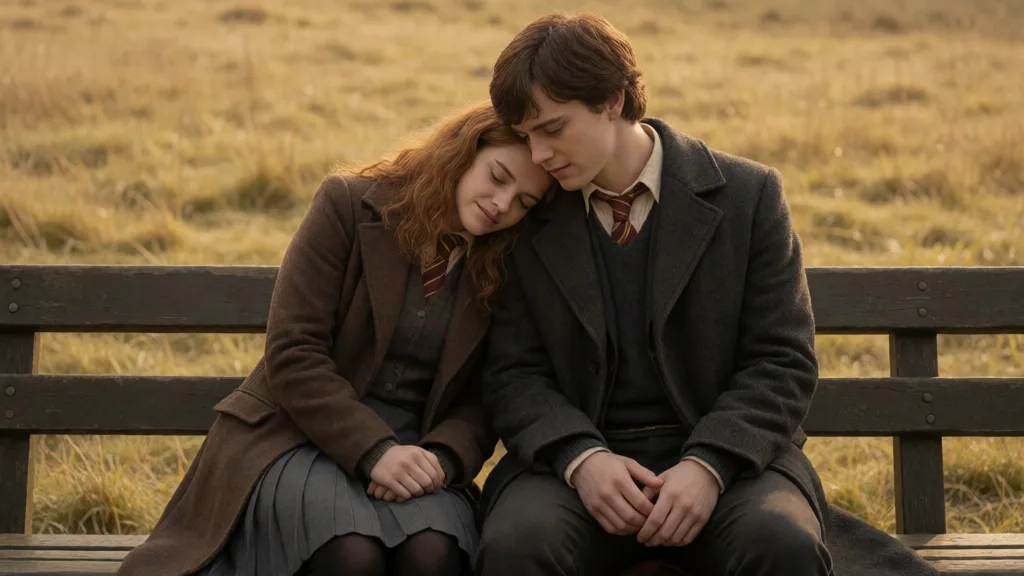
The bench was ours before we ever touched it.
I knew that the first time I saw it, third week of October, when the field had gone the color of old brass and the wind came off the hills carrying the smell of rain that never quite arrived. A wooden bench, weathered gray, set at the edge of a wheat field that nobody harvested anymore. The farmer who owned the land had died the winter before. His sons lived in the city now, and the wheat had gone feral, reseeding itself year after year, gold and useless and beautiful.
I walked out there to get away from the house. From my mother's silence, which had gotten louder since the diagnosis. From my father's hands, which shook when he poured his tea and shook worse when he didn't. I was sixteen and I couldn't fix anything, so I walked.
The bench sat alone like it had been waiting for someone. I sat down. I didn't cry. I just watched the wheat move and thought about how my mother used to call me her little philosopher, back when she still called me things.
That was September.
By October, I wasn't alone on the bench anymore.
His name was Kevin Granger, and he had the kind of face that made you want to tell him things. Not because he was handsome, though he was, in a way that snuck up on you. Brown skin, wide-set eyes, a mouth that held its own opinions. He was new to the village, moved in with his grandparents after something happened in London that he wouldn't talk about. I didn't push. I had my own things I wouldn't talk about.
The first time he found me on the bench, he stood at the edge of the field for a long time, watching. I watched him back. He had a book in his hand, and he held it the way some people hold a shield.
"You're in my spot," he said finally.
"It's a bench," I said. "There's room."
He sat down. Not close. The kind of distance that says I'm here but I'm not sure I want to be. We didn't talk for an hour. When the light started to go, he stood up, nodded at me like we'd had a conversation, and walked back toward the village.
The next day he came back. Sat closer. The day after that, closer still.
By the end of the second week, I knew three things about him. He read philosophy and didn't understand half of it. His parents were dead, and he didn't use that word, he said gone, which told me more than the word dead ever could. And he was terrified of something he wouldn't name.
I knew because I recognized the fear. I had it too. Different shape, same weight.
"You ever think about just leaving?" he asked me one afternoon. The wheat was moving in long waves, and the sky was that pale blue that only happens in autumn, thin and far away.
"All the time," I said.
"Where would you go?"
"Somewhere with no hospitals. No waiting rooms. No doctors saying we're doing everything we can."
He didn't say sorry. That's why I kept talking to him. Everyone else said sorry, and sorry was just a word that meant I don't know what to do with your pain. Kevin just nodded and looked at the field.
"My mum used to sing while she did dishes," I said. "Stupid songs. Songs she made up about the plates and the soap. I used to think it was embarrassing."
"What do you think now?"
"I think I'd give anything to hear it one more time."
He reached over and took my hand. Not romantic. Not yet. Just two people holding on because the ground felt unsteady. His palm was warm and a little rough, like he'd been working with his hands.
"My dad used to laugh in the kitchen," he said. "Big laugh. You could hear it from the front door. After he died, my mum and I, we just sat in the living room. For weeks. The kitchen was too quiet."
"Did you ever go back in?"
"Eventually. Had to eat."
We laughed at that, both of us, and it was the kind of laugh that hurt a little.
October moved on. The leaves turned and fell and the wheat got darker, and we kept coming back to the bench. It became a ritual. Three o'clock, after school, after the buses left. He'd bring books sometimes, and I'd bring whatever I could steal from the kitchen, apples and biscuits and once a whole meat pie that my father hadn't touched.
We'd eat and talk and sometimes not talk. The not-talking was the best part. Sitting next to someone and not needing to fill the silence, that's when you know.
"Do you think we could live like this?" I asked him one day. I don't know where it came from. The words just fell out. "No city. Just wind and this bench. Forever."
He pulled his coat around both of us. It was a big coat, brown wool, too big for him. His grandfather's, probably. It smelled like woodsmoke and something sweet I couldn't name.
"We would need a small house," he said. "One with a crooked chimney."
"And a garden we never weed properly."
"And your laugh in the kitchen."
"And your songs while you wash dishes."
I felt him smile against my hair. "Is that happiness enough?"
I turned and kissed his cheek. I didn't plan it. My lips just found his skin, and for a second the whole world went quiet.
"Happiness is not big," I said. "It's this. You, me, and nowhere to rush to."
He was still for a long moment. Then he hugged me tighter, and I felt his breath against my ear, warm and uneven.
"Then let's stay," he said. "The future can be just this field. But forever."
"Promise?"
"I promise the countryside will learn our names."
Leaves fell. We didn't move. The bench held us like it was built for this moment, like the farmer who died had known, somehow, that two kids would need a place to be still.
I believed him. That's the thing I want you to understand. When Kevin Granger promised me forever, I believed him completely.
I was sixteen. I didn't know yet that forever is a word people use when they're trying to outrun something. I didn't know what he was running from. I wouldn't find out for another three months, and by then it would be too late.
But that afternoon, the field was gold and the wind was soft and his heart was beating under my ear like a drum. I thought I knew what happiness was. I thought it was small and quiet and ours.
I was wrong about a lot of things.
The first sign came that same week, though I didn't recognize it. We were walking back from the bench, hand in hand, the way we always did, and a car passed us on the lane. Black, expensive, the kind of car that didn't belong in a village where most people drove tractors. The windows were tinted. I couldn't see who was inside.
Kevin's hand tightened on mine. Hard. Hard enough to hurt.
"Hey," I said. "You're crushing me."
He let go immediately. "Sorry. Sorry."
But he watched the car until it disappeared around the bend. And that night, when I got home, I found him standing outside my gate. He hadn't knocked. He was just standing there, hands in his pockets, breath fogging in the cold.
"Kevin? What are you doing?"
"I needed to see you." He looked at me like he was memorizing my face. "I needed to make sure you were okay."
"I'm fine. I was just inside."
"I know. I know." He laughed, but it wasn't a real laugh. "I'm being stupid."
I walked him home. Or he walked me home. I can't remember which. What I remember is the way he kept looking over his shoulder, and the way the streetlights seemed to dim when we passed under them, like something was draining the light.
He kissed me goodnight. On the mouth, this time. Soft and quick and desperate.
"Tomorrow," he said. "The bench."
"The bench," I agreed.
He watched me walk to my door. He was still standing there when I looked out my window ten minutes later. Still standing in the cold, hands in his pockets, staring at the sky.
I should have asked him what he was afraid of. I should have made him tell me.
But I was sixteen, and I was in love, and I thought we had forever.
The countryside never did learn our names. But something else did. Something that had been looking for Kevin Granger long before I ever found him on that bench.
And when it found him, it found me too.
Watch this moment
Turn the current scene into a cinematic Live Chapter — what you watch becomes the story's next part.
Disclaimer
This is a work of fiction, assisted by artificial intelligence. Any names or characters, businesses or places, events or incidents, are fictitious. Any resemblance to actual persons, living or dead, or actual events is purely coincidental.
Content Removal Policy
- Users may report content that may be illegal or violates our Standards.
- All reported complaints will be reviewed and resolved within seven business days.
- Review Process: Our team will assess the reported content against our guidelines.
- Appeals: If you disagree with a decision, you may appeal within 14 days of notification.
- Potential outcomes include: content removal, account warning, or no action if no violation is found.
To report content, email us at [email protected]