Share
Embers of the Oath
·
Published 8/21/2026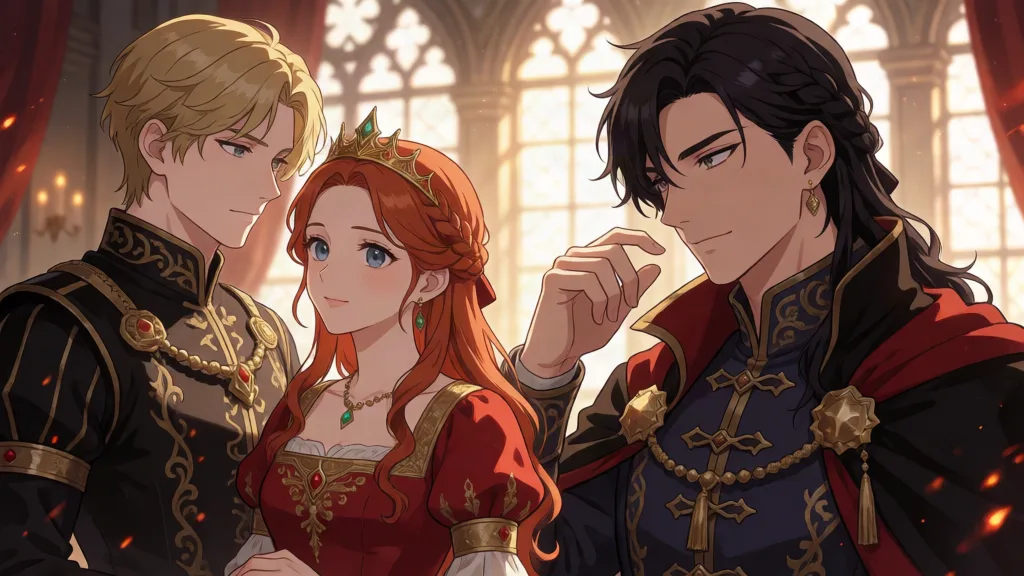
The horses’ hooves hit the cobblestones in a rhythm you’ve known since childhood. A steady, hollow beat that bounces off the stone walls of the lower city, where the buildings lean close together like old women sharing secrets. You hold the reins loose in your gloved hands, letting your mare find her own pace through the narrow streets. The guards behind you keep their distance. They always do when you ride like this, fast and reckless, your dark hair whipping free from its pins.
You shouldn’t be here.
The thought slides through your mind like a blade, familiar and sharp. You push it aside and dig your heels into the mare’s flanks. She surges forward, and the wind tears at your face, cold and clean. The lower city blurs past. A fishmonger shouts at a boy who’s knocked over his basket. A woman hangs laundry from a third-story window, her arms bare and red from the cold. A dog chases your horse for three blocks before giving up, tongue lolling.
You love this city. You hate it too. The way you can only love and hate something you’ve never been allowed to leave.
The palace rises behind you, a white stone mountain that throws its shadow over half the capital. You don’t look back at it. You never do, not once you’ve cleared the gates. Looking back feels like admitting you’ll have to return.
The market square opens before you, wide and chaotic. Stalls crowd every inch of available stone, their canvas canopies snapping in the wind. The smells hit you in waves. Roasting meat. Spiced wine. The sweet rot of overripe fruit. The sharp tang of tanned leather. You slow your mare to a walk, and the crowd parts around you like water around a stone. They know the horse. They know the crest on your saddle, the silver thread in your riding cloak.
They know a princess when they see one, even when she’s trying not to look like one.
You slide from the saddle before your mare has fully stopped, handing the reins to a boy who appears at your elbow. He’s maybe twelve, all sharp elbows and hungry eyes. You press a silver coin into his palm.
“Watch her well.”
He nods, already leading the mare toward the stables at the edge of the square. You don’t watch him go. You’re already moving, threading through the crowd with the practiced ease of someone who’s learned to be invisible in plain sight. You keep your head down. You let your cloak hide the cut of your dress. You become just another woman in the market, nothing special, nothing worth noticing.
The stall you’re looking for sits at the far end of the square, tucked between a spice merchant and a woman selling painted fans. A plain wooden counter. A canvas roof that sags in the middle. No sign, no name. Just a man in a leather apron, his hands stained dark with ink and dye.
He looks up when you approach. His eyes are the color of old copper, and they don’t widen when they land on your face. He’s been expecting you.
“Your package arrived this morning,” he says. His voice is low, rough. A smoker’s voice, though you’ve never seen him touch a pipe. “From the eastern provinces. The merchant who brought it said the roads were bad. Mudslides near the pass. He lost two horses.”
You nod, though you don’t care about the horses. You care about what’s inside the package, the thing you’ve been waiting for since the snow melted. The thing that might finally give you a way out.
“Do you have it?”
The man reaches under his counter and pulls out a flat wooden box, no larger than your hand. He sets it on the counter between you, and you feel the weight of his gaze as you reach for it.
“You know what you’re asking for,” he says. It’s not a question.
You open the box. Inside, nestled in black velvet, is a key. Small, iron, unremarkable. The kind of key that opens a lock you could pick with a hairpin. But the lock it’s meant for isn’t on a door. It’s on a box, and the box is buried in the foundation of the north tower, and inside that box is a letter your mother wrote twenty years ago, a letter that proves she knew about the massacre at Thornfield before it happened, a letter that proves she let it happen.
You close the box. You slide it into the pocket sewn into the lining of your cloak.
“Thank you,” you say.
The man’s eyes hold yours for a long moment. Then he nods once, and you turn away, and the market swallows you again.
Your heart is beating too fast. You can feel it in your throat, in your temples, in the tips of your fingers. You’ve been planning this for six months. Six months of careful questions, of bribes paid in silver and silk, of letters written in cipher and burned before the ink was dry. Six months of pretending you were still the obedient princess, the one who smiled at her mother’s banquets and danced with the ambassadors her mother chose and never, ever asked about the war that ended before you were born.
You’re so focused on the weight of the key in your pocket that you don’t see him until you’ve already collided.
Your shoulder slams into his chest. You stumble back, your hand flying to the pocket, your heart lurching into your throat. Your guards are fifty yards away, maybe more, and if this man has a knife, if this man is one of your mother’s spies, if this man—
His hand catches your elbow. Steadying you. His grip is firm but not rough, and when you look up, you see his face.
You know him.
You’ve known him your whole life, in the way you know the shape of a scar you got as a child, in the way you know the sound of a door you’ve passed a thousand times. He’s etched into your memory like a brand, and seeing him here, now, in the middle of a crowded market, feels like a crack splitting open the ground beneath your feet.
Kael Varnath.
He’s taller than you remember. Broader too. The last time you saw him was three years ago, at the peace summit your mother forced you to attend. He’d been standing at his father’s side, his jaw tight, his eyes fixed on a point somewhere above your head. He’d looked like a boy playing at being a man. Now he looks like a man who’s forgotten how to be anything else.
His hair is dark, almost black, and it falls across his forehead in a way that makes you want to push it back. His eyes are the color of a winter sky, pale and cold and full of things he doesn’t say. He’s wearing a plain leather jerkin over a linen shirt, no crest, no sigil, no sign of the house that’s been your family’s enemy for four generations.
But you know. You know the line of his jaw, the set of his shoulders, the way his hand is still on your elbow, warm and steady, like he’s forgotten to let go.
“Princess.”
His voice is lower than you remember. Rougher. It scrapes against something inside you, something you’ve tried to bury.
“Lord Varnath.”
You pull your arm free. He lets you, but his eyes don’t leave your face. They move over you like he’s reading a map, tracing the lines of your cheekbones, the curve of your lips, the pulse beating at the base of your throat.
“You’re a long way from the palace,” he says. “And your guards are distracted.”
You glance over your shoulder. He’s right. Your guards are clustered around a jeweler’s stall, their backs to you, their attention caught by something glittering. You feel a flash of irritation, hot and sharp. Useless. All of them useless.
“I’m not a prisoner,” you say. “I can go where I please.”
Kael’s mouth curves. It’s not quite a smile. It’s something sharper, something that makes your stomach tighten.
“Can you?”
He says it like he knows. Like he’s seen the walls of your gilded cage, the locks on your doors, the way your mother’s hand closes around your throat every time you try to speak your own mind. And maybe he has. Maybe his cage is the same as yours, just painted a different color.
You should walk away. You should turn on your heel and find your guards and ride back to the palace and pretend this meeting never happened. That’s what a smart princess would do. That’s what a safe princess would do.
But you’ve never been safe. You’ve never wanted to be.
“What are you doing here?” you ask. The words come out sharper than you intended. A blade disguised as a question.
Kael’s smile widens. Just a fraction. Just enough to show you the edge of his teeth.
“Looking for something I lost.”
The market noise fades around you. The shouts of the merchants, the laughter of children, the clatter of hooves on stone. It all becomes a distant hum, like water running underground. There’s only him. Only the cold winter of his eyes and the heat of his body and the space between you that feels smaller than it should.
“I don’t have anything of yours,” you say.
“No.” He steps closer. Close enough that you can smell him. Leather and woodsmoke and something else, something clean and sharp, like rain on stone. “But I might have something of yours.”
He reaches into his pocket. Your hand moves to your belt, where a small knife is hidden in the folds of your dress. He sees it. His eyes flick down, then back up, and something warm flickers in their depths. Approval, maybe. Or amusement.
He pulls out a piece of paper. Folded small, creased and worn at the edges. He holds it out to you, and you take it, your fingers brushing his.
The touch is electric. A shock that travels up your arm and settles in your chest, hot and insistent. You pull your hand back like you’ve been burned.
You unfold the paper.
It’s a sketch. Done in charcoal, quick and rough, but unmistakable. It’s you. Your face, your hair, the curve of your neck. You’re looking over your shoulder, your lips parted, your eyes wide. Like you’ve been caught.
“Where did you get this?”
“I drew it,” he says. “Three years ago. After the summit. I couldn’t get your face out of my head.”
The confession lands like a blow. You feel it in your ribs, in your lungs, in the space behind your eyes where you keep all the things you’re not supposed to feel.
“You shouldn’t have that.”
“I know.”
“If anyone saw it—”
“No one saw it.” His voice drops. Lowers until it’s almost a whisper. “No one sees anything I don’t want them to see. Same as you.”
You look at the sketch again. The way he’s drawn your mouth, soft and full. The way he’s caught the light in your eyes, the fire you try so hard to hide. He saw you. Three years ago, across a crowded room, while you were pretending to be nothing, he saw you.
And he remembered.
You fold the paper. You slide it into your pocket, next to the box with the key. His eyes follow the movement, and something shifts in his expression. Something that looks like hunger.
“I need to go,” you say.
“I know.”
“My guards will notice I’m gone.”
“They already have.”
You look up. He’s right. One of your guards is scanning the crowd, his hand on his sword, his face tight with worry. You have maybe thirty seconds before he spots you.
You should leave. You should turn and walk away and never look back.
But you don’t.
“The old mill,” you say. The words come out before you can stop them. “Outside the eastern gate. Two hours after sunset.”
Kael’s breath catches. You see it, the way his chest stills, the way his eyes go dark.
“I’ll be there,” he says.
You turn and walk away. Your legs feel unsteady, like the ground beneath you has turned to water. You don’t look back. You don’t let yourself. You reach your guards and let them surround you, let them escort you to your horse, let them lead you back through the winding streets toward the palace.
The key burns in your pocket. The sketch burns too. And underneath both, something else. Something you haven’t felt in years.
Hope.
The palace gates open to receive you. The guards salute. The servants bow. You ride through the courtyard and dismount, and your handmaiden is there, waiting with a cloak and a cup of warm wine and a look that says she knows you’ve been up to something.
You don’t meet her eyes.
Your rooms are on the third floor, in the east wing, where the windows face the sunrise. They’re beautiful rooms. Silk curtains, marble floors, a bed so large you could drown in it. Your mother chose them for you when you turned sixteen, and you’ve always hated them. They feel like a cage dressed up as a gift.
You close the door behind you. You lock it. You cross to the window and look out at the city, at the smoke rising from a thousand chimneys, at the river winding through the lower districts like a silver snake.
Somewhere down there, Kael Varnath is still walking through the market. Still carrying the memory of your face in his hands.
You press your palm to the glass. The cold seeps through your skin, into your bones.
You shouldn’t have said yes. You shouldn’t have told him where to meet you. You shouldn’t have let him see that you want him, that you’ve always wanted him, that the hatred between your families has never felt like hatred to you. It’s felt like hunger. Like longing. Like a fire you can’t put out, no matter how much water you pour on it.
But you did. You said yes. And now you have to decide what you’re going to do about it.
The key is still in your pocket. The key to your mother’s secret. The key to the truth that could destroy her, could destroy the kingdom, could set you free.
Or it could get you killed.
You pull the box out of your pocket. You open it. You look at the key, small and dark and ordinary, and you think about all the ways this could go wrong.
Then you think about Kael’s hand on your elbow. The warmth of his palm through your sleeve. The way he looked at you like you were the only thing in the world worth seeing.
You close the box. You hide it in the false bottom of your jewelry chest, beneath the pearls your father gave you and the emerald pendant your mother insists you wear to every banquet.
Two hours after sunset.
You have time to change your mind.
You won’t.
The sun sets slowly, the way it always does in winter. The sky turns from blue to pink to orange to a deep, bruised purple. You watch it from your window, your forehead pressed to the cold glass, your breath fogging the pane.
Your mother summons you for dinner. You send word that you’re unwell. She doesn’t argue. She never does. Illness is the one excuse she can’t question, the one weakness she can’t exploit.
You wait.
The palace settles into its nightly rhythm. The servants finish their duties and retreat to their quarters. The guards change shifts, their boots echoing through the halls. The candles burn down, one by one, until the only light comes from the moon and the stars.
You change your clothes. A plain wool dress, dark and unremarkable. A cloak with a hood that hides your face. Soft boots that make no sound on the stone floors.
You slip out of your room. Down the back stairs. Through the kitchen, where the fires have been banked and the cooks have gone to bed. Out the service door, into the garden, where the frost has turned the grass white and brittle.
The wall is high, but you know where the ivy grows thick. You know where the stones are loose. You’ve been climbing this wall since you were twelve, and your mother has never caught you.
You drop to the other side, landing soft as a cat. The street is empty. The city is quiet.
You walk.
The old mill is outside the eastern gate, past the last of the houses, where the road turns to dirt and the trees grow thick. It’s been abandoned for years, its wheel broken, its roof half-collapsed. No one comes here. No one remembers it.
Except you. Except him.
You reach the gate and slip through, your heart pounding. The guards don’t see you. They never do. You’re a ghost, a shadow, a thing that moves through the cracks of the world.
The mill rises out of the darkness, a black shape against the stars. You approach slowly, your hand on the knife at your belt.
A figure steps out of the shadows.
Kael.
He’s wearing dark clothes, like you. A cloak that blends into the night. His face is half-hidden, but you can see his eyes, pale and bright, watching you.
“You came,” he says.
“So did you.”
He steps closer. The moonlight catches his face, carves shadows into his cheekbones, his jaw, the hollow of his throat.
“I’ve been thinking about you,” he says. “Every day. Every night. I tried to stop. I couldn’t.”
The words hit you like a wave. You feel them in your chest, in your stomach, in the space between your thighs.
“You shouldn’t say that.”
“I know.” He’s close now. Close enough that you can feel the heat of his body, see the pulse beating in his throat. “But I don’t care.”
His hand comes up. His fingers brush your cheek, light as a whisper. You should pull away. You should slap his hand down and walk away and never look back.
Instead, you lean into his touch.
“This is insane,” you whisper.
“I know.”
“If anyone finds out—”
“No one will.”
His hand slides to the back of your neck. His fingers thread through your hair, and he pulls you closer, and you let him. You let him because you’ve been waiting for this, because you’ve been wanting this, because the hatred between your families has never felt like hatred to you.
It’s felt like this. Like his mouth on yours. Like his hands on your body. Like the way he says your name, soft and rough, like a prayer and a curse all at once.
You kiss him. Your lips part. His tongue slides against yours, and you taste him, taste the wine he drank before he came, taste the hunger that’s been building in him for three years.
Your back hits the wall of the mill. The stone is cold through your dress. His body is hot against yours, pressing you into the rough surface, and you arch into him, your hands fisting in his shirt, pulling him closer.
He breaks the kiss. His forehead rests against yours. His breath comes hard and fast, matching yours.
“I want you,” he says. “I’ve wanted you since the moment I saw you.”
“Then have me.”
His laugh is low, rough, broken. “You don’t know what you’re saying.”
“I know exactly what I’m saying.” You pull back, just enough to look him in the eye. “I’ve spent my whole life doing what I’m told. Being who they want me to be. And for what? So I can marry some lord I don’t love and spend the rest of my life in a cage?”
You reach up. You touch his face, trace the line of his jaw, the curve of his mouth.
“I want this. I want you. And I’m tired of pretending I don’t.”
Something breaks in his eyes. Something that’s been holding him together, holding him back. He kisses you again, harder this time, and his hands find your waist, your hips, the curve of your ass.
You don’t stop him.
You don’t want to.
The night is cold, but you don’t feel it. You feel only him. His mouth on your throat. His hands under your dress. The way he groans when you arch against him, the way he says your name like it’s the only word he knows.
You take him inside the mill. The floor is covered in straw and dust, but you don’t care. You pull him down with you, and he comes willingly, his body covering yours, his weight a comfort you didn’t know you needed.
He takes you slow at first. Gentle. Like you’re something precious, something fragile. But you don’t want gentle. You want him. All of him.
“Harder,” you whisper.
He looks at you. His eyes are dark, his jaw tight.
“Are you sure?”
“I’ve never been more sure of anything.”
He takes you harder. And you take him. And the world outside the mill ceases to exist.
Later, you lie in each other’s arms, your bodies tangled in the straw. The moon has moved across the sky. The night is half-gone.
“I have something to tell you,” you say.
His hand stops moving on your back.
“What?”
You tell him about the key. About the letter. About what your mother did, what she let happen, what she covered up.
He listens. His body goes still. When you finish, he’s quiet for a long moment.
“If you expose her,” he says, “the kingdom will fall apart.”
“I know.”
“The peace will shatter. The war will start again.”
“I know.”
“People will die.”
You sit up. You look at him, at his face in the moonlight, at the man who’s been your enemy and your lover and everything in between.
“If I don’t expose her,” you say, “she wins. She gets away with it. And I spend the rest of my life knowing I could have stopped her and didn’t.”
He reaches up. His hand cups your cheek.
“What do you want to do?”
You close your eyes. You lean into his touch.
“I don’t know.”
He pulls you down. He holds you close. His lips press against your forehead.
“Then we figure it out together.”
You don’t sleep. You lie awake in his arms, listening to his breathing, feeling his heartbeat against your cheek.
The key is still in your pocket. The truth is still buried in the foundation of the north tower.
And tomorrow, you have to decide what kind of princess you’re going to be.
The one who obeys. Or the one who burns it all down.
Disclaimer
This is a work of fiction, assisted by artificial intelligence. Any names or characters, businesses or places, events or incidents, are fictitious. Any resemblance to actual persons, living or dead, or actual events is purely coincidental.
Content Removal Policy
- Users may report content that may be illegal or violates our Standards.
- All reported complaints will be reviewed and resolved within seven business days.
- Review Process: Our team will assess the reported content against our guidelines.
- Appeals: If you disagree with a decision, you may appeal within 14 days of notification.
- Potential outcomes include: content removal, account warning, or no action if no violation is found.
To report content, email us at [email protected]