Share
Go Live
The Hilarious Diagnosis
·
Published 10/3/2026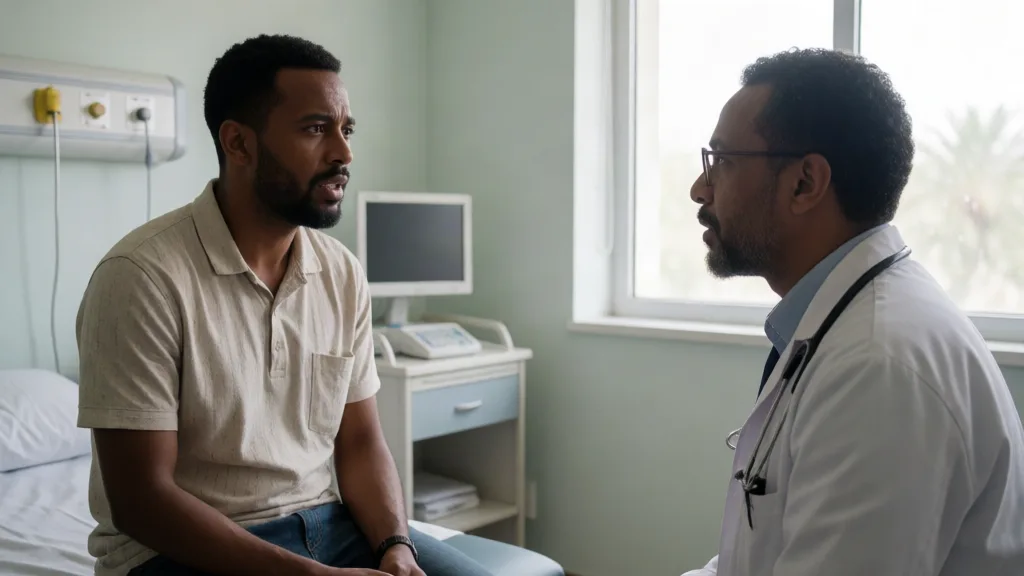
The chair had a wobble in its left leg. I'd been sitting in it for eleven minutes, which was long enough to learn the rhythm of the wobble, the way it clicked against the linoleum every time I shifted my weight. Click. Pause. Click. The examination room smelled like rubbing alcohol and something older underneath, something like dust and paper and the particular staleness of a room where bad news had been delivered before. I knew that smell. Every Ethiopian knows that smell. It's the smell of waiting for someone to tell you what's wrong with you.
The doctor hadn't looked up from his clipboard yet. He was maybe forty, with glasses that sat low on his nose and a white coat that had been ironed so many times the collar had gone soft and frayed at the edges. His name was Dr. Bekele. I knew this because it was printed on a small plaque on his desk, and also because I'd asked the receptionist three times if I was seeing the right doctor, the one who specialized in mysterious cases, the one who had supposedly cured a man in Bahir Dar who had been coughing up green stones for two years.
"You can stop fidgeting," Dr. Bekele said, still not looking up. "The chair has been broken since 2019. You are not the first person to sit in it and you will not be the last."
"I'm not fidgeting," I said. "I'm adjusting."
He made a small sound in his throat, something between a laugh and a cough. Then he finally looked at me, and his eyes were tired in a way that made me feel tired too, like his exhaustion was contagious and I'd already caught it. He set the clipboard down on the desk and folded his hands on top of it.
"Mr. Tesfaye," he said. "You called my office four times in the last two days. You told my receptionist, and I quote, that your body was 'doing things bodies should not do.' You said you couldn't sleep. You said you couldn't eat. You said, and I remember this specifically because it made my receptionist laugh so hard she spilled her coffee, that you were afraid you were turning into a goat."
I felt my face get hot. "I didn't say goat. I said something was growing. Something with hair."
"Ah. Hair." He nodded slowly. "That's different. Goat was my interpretation."
"It's not funny, Doctor."
"I didn't say it was funny. I said my receptionist spilled her coffee."
I wanted to be angry at him, but I couldn't. He had that way about him, the way some doctors do, where they make you feel like you're the only person in the room even though you know for a fact there are at least six other patients waiting outside, all of them with their own mysterious diseases, all of them probably sitting in chairs with wobbling legs, all of them probably convinced they were turning into something they weren't. I took a breath. The wobble clicked under me.
"Doctor," I said, and my voice came out smaller than I meant it to. "Please help me. I have a very strange disease."
There it was. The sentence I'd been rehearsing for two days, in the mirror, in the shower, on the bus ride over. In Amharic it sounded even worse than it had in my head. ዶክተር፣ እባክህ እርዳኝ! በጣም የሚገርም በሽታ ይዞኛል። Doctor, please help me. I have a very strange disease.
Dr. Bekele didn't laugh. He didn't even smile. He just looked at me with those tired eyes, and for a moment I thought I saw something flicker behind them, something that might have been curiosity or might have been the same look a man gives a stray dog when it limps up to his gate. He leaned forward. The chair creaked.
"Tell me about the hair," he said.
So I told him. I told him about the patch on my lower back, just above my hip, that had started as an itch three weeks ago and had grown into something that felt like fur when I ran my fingers over it. I told him about the dreams, the ones where I was standing in a field outside Addis, in the hills where my grandmother used to take me when I was a boy, and there were animals all around me, goats and sheep and something bigger, something with horns, and they were all looking at me like they knew me. Like I was one of them. I told him about the way my stomach had started making sounds at night, not hungry sounds, but something else, something like a language I almost understood but couldn't quite translate.
I told him I hadn't slept in four days. I told him I was afraid to close my eyes.
When I finished, Dr. Bekele was quiet for a long time. He picked up his clipboard and wrote something down, then put it down again. Then he took off his glasses and rubbed the bridge of his nose, and without the glasses his face looked younger and also sadder, like the glasses had been holding something back.
"Mr. Tesfaye," he said. "How old are you?"
"Thirty-one."
"And you work where?"
"The Merkato. I sell fabrics. Imported cotton, mostly. Some silk."
"Imported from where?"
"China. Dubai. Sometimes Turkey."
He nodded. "And when did you first notice the patch?"
"Three weeks ago. Maybe four. I thought it was a rash. I put butter on it. My mother told me to put butter on it."
"Your mother."
"She's very traditional."
"I see." He put his glasses back on. "And the dreams. You said there was something with horns. Can you describe it?"
I closed my eyes. The image was there, waiting for me, the way it always was. "It's big," I said. "Bigger than a goat. Bigger than a cow, even. It has a long face and these eyes that are almost human, and when it looks at me I feel like it's asking me a question. But I don't know what the question is. And I don't know how to answer."
I opened my eyes. Dr. Bekele was watching me with an expression I couldn't read.
"There's something I should tell you," he said.
"What?"
He stood up and walked to the window. Outside, the afternoon light was turning gold, and I could hear the traffic on the ring road, the constant hum of minibuses and taxis and people shouting at each other in the street. It was a sound I'd grown up with, a sound I usually didn't notice, but right now it felt far away, like it was coming from another world.
"I've been a doctor for fifteen years," he said. "I've seen things I can't explain. A woman in Jimma who sweated honey for a month. A man in Hawassa whose bones clicked in rhythm with his heartbeat. A child in Gondar who could tell you what you'd dreamed the night before, even if you'd never met her." He turned to face me. "I don't believe in curses, Mr. Tesfaye. I don't believe in demons or spirits or the evil eye. But I do believe that sometimes the body knows things the mind doesn't. And sometimes it tries to tell us something."
"What is it trying to tell me?"
He was quiet for a moment. Then he said, "I don't know yet. But I'd like to find out."
He walked back to his desk and sat down. The chair creaked again. He pulled a form from a drawer and began to fill it out, his pen moving in quick, sure strokes.
"I'm going to run some tests," he said. "Blood work. A biopsy of the patch. And I want you to keep a journal. Write down everything you feel, everything you dream, everything you think might be connected. Don't edit. Don't try to make it make sense. Just write."
"For how long?"
"As long as it takes."
He tore the form off the pad and handed it to me. Our fingers touched for a moment, and his hand was warm, warmer than I expected, and I wondered if that was a doctor thing or just a human thing.
"One more question," I said.
"Go ahead."
"Am I going to be okay?"
He looked at me for a long moment. The traffic outside seemed to get louder, then quieter, then louder again, like a tide.
"I don't know," he said. "But I'll tell you this. You're not the first person to come to me with a strange disease. And you won't be the last. Whatever is happening to you, you're not alone in it."
I wanted that to be enough. I wanted to stand up and shake his hand and walk out of the room feeling like everything was going to be fine. But the wobble in the chair clicked one more time as I stood, and the sound followed me out into the hallway, and I knew, even then, that I wasn't going to be able to forget it.
Watch this moment
Turn the current scene into a cinematic Live Chapter — what you watch becomes the story's next part.
Disclaimer
This is a work of fiction, assisted by artificial intelligence. Any names or characters, businesses or places, events or incidents, are fictitious. Any resemblance to actual persons, living or dead, or actual events is purely coincidental.
Content Removal Policy
- Users may report content that may be illegal or violates our Standards.
- All reported complaints will be reviewed and resolved within seven business days.
- Review Process: Our team will assess the reported content against our guidelines.
- Appeals: If you disagree with a decision, you may appeal within 14 days of notification.
- Potential outcomes include: content removal, account warning, or no action if no violation is found.
To report content, email us at [email protected]