Share
Go Live
Sands of Union
·
Published 8/15/2026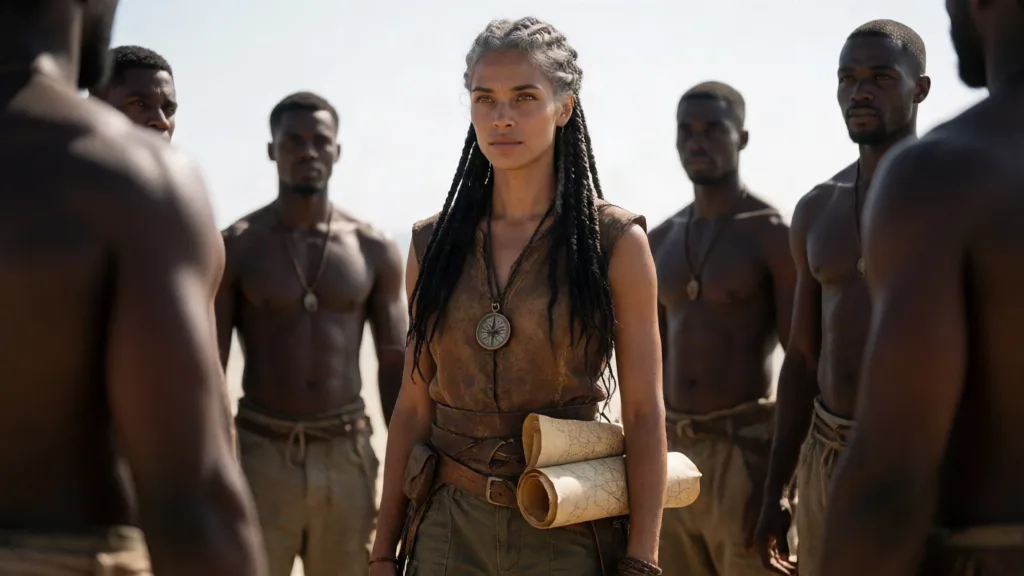
The salt hit my tongue before I saw the water. That’s how it always is on this coast. The air thick with it, a film on your skin that never washes off. I’d been three weeks inland, mapping the dry riverbeds east of the escarpment, and my body had forgotten what wet felt like. Now it remembered all at once.
The beach curved like a blade. White sand so bright it hurt, the kind of light that makes you squint even with your eyes closed. I stood at the treeline where the baobabs gave way to palm scrub, my boots sinking into something that wasn’t rock or dust for the first time in a month. The parchment at my hip was rolled tight, the compass around my neck warm against my collarbone.
They were already there.
Four of them. Maybe five. Hard to count from the shadows, and I wasn’t in the habit of trusting my first count anyway. Black men, dark as wet earth, their bodies slick with seawater and sweat. They moved in the surf like they owned it. Like the ocean was just another room in their house.
I didn’t come here for this. I came to chart the old harbor ruins, the ones the elders said sank during the great shift. But the map I’d drawn from memory had a hole in it, a blank space where something should be. And blank spaces don’t stay blank for long. Not in my line of work.
The tallest one saw me first. He stopped mid-stride, water lapping at his thighs, and turned his head like a dog catching a scent. His eyes found mine through the palm fronds. I didn’t move. Neither did he.
Then he smiled.
Not a threat. Not an invitation either. Something in between, something I couldn’t read yet. That’s the thing about this place. The rules are different. The air is different. Even the shadows fall at angles I don’t recognize.
I stepped out onto the sand.
The heat came up through my soles, a dry heat that didn’t belong next to all that water. I walked toward them because walking away would have meant admitting I was lost, and I wasn’t lost. I was exactly where the map said I’d be. The map just happened to be wrong.
“You’re the cartographer,” the tall one said. Not a question.
I stopped ten feet from the waterline. Close enough to see the scar that ran from his collarbone to his ribs, a pale line against dark skin. Close enough to smell the salt on him, the fish and the sun and something else. Something green.
“I’m a cartographer,” I said. “Don’t know if I’m the one you’re looking for.”
He laughed. The others laughed too, a sound that rolled like the waves. They were all watching me now, their eyes moving over my tunic, my cargo pants, the compass at my throat. I let them look. Let them see the leather worn soft at the elbows, the ink stains on my fingers, the knife I kept visible at my belt. Better they see it now than find it later.
“We’ve been waiting,” the tall one said. He waded closer, the water dropping away from his body as he climbed the sand. “Three days. The old woman said you’d come when the tide turned.”
The old woman. That got my attention. There was only one old woman on this coast who knew my name, and she’d been dead two years. Or so I’d been told.
“Which old woman?”
He shrugged. The motion sent water droplets flying, catching the light like tiny flames. “She didn’t give a name. Said you’d know her by the map you carry. The one with the hole.”
My hand went to my hip before I could stop it. The parchment was still there, still rolled tight, still wrong. I’d drawn that map myself, traced every line from memory, and the hole was new. It hadn’t been there when I started. It appeared overnight, three weeks ago, in the middle of a dry camp with nothing but stars and silence. I woke up and the blank space was just there. Like something had eaten the land while I slept.
“What else did she say?”
The tall man looked at the others. They exchanged something I couldn’t read, a silent conversation that moved across their faces like weather. Then he looked back at me.
“She said you’d be hungry for something you couldn’t name. That you’d come here looking for a place that isn’t on any map. And that when you found it, you’d have to choose.”
“Choose what?”
He didn’t answer. He just stood there, water dripping from his hair, his body blocking the sun. Behind him, the others were moving now, spreading out along the beach like they were taking positions. Not threatening. Not yet. But the space between us was getting smaller without anyone walking forward.
I pulled the map from my hip. Unrolled it one-handed, let the wind catch the edges. The hole was still there, a perfect circle of nothing where the harbor ruins should be. I’d drawn everything else with care. The cliffs. The reef. The old stone pier. But the center was gone, like someone had cut it out with a blade.
“You know what’s there,” I said. Not a question.
The tall man looked at the hole. Then at me. His smile was gone now, replaced by something harder, something that belonged to the deep water.
“I know what was there,” he said. “What’s there now is different. The tide changed everything. The old woman didn’t tell you that part?”
I shook my head.
“She wouldn’t. That’s not how she works.” He stepped closer, close enough that I could see the gold flecks in his eyes, the way his pupils dilated in the bright light. “She sends people to the edge of things. Lets them decide the rest.”
The edge of things. That’s where I’d been my whole life. The edge of deserts, the edge of maps, the edge of what people thought was possible. I’d built a life on edges. But this felt different. This felt like the edge was looking back.
“What’s your name?” I asked.
“Does it matter?”
“It does if I’m going to trust you.”
He considered that. The waves kept their rhythm, a constant heartbeat against the sand. The others had stopped moving now, waiting.
“My name is Kofi,” he said. “And these are my brothers. We’re the ones who guard the hole in your map. We’ve been waiting for someone brave enough to fill it.”
I looked at the hole again. Then at the water. Then at the five men who stood between me and whatever was out there.
“I’m not brave,” I said. “I’m curious. There’s a difference.”
Kofi smiled again, and this time it reached his eyes.
“That’s what she said you’d say.”
He turned and walked back into the water. The others followed, one by one, their bodies disappearing into the surf until only their heads were visible, dark shapes bobbing on the swell. They were waiting for me.
I rolled the map. Tucked it back into my belt. The compass swung against my chest, pointing east, the same direction it always pointed. But the water was west. And the hole in my map wasn’t on any compass rose I knew.
The old woman was dead. I’d seen her grave myself, two years ago, a pile of stones in the high desert. But she’d sent them anyway. She’d known I’d come. She’d known about the hole.
I stepped into the water.
It was colder than I expected. Colder than the air, colder than the sand, cold enough to steal my breath. The salt stung the cuts on my hands, the ones I’d gotten climbing the escarpment. I kept walking.
Kofi didn’t look back. Neither did the others. They just swam, steady strokes that carried them toward the horizon, toward the place where the water turned from blue to something darker. Something I couldn’t see through.
I followed.
The map at my hip was getting heavier. The compass was spinning now, slow circles that didn’t stop. And somewhere ahead, in the blank space where nothing should be, something was waiting.
I just hoped I’d recognize it when I found it.
Watch this moment
Turn the current scene into a cinematic Live Chapter — what you watch becomes the story's next part.
Disclaimer
This is a work of fiction, assisted by artificial intelligence. Any names or characters, businesses or places, events or incidents, are fictitious. Any resemblance to actual persons, living or dead, or actual events is purely coincidental.
Content Removal Policy
- Users may report content that may be illegal or violates our Standards.
- All reported complaints will be reviewed and resolved within seven business days.
- Review Process: Our team will assess the reported content against our guidelines.
- Appeals: If you disagree with a decision, you may appeal within 14 days of notification.
- Potential outcomes include: content removal, account warning, or no action if no violation is found.
To report content, email us at [email protected]