Share
Go Live
Concrete Omens
·
Published 11/14/2026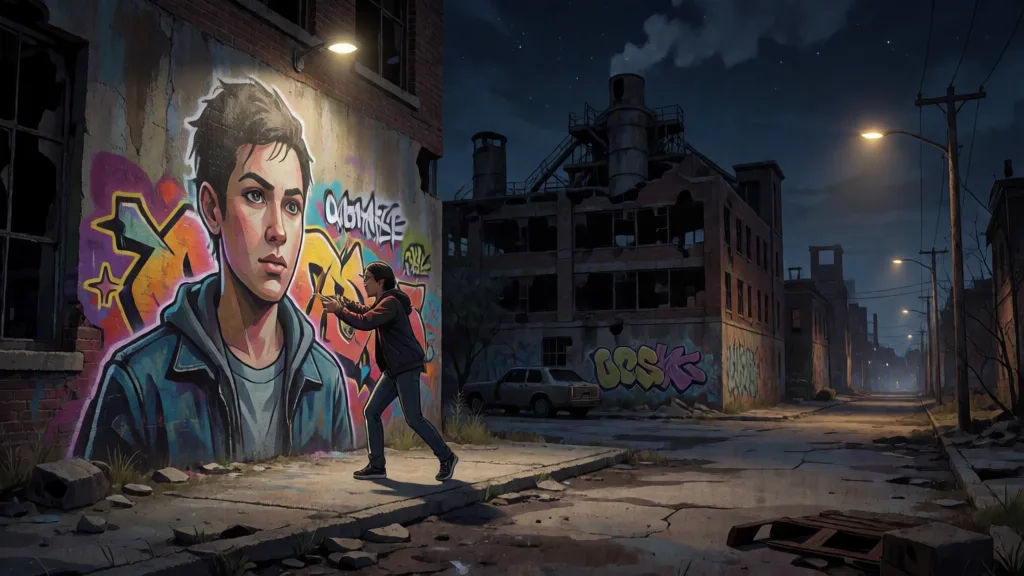
The paint was still wet when I saw my brother's face in it.
I hadn't painted a face. I'd painted a wall.
That's the thing nobody understands about what I do. It isn't about the picture. It's about the wall, the brick, the way a surface holds light, the way a corner catches shadow at four in the morning when the streetlights are orange and dying and the whole city looks like a photograph left in the sun too long. You learn a wall the way you learn a person. Its moods. Its secrets. Where it wants to hold color and where it wants to let it go.
This wall was the east side of the old Schaefer factory on Michigan Avenue, a building that had been dying since before I was born. Twelve feet of brick, pitted and scarred, tagged over by a hundred hands that weren't mine. I'd spent three nights clearing it, laying down primer in the dark, working by the light of a battery lamp I'd stolen from my mother's garage. The primer was white. Pure. A held breath.
Tonight I'd started the color.
Midnight. The city quiet in that way it gets in October, when the heat's gone but the cold hasn't committed yet, when you can still smell the river if the wind's right. I had my cans laid out on a tarp, my respirator hanging around my neck, my hands stained the color of a bruise. I was working on the sky. That's where I always start. The sky sets the mood, tells you what kind of world you're standing in. A red sky means violence. A gray sky means forgetting. A sky the color of a peach means something's about to be born.
I'd chosen peach. I don't know why. It felt right.
The figure came next. I never plan the figure. I plan the wall, the sky, the light. The figure arrives on its own, like a guest who wasn't invited but somehow belongs. I've been painting since I was twelve, six years now, and I've learned not to argue with what wants to be painted. You argue, you lose the thread. The thread is everything.
I was spraying the outline of a shoulder, a curve of jaw, when my hand stopped.
The jaw was Marcus's jaw. The shoulder was Marcus's shoulder. The tilt of the head, that slight lean to the left, like he was listening to something far away. I knew it the way you know your own reflection. I'd been looking at that face my whole life.
I stepped back. My heel caught the edge of the tarp and I almost fell. The can was still in my hand, hissing softly, paint drifting down like colored snow.
"No," I said. Out loud. To no one.
The face on the wall didn't answer. It never does. But it was there, unmistakable, rendered in six shades of gray and a peach sky that suddenly looked less like dawn and more like a wound.
I hadn't painted Marcus. I'd never painted Marcus. I painted strangers, faces I'd seen on the bus or in line at the corner store, faces that came to me in dreams and demanded to be remembered. I painted the dead. That's what I told myself, anyway. That I was a witness. That the city spoke through me and I was just the hand.
But I knew better. I'd known better for a long time.
The first time it happened, I was fourteen. I painted a girl on the side of an abandoned house on Kercheval, a girl with braids and a yellow dress, and three days later I saw her picture on the news. Drowned in the Detroit River. They never found out how she got there. I told myself it was coincidence. I told myself a lot of things.
The second time, I painted a man on the overpass on I-75, a man with a beard and a scar above his left eye, and a week later he was shot outside a liquor store on Gratiot. I stopped painting for six months after that. I couldn't sleep. I couldn't eat. My mother thought I was on drugs. She sent me to a counselor who asked me about my feelings and I told her I felt like a murderer.
She said that was a normal response to trauma.
I said I wasn't traumatized. I was haunted.
She wrote something down. I never went back.
But I couldn't stop. The walls called to me. The city called to me. And the faces kept coming, strangers, ghosts, people I'd never met and would never meet, their stories written on my hands before they even knew their stories were ending.
I told myself it was a gift. A terrible gift, but a gift. I was a witness. I was a voice for the voiceless. I was a prophet of the forgotten.
I was lying.
Because here was Marcus, my brother, my blood, the only person in this world who'd never let me down, and his face was on the wall and I hadn't put it there.
Not consciously.
I grabbed my phone. 12:47 AM. Three missed calls from Marcus. Three. He never called me three times. He called once, left a voicemail, and waited for me to call back. That was our rhythm. That was our whole relationship. He was the patient one. I was the one who forgot to eat.
I called him back. It rang once. Twice. Three times.
"Yo." His voice was thick, like he'd been sleeping. "You okay?"
"I'm fine. Why'd you call?"
"Just checking on you. Ma said you been out late again."
"I'm always out late."
"Yeah." A pause. I could hear the TV in the background, some late-night talk show, the audience laughing at something that wasn't funny. "You coming home tonight?"
"I don't know. Maybe."
"Rae." His voice changed. Softer. "Come home."
The way he said it. Like a request. Like a prayer. Like he knew something I didn't.
"I'll be there," I said. "Give me an hour."
"Okay."
I hung up. The wall was still there. Marcus's face, rendered in grays and peach, looking at me with eyes I hadn't painted yet. Empty sockets. Waiting.
I picked up the can. I could paint over it. I could erase him. I could pretend I'd never seen it, never felt the cold certainty that had settled in my chest like a stone.
But I'd tried that before. It never worked. The faces always came back.
I pulled on my respirator and stepped toward the wall. The night was quiet. The city was watching. And somewhere, in the dark, something was choosing.
I just didn't know yet that it was me.
Watch this moment
Turn the current scene into a cinematic Live Chapter — what you watch becomes the story's next part.
Disclaimer
This is a work of fiction, assisted by artificial intelligence. Any names or characters, businesses or places, events or incidents, are fictitious. Any resemblance to actual persons, living or dead, or actual events is purely coincidental.
Content Removal Policy
- Users may report content that may be illegal or violates our Standards.
- All reported complaints will be reviewed and resolved within seven business days.
- Review Process: Our team will assess the reported content against our guidelines.
- Appeals: If you disagree with a decision, you may appeal within 14 days of notification.
- Potential outcomes include: content removal, account warning, or no action if no violation is found.
To report content, email us at [email protected]