Share
Go Live
Echoes of Devotion
·
Published 11/16/2026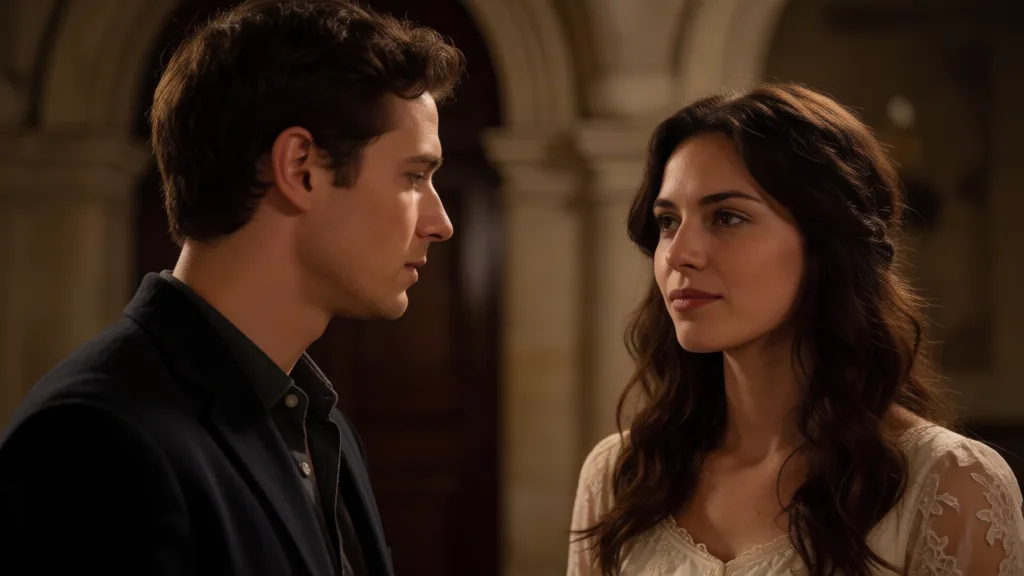
The first time I sang for her, I got the words wrong.
Not the lyrics. I knew those cold, the way you know your own phone number or the sound of your mother's cough through a wall. It was the other words, the ones underneath. The ones I was trying to say without saying. Those came out sideways, bent, like silverware you've dropped one too many times.
She was standing at the edge of the platform, and the 7:42 had just pulled away, and she was looking at the empty tracks the way people look at something they've lost. I had my guitar case in one hand and a cup of coffee going cold in the other. I wasn't planning to sing. I never plan it. The song just rises up sometimes, like water finding a crack in the foundation.
Her hair was doing that thing, the thing where it falls across her face and she doesn't push it back because she's too busy thinking about something else. She was wearing a green coat. Not emerald, nothing that fancy. More like the green of a stoplight just before it turns yellow. The kind of green you don't notice until it's gone.
I opened my mouth.
"*The way you move through a room,*" I sang, and my voice cracked on the second syllable, and I wanted to throw myself onto the tracks. "*Is the way I want to move through my life.*"
She turned.
Not all the way. Just her head, just enough so I could see the corner of her mouth. That mouth. I'd seen it a thousand times in my dreams, and I'm not being poetic. I mean actual dreams, the kind that leave you sweating and reaching for something that isn't there.
"You're off-key," she said.
"I know."
"The words are wrong too."
"I know that too."
She looked at me then. Really looked. And I felt it, the way you feel a door opening in a house you thought was empty. Something shifted. Something I couldn't name.
"You don't know me," she said.
"I know I don't."
"Then why are you singing?"
I didn't have an answer. Not one that made sense. So I just stood there, holding my guitar case, watching the 7:42 disappear into the tunnel, and feeling like I'd just missed something important. Something I'd been waiting for my whole life without knowing it.
---
Her name was Marguerite. I learned that three days later, at a coffee shop on Rue des Martyrs, where she was arguing with the barista about the temperature of her latte. Not the heat. The temperature. There's a difference, apparently.
"You steamed it to one-fifty," she said. "I asked for one-forty."
The barista, a kid with a mustache that looked like it was drawn on with a Sharpie, stared at her like she was speaking Latin.
"It's the same thing," he said.
"It's not."
She was right. It wasn't. I knew that without knowing why, the same way I knew her name before she told me. Some things you just carry. Some things are already written.
I was sitting at a table near the window, pretending to read a book I'd been carrying around for three months without finishing. I watched her take the latte, take a sip, and make a face that said *close enough*. Then she turned, and she saw me, and she didn't look surprised.
"You," she said.
"Me."
"The train singer."
"That's one way to put it."
She sat down across from me without asking. She had a way of doing that, of moving through the world like she already owned it, like every chair was her chair. I would learn that about her. I would learn a lot of things.
"You never told me why you were singing," she said.
"You never asked."
"I'm asking now."
The book was open in front of me, the same page I'd been staring at for an hour. I closed it. The cover was worn, the spine cracked, a collection of poems by someone I'd never heard of. I'd bought it at a used bookstore because the title spoke to me. *The Distance Between Two Heartbeats*. I hadn't read a single poem.
"I don't know why," I said. "I just do it. When I see something beautiful, I sing."
"And you saw something beautiful."
"I saw you."
She didn't blush. She didn't look away. She just held my gaze, steady, like she was testing the weight of what I'd said. Then she nodded, once, like she'd made a decision.
"Sing it again," she said. "The right way this time."
---
I sang for her on a bench in Parc Monceau, under a sky the color of old pewter. It wasn't a performance. It was just us, and the pigeons, and an old man feeding breadcrumbs to something that might have been a duck. I sang the song I should have sung on the platform, the one I'd been hearing in my head for weeks, the one that felt like it had been written before I was born.
*"I knew you before I knew your name,*" I sang. *"I knew you before I knew my own.*"
She listened. She didn't interrupt. She didn't correct me. She just sat there, her hands folded in her lap, her eyes closed, and I could see her breathing. Slow, steady, like she was counting something.
When I finished, she opened her eyes.
"That's better," she said.
"Better how?"
"Truer."
I didn't know what that meant. I still don't. But I knew she was right. She was always right about things like that.
We walked through the park, past the statues and the fountains, past the children chasing each other around the pond. She told me about her job, something in publishing, something that required her to read manuscripts she didn't care about and pretend she did. I told her about my guitar, about the songs I'd written and never played for anyone, about the way music felt like the only language I actually spoke.
"You speak French," she said.
"Badly."
"You speak English."
"Worse."
"You speak music."
I stopped walking. She kept going, a few steps, then turned.
"What?" she said.
"Nothing."
"Liar."
She was smiling. That smile. The one that made me want to write a hundred songs and burn them all because none of them would be good enough.
"I don't believe in fate," she said. "I want you to know that. I don't believe in soulmates. I don't believe in any of that."
"Okay."
"I'm serious."
"I know you are."
"Then why are you looking at me like that?"
I didn't answer. I didn't have to. She knew. She knew the way I knew her name, the way I knew the song, the way I knew that this, whatever this was, had been waiting for us both.
---
The thing about Marguerite is that she was wrong.
Not about everything. About most things, she was right. She was right about the latte, and the song, and the way I looked at her. But she was wrong about fate. She was wrong about soulmates. She was wrong about the idea that two people could meet by accident, by chance, by some random collision of atoms in a universe that didn't care.
I knew because I'd seen her before.
Not in a dream. Not in a vision. In a photograph, tucked into the back of a book I'd bought at a flea market when I was nineteen. A photograph of a girl with green eyes and a green coat, standing at the edge of a platform, looking at the empty tracks.
I'd carried that photograph for ten years without knowing why. I'd looked at it on bad days and good days, on days when I wanted to give up and days when I thought I might actually make something of myself. I'd never shown it to anyone. I'd never told anyone.
And then, on a Tuesday afternoon, on a train platform in Paris, I'd looked up and seen her. The same girl. The same coat. The same look on her face.
I didn't tell her that. Not then. Not for a long time.
But I knew. I knew that some things are written before you're born. I knew that some songs are sung before you open your mouth. I knew that love, real love, isn't something you find. It's something you remember.
She was still standing there, waiting for me to answer.
"I'm looking at you," I said, "like I've been looking for you my whole life."
She didn't laugh. She didn't roll her eyes. She just took my hand, and we walked, and the sky stayed gray, and the pigeons kept eating, and somewhere in the distance, a train pulled into a station.
I didn't know what would happen next. I didn't know if she'd stay, or if I'd stay, or if any of it would make sense in the morning. But I knew one thing, one small, impossible thing.
I would sing for her again. And this time, I would get the words right.
Watch this moment
Turn the current scene into a cinematic Live Chapter — what you watch becomes the story's next part.
Disclaimer
This is a work of fiction, assisted by artificial intelligence. Any names or characters, businesses or places, events or incidents, are fictitious. Any resemblance to actual persons, living or dead, or actual events is purely coincidental.
Content Removal Policy
- Users may report content that may be illegal or violates our Standards.
- All reported complaints will be reviewed and resolved within seven business days.
- Review Process: Our team will assess the reported content against our guidelines.
- Appeals: If you disagree with a decision, you may appeal within 14 days of notification.
- Potential outcomes include: content removal, account warning, or no action if no violation is found.
To report content, email us at [email protected]