Share
Go Live
The Permissions
·
Published 9/29/2026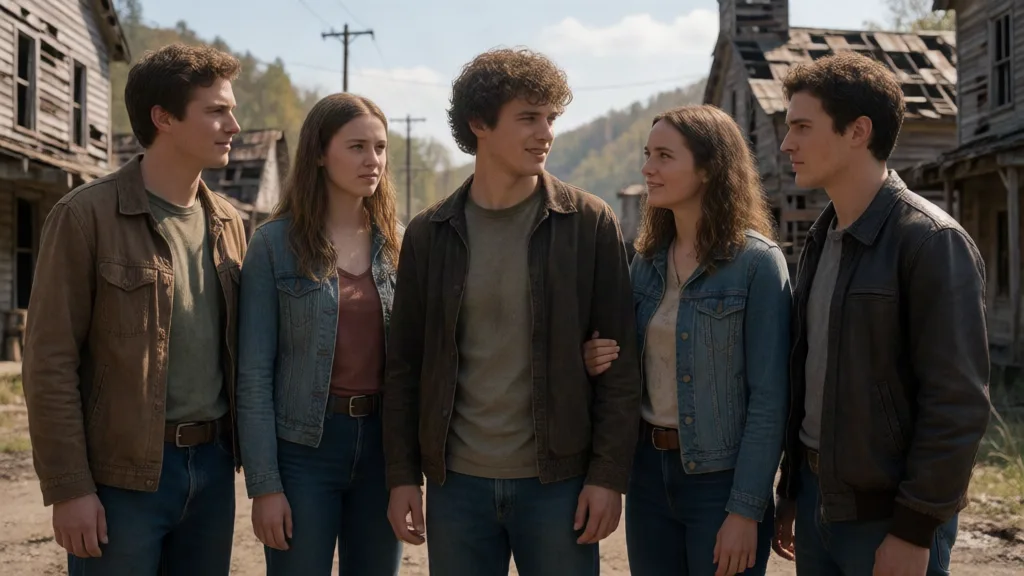
The first thing we ever did with the book was make my brother call me.
That's not true. The first thing we did was run.
We ran out of that house in the mountains with the grimoire wrapped in a hoodie, and we didn't stop until the trees thinned and we could see the lights of Bellweather blinking down in the valley like something drowning. Hollis fell twice. June lost a shoe. I carried the book against my chest and felt it through the fabric, warm the way a stone is warm after the sun's been on it all day, and I told myself that was just body heat. That was October. We were twenty-two and twenty-three and we'd known each other since we were old enough to walk to the creek without permission.
The house shouldn't have been there. That's what I keep coming back to. We'd hiked that ridge a hundred times. There was no house on that ridge.
But there it was, that night, leaning into the hill like it had grown tired of standing. No road led to it. No mail ever came. The windows were black and the porch sagged and the door was gone, just a doorway full of dark, and Hollis said *I bet it's got copper pipes* because Hollis's family had been stripping abandoned houses since before he was born, and we were drunk enough to think that was funny.
Inside, the floor held. The stairs held. And at the end of a hallway that made no sense, a hallway that ran longer than the house was wide, we found the room.
No windows. One door, the one we came through. The walls were stacked stone, fitted so tight you couldn't slide a knife between them. No furniture, no dust, no smell. Just the deer hide on the floor, folded, blackened like it had been smoked over a fire for years, and inside the hide, the book.
Handwritten. No title. No author. The script was small and patient, the letters leaning left, and the first page said only this:
*There are no spells in this book. There are only permissions.*
June read it out loud. Her voice changed when she did. I noticed that. I noticed everything that night, the way you notice everything when you're scared and pretending not to be.
We should have left it. I know that now, and I knew it then, in the part of me that's always watching, always keeping score. But Hollis was already reaching for it. And Hollis has a way of making the wrong thing feel like the only thing.
---
Bellweather isn't the kind of town you leave. It's the kind of town that leaves you.
The mine closed before we were born. The hospital closed when we were in middle school. The last grocery store burned down two summers ago and nobody rebuilt it, so now we drive forty minutes to a Food Lion and call it a trip. The hollows flood every spring. The churches run revivals every fall and people still speak in tongues like it's 1910. Old families still don't speak to other old families over land that was stolen or sold or both, and the grudge gets passed down the way other families pass down silverware.
I love it. That's the embarrassing part. I love the smell of coal smoke and wet leaves. I love the way the mountains go blue at dusk. I've wanted to leave since I was nine years old, and I've never been able to, and I don't know anymore which one of those is the truer thing.
My name is Wren. Hollis gave me that name in fifth grade and it stuck.
June is the one who's grieving. Her mother died in March, and June has been walking around since then like a person holding a full cup they're not allowed to spill. She doesn't cry. She organizes. She labels everything. She's the one who read the book out loud and she's the one who said, quietly, after, *we should put it back.*
Nobody put it back.
Mason is the one drowning in debt. He took out loans for a degree he didn't finish and now he works nights at a distribution center and the interest eats him alive a little more every month. He doesn't talk about it. He just gets quieter, and his jaw gets tighter, and sometimes he looks at other people's cars in the parking lot like he's doing math.
Priya is the one who's terrified of being ordinary. She was the smart one, the one everybody said was going places, and then she didn't go anywhere, and now she teaches third grade in the same building where we learned our multiplication tables. She's good at it. She hates that she's good at it.
And Hollis. Hollis is the angry one. His dad went to prison when we were fourteen. His mom works two jobs and her back is ruined. Hollis has spent his whole life watching people with money decide what happens to people without it, and he's not sad about it anymore. He's past sad. He's at the place past sad where the world starts to look like something that needs to be corrected.
I'm the one who watches. That's my role. Always has been. I see the thing everyone else is about to do and I don't stop them. I don't know why. Maybe because stopping them would mean I'm not one of them.
---
We tested it three days later, in Priya's grandmother's basement, because it was the only place none of us would be seen.
The working was small. Laughably small. The book had a page on finding lost things, and Priya had lost a ring in that basement when she was twelve, a ring her grandmother gave her, and she'd torn the whole place apart looking for it and never found it. So we sat in a circle on the concrete floor and we read the words and we held the idea of the ring in our minds the way the book said, which is hard to describe, because it wasn't visualizing exactly. It was more like wanting something so specifically that the wanting became a shape.
Then Priya stood up and walked to the water heater and reached behind it without looking and pulled out the ring.
Nobody said anything.
The furnace kicked on. The pipes knocked. Somewhere upstairs her grandmother's television murmured through the floor, and outside, a dog was barking at something in the dark.
Then June laughed. It came out of her like it had been trapped in there since March, and once it started she couldn't stop, and then Mason was laughing too, and Priya was crying and laughing at the same time, and Hollis was just grinning, that wide, dangerous grin he gets, and I was laughing too, I was, except some part of me was standing outside the circle watching the five of us on that floor and thinking, very clearly:
*This is the last night we'll all be the same people.*
I didn't say it. You don't say things like that. Not when everyone's happy. Not when June is laughing for the first time in seven months.
We stayed up until sunrise. We gave ourselves names as a joke, witch names, and Hollis named himself something in Latin he couldn't pronounce. We made charms out of bottle caps and fishing line. Priya tried a working to make her ex think about her and we all screamed when her phone buzzed twenty minutes later. It was nothing. It was probably nothing. But we screamed, and we laughed, and we were so alive that night, all five of us, alive in a way we hadn't been since we were kids running the creek in summer, and I want to be honest with you about this part.
It was the best night of my life.
I have never felt anything like it since, and I have done a lot of things since.
---
The trouble started small too. That's how it works. That's the whole trick of it.
Two weeks in, Hollis used a working on his landlord. Nothing big. Just a nudge. Just a small suggestion that maybe the rent could wait a month. And the rent waited a month. Hollis came over that night and he was vibrating, he was lit up, and he said, *Wren, do you understand what this means.*
I said I did.
I didn't. Not yet.
Then Priya used one on a parent at a conference, a father who'd been screaming at her in front of the principal, and the next day he came in and apologized and cried and said he didn't know what had gotten into him. Priya told us about it at the diner and her hands were shaking around her coffee cup and she said, *I just wanted him to stop.*
And June, June used one on herself. Just a small one. Just to move the grief from her chest to her hands for a few hours so she could sleep.
It worked. That's the thing. It worked.
Mason used one to make a loan officer forget a phone call.
I used one to make a girl at the gas station think about me. I'm not proud of that. I'm telling you because I want you to understand that I wasn't better than them. I was just slower. I was the watcher. And the watcher always ends up doing the thing he watched everybody else do, just later, just quieter, just with more excuses.
The book had a rule in it. We found it on page forty-something, in the same small patient handwriting, and it was underlined twice.
*Magic does not require payment. It never has. This is why it was buried.*
Below that, someone else had written, in different ink, in a hand that shook:
*We tried to burn it. It would not burn. God forgive us. God forgive us.*
Hollis read that page and closed the book and looked at the four of us sitting in his mother's kitchen and said the sentence that I think about every single day now.
He said, *Why would anybody want to burn something that helps people.*
And none of us had an answer.
That was the beginning. Not the house. Not the book. The moment none of us had an answer.
Watch this moment
Turn the current scene into a cinematic Live Chapter — what you watch becomes the story's next part.
Disclaimer
This is a work of fiction, assisted by artificial intelligence. Any names or characters, businesses or places, events or incidents, are fictitious. Any resemblance to actual persons, living or dead, or actual events is purely coincidental.
Content Removal Policy
- Users may report content that may be illegal or violates our Standards.
- All reported complaints will be reviewed and resolved within seven business days.
- Review Process: Our team will assess the reported content against our guidelines.
- Appeals: If you disagree with a decision, you may appeal within 14 days of notification.
- Potential outcomes include: content removal, account warning, or no action if no violation is found.
To report content, email us at [email protected]