Share
Go Live
The Leviathan Awakens
·
Published 9/16/2026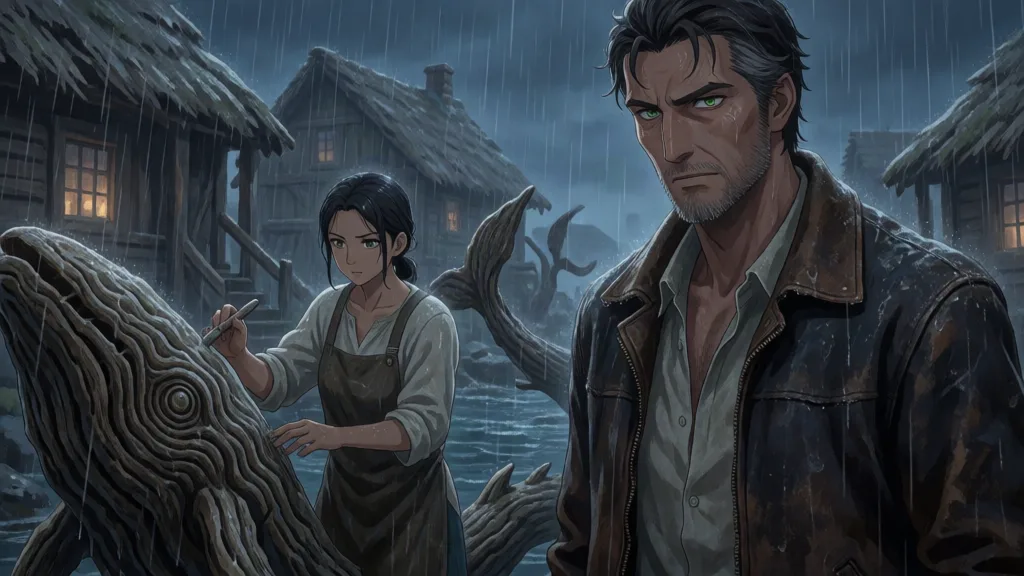
The chisel slipped.
I caught it before it hit the floor, but not before it carved a fresh gash across my palm. Blood welled up, dark and warm, mixing with the sawdust that coated every surface of my workshop. I didn't bother wiping it off. The salt in the air would sting later, but right now I had bigger problems.
The leviathan's eye was wrong.
I'd been working on it for three hours. Three hours of shaving millimeters of driftwood, of running my fingers over the grain until I knew every ridge and whorl better than I knew my own face. And still, it wouldn't look at me. Wouldn't look anywhere, really. It was just a carved socket, empty and dead.
I set the chisel down and pressed my palm flat against the creature's snout. The wood was cool, smooth, patient. It had been patient for decades, tumbling in the waves, washing up on this shore, waiting for me to find it. Waiting for me to give it shape.
"Sorry," I muttered. My voice came out rough from disuse. I'd been alone for six days now, ever since the last supply boat left before the storm season. "I'm rushing. You don't deserve that."
The leviathan didn't answer. It never did. That was the point.
I stepped back and let my eyes travel over the work. Twelve feet from snout to tail, coiled like a sea serpent ready to strike. Scales overlapping in patterns I'd learned from watching actual waves, not other carvings. Fins delicate as lace, each one a puzzle of interlocking pieces I'd spent a month perfecting. And the eye, the eye that should have held the weight of the ocean, was just a hole in the wood.
I grabbed my rag and wiped the blood off my hand. The wound was deeper than I thought. I'd have to stitch it or wrap it, and either way I'd lose time.
Time. That was the real problem. The storm season was coming, and once it hit, I wouldn't be able to work. The humidity would warp the wood. The wind would steal my concentration. And the leviathan would sit here, unfinished, until spring.
Unless I finished it tonight.
I'd never worked through the night before. The carvings always came to me in pieces, over weeks, months. I'd find a branch that curved like a dolphin's back, a root that twisted like an octopus arm, a plank worn smooth by the tide until it felt like skin. I'd bring them home, arrange them on my workbench, and wait. Wait for them to tell me what they wanted to become.
The leviathan had been telling me for years. Every time I walked the beach, I found a piece of it. A rib here. A spine there. A jawbone shaped from a fallen oak branch. I'd collected them all, stored them in my shed, and one day, six months ago, I'd started putting them together.
It was the biggest thing I'd ever attempted. The most ambitious. The most dangerous.
Because the bigger the carving, the harder it was to let go.
I wrapped my hand in a strip of canvas and picked up the chisel again. The leviathan's eye stared back at me, empty and waiting. I pressed the blade to the wood and closed my own eyes.
The rain started at midnight.
I heard it before I felt it, the way it always happened. The drumming on the roof, the hiss against the windows, the way the whole world seemed to hold its breath between drops. I'd been deaf since I was seven, but sound still found me. Through the floorboards, through the air pressure, through the way the light changed when the clouds rolled in.
I didn't stop working.
The leviathan's eye was taking shape now. I'd found the grain, the way the wood wanted to curve, the shadow that would make it look alive. I was close. So close I could feel it in my bones, that electric hum that meant the carving was almost ready.
That was when I heard the knock.
Not a knock, exactly. A thumping. A vibration that traveled up through the floor, into my feet, into my chest. Someone was at my door.
I set the chisel down and wiped my hands on my apron. The canvas wrap was soaked through with blood, but the cut had stopped bleeding. Mostly.
The door swung open before I reached it.
A man stood on my porch, rain streaming off his leather jacket, his gray-stubbled jaw clenched tight. He was tall, lean, with the kind of weathered face that came from years of sun and salt and disappointment. A silver compass hung from his neck, catching the lantern light.
"You're the carver," he said. Not a question.
I didn't answer. I just stood there, letting the rain mist my face, watching him watch me.
"I need to see your workshop."
I tilted my head. "No."
He blinked. People weren't used to being told no, especially by a deaf woman in a rain-soaked village at the edge of the world. But I'd learned long ago that the only way to protect what mattered was to keep it hidden.
"I'm not here to steal anything," he said. "I'm here to verify something."
"Verify what?"
"Whether your carvings are real."
The words hit me like a wave. Cold, unexpected, threatening to knock me off my feet. I gripped the doorframe and steadied myself.
"I don't know what you're talking about."
"Yes, you do." He reached into his jacket and pulled out a photograph. It was water-stained, creased, clearly old. But I recognized the shape in it immediately. A dolphin, carved from driftwood, its nose pointing toward the horizon.
I'd made that dolphin three years ago. I'd left it on the beach, as I always did, and walked away. I'd never seen it again.
"You left this on the shore," he said. "The next morning, it was gone. But a fisherman found something else. A real dolphin, beached and dying, with a piece of driftwood lodged in its throat."
My stomach turned.
"I've been tracking you for two years," he said. "Following the trail of your carvings. Every time you finish one, something happens. A whale washes up. A sea turtle gets tangled in fishing nets. A pod of orcas beaches itself on a shore where no orcas should be."
"That's not my fault."
"Isn't it?" He stepped closer, and I caught the scent of him. Salt and sweat and something else, something bitter. "Your carvings don't just look like sea creatures. They become them. And when they come to life, they don't know how to be real animals. They don't know how to survive."
I wanted to shut the door. I wanted to go back to my workshop and finish the leviathan and pretend this man had never shown up. But something in his voice stopped me. Something that sounded like grief.
"How do you know all this?" I asked.
"Because I've seen it." He pulled the compass from around his neck and held it out to me. The glass was cracked, the needle spinning wildly. "This was my brother's. He was a marine biologist. He spent ten years trying to prove that myths were real. And then he found one of your carvings. A kraken, if I'm not mistaken."
I remembered the kraken. It had been my second piece, after the dolphin. I'd made it from a single massive root, twisted and gnarled, with tentacles that curled like question marks.
"He followed it into the water," Jack said. "He never came back."
The rain was falling harder now, drumming against the roof, streaming down the walls. I could feel it in my bones, that vibration that meant the world was shifting, changing, becoming something new.
"What do you want from me?" I asked.
"I want you to stop."
I shook my head. "I can't."
"Why not?"
I looked past him, toward the ocean. The waves were churning, white-capped, hungry. Somewhere out there, the leviathan was waiting. Waiting for me to finish it. Waiting to be born.
"Because I don't make the carvings," I said. "They make me."
Jack's eyes narrowed. "What does that mean?"
I stepped aside and let him see the workshop. Let him see the leviathan, coiled and waiting, its eye now gleaming in the lantern light.
"It means I'm not the artist," I said. "I'm just the instrument."
The leviathan's eye was no longer empty. It was watching us.
And it was hungry.
Watch this moment
Turn the current scene into a cinematic Live Chapter — what you watch becomes the story's next part.
Disclaimer
This is a work of fiction, assisted by artificial intelligence. Any names or characters, businesses or places, events or incidents, are fictitious. Any resemblance to actual persons, living or dead, or actual events is purely coincidental.
Content Removal Policy
- Users may report content that may be illegal or violates our Standards.
- All reported complaints will be reviewed and resolved within seven business days.
- Review Process: Our team will assess the reported content against our guidelines.
- Appeals: If you disagree with a decision, you may appeal within 14 days of notification.
- Potential outcomes include: content removal, account warning, or no action if no violation is found.
To report content, email us at [email protected]