Share
Go Live
The Chaos Clause
·
Published 9/6/2026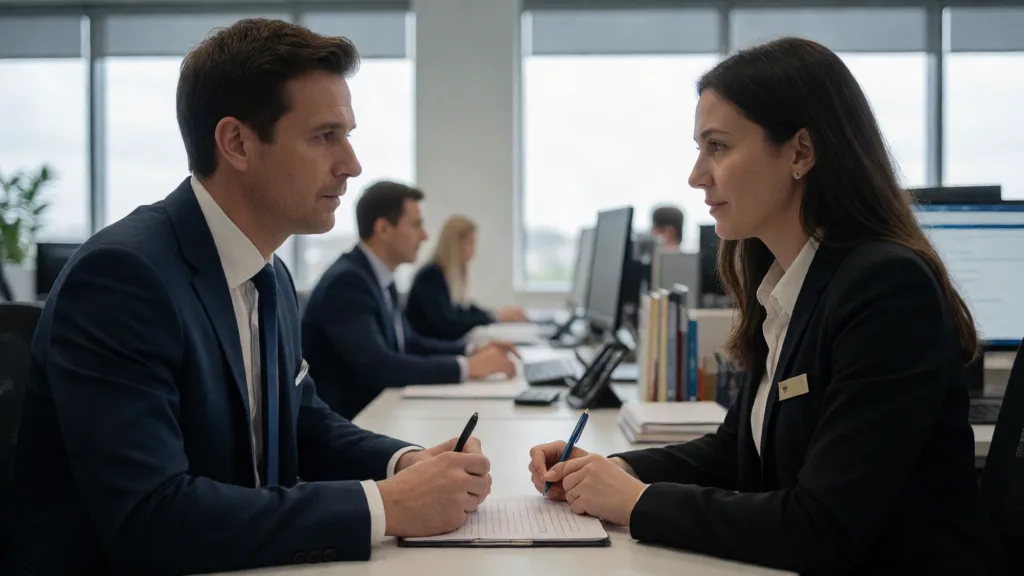
The first time I saw Serg, I thought someone was playing a joke on me.
He was standing in the doorway of my corner office, holding a manila folder like it might bite him, wearing a jacket that cost less than my dry cleaning bill for the month. The fabric had a sheen to it, that cheap polyester shine that catches fluorescent light and holds it hostage. His tie was crooked. His hair looked like he’d been electrocuted and then given a comb as an afterthought.
“You’re late,” I said.
“I’m not late.” He checked his phone. “I’m exactly on time. The email said nine.”
“The email said nine. I said eight-thirty.”
“I don’t work for you yet. I work for the agency. The agency said nine.”
I set down my pen and looked at him properly. He was younger than I’d expected. Mid-twenties maybe. A little too lean, a little too restless. His eyes moved around my office like he was cataloging everything, the framed certificates, the minimalist desk, the single orchid I kept alive through sheer force of will.
“Come in,” I said. “Sit.”
He didn’t sit. He walked to the window and looked down at the street. “Nice view. You can see the river if you lean right.”
“I know what the view is. I pay for it.”
“Do you ever actually look at it? Or is it just a thing you have?”
I felt my jaw tighten. “I look at it.”
“When?”
“What’s your name again?”
“Serg. Just Serg. No last name. Like Cher.”
“Cher has a last name.”
“Cher doesn’t use it. Neither do I.”
I opened the folder he’d dropped on my desk. His resume was inside, along with the agency’s standard placement documentation. I’d requested someone with at least five years of executive support experience, preferably in finance, with references from at least two C-suite clients.
Serg had been a barista for three years. He’d worked at a bookstore for a year and a half. He’d spent six months as a receptionist at a dental practice. His most recent job was something called a “community liaison” for a nonprofit that I’d never heard of, which apparently meant he’d organized events and answered phones.
“This is a joke,” I said.
“What is?”
“Your resume. You’re not qualified for this position.”
He turned from the window. “I’m qualified for any position that involves keeping someone organized. I’ve been keeping people organized my whole life. My mother is a disaster. My father is worse. I’ve been functionally parenting both of them since I was twelve. I can handle a finance executive.”
“You’ve never worked in finance.”
“I know what a spreadsheet is. I know what a calendar is. I know how to say ‘he’s in a meeting’ in a way that makes people feel important without lying. What else do you need?”
I stared at him. He stared back. He wasn’t cocky exactly. He was matter-of-fact, like he’d already decided how this was going to go and was just waiting for me to catch up.
“The agency sent you,” I said slowly. “They didn’t send me anyone else.”
“They sent you five other people. You rejected all of them.”
“I didn’t reject them. They weren’t suitable.”
“Same thing.”
He had a point. I’d been through four assistants in the last eight months. The first one quit after three weeks. The second one I fired for putting a meeting on my calendar with a vendor I’d explicitly told her I was avoiding. The third one cried in the break room every day for two weeks and then just stopped showing up. The fourth one was competent but boring, and I couldn’t stand the way she breathed.
I didn’t tell Serg any of that. He didn’t need to know.
“Fine,” I said. “Trial period. Two weeks. If you can’t keep up, you’re out.”
“What’s the criteria for keeping up?”
“You’ll figure it out.”
He smiled. It was a small smile, barely a movement of his mouth, but it changed his whole face. Made him look like he knew something I didn’t.
“Okay,” he said. “Two weeks.”
That was three months ago.
He’s still here.
I don’t know why.
The first week was a disaster. He couldn’t find anything. He put files in the wrong places. He scheduled a conference call for three in the morning because he forgot to account for time zones. He asked me questions constantly, little ones, annoying ones, like “Do you want the blue pen or the black pen?” and “Should I use your full title or just Mr. Mitchell?” and “Do you actually need this meeting or is it a waste of everyone’s time?”
That last one made me pause.
“It’s a standard quarterly review,” I said.
“Standard doesn’t mean necessary.”
“I’m not paying you to question my meetings.”
“You’re not paying me at all. The agency is. But I’m asking because I’m the one who has to sit in the corner and take notes, and I’d like to know if I should be paying attention or if I can use that time to organize your email inbox which is, and I say this with respect, a war crime.”
I had no response to that. He was right about the inbox. It had seventeen thousand unread messages.
I let him skip the meeting.
He organized my inbox instead. By the time I came back, he’d sorted everything into folders with names like “Urgent (Not Really),” “Liam’s Personal (Don’t Ask),” and “People Who Want Things They Can’t Have.” The last one had two hundred and thirty-seven messages.
“That’s most of my professional network,” I said.
“Yeah, I noticed.”
He started bringing me coffee without asking how I took it. The first time, it was black with one sugar. I drank it. The second time, it was black with one sugar. I drank it. The third time, he switched to oat milk.
“I’m lactose intolerant,” I said.
“I know. You mentioned it once. I remembered.”
I didn’t remember mentioning it. I probably hadn’t. I probably said it to someone on the phone while he was in the room, not even talking to him, just existing in his general vicinity.
He noticed things. That was his thing. He noticed.
He noticed that I cracked my knuckles before important calls. He noticed that I ate the same thing for lunch every day (grilled chicken salad, no dressing, extra croutons) and started ordering it before I asked. He noticed that I got headaches in the afternoon and started leaving a glass of water and two ibuprofen on my desk at exactly two o’clock.
It was unsettling. It was like being watched by someone who had no other purpose.
“Do you have a life?” I asked him one day.
He was standing at my desk, handing me a stack of signed documents. “Define life.”
“Friends. Hobbies. A reason to leave this building at five o’clock.”
“I have friends. I have hobbies. I leave at five-thirty because you always need one more thing at four-fifty.”
“I don’t always.”
“You always. Yesterday it was the Peterson file. The day before it was the quarterly projections. The day before that it was a last-minute dinner reservation at a restaurant that’s booked three months in advance, which I somehow got for you because I called in a favor from a guy I used to work with at the bookstore.”
“That’s your job.”
“I’m not complaining. I’m just answering your question.”
He was always like that. Calm. Unflappable. He never raised his voice, never got flustered, never seemed to care that I was his boss and he was supposed to be intimidated.
Everyone else was intimidated. That was the point. I cultivated it. I kept my office cold, my voice flat, my expectations high. I didn’t smile unless I meant it, and I rarely meant it. People who worked for me learned quickly that I wasn’t interested in small talk or personal stories or any of the soft nonsense that slowed down productivity.
Serg didn’t learn that. He just kept being himself, which was apparently someone who asked questions and made observations and didn’t understand the basic hierarchy of professional relationships.
“Why do you do that?” he asked me one afternoon.
I was reviewing a contract. I didn’t look up. “Do what?”
“Hold your pen like you’re about to stab someone with it.”
I looked down at my hand. I was holding the pen in a fist, my knuckles white, the tip pressed hard against the paper.
“I’m concentrating,” I said.
“You’re angry.”
“I’m not angry.”
“You’re angry at the contract. What did the contract do to you?”
I set the pen down. “It’s a bad contract. The terms are unfavorable. The other party is trying to slip in a clause that would let them renegotiate after six months, which defeats the purpose of a two-year agreement.”
“So fix it.”
“I’m trying to.”
“No, I mean, fix it. Cross out the clause. Write in what you want. Send it back.”
“It’s not that simple.”
“Why not?”
I looked at him. He was leaning against the doorframe, arms crossed, head tilted. He looked genuinely curious. Not challenging, not trying to prove a point. Just curious.
“Because that’s not how it works,” I said.
“That’s exactly how it works. You have leverage. They want your business. You tell them what you need, and they either agree or they don’t. If they don’t, you walk. If they do, you have a better contract.”
“You don’t know anything about negotiation.”
“I know that people pretend things are more complicated than they are so they don’t have to take risks.”
I opened my mouth to argue. Closed it. Opened it again.
“That’s not true,” I said.
“It’s a little true.”
I crossed out the clause. I wrote in my own terms. I sent it back. The other party agreed within twenty-four hours.
I didn’t tell Serg he was right. He knew anyway.
The tension between us shifted after that. Not dramatically. Not in a way that anyone else would notice. But I started to look at him differently. I started to see him as something other than a temporary inconvenience I had to tolerate until I found someone better.
He was good at his job. He was better than good. He anticipated problems before I saw them coming. He handled difficult people with a patience I didn’t possess. He kept my life running smoothly enough that I stopped noticing the mechanics of it, which was the highest compliment I could give.
But he was still annoying.
He played music at his desk. Not loudly, but audibly. Indie stuff I’d never heard, with weird time signatures and lyrics that didn’t rhyme. He hummed while he worked. He ate lunch at his desk and the smell of whatever he was having (usually something with garlic, always something I wouldn’t order) drifted into my office and made it impossible to concentrate.
He talked to the other assistants on the floor. He knew their names, their kids’ names, their dogs’ names. He brought in baked goods on Fridays and left them in the break room with a note that said “From the 47th floor” in his messy handwriting.
“You’re making me look bad,” I told him.
“How?”
“You’re too friendly. People will think I’ve gone soft.”
“People already think you’ve gone soft. They just don’t say it to your face.”
“Who said that?”
“No one. I’m inferring from context clues.”
He smiled. That small, knowing smile. I wanted to wipe it off his face. I also wanted to see it again.
That was the problem.
I started noticing things about him. The way he bit his lip when he was thinking. The way he ran his hand through his hair when he was frustrated, making it even messier. The way he laughed, a real laugh, not a polite one, when something actually amused him.
He laughed at me once. I’d made a joke. I didn’t mean to. It just came out, dry and sharp, and he’d looked at me with surprise and then laughed, and I’d felt something crack open in my chest that I’d been keeping sealed for years.
I didn’t like it.
I didn’t like him.
I didn’t like the way I felt when he walked into a room, the way my attention shifted toward him like a compass finding north. I didn’t like the way I started dressing better, started checking my reflection before meetings, started caring about things I hadn’t cared about since college.
I was forty-two years old. I had a corner office and a six-figure salary and a reputation for being cold and ruthless and effective. I didn’t have time for this.
But here I was, at eight o’clock on a Thursday night, still in my office, waiting for him to leave so I could go home without having to walk out with him.
The problem was that he wasn’t leaving.
I could hear him at his desk, typing. He was always typing. He had a novel he was working on, he’d told me once, something he wrote in the evenings when he wasn’t doing anything else. I’d asked what it was about and he’d said “a man who falls in love with a ghost” and then refused to say anything else.
I wanted to read it. I wanted to know what his imagination looked like, what kind of stories he told himself when he was alone.
I wanted to know a lot of things about him.
That was the problem.
I stood up. I walked to my door. I opened it.
He was at his desk, headphones on, typing furiously. His face was lit by the screen, his eyes focused, his mouth moving slightly as he worked out whatever words he was putting down.
He looked up. Saw me. Pulled off the headphones.
“You’re still here,” he said.
“You’re still here.”
“I’m finishing something.”
“It’s eight o’clock.”
“I know what time it is.”
I leaned against the doorframe. “What are you working on?”
“The novel.”
“The one about the ghost.”
“Yeah.”
“Is it any good?”
He shrugged. “I don’t know. I think so. But I’m biased.”
“Can I read it?”
The question came out before I could stop it. I didn’t want to read his novel. I didn’t want to know anything more about him. I wanted to keep him at a distance, professional, contained.
But I’d asked. And now he was looking at me with that expression, the one that said he was figuring me out, putting pieces together that I didn’t want assembled.
“Maybe,” he said. “When it’s done.”
“When will that be?”
“I don’t know. When I stop being afraid of the ending.”
That hit me somewhere I didn’t expect. I felt it in my chest, a sharp ache that I couldn’t explain.
“What happens at the end?” I asked.
“The man has to choose. Stay with the ghost or let her go.”
“Which does he choose?”
“I haven’t decided yet.”
“That’s why you’re afraid.”
He nodded. “Yeah. That’s why I’m afraid.”
We looked at each other. The silence stretched. I could hear the hum of the building, the distant sound of traffic, my own heartbeat in my ears.
“You should go home,” he said. “It’s late.”
“You should go home.”
“I will. After this scene.”
“What scene?”
“The one where the ghost tells him she’s been dead the whole time. He thought she was alive. He thought they had a future. But she’s been dead since before they met, and now he has to decide if he can love something that isn’t real.”
I didn’t know what to say to that. I didn’t know why he was telling me. I didn’t know why I wanted to hear more.
“That’s sad,” I said.
“It’s not sad. It’s honest. Love doesn’t care about what’s real. Love cares about what feels real. And sometimes the feeling is enough.”
“Is it?”
“I don’t know. I’m still writing the scene.”
He turned back to his computer. The conversation was over. I was being dismissed by my own assistant.
I should have been angry. I should have told him to pack up and go home, that I wasn’t paying him to write fiction in my office after hours.
Instead, I said goodnight and closed my door.
I stood in the dark of my office, looking out at the river. The lights of the city reflected on the water. The view I paid for, the view I never looked at.
I thought about the ghost. I thought about the man who loved her. I thought about what it meant to love something that wasn’t real.
I thought about Serg.
The next morning, I came in at seven. He was already there. There was coffee on my desk, black with one sugar. There was a sticky note next to it.
“Read this,” it said. “Tell me what you think.”
A stack of papers. The first chapter of his novel.
I sat down. I read it.
It was good. It was better than good. It was raw and honest and strange, full of sentences that made me stop and go back and read them again. The ghost was a woman who appeared in a man’s apartment one night, soaking wet, claiming she’d fallen into the river. He gave her his clothes, made her tea, fell in love with her without knowing anything about her.
She never told him she was dead. She let him believe.
I didn’t know why Serg had given it to me. I didn’t know what he wanted me to say.
When he came in at eight, I was still reading.
“You’re early,” he said.
“You’re earlier.”
“I couldn’t sleep.”
“Neither could I.”
He sat down at his desk. He didn’t ask what I thought of the chapter. He just started working, opening emails, making calls, being efficient and competent and infuriating.
I watched him through the glass wall of my office. I watched the way his hands moved across the keyboard. I watched the way he tucked his hair behind his ear when it fell in his face. I watched the way he smiled at something on his screen, a private joke, a memory, a line from his novel that he liked.
I wanted to know what he was smiling at.
I wanted to know everything.
That was the problem.
At noon, he brought me lunch. Grilled chicken salad, no dressing, extra croutons. He set it down and didn’t leave.
“Well?” he said.
“Well what?”
“The chapter. What did you think?”
I looked at the salad. I looked at him. “It’s good.”
“Just good?”
“It’s really good.”
“But?”
“No but. It’s really good. You should finish it.”
He nodded. He didn’t smile. He just looked at me with those eyes, the ones that saw too much, the ones that made me feel like I was the one being watched, not the other way around.
“Thank you,” he said.
“You’re welcome.”
He left. I ate my salad. I read the rest of the chapter.
I thought about the ghost. I thought about the man who loved her. I thought about what it meant to love something that wasn’t real.
I thought about Serg.
At five o’clock, he knocked on my door.
“I’m leaving,” he said.
“Okay.”
“There’s another chapter. On your desk. If you want to read it.”
I looked down. There it was, a fresh stack of papers, tucked under the edge of my keyboard.
“I’ll read it,” I said.
“Good.”
He turned to go. Then he stopped.
“Liam?”
I looked up. He almost never used my first name.
“Yeah?”
“The man in the story. The one who loves the ghost. He knows she’s not real. He’s known from the beginning. That’s why he can love her. Because she’s not real. Because there’s no risk.”
He held my gaze for a moment. Then he left.
I sat in my office, alone, the chapter in front of me, the words he’d said hanging in the air.
I thought about risk. I thought about what it meant to love something real, something that could hurt you, something that could leave.
I thought about Serg.
I picked up the chapter. I started reading.
I didn’t stop until I was done.
Watch this moment
Turn the current scene into a cinematic Live Chapter — what you watch becomes the story's next part.
Disclaimer
This is a work of fiction, assisted by artificial intelligence. Any names or characters, businesses or places, events or incidents, are fictitious. Any resemblance to actual persons, living or dead, or actual events is purely coincidental.
Content Removal Policy
- Users may report content that may be illegal or violates our Standards.
- All reported complaints will be reviewed and resolved within seven business days.
- Review Process: Our team will assess the reported content against our guidelines.
- Appeals: If you disagree with a decision, you may appeal within 14 days of notification.
- Potential outcomes include: content removal, account warning, or no action if no violation is found.
To report content, email us at [email protected]