Share
Go Live
The Deans Last Warning
·
Published 10/1/2026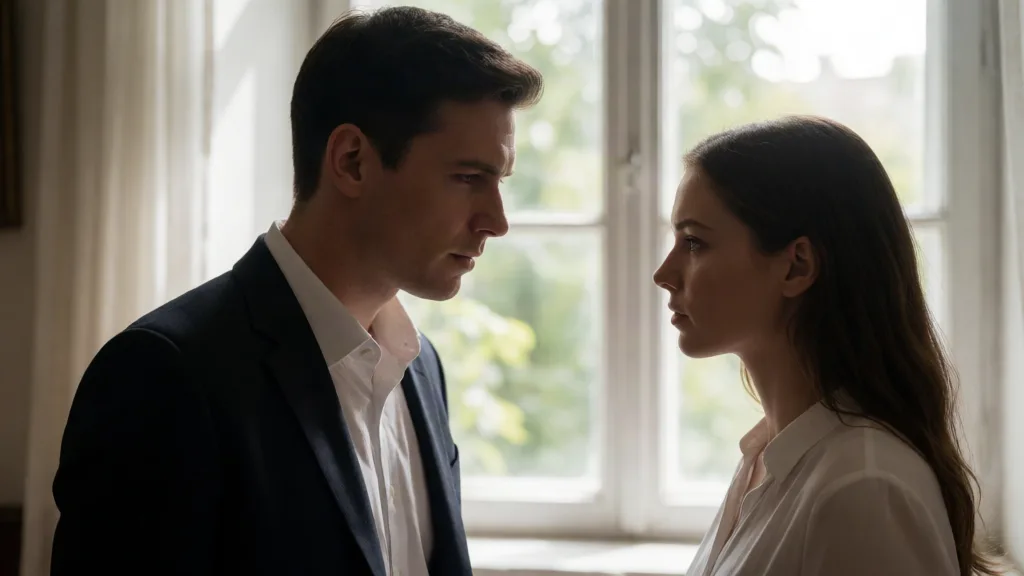
The door to my office doesn't lock from the inside. I've been meaning to fix that for three years.
Not because of anything like this. Because of the drafts. The building is old, the frames are warped, and on windy days the door drifts open on its own, which makes it look like I'm inviting the whole corridor in to watch me grade papers. But I never called anyone. You get used to a thing. You learn to work around it. That's most of what adulthood is, I've found. Learning to work around the things you keep meaning to fix.
So when the door swung open that afternoon in late October, I didn't look up right away. I assumed it was the wind. I assumed it was a colleague. I assumed it was anyone but her.
"You're still here."
I knew the voice before I saw the face. That's the thing about teaching the same students for three years. You learn their voices the way you learn your own phone number. Daria Kovalenko. Third year, philology, the kind of student who sits in the back and says nothing for two months and then, in one seminar, dismantles an entire lecture with a question so precise it feels surgical.
"It's five o'clock," I said, still not looking up. "Why wouldn't I be here?"
"Because everyone else left an hour ago."
I set down my pen. She was standing in the doorway with her shoulder against the frame, a canvas bag hanging off one arm, her coat unbuttoned. October had turned cold that week, the first real cold, the kind that comes down from the north and settles in the streets like it plans to stay. She was wearing a gray sweater and dark jeans. Her hair was wet from the rain.
"You're dripping on my floor," I said.
"I know." She didn't move.
I'd known Daria for two years. She was twenty. Twenty-one, maybe. I'd never checked. She had a face that was hard to describe because it kept changing, depending on the light, depending on whether she was bored or interested or angry. She was always one of those three. She had a way of looking at people like she was reading a text and deciding whether it was worth finishing.
"Did you need something?" I asked.
"Yes."
She came in and closed the door behind her. The latch didn't catch. It never does.
I should explain something about my position here, because it matters. I'm the dean of the faculty. I'm forty-seven years old. I have a wife, a daughter who's studying in Warsaw, a mortgage on an apartment that's too big for three people and too small for the books I keep buying. I have a reputation for being fair and for being cold, which are the same thing to students who've never been on the wrong side of me. I have the power to expel any student in this building. I've done it four times in eleven years. Each time, I slept fine.
That's the part people don't understand. The sleeping fine. They think power keeps you up at night. It doesn't. It's the moments before you use it that keep you up. The moment when you're standing at the edge of a decision and you know that whatever you do next, you can't undo it.
Daria sat down in the chair across from my desk without being invited. She dropped her bag on the floor, and it landed with a wet thud. Water pooled around it. She looked at me the way she always looked at me, like I was a problem she was working on.
"I need you to not expel me," she said.
I picked up my pen again. I don't know why. Maybe to have something in my hand. "That's not usually how it works. You don't come to the dean and ask for a favor. You come and explain why you shouldn't be expelled, and I decide."
"Same thing."
"Not the same thing."
She smiled. It was a small smile, almost nothing, just the corner of her mouth. "Okay. I'll explain. Then you decide."
I leaned back in my chair. The radiator under the window clanked and hissed. It always did that in October, like it was complaining about being woken up. Outside, the streetlights were coming on, one by one, down the hill toward the river.
"Explain," I said.
She didn't start right away. She looked around my office, at the bookshelves, at the framed diploma from Kyiv, at the photograph of my wife and daughter on the windowsill. I watched her take it all in. I wondered what she was seeing. I wondered if she was building a case.
"I missed three seminars this month," she said.
"I know."
"I missed them because I was working."
"Everyone works."
"Not like this." She pulled her sleeve up. There was a bruise on her forearm, yellow-green at the edges, dark in the center. It looked like a handprint. "I work at a bar on the far side of the river. The kind of bar where people don't ask questions. I carry crates. I break up fights. I do what needs doing."
I looked at the bruise. I didn't look away from it. That's important. If you look away, they know they've got you. "And?"
"And I missed the seminars because I was working doubles. I needed the money. My mother's sick. She's in the hospital in Vinnytsia. I send her everything I make."
The radiator clanked again. I set the pen down. "You could have come to me. There's a process. A medical leave, a deferral, something."
"I didn't want the process."
"Why not?"
"Because the process is a paper trail. And I don't want a paper trail."
That was the first moment I felt it. Not attraction, not yet. Something else. The sense that I was in a room with someone who was playing a game I didn't fully understand. I'd been a dean for six years. I'd heard every story. The dying grandmothers, the sick mothers, the brothers in prison, the landlords who threw students out on the street. Most of them were true. Most of them didn't matter, because the rules were the rules, and the rules existed for a reason.
But this girl wasn't asking me to break the rules. She was asking me to understand why she'd broken them, and then to decide whether that mattered.
"You want me to make an exception," I said.
"I want you to make a decision."
"That's the same thing."
"No." She leaned forward. Her hair was still wet, and a strand of it stuck to her cheek. She didn't brush it away. "An exception is when you bend the rule for someone special. A decision is when you look at the rule and decide it doesn't apply. Those are different things."
I almost laughed. I didn't, but I almost did. She was twenty years old and she was lecturing me on ethics.
"Where did you learn to talk like that?" I asked.
"From you."
The room got quiet. The radiator stopped clanking. The rain had picked up outside, drumming against the window, and the light from the streetlamp came through the wet glass in a way that made everything look underwater.
I'd been teaching for twenty years. I'd heard students say things like that before. You're my favorite professor. You changed my life. I want to be like you when I'm older. It was flattery, mostly. Sometimes it was true. But it never felt like this. It never felt like a hand reaching across the desk and closing around my wrist.
"I don't remember teaching you to talk like that," I said.
"You don't remember a lot of things." She sat back. "That's not an insult. You have four hundred students. I'm one of them. I don't expect you to remember."
"Then why did you say it?"
"Because it's true. I took your seminar on nineteenth-century prose in my first year. You spent three weeks on Dostoevsky. You said something I never forgot. You said that the most dangerous people in the world are the ones who believe they're good. Because they'll do anything, and they'll sleep fine afterward."
I remembered saying it. I remembered the room, the second floor, the windows open because it was May and the heat hadn't come yet. I remembered a girl in the back row with dark hair and a face like a closed book.
"You were in that seminar," I said.
"I was in the back row."
"I remember."
She looked at me then, and for the first time, something in her face opened. It was small, a crack in the surface, but I saw it. And I understood, in that moment, that she'd come here for a reason, and the reason wasn't the seminars. The seminars were the excuse. The bruise was the excuse. The sick mother in Vinnytsia, true or not, was the excuse.
She'd come because she wanted to see what I would do.
"You should go," I said.
"I know."
"Then why are you still sitting there?"
"Because you haven't decided yet."
I stood up. I don't know what I meant to do. Maybe open the door. Maybe walk to the window. Maybe put some distance between us, some furniture, some air. But I didn't do any of those things. I just stood there, behind my desk, looking down at her.
She was twenty years old. She was a student. She was sitting in my office with wet hair and a bruise on her arm, and she was looking up at me like she'd already won something.
"I'll think about it," I said.
"That's not a decision."
"It's the best you're getting tonight."
She stood up. She picked up her bag. She didn't button her coat. She walked to the door and put her hand on the knob, and then she turned around.
"There's one more thing," she said.
"Of course there is."
"My roommate. Kateryna. She's in your faculty too. Second year. She's going to come see you tomorrow. She's going to tell you a story about me. I want you to know it's not true."
"What story?"
"That I slept with a professor last year. In the economics department. That I did it for a grade."
I didn't say anything. The rain kept coming down. The radiator hissed.
"It's not true," she said. "But she'll tell you it is. And she'll have proof. A screenshot, a text message, something. She's been planning this for months."
"Why would she do that?"
"Because she hates me." She said it simply, like she was reporting the weather. "And because she wants my spot in the exchange program. The one in Heidelberg. There's only one slot this year. It's between me and her. If you expel me, she gets it."
"And if I don't?"
"Then she'll try something else."
She opened the door. The corridor was dark, the lights on a timer that had already switched off. She stepped into the darkness and turned back one last time.
"Goodnight, professor."
"Goodnight."
She closed the door. The latch didn't catch. It drifted open a few inches, and I stood there listening to her footsteps go down the hall, fading, until there was nothing but the rain.
I sat back down. I opened the drawer where I kept the student files and pulled out the folder for the exchange program. Heidelberg. One slot. Two names on the shortlist. Daria Kovalenko and Kateryna Melnyk.
I'd read their applications a month ago. Daria's essay was about translation, about the impossibility of carrying one language into another without losing something, and how that loss was the point. Kateryna's essay was about identity, about growing up between two languages and never fully belonging to either. Both were good. Daria's was better.
I closed the folder and put it back in the drawer. I turned off the desk lamp. I sat in the dark for a long time, listening to the radiator and the rain, and I thought about what she'd said.
The most dangerous people in the world are the ones who believe they're good.
I'd said that. I'd meant it. But I'd never thought about what it meant for me. I'd always assumed I was one of the good ones. I'd assumed that because I followed the rules, because I was fair, because I slept fine after expelling students who deserved it, that I was on the right side of things.
But here was a girl who'd walked into my office and told me a story, and I couldn't tell if it was true or false, and I couldn't tell if it mattered. And the worst part, the part that kept me in that chair long after I should have gone home, was that I wanted to see her again.
Not because of the bruise. Not because of the sick mother. Because of the way she'd looked at me when she said she'd learned to talk from me. Because of the way she'd leaned forward, and her hair had stuck to her cheek, and she hadn't brushed it away.
I was forty-seven years old. I had a wife. I had a daughter. I had a position that I'd worked for my entire life, and a reputation that I'd built with the same care, and a life that was, by any measure, settled.
And I was sitting in the dark, thinking about a student.
The next morning, Kateryna Melnyk came to my office at nine o'clock.
I knew her by sight. Second year, serious, always in the front row, always with a notebook open and a pen in her hand. She had blonde hair cut short, and she wore glasses with thin gold frames, and she had a way of speaking that was careful, measured, like she was reading from a prepared statement.
She knocked before she entered. The door was already ajar. She waited in the doorway until I looked up.
"Professor, do you have a moment?"
"Come in."
She sat down in the same chair Daria had sat in the night before. She folded her hands in her lap. She looked at me through her glasses, and I saw something in her face that I recognized. Not nervousness. Determination. The look of someone who'd rehearsed this.
"I need to tell you something about Daria Kovalenko," she said.
"Go ahead."
"She's been lying to you. To the faculty. To everyone." She reached into her bag and pulled out a phone. She set it on the desk between us, face up. "Last year, she had a relationship with Professor Bondar. In the economics department. He gave her a grade she didn't earn. I have messages. Screenshots. She sent them to a friend, and the friend sent them to me."
I looked at the phone. The screen was dark. I didn't reach for it.
"Why are you telling me this?" I asked.
"Because she's up for the Heidelberg exchange. And I don't think someone like her should represent this faculty."
"Someone like her."
"Someone who sleeps with professors to get ahead."
I leaned back in my chair. The radiator was quiet this morning. Outside, the rain had stopped, and the sky was a flat gray, the kind of sky that makes everything look like a photograph taken through dirty glass.
"You know," I said, "Daria came to see me last night. She told me you'd come. She told me what you'd say."
Kateryna's face didn't change. She was good. I'll give her that. She was very good. "She would. She's manipulative. That's what she does. She gets ahead of the story so you don't believe it when you hear it."
"And she told me the story isn't true."
"Of course she did."
I picked up the phone. I looked at the screen. Kateryna reached over and unlocked it, her fingers moving quickly, and then she opened a messaging app and scrolled to a conversation.
The messages were there. Screenshots of a chat between Daria and someone named Olya. The texts were explicit. Dates, times, a room number in the economics building. A description of what happened. And then, at the end, a message from Daria: Don't tell anyone. I need the grade.
I set the phone down.
"When did you get these?" I asked.
"Two weeks ago."
"And you're bringing them to me now."
"Because the exchange decision is next week."
I nodded. I looked at the phone, at the messages, at the words on the screen. They looked real. They looked like something a twenty-year-old would write. They looked like the truth.
But I'd seen Daria's face the night before. I'd seen the way she'd looked at me when she said it wasn't true. And I'd been a dean for six years. I'd learned to read people the way I read old manuscripts, looking for the seams, the places where the ink didn't match.
"Thank you for bringing this to my attention," I said. "I'll look into it."
Kateryna stood up. She picked up her phone and put it back in her bag. She looked at me for a moment, and I saw something flicker in her eyes. Not triumph. Something else. Something that looked almost like disappointment.
"You believe her, don't you?" she said.
"I didn't say that."
"You didn't have to." She turned to go. At the door, she stopped. "She's not what you think she is, professor. She's not a victim. She's a player. And she'll play you too, if you let her."
She left. The door drifted open behind her. I sat there for a long time, looking at the empty chair, thinking about the two of them. Two students. Two stories. One slot in Heidelberg.
I didn't know which one was lying. I didn't know if either of them was telling the truth. But I knew one thing, and it was the thing that kept me in that chair, the thing that made me cancel my afternoon meetings and close the door and sit in the dark with my thoughts.
I wanted to see Daria again.
Not to ask her about the messages. Not to confront her. Just to see her. To watch her walk into a room and sit down and look at me with that look she had, like I was a problem she was working on. To hear her voice, which I'd known for two years but had only really heard for the first time the night before.
I was forty-seven years old. I had a wife. I had a daughter. I had a life that was settled and good and fine.
And I was sitting in my office, in the dark, thinking about a student.
That's how it starts. Not with a decision. Not with a choice. With a moment. A moment when you look at the door and realize it doesn't lock, and you think about fixing it, and then you think about all the reasons you haven't, and you realize that maybe you didn't want it to lock. Maybe you wanted someone to walk in. Maybe you'd been waiting for someone to walk in for a long time, and you just didn't know it until she did.
I picked up my phone and called my wife. She was at work. She answered on the third ring.
"Are you coming home for dinner?" she asked.
"I don't know," I said. "I might have to stay late."
"Again?"
"There's a situation with a student."
There was a pause. I could hear the office in the background, the hum of computers, the murmur of voices. "What kind of situation?"
"The kind I have to handle."
"Okay," she said. "Don't stay too late."
"I won't."
I hung up. I put the phone in my pocket. I stood up and walked to the window. The street below was wet, and the trees were bare, and the sky was the color of old paper. I stood there for a long time, looking down at the street, at the students walking by with their bags and their phones and their lives that I knew nothing about.
And then I went to find her.
I didn't know where she'd be. I didn't know her schedule, her habits, the places she went when she wasn't in class. But I knew she worked at a bar on the far side of the river, and I knew the kind of bar she meant, and I knew that if I went there, I'd find her.
I told myself I was going to ask her about the messages. I told myself I was going to get to the bottom of it, that I was going to do my job, that I was going to be the dean I'd always been.
But that's not why I went. I went because I wanted to see her. I went because I couldn't stop thinking about the way she'd looked at me. I went because I was forty-seven years old and I'd spent my whole life doing the right thing, and for the first time in as long as I could remember, I didn't want to.
The bar was called The Anchor. It was on a side street near the river, in a part of the city I'd never had reason to visit. The windows were dark, and the sign was hand-painted, and the door was heavy, the kind of door that takes both hands to open.
I stood outside for a minute, in the cold, with my hands in my pockets, listening to the river and the traffic and the sound of my own breathing. I thought about my wife. I thought about my daughter. I thought about the life I'd built, the life that was waiting for me at home, the life that was good and fine and settled.
And then I opened the door and went in.
Watch this moment
Turn the current scene into a cinematic Live Chapter — what you watch becomes the story's next part.
Disclaimer
This is a work of fiction, assisted by artificial intelligence. Any names or characters, businesses or places, events or incidents, are fictitious. Any resemblance to actual persons, living or dead, or actual events is purely coincidental.
Content Removal Policy
- Users may report content that may be illegal or violates our Standards.
- All reported complaints will be reviewed and resolved within seven business days.
- Review Process: Our team will assess the reported content against our guidelines.
- Appeals: If you disagree with a decision, you may appeal within 14 days of notification.
- Potential outcomes include: content removal, account warning, or no action if no violation is found.
To report content, email us at [email protected]