Share
Go Live
Beneath Divided Skies
·
Published 9/28/2026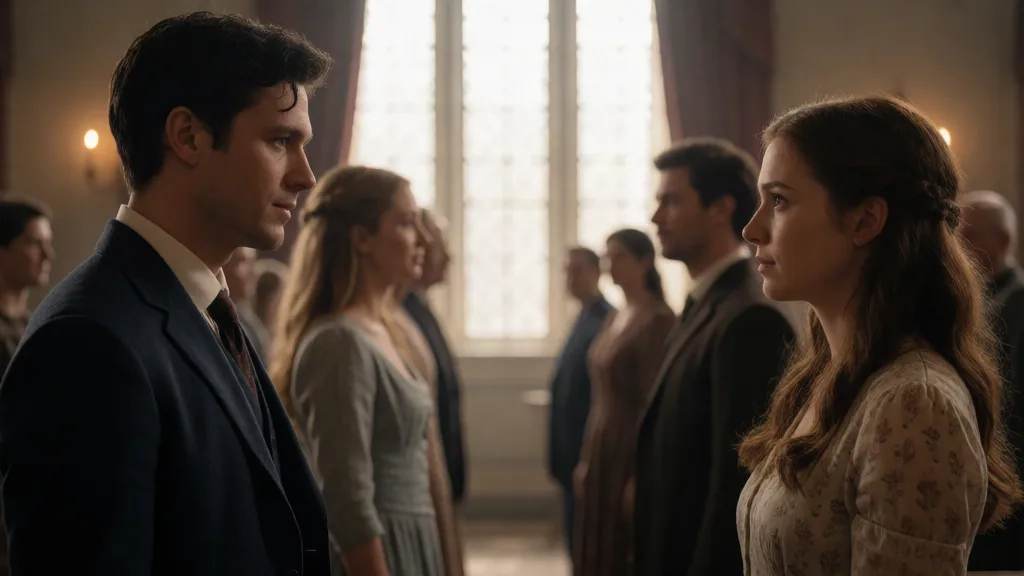
The first time I saw her, she was arguing with a parking meter.
Not arguing. Negotiating. She had one palm flat against the meter's gray head and the other hand digging through a canvas bag the size of a small dog, and she was speaking to the machine in a low, reasonable voice, the way you'd talk down a nervous horse.
"Come on," she said. "You took my last quarter. You know you did. Give me something."
The meter, being a meter, said nothing.
I was double-parked on Crescent Street with a van full of flowers and a delivery slip that said 4:30 sharp, and it was 4:41, and I had no business watching this woman bargain with city property. But I watched. She had on a yellow raincoat in weather that hadn't decided if it was raining, and her hair was pinned up with what looked like a pencil, and when she finally gave up and kicked the meter's base, she did it with such precise, personal fury that I laughed out loud through the open window of my van.
She heard me. Of course she heard me.
She turned, and I got the full force of her face for the first time, and here's the thing I remember most clearly: she didn't look embarrassed. She looked like she was deciding whether I was worth her attention. Most people, caught yelling at a parking meter, would've laughed it off or looked away. She just stood there in her yellow coat, weighing me.
"You got a quarter?" she said.
"I got a whole roll."
"Then why are you sitting there grinning?"
Fair question. I killed the engine and got out, and I gave her the roll because I wasn't going to need it, and because she'd asked, and because something about the way she stood there, chin up, waiting, made me want to be the kind of person who had a roll of quarters to give.
That was the whole first meeting. A parking meter, a roll of quarters, forty seconds of conversation. I didn't get her name. I got back in the van and drove to the florist's client four blocks over, and I set up the arrangement for a wedding I wasn't invited to, and I thought about her the entire time. Not in a romantic way. I want to be honest about that. I thought about her the way you think about a song you heard once through a wall. You don't know the words. You just know you want to hear it again.
---
My name is Daniel Reyes, and I deliver flowers for a living, which is not as charming as it sounds. It's a job I took after my father's business went under, a job I told myself was temporary, and that was three years ago. I work for a shop called Petals on Ninth that's owned by a man named Gus who's seventy-one and still thinks the internet is a fad. I carry bouquets up the back stairs of restaurants and down into the lobbies of office buildings and once, memorably, onto a yacht. I know the city by its service entrances.
She, I would learn, was Adaeze Okonkwo, and she was in her second year of law school, and she was the kind of person who argued with parking meters because she'd grown up watching her mother argue with landlords, with banks, with anyone who tried to tell her no, and she'd absorbed the lesson that the world only moves when you push it.
But I didn't know any of that yet. I knew a yellow raincoat and a pencil in her hair.
---
The second time was two weeks later, at a coffee shop on Delancey, and this time I was the one who was stuck. My card kept getting declined. Not because there was no money in the account, there was, barely, but because the machine was old and the strip was worn and the girl behind the counter was looking at me with the particular pity you reserve for people who can't afford three dollars and fifty cents.
"I'll get it," said a voice behind me.
I turned. Yellow raincoat. No pencil this time, her hair was down, and she was holding a paperback with a cracked spine, and she looked at me like she was trying to place me.
"You're the quarter guy," she said.
"I'm the quarter guy."
She paid for my coffee. I tried to give her cash and she waved it off like it was insulting. We sat at a small table by the window because there were no other seats, and we talked for an hour and forty minutes, and I missed two deliveries and Gus yelled at me the next morning, and I didn't care.
Here's what I learned in that hour and forty minutes: she was from a family that had money, real money, the kind of money that has opinions about who you marry. Her father was a surgeon. Her mother sat on the boards of three nonprofits. They lived in a house in Scarsdale with a gate, an actual gate, and Adaeze had spent her whole life inside that gate and was now, quietly, methodically, trying to get out.
I learned she hated the word "networking." I learned she read three books a week and forgot most of them on purpose. I learned that when she laughed, she laughed with her whole body, head back, no restraint, and it was the best sound I'd ever heard in my life.
I told her I delivered flowers. She didn't blink. She asked what kind of flowers, and I said, "Whatever people want to say but can't," and she looked at me for a long moment and said, "That's the best job description I've ever heard."
---
I want to tell you that we fell in love slowly, the way people are supposed to, over months of careful getting-to-know-you. That's not what happened.
What happened is that we fell in love in about three weeks, the way you fall off a cliff, all at once and with no way back up. What happened is that I started taking deliveries in her neighborhood on purpose and she started taking the long way home past the flower shop and we spent every evening we could together, sitting on the steps of her building because her roommates were home and my apartment was a studio with a broken radiator, and we talked about everything. Her family. Mine. The future, which we were both too young to be sure about and too stubborn to be scared of.
Her family didn't know about me. Mine didn't know about her. We were living in a bubble we'd built ourselves, and we both knew, in the way you know a storm is coming when the air goes still, that it couldn't last.
But we didn't say that out loud. Not yet.
We just sat on those steps, night after night, and I held her hand and she told me about the life she was supposed to want, and I told her about the life I was trying to build, and neither of us said the thing we were both thinking, which was: what happens when these two things meet?
What happens is this.
Watch this moment
Turn the current scene into a cinematic Live Chapter — what you watch becomes the story's next part.
Disclaimer
This is a work of fiction, assisted by artificial intelligence. Any names or characters, businesses or places, events or incidents, are fictitious. Any resemblance to actual persons, living or dead, or actual events is purely coincidental.
Content Removal Policy
- Users may report content that may be illegal or violates our Standards.
- All reported complaints will be reviewed and resolved within seven business days.
- Review Process: Our team will assess the reported content against our guidelines.
- Appeals: If you disagree with a decision, you may appeal within 14 days of notification.
- Potential outcomes include: content removal, account warning, or no action if no violation is found.
To report content, email us at [email protected]