Share
Go Live
Embers of Foraged Trust
·
Published 8/16/2026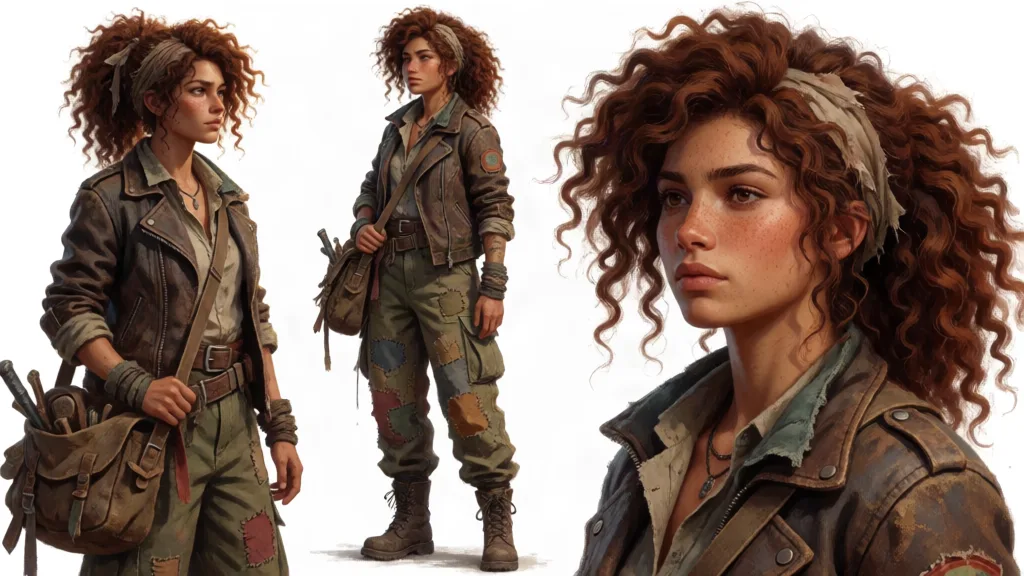
The first time I kissed Rosa, she tasted like rust and honey. Three in the morning on the roof of her building, the city spread beneath us like a circuit board of dying lights. She had been showing me how she could identify every neighborhood by its ambient hum. The low grumble of the financial district. The clatter of the Lower Flats. The silence of the cemetery quarter.
I was supposed to be her friend. That was the deal. The only deal.
But she turned from the skyline and looked at me with those eyes that saw too much, and I leaned in because I am a man who has never learned the difference between curiosity and hunger.
She let me kiss her. She did not kiss me back.
That should have been the end of it. It should have been a lesson.
Instead, she wiped her mouth with the back of her hand and said, “You taste like bad decisions and cheap cologne.” Then she laughed. Not a mean laugh. A laugh like she had just confirmed something she already suspected.
“Is that a no?” I asked.
“It’s a maybe.” She pulled a crumpled pack of cigarettes from her jacket. “But maybes are dangerous with me.”
I should have listened.
That was three months ago. Three months of this strange, suspended thing we do. Not dating. Not nothing. A territory without a name. She calls it our arrangement. I call it what I can get.
Tonight, she is late.
I sit on the curb outside her building, a converted warehouse in the industrial district where the streetlights are more broken than working. The air smells like wet concrete and diesel. A stray dog watches me from across the street, its ribs a xylophone under matted fur.
Rosa is never late. She moves through the city like a needle through cloth, precise and purposeful. She knows which dumpsters behind which restaurants throw out edible food at what hour. She knows which fire escapes hold and which ones will dump you three stories down. She knows the names of the pigeons that roost in the abandoned trolley station.
I know none of this. I am a man who lives in a clean apartment with a dishwasher and a job that requires me to wear a tie. I am a man who has never gone hungry a day in his life.
This is what I cannot explain. Why I keep coming back to her. Why I sit on cold concrete waiting for a woman who will never let me past a certain point.
Maybe it is because she is the only person I have ever met who does not want anything from me.
She appears from the alley to my left, materializing out of shadow like she was always there. Her satchel is full, bulging at the seams. A strip of red fabric holds her hair back. Her boots are caked with mud.
“You’re early,” she says. Not an accusation. An observation.
“You’re late.”
“Time is a construct.” She drops the satchel at my feet and sits beside me. Her shoulder brushes mine. She lets it stay. “I found something.”
She pulls it from her bag. A book. Old. The cover is leather so cracked it looks like dry riverbed. No title. No author. She holds it like it might shatter.
“Where did you get that?”
“The basement of the old textile mill on Mercer. There is a room behind a wall behind another wall. Someone sealed it up a long time ago.” She runs her thumb along the spine. “This was on a desk. Under a layer of dust thick enough to plant potatoes.”
“You broke into a sealed room.”
“I found a sealed room. There is a difference.” She looks at me. The streetlight catches her face. Freckles like constellations. “Do you want to see what is inside?”
She knows I do. She knows I will say yes. This is our rhythm. She finds. I witness. She collects. I validate. It is not a bad rhythm. It is just not one I chose.
She opens the book.
The pages are yellowed, brittle. The handwriting is small and cramped, the ink faded to brown. It is a journal. The first entry is dated October 14, 1923.
*Today I buried her in the garden. She asked me to. She said she wanted to be near the roses. I told her the roses would not bloom this late. She said they would for her. She was always like that. Certain of impossible things.*
I look at Rosa. She is reading over my shoulder, her breath warm against my neck.
“Keep going,” she says.
I turn the page.
*She was not my wife. She was not my sister. She was not my daughter. She was something else. Something I do not have a word for. Something the world does not have a word for. I found her in the river. She was drowning. I pulled her out. She looked at me and I knew I would never be the same.*
“This is a love story,” I say.
“Maybe.” Rosa takes the book from me gently. “Or maybe it is a ghost story. Hard to tell the difference sometimes.”
She closes it. Tucks it back in her satchel. Stands up.
“Come on. I am hungry. There is a Thai place two blocks over that throws out perfectly good spring rolls at ten. We can make it.”
I do not move. “Rosa.”
She stops. Looks back.
“What are we doing?”
The question hangs between us. She could deflect. She could make a joke. She could change the subject. She is good at all three.
Instead, she walks back to me. Squats down so we are eye level.
“We are two people who found each other in a city that does not care if we live or die,” she says. “We are two people who are too broken for the kind of love that has a name. So we make our own. We call it friendship. We call it convenience. We call it whatever gets us through the night.” She tilts her head. “Is that not enough?”
It is not. But I do not say that.
“It is something,” I say.
She smiles. A real one. Rare.
“Something is better than nothing,” she says. “I have had nothing. Nothing tastes like tap water and silence.”
She stands. Offers me her hand. I take it.
We walk through the dark streets, past shuttered storefronts and sleeping cars. The city hums its broken song. Rosa walks with her hand in her pocket, the satchel swinging at her hip. She does not hold my hand. She never does.
But she stays close enough that our arms brush.
The Thai place is a fluorescent box on a corner, still open, still serving. Rosa leads me around back to the dumpster. She knows the schedule. She knows the owner. She knows that the cook, a man named Panya, leaves the good food in a separate bag on top so it does not get crushed.
The bag is there. She pulls it out. Spring rolls. Still warm.
We sit on the loading dock, our legs dangling, eating stolen food. The spring rolls are good. Crispy. The dipping sauce is sweet and sharp.
“You could just buy dinner,” I say. “You have money.”
“It is not about the money.” She wipes her fingers on her pants. “It is about not being part of the machine. Every dollar I spend is a vote for a world I do not want to live in.”
“And every spring roll you steal?”
“Is a small act of liberation.” She grins. “Also, it tastes better when it is free.”
I laugh. She makes me laugh. This is another thing I cannot explain. I have friends who are funnier. I have friends who are smarter. I have friends who are kinder. But none of them make me feel like the world is slightly less heavy.
She finishes her spring roll. Wipes her hands. Pulls out the journal again.
“Read the second entry,” she says. “Out loud.”
I take the book. Open to the next page.
*November 2, 1923.*
*She has a name now. Elara. She told me this morning. She said she did not trust me with it before. I asked her why she trusts me now. She said because I did not ask for it. I do not understand her logic. But I do not need to. I only need to be near her.*
I stop reading.
“That is sad,” I say.
“Why?”
“Because he is already lost. He does not even know it yet.”
Rosa takes the book back. Holds it to her chest.
“That is not sad,” she says. “That is the most honest thing I have ever read. He knows what he wants. He knows he will not get it the way he wants it. But he stays anyway. That takes courage.”
“Or stupidity.”
“Same thing, mostly.”
She looks at me. The fluorescent light from the restaurant makes her look pale, almost ghostly. Her eyes are dark and deep.
“Why do you stay?” she asks.
The question catches me off guard. She does not ask questions like this. She asks about the weather. She asks about my job. She asks if I have seen any good movies. She does not ask why I stay.
“Because I do not know how to leave,” I say.
She nods. Like that makes sense. Like that is the right answer.
“That is honest,” she says. “I can work with honest.”
She stands. Brushes off her pants. Puts the journal away.
“I have to go,” she says. “There is a salvage auction at dawn. Old estate. Might be good stuff.”
“Can I come?”
She considers. This is another thing about Rosa. She does not say yes to be polite. She does not say yes to make anyone feel good. She says yes only when she means it.
“No,” she says. “Not this time.”
“Why?”
“Because some things I do alone.” She steps closer. Puts her hand on my chest. Just for a second. “But I will see you tomorrow. Same place. Same time.”
She leaves before I can argue. Walks into the dark like she owns it.
I sit on the loading dock with the empty bag of spring rolls and the taste of sweet chili on my lips. The city hums. The stray dog from earlier appears at the end of the alley, watching me.
“I do not know what I am doing,” I tell the dog.
The dog does not answer. Dogs are honest that way.
I go home. My apartment is clean and quiet. The dishwasher hums. The refrigerator clicks. I shower. I lie in bed. I stare at the ceiling.
I think about Rosa. I think about the journal. I think about the man who buried someone in a garden and the woman who found it eighty years later.
I think about what it means to stay when staying makes no sense.
I do not sleep well.
The next day, I go to work. I sit in meetings. I look at spreadsheets. I answer emails. I am good at my job. I have been doing it long enough that I can do it without thinking.
But I am thinking about Rosa.
I am thinking about the way she said *I can work with honest*. Like honesty was a raw material. Like she could shape it into something useful.
At five, I leave. I do not go home. I go to the industrial district. I go to her building.
The door is unlocked. It always is. She does not believe in locks. She says they keep out honest people and let in dishonest ones. I do not understand her logic. But I do not need to.
I climb the stairs. Her apartment is on the third floor. The door is open.
She is inside, sitting on the floor, surrounded by the contents of her satchel. The journal is open in her lap. She is reading by candlelight. She does not have electricity. She says it interferes with her thinking.
“You are early,” she says without looking up.
“I could not wait.”
She looks up. There is something in her eyes I have not seen before. Something soft. Something vulnerable.
“I read the whole thing,” she says. “The journal. I read it all.”
“And?”
“And I need to tell you something.” She pats the floor beside her. “Sit.”
I sit. The floor is cold. The candle flickers. Her face is half in shadow.
“The man who wrote the journal,” she says. “He was not a man. She was a woman. Her name was Margaret. She wrote it for Elara. Elara was her lover.”
She holds out the journal. A page near the end.
*December 24, 1923.*
*She is gone. I buried her in the garden. She asked me to. She said she wanted to be near the roses. The roses will not bloom until spring. But I will wait. I will wait for them. I will wait for her. I have nothing else.*
I look at Rosa. Her eyes are wet.
“I found her grave,” Rosa says. “In the basement of the mill. Under the floorboards. A small marker. It said *Elara. Beloved. Unknown.*”
“That is why you were late.”
She nods. “I could not leave her there. So I did not. I brought her home.”
She gestures to a corner of the room. A small box. Wood. Hand-carved.
“I am going to bury her properly,” Rosa says. “In the park. Under the big oak. She deserves that.”
I do not know what to say. So I say nothing. I take her hand. She lets me.
We sit in the candlelight. Two people holding hands in a room full of ghosts.
“I want to help,” I say.
She looks at me. Her eyes search mine.
“Why?”
“Because I do not know how to leave.”
She laughs. A wet laugh. A real one.
“That is the best reason you have ever given me,” she says.
She squeezes my hand. She does not let go.
We stay like that until the candle burns out. Then we stay longer. In the dark. In the quiet.
I do not know what we are. I do not know what we will become. But I know I am not leaving.
And for now, that is enough.
Watch this moment
Turn the current scene into a cinematic Live Chapter — what you watch becomes the story's next part.
Disclaimer
This is a work of fiction, assisted by artificial intelligence. Any names or characters, businesses or places, events or incidents, are fictitious. Any resemblance to actual persons, living or dead, or actual events is purely coincidental.
Content Removal Policy
- Users may report content that may be illegal or violates our Standards.
- All reported complaints will be reviewed and resolved within seven business days.
- Review Process: Our team will assess the reported content against our guidelines.
- Appeals: If you disagree with a decision, you may appeal within 14 days of notification.
- Potential outcomes include: content removal, account warning, or no action if no violation is found.
To report content, email us at [email protected]