Share
Go Live
Cold Possession
·
Published 11/14/2026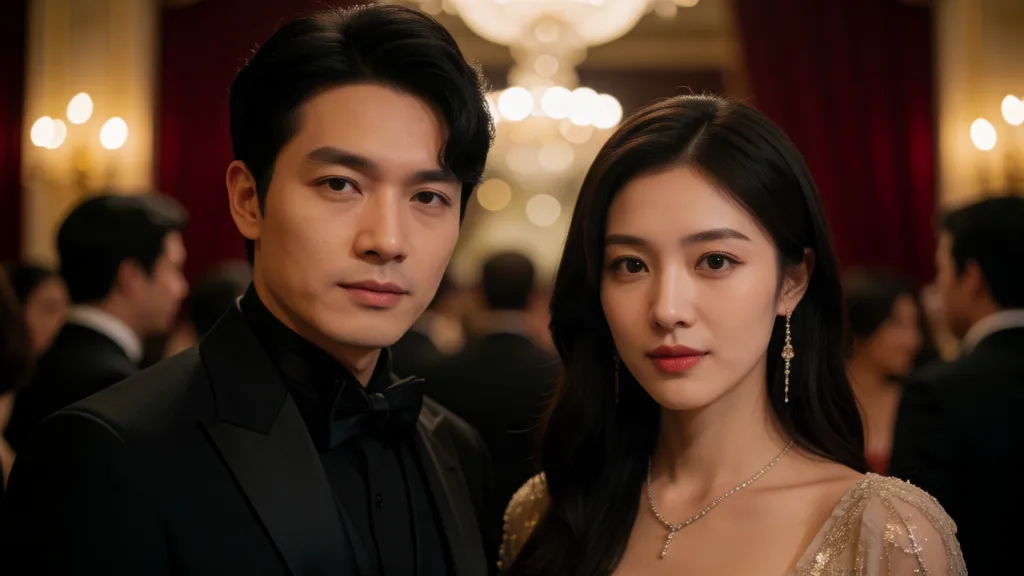
The first thing I noticed about her wasn't her face, though that would come later, sharp and unforgettable. It was her hands. She held her champagne flute like it was a weapon she hadn't decided whether to use, fingers wrapped loose around the stem, thumb tracing the rim in a slow, absent circle. Everyone else at the party clutched their drinks like shields. She held hers like an afterthought. Like she'd already calculated the exits and decided none of them were worth taking.
I was supposed to be talking to Matsuda about the Osaka acquisition. Instead I was watching a woman I'd never met stand alone by the terrace doors, her back to the city lights, her eyes moving across the room with the calm assessment of someone who'd been looked at her whole life and had long since stopped caring whether anyone liked what they saw.
"You're not listening," Matsuda said.
"I'm listening." I wasn't.
He followed my gaze and laughed, a short, knowing sound I didn't appreciate. "Ah. The florist's daughter. She's not your type."
I didn't ask what he thought my type was. I didn't care. I finished my whiskey in one swallow and set the glass down on a passing tray without looking at the server. The ice clinked against crystal. Somewhere behind me a woman laughed too loudly at a joke that wasn't funny. The air smelled of expensive perfume and the particular desperation of people who'd spent three hours pretending to enjoy themselves.
I walked toward the terrace doors.
She didn't turn when I approached. Most people did. I was used to the way conversations shifted when I entered a room, the way backs straightened and smiles turned nervous. I'd built an empire on that reaction. I'd learned to read it the way other people read weather.
This woman watched the city instead. Tokyo sprawled below us, a circuit board of light and shadow, and she looked at it like she was reading a language no one else spoke.
"You're blocking my view," she said.
Her voice was low, unhurried. Not rude. Just factual. Like she was telling me the time.
"There's a better one inside," I said. "The bar has a private balcony. Floor-to-ceiling glass. You can see all the way to Odaiba."
Now she turned. And I understood why Matsuda had laughed.
She wasn't beautiful in the way I was used to. Not polished. Not curated. Her hair was black and long and slightly tangled at the ends, like she'd been running her fingers through it all night. She wore a dress the color of dried blood, simple, no jewelry except a thin silver chain at her throat that caught the light when she moved. Her eyes were dark and direct and utterly unimpressed.
"I've seen Odaiba," she said. "I've seen everything from up here. What I haven't seen is a reason to stay at this party."
"Then why are you here?"
"My father's shop did the flowers. He couldn't come. He's sick. So I came instead. Network, he said. Make connections." She smiled, but it wasn't a real smile. It was the shape of one, empty inside. "I've been standing here for two hours and the only person who's spoken to me is a drunk banker who wanted to know if my dress was real silk."
I didn't ask what she'd told him. I didn't need to. The answer was in the way she held herself, still and contained, like a blade folded into its handle.
"Was it?" I asked.
"Was it what?"
"Real silk."
She looked at me for a long moment. Then she laughed, a real one this time, short and surprised, like it had escaped before she could stop it.
"No," she said. "It's polyester. I bought it at a secondhand shop in Koenji for three thousand yen. But he didn't need to know that."
"Why tell me?"
"Because you don't care about the dress." She tilted her head. "You care about something else."
The city hummed below us. A helicopter passed in the distance, its lights blinking red against the dark. I could feel the cold through the open terrace doors, the February air sharp against my face. She didn't seem to notice the cold at all.
"What's your name?" I asked.
"Does it matter?"
"Everything matters."
She considered this. Then she set her champagne glass down on the stone ledge beside her, and I watched her fingers release the stem, slow and deliberate, like she was letting go of something heavier than glass.
"Yuki," she said. "And you're Kaito Mori. I know who you are. Everyone knows who you are."
"Then you know I'm not a drunk banker."
"I know you own half the buildings in this city. I know you fired three hundred people last year when you restructured your shipping division. I know your wife died five years ago and you haven't been photographed with a woman since." She paused. "I also know you've been staring at me for the last twenty minutes, and I want to know why."
The directness of it hit me like cold water. I wasn't used to being asked questions. I was used to being researched, anticipated, managed. People studied me the way they studied weather systems, looking for patterns, trying to predict where the damage would land.
Yuki didn't study me. She just looked.
"You're interesting," I said.
"That's not an answer."
"It's the only one I have."
She shook her head, a small movement, almost imperceptible. Then she turned back to the city, dismissing me the way she'd dismissed the banker, the party, the whole glittering room behind us.
I should have walked away. I should have gone back inside, found Matsuda, closed the Osaka deal, gone home to my empty apartment and my empty bed and the particular silence of a life that had been arranged for efficiency rather than pleasure.
Instead I stayed.
"The flowers," I said. "Your father's shop. What's it called?"
She didn't turn around. "Why do you want to know?"
"Because I want to know."
A pause. The wind moved through her hair, lifting the ends. I watched the silver chain at her throat catch the light and lose it again.
"Sakura," she said. "Sakura Flowers. It's in Asagaya. Small place. You wouldn't have heard of it."
"I've heard of it."
Now she turned. Her eyes narrowed, just slightly, the first crack in her composure.
"You're lying," she said.
"I don't lie."
"Everyone lies."
"Not me."
She studied me the way I'd studied her, looking for the seam, the place where the performance ended and the person began. I let her look. I had nothing to hide. Or rather, I had everything to hide, but I'd learned long ago that the best concealment was transparency. Let them see what they expected to see. Let them fill in the gaps with their own assumptions.
"You're not what I expected," she said finally.
"What did you expect?"
"Someone colder. Someone who looks through people instead of at them." She paused. "You look at people. That's worse."
I felt something shift in my chest, a pressure I hadn't felt in years. Not desire, not exactly. Something closer to recognition. The feeling of being seen by someone who had no reason to see me, no stake in the outcome, no fear of what I might do with the knowledge.
"What do you want?" I asked.
It was the wrong question. I knew it as soon as I said it. Too direct, too hungry. It gave her power, and I never gave anyone power.
But Yuki didn't seize it. She just smiled, that same empty shape from before, and picked up her champagne glass.
"I want to go home," she said. "I want my father to get better. I want to stop standing in rooms full of people who look at me like I'm something to be consumed." She drank the last of her champagne and set the glass down again, harder this time, a small clink against the stone. "But you're not asking what I want. You're asking what I want from you. And the answer is nothing."
She walked past me toward the terrace doors. I caught her wrist before I knew I was moving, my fingers closing around the thin bones, the skin warm despite the cold. She stopped. She didn't pull away.
"Let go," she said.
"No."
"People are watching."
"Let them."
She turned her head, just enough to look at me over her shoulder. Her eyes were dark and steady and utterly unafraid. I could feel her pulse under my thumb, quick and light, a bird trapped in my palm.
"You don't know what you're doing," she said.
"I know exactly what I'm doing."
"No." She shook her head. "You know what you want. That's different."
She was right. I did want her. I wanted her the way I wanted nothing else in my life, not the deals, not the buildings, not the empire I'd spent twenty years building from nothing. I wanted her with a hunger that felt almost violent, a need to possess and consume and keep.
But she was also right about the other thing. I didn't know what I was doing. I didn't know what it meant to want something I couldn't buy, couldn't negotiate, couldn't control.
I let go of her wrist.
She didn't move. She stood there, half-turned toward me, the city lights behind her and the party noise spilling through the open doors, and she looked at me like she was waiting for something. A word. A gesture. A reason to stay.
I didn't give her one.
"Goodnight, Yuki," I said.
She nodded, once, and walked away. I watched her cross the terrace, watched her disappear through the doors, watched the crowd swallow her whole. Then I stood alone in the cold, the city spread out below me like a map of everything I owned and nothing I wanted.
I stayed there for a long time. Longer than I should have. The party ended around me, cars pulled up and pulled away, the lights in the ballroom went dark one by one. I didn't move.
Somewhere in Asagaya, a florist's daughter was going home to a sick father and a small shop and a life I knew nothing about. And I was standing on a terrace in Roppongi, the most powerful man in the room, unable to make myself leave.
I'd spent my whole life acquiring things. Companies. Buildings. People. I'd never once had to wait for something I wanted.
I had a feeling I was going to learn.
Watch this moment
Turn the current scene into a cinematic Live Chapter — what you watch becomes the story's next part.
Disclaimer
This is a work of fiction, assisted by artificial intelligence. Any names or characters, businesses or places, events or incidents, are fictitious. Any resemblance to actual persons, living or dead, or actual events is purely coincidental.
Content Removal Policy
- Users may report content that may be illegal or violates our Standards.
- All reported complaints will be reviewed and resolved within seven business days.
- Review Process: Our team will assess the reported content against our guidelines.
- Appeals: If you disagree with a decision, you may appeal within 14 days of notification.
- Potential outcomes include: content removal, account warning, or no action if no violation is found.
To report content, email us at [email protected]