Share
Go Live
Strings of Vengeance
·
Published 9/6/2026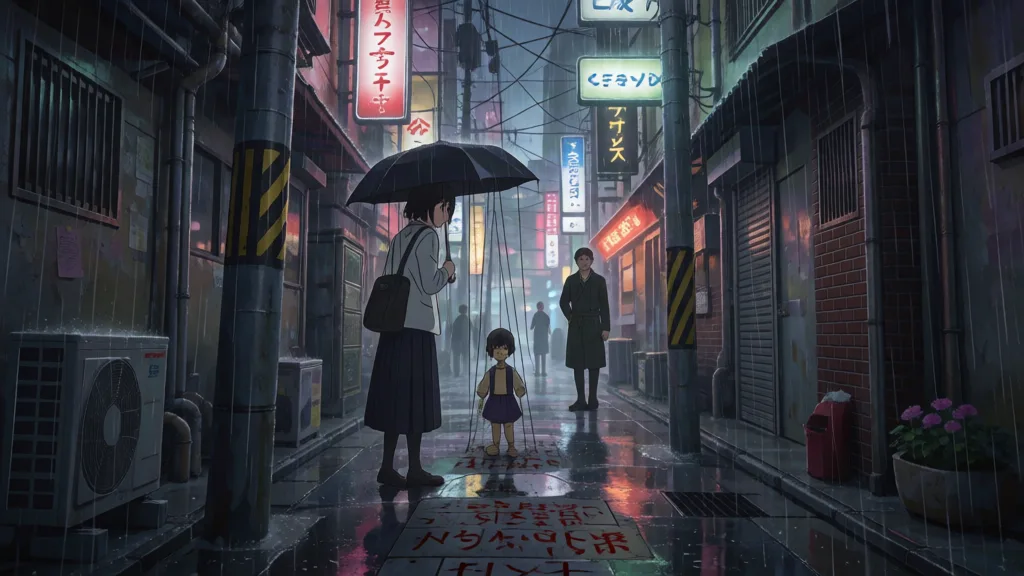
The marionette’s hand twitched. I felt it through the strings, a tremor that wasn’t mine, and my own fingers went cold on the cross.
I stopped mid-sentence. The salaryman in the front row leaned forward, his umbrella dripping onto the asphalt. Two college girls whispered behind their phones. Rain hammered the awning above my makeshift stage, a sheet of gray water that turned the alley into a tunnel of sound.
The marionette hung from my strings, head bowed, arms limp. Wood and paint. String and bone. I’d carved her myself, three months of nights in my closet apartment, sanding her limbs until they were smooth as river stones. Her face was a blank oval, no features yet. I’d been saving the face for last.
She lifted her head.
The crowd gasped. I didn’t blame them. Her neck turned with a sound like cracking ice, and where there should have been nothing, there was a mouth. Open. Hungry. Her wooden fingers curled into fists.
I dropped the cross.
The strings went slack. She should have collapsed. Instead, she landed on her feet, took three steps across the wet pavement, and knelt. Her finger touched the ground. Dragged.
I couldn’t move. The salaryman’s beer can hit the ground and rolled. The college girls had stopped whispering. Rain ran down my neck, cold as guilt, and I watched my creation write in the water.
*He is coming.*
Four characters. Kanji. The strokes were perfect, schoolbook clean. I’d never taught her to write. I’d never taught her anything. She was wood and paint and the hollow space where I’d poured my loneliness for three months, and now she was carving warnings into the street.
The marionette looked up at me. Her face was still blank, no eyes, no nose, just that mouth, and I felt seen anyway. Seen through. Like she knew every lie I’d ever told myself.
I grabbed her by the back of the neck, shoved her into my bag, and ran.
The alley opened onto a main street, neon bleeding through the rain. Pachinko parlors. A ramen shop with steam rising like a ghost. I kept my head down, my bag bouncing against my hip, and I didn’t stop until I hit the underpass near Ueno Station.
My hands were shaking. I sat on the damp concrete and opened the bag.
She was still. Just wood now. A half-carved face, a body I’d sanded smooth, joints I’d wired with piano string. I’d made her beautiful. I’d made her perfect. I’d made her from nothing because I had nothing else, and now she was something else entirely.
*He is coming.*
Who? And why did she write it in kanji I’d never taught her? My grandmother spoke Chinese. My mother spoke Japanese with a Fukuoka accent I’d sanded off my own tongue. I spoke silence. That was my language. The language of hands and strings and the hollow clack of wood on wood.
The marionette’s finger twitched.
I slammed the bag shut.
I didn’t sleep that night. I sat in my apartment, a six-tatami box with a window that faced a brick wall, and I watched the bag. The rain stopped around midnight. The city hummed its electric song. At three in the morning, a cat yowled in the alley below, and I jumped so hard I knocked over my tea.
The bag didn’t move.
I was starting to think I’d imagined it when I heard the footsteps.
They came up the stairs slow. Deliberate. The kind of footsteps that wanted to be heard, wanted you to count them, wanted you to know exactly how close they were getting. One. Two. Three. The landing creaked. My door had no lock, just a sliding panel I’d never bothered to secure, because who would come for me? I was nobody. A mute puppeteer in a rain-slicked alley. The ghost of a girl who didn’t exist.
The panel slid open.
He filled the frame. Tall, wide-shouldered, wearing a suit that cost more than I’d made in my entire life. His hair was slicked back, his jaw a blade, and his eyes were the color of old coins. He looked at me the way you look at a stain on a good shirt.
“You,” he said.
I didn’t answer. Couldn’t. My throat locked up the way it always did when someone demanded words from me, my tongue a dead thing in my mouth.
He stepped inside. His shoes were expensive leather, wet from the street, and he didn’t bother to wipe them. He walked past me like I was furniture and stopped at the bag.
“This yours?”
I nodded.
He opened it. The marionette lay there, still as death, and he picked her up by the hair. Dangled her. She spun slowly, her blank face catching the yellow light from my single bulb.
“Pretty,” he said. “You make her?”
Another nod.
“You carve her face?”
I shook my head. I pointed at the blank oval, then at my own face, then at my hands. No face yet. I’d been waiting.
He stared at me. Long enough that I felt my skin prickle. Long enough that I started counting my own breaths.
“I’m looking for someone,” he said. “Someone who stole something from my boss. Something he can’t replace.”
He set the marionette on my table. She sat there, legs dangling, head tilted like she was listening.
“They say the thief was a woman. Small. Quiet. Hands that never stop moving.” He looked at my hands. I folded them behind my back. “They say she can make wood dance.”
I didn’t move. Didn’t breathe.
“They say she stole a soul.”
The marionette’s head turned.
Slow. Deliberate. The same cracking-ice sound from the alley. The man’s eyes went wide, and I watched his hand move to his jacket, watched him reach for something I didn’t want to see, and the marionette opened her mouth and spoke.
“You should run.”
The voice wasn’t mine. It wasn’t human. It was wood scraping wood, string pulling string, the sound of something that had been dead a long time and was angry about it.
The man pulled a gun.
The marionette lunged.
I didn’t see her move. One second she was on the table, the next she was on his chest, her wooden fingers wrapped around his wrist, her blank face inches from his. He fired. The shot went wild, punched a hole in my wall, and the marionette twisted his hand until the gun clattered to the floor.
He screamed.
She rode him down. He hit the tatami hard, and she sat on his chest, her head tilted, that empty face staring at him.
“Tell your boss,” she said, “that I’m not finished.”
The man scrambled backward. His face was white, his hand bent at an angle that made my stomach turn. He grabbed his gun, shoved it in his jacket, and ran. His footsteps hammered down the stairs, out the door, into the wet Tokyo night.
The marionette stood up.
She walked to me. Her wooden feet clicked on the tatami, and she stopped between my knees, looking up at me with a face that had no eyes but saw everything.
“I’m sorry,” she said.
I stared at her. My hands were shaking. My throat was locked. I wanted to ask a thousand questions, and I couldn’t ask one.
She reached up and touched my cheek. Her fingers were cold. Smooth. The wood I’d sanded for three months, the wood I’d carved with my own hands, and it felt like a stranger’s touch.
“I didn’t ask to be here,” she said. “But I am. And he wants me back.”
She turned her head toward the door.
“He’s not going to stop coming.”
I found my voice. It came out cracked, rusty, a sound I hadn’t made in years.
“Who?”
The marionette looked at me. Her blank face tilted. Her mouth curved into something that wasn’t a smile.
“My husband.”
Watch this moment
Turn the current scene into a cinematic Live Chapter — what you watch becomes the story's next part.
Disclaimer
This is a work of fiction, assisted by artificial intelligence. Any names or characters, businesses or places, events or incidents, are fictitious. Any resemblance to actual persons, living or dead, or actual events is purely coincidental.
Content Removal Policy
- Users may report content that may be illegal or violates our Standards.
- All reported complaints will be reviewed and resolved within seven business days.
- Review Process: Our team will assess the reported content against our guidelines.
- Appeals: If you disagree with a decision, you may appeal within 14 days of notification.
- Potential outcomes include: content removal, account warning, or no action if no violation is found.
To report content, email us at [email protected]