Share
Go Live
The Door Stayed Shut
·
Published 8/29/2026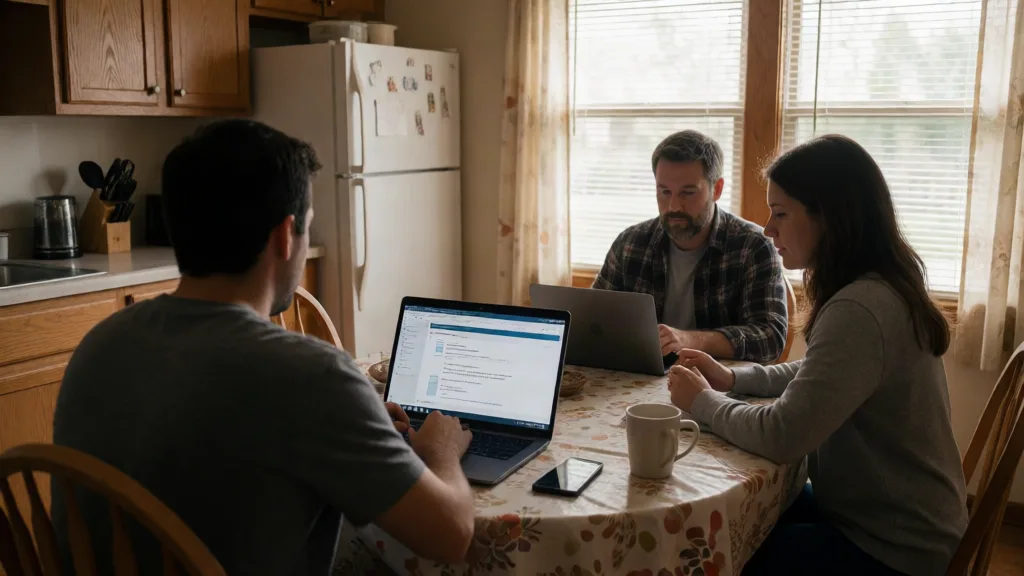
The text came in while I was deep in a vendor report, the kind of spreadsheet work that makes you forget your own name after an hour. My phone buzzed against the oak table. I glanced at it, expecting a reminder about a meeting or maybe Mark asking what we should do for dinner.
*Mom's moving in. It's already decided.*
I read it twice. That thing your brain does, giving people you love one free chance to have typed something stupid by accident. The phone felt wrong in my hand. Too light. Like it had shed some essential weight between the buzz and my thumb swiping the screen.
I called him. He answered on the fourth ring.
"Hey."
"Hey. What does 'already decided' mean?"
A pause. Not long. Just enough to tell me he knew exactly why I was calling.
"It means Mom needs somewhere to stay for a while."
"For a while?"
"Yeah."
"How long is a while, Mark?"
"I don't know, Claire. A few weeks. Maybe a couple months."
I closed my laptop. The screen went dark, my half-finished report swallowed by black.
"And when were you planning to ask me? She's my mother too."
"I know who she is."
"Then why are you making this difficult?"
I actually looked at the phone. The absurdity of it. He was my husband. We had been married seven years. We had a house, a life, a rhythm. And he was calling me difficult for wanting to be consulted about another adult moving into our home.
"Mark, you just informed me that another adult is moving into our house. I'm not the one making this difficult."
He lowered his voice, the way he did when he was at work and wanted me to know other people might hear him. "Her rent went up. She hates that apartment. She's lonely. Lisa can't take her."
That part caught my attention.
"Lisa can't take her? Why not?"
"She needs her spare room for work."
"Lisa works from home two afternoons a week selling commercial insurance."
"So?"
"So her spare room is sacred, but my office is apparently available to the public?"
"Come on."
"No, really. I'm curious how this works."
He exhaled into the phone. "You're home three days a week. We can move your desk upstairs."
I went quiet.
There are moments in a marriage when the actual problem walks into the room wearing a name tag. This was one of them.
"You already picked my office."
"I'm trying to make this work."
"No, you already made it work. I'm just finding out what my part is."
"Claire."
"What happened to that senior place in Lenexa she toured?"
"She didn't like it."
"That's not the same thing as having nowhere to live."
"She's seventy-four, Claire."
"I'm forty-eight."
"Are we just stating ages now?"
He ignored that. "She needs family."
"I'm your family too."
Usually that gets me into the meeting before the vote. He was silent.
Then: "We'll talk when I get home."
"No. You need to call your mother before she gets here."
Another pause. That one bothered me more.
"Mark. I have to go. Is she already coming?"
"I said I have to go."
And he hung up.
I sat there for maybe ten seconds staring at my phone. Then I called him back. Straight to voicemail. I tried again. Same thing.
At that point, I still wasn't furious. Not exactly. I was offended. And confused. And starting to get that unpleasant little feeling you get when everybody else seems to know the plan except you.
I went back to my report because, unlike my husband, my vendors preferred advance notice when I changed something important.
At 5:11, I heard tires on the driveway. I looked through the front window. A silver SUV pulled in.
Diane got out first. Mark's mother was seventy-four, but she moved like a woman who considered slowing down a personal insult. She was wearing white capri pants, a navy blouse, and the large sunglasses she wore even when the sun was behind a cloud.
Then Lisa climbed out of the passenger side. That was when I knew this had been organized.
They opened the back.
Three rolling suitcases. Two plastic storage bins. A garment bag. A canvas tote stuffed with what looked like toiletries and prescription bottles. And for reasons I still cannot explain, a peace lily.
I remember looking at that plant and thinking the peace lily had apparently received more advance notice about its living arrangements than I had.
The doorbell rang.
I opened the door but stayed where I was. Diane smiled like we were all about to enjoy a pleasant weekend together.
"Hi, honey."
"Hi, Diane."
Lisa gave me a little nod. Diane pointed over her shoulder. "Which room did Mark clear out?"
"He didn't."
The smile vanished. "What do you mean?"
"I mean he didn't clear out a room."
Lisa shifted the storage bin against her hip. "Oh, Claire. Don't start."
I looked at her. "I haven't started anything. You two are the ones standing on my porch with luggage."
Diane frowned. "Mark said I could stay here."
"I know what Mark said."
"Then move, sweetheart. These bags are heavy."
I didn't move.
"Diane, you're welcome to come inside and sit down. You're not moving in today."
She stared at me.
"What?"
"You can come in as a guest. The luggage stays outside until Mark and I actually have a conversation."
Lisa gave a short laugh. "She's seventy-four years old."
"Yes, Lisa. Mark mentioned that. It continues to be true."
Diane's face hardened. "My son lives here."
"Yes."
"This is his home."
"Yes."
"Then stop acting like I'm some stranger asking to sleep in your garage."
"You're not a stranger. You're also not moving into this house because Mark volunteered it without asking me."
Diane blinked. "My son does not need permission to let his own mother into his house."
Something about the way she said it made me stop. Not the anger. The certainty.
Before I could answer, Lisa pulled out her phone.
"Say that again."
I looked at the camera. "No."
"What are you afraid of? Mostly being bored to death watching this later."
That did not improve Lisa's mood. Diane called Mark. No answer. Again. No answer.
Then she looked at me and said, "My son owns this house."
I almost corrected her. The words were right there. Then I remembered all the little comments over the years. How lucky I was that Mark provided so well. How nice it must be not to worry about money. How proud she was that he'd done so well for himself.
I had always assumed Diane was being old-fashioned. Suddenly, I wasn't so sure.
Diane was already dialing another number. Lisa looked at the screen. "Mom, don't."
"I'm not standing out here while she locks me out of my son's home."
"Who are you calling?"
"911."
I honestly thought she was bluffing. She wasn't. When the dispatcher answered, Diane said loud enough for half the neighborhood to hear, "My daughter-in-law has locked me out of my son's house and won't let me inside."
I just stood there.
I could have ended the whole thing in thirty seconds. I had every document I needed inside. But by then I didn't want to explain anything for Mark. I wanted to hear him explain it himself.
At 5:34, his car finally turned into the driveway. At almost the exact same moment, a police cruiser rounded the corner.
Mark saw his mother, Lisa, the suitcases, then the flashing lights. For the first time all afternoon, he looked like a man who understood exactly how badly he had miscalculated.
I opened the door a little wider. Not for Diane. For the truth.
Officer Ruiz got out of the cruiser with the calm expression of a man who had probably spent his shift explaining obvious things to people who did not want them explained. Diane stepped toward him immediately.
"Officer. Thank goodness."
Mark had just parked. He stayed by his car for a second, looking from his mother to me. That annoyed me more than I expected. Not because I needed him to rush to my side. Because he looked like he was trying to figure out which side would cost him less.
Officer Ruiz glanced at the luggage. "Who called?"
"I did," Diane said. "My daughter-in-law is refusing to let me into my son's house."
Lisa crossed her arms. "She's being completely unreasonable."
Ruiz looked at me. "Ma'am?"
"My name's Claire Bennett. I live here."
"Okay. Does Mrs. Bennett live here too?"
Diane answered before I could. "I'm moving in today."
Ruiz nodded once. "Have you lived at this address before?"
"No."
"Do you currently receive mail here?"
"No. But my son told me I could stay."
He looked at Mark. "Sir?"
Mark finally walked over. "I'm Mark Bennett."
Ruiz nodded. "Do you own the property?"
It was such a simple question. That was what made the silence so ugly.
Mark looked at me first, then at his mother, then back at the officer. "Claire," he said, "can we please stop embarrassing everybody?"
There it was. Not "Mom, you misunderstood." Not "Officer, the house belongs to Claire." Not even "I handled this badly." No. I was embarrassing everybody.
Officer Ruiz waited. "Sir. I still need an answer."
Mark rubbed the back of his neck. "Well. Claire bought the house before we were married."
Diane turned toward him. "What?"
I looked at Mark. "You never told her?"
He didn't answer.
Diane stared at me. "Told me what?"
"The house is mine, Diane. I bought it six years before Mark and I got married."
She actually laughed. One sharp little laugh. "No, you didn't."
I almost admired the confidence.
"I did."
She looked at Mark again. "You told me you bought this place."
Mark frowned. "I never said I bought it."
"Yes, you did."
"I said 'we' bought the house."
"That means you bought the house."
"I meant when we made it our home."
I looked at him. That was Mark. He could turn a lie into a grammar discussion if you gave him enough time.
Officer Ruiz stepped in before Diane could start again. "Ma'am, if you don't currently reside here and the homeowner is not giving you permission to move in, this isn't something I can force."
Diane pointed at Mark. "My son lives here."
"I understand."
"It's his home."
"I understand that too."
"So I can stay with him."
Ruiz gave her a patient look. "Not if the person who owns the property is telling you no."
Lisa cut in. "So she can just put a seventy-four-year-old widow on the street because her name happens to be on a piece of paper?"
I said, "She has an apartment."
Diane snapped, "I'm leaving that apartment."
I looked at her. "Leaving it or losing it?"
She hesitated. Just a fraction. That was enough.
Mark jumped in. "Can we all just calm down?"
Nobody had been helped by that sentence since the invention of marriage.
Diane turned back to Officer Ruiz. "So you're just leaving?"
He looked toward the cruiser. "Unless somebody here plans to commit a crime, yes, ma'am."
"I'd prefer that."
I had to look away. Lisa didn't. She was not amused.
Eventually they put the luggage back in the SUV. All of it except the peace lily, which Lisa left beside the porch. Diane was still arguing when she got into the passenger seat.
"This is unbelievable."
I said nothing.
Lisa slammed the hatch. Then she looked at me. "You're going to regret this."
I nearly said something smart. I didn't. Maybe I was getting tired. Maybe part of me was already wondering whether I had just blown up my marriage in front of the neighborhood.
They drove away. The police cruiser left right after them.
Mark and I stood in the driveway. He looked at the abandoned plant. Then at me.
"Seriously."
That word did it. I walked inside. He followed.
"Claire."
I turned in the kitchen. "Your mother called the police because she thought she had more right to my house than I did."
"She was upset."
"She thought you owned it."
"It was a misunderstanding."
"No. Misunderstandings are when somebody shows up at six instead of seven. This took years."
He sighed. "You always make everything bigger."
"And you keep making things smaller until they disappear."
He looked exhausted. "So what do you want me to say?"
"The truth would be interesting."
"I didn't lie to her."
"You let her believe you bought this house."
"I never told her that."
"You also never corrected her."
He opened the refrigerator, stared into it, then shut it without taking anything out. That tiny motion told me he had no idea what to do with himself.
I said, "What exactly happened with Lisa? She can't take Mom. Why?"
"She needs her office."
I stared at him. "So Lisa's office counts."
"Claire."
"No, I'm asking. Her office is untouchable. Mine gets reassigned."
"She only has a two-bedroom."
"We have three bedrooms because one of them is where I work."
"She's my mother."
"And I'm still your wife."
That landed. For maybe two seconds, I thought he was going to apologize. Instead, he said, "You could have let her stay one night. Then tomorrow we would figure it out."
Meaning I would.
He looked away.
I went upstairs around ten. Mark stayed in the guest room. I couldn't sleep.
At eleven-thirty, I came back downstairs and opened the smaller joint checking account on my laptop. We had two joint accounts. The main household account was mine to manage. Mortgage, insurance, utilities, property taxes, major repairs. The second one was for the smaller stuff. Groceries, gifts, family dinners, random household expenses.
Years earlier, Mark had offered to handle that account because he said I already carried enough of the boring things. I had thought that was thoughtful. I transferred the same amount into it every month and rarely looked beyond the total.
The balance usually made sense.
That night I looked at the details.
At first nothing jumped out. Target. Grocery store. Gas. Restaurant. Then I noticed a transfer to Mark's personal checking. Seven hundred dollars. A few weeks earlier, nine hundred. Before that, five hundred.
I opened another statement. Then another.
The pattern kept going. Money from the joint account into his personal account. Regular enough to be a habit. Irregular enough not to look like one.
Then I found a larger transfer. Four thousand eight hundred dollars. The memo line said "Mom deposit."
I sat back.
Diane supposedly had nowhere to go. So what exactly had my husband put down a deposit on?
I was still at the kitchen table when the sun came up. I'd like to tell you I spent the night conducting some brilliant forensic investigation. I didn't. I drank two cups of coffee, forgot about the second one until it was cold, and clicked through bank statements with a yellow legal pad beside me. That was about as glamorous as it got.
By seven thirty I had a list.
The transfers from our smaller joint account to Mark's personal checking went back at least eighteen months. Five hundred here. Nine hundred there. Twelve hundred once. Then smaller amounts that could easily disappear inside ordinary married life.
That was the part that bothered me. I wasn't careless with money. But Mark and I had divided responsibilities years ago. I handled the main household account. The mortgage, insurance, taxes, utilities, anything expensive enough to ruin your Tuesday. Mark handled the miscellaneous account. Groceries, gifts, dinners, little household purchases. I automatically funded it every month. He paid things from it.
It had worked for years.
Or I thought it had.
I hadn't ignored our finances. I'd trusted my husband with his part of them. There was a difference.
By eight I'd traced a little over twenty-one thousand dollars that appeared to have gone toward Mark's family in one form or another. Not all of it made me angry. That's important. Diane had needed a new transmission the previous winter. I knew about that. There had been a dental bill. I knew she'd had dental work, although I hadn't known we helped pay for it. Lisa's furnace repair was new information. So were several transfers around Christmas. And there were restaurant charges that suddenly looked less like Mark taking his mother to lunch and more like Mark picking up the check for everybody.
None of those things individually would have ended my marriage.
But I kept coming back to the four thousand eight hundred dollars. "Mom deposit."
Mark came downstairs around eight fifteen wearing his work clothes. He stopped when he saw me.
"You've been up all night."
"Pretty much."
He saw the statements. His face changed. Not dramatically. He just got quieter.
"What's the forty-eight hundred dollars for?"
He put his travel mug on the counter. "Mom's apartment."
"What apartment?"
"The place in Lenexa."
I stared at him. "The place she supposedly didn't like."
"She doesn't. But she put down a deposit."
"I did."
"Why?"
"Because at the time she was going to move there."
"At the time. Meaning what? A couple weeks ago?"
I sat there looking at him. "So yesterday your mother called nine-one-one because I was making her homeless while she had an apartment waiting for her?"
"It's not that simple."
I swear if marriage had an official warning siren, it would be those five words.
"What part am I missing?"
"She hates the place."
"Then she can find another place."
"She wanted to stay with family."
"No. She wanted to stay here for free."
"That's unfair."
"Is it?"
He picked up his coffee. I said, "And what exactly did you promise her?"
He didn't answer.
"Mark."
"I told her she could use the downstairs room."
"My office."
"We could move your desk upstairs."
There it was again. We.
"You gave your mother my office."
"I didn't give her anything."
"You told her she could live in it."
"Temporarily."
"Without asking me."
"I knew how you'd react."
That one sat between us for a second.
"So you skipped asking because you knew I might say no."
He looked at his watch. "I'm going to be late."
"Go."
He hesitated, like he expected me to stop him. I didn't.
After he left I went upstairs to shower. On the way I noticed the family tablet on the hallway table. We mostly used it for recipes, streaming, and video calls with relatives. Mark's messages were synced to it.
I wasn't digging for an affair. I wasn't even looking for another secret. I searched Diane's name because I wanted to understand the apartment.
What I found instead was Lisa.
A message from three weeks earlier: *Mom hates that place. You guys have three bedrooms.*
Mark had replied: *Claire uses one as an office.*
Lisa: *She works all day anyway. She can move her desk upstairs.*
I read that twice.
Then another message: *I kept Mom for six weeks after Dad died. Your turn.*
There it was. Lisa's sudden concern for elderly widows had a spare bedroom problem attached to it.
Farther down, Mark had written to Diane: *Don't worry about rent. Stay with us as long as you need.*
As long as you need.
Not a week. Not while you find something. As long as you need.
I called Mark. This time he answered.
"You promised her she could stay indefinitely."
"Claire, I'm driving."
"You promised her my office."
"I told you we'd figure it out."
"No, you figured it out with your sister and your mother. Then you notified me."
He went quiet.
I said, "Why does Diane think you own the house?"
"Here we go again."
"And why does she think you paid for the kitchen?"
"She assumes things."
"My car too, then. Your mother told me last Christmas I should be grateful you bought me such a nice car."
"I don't remember that."
"I do."
"Claire."
"Mom thinks I'm the one who takes care of us."
That stopped me.
"Why would she think that?"
"Nothing."
"Mark."
"You don't understand how Mom is."
"I understand exactly how your mother is. I'm trying to understand how you are."
And then I remembered Thanksgiving three years earlier. Mark had just been passed over for a promotion he'd been sure was his. Diane had raised her wine glass and said, "So when do we start calling you Vice President Bennett?"
Mark smiled. "Things are moving. They've given me a lot more responsibility."
They hadn't.
I had opened my mouth. Under the table, Mark touched my knee. Later he told me he hadn't wanted to disappoint his mother on Thanksgiving.
I let it go.
Sitting there Friday morning, I realized I'd thought I was protecting him for one dinner. Apparently he had turned it into a subscription service. The house. The renovation. My car. My work. His mother didn't just misunderstand one thing. She had been given an entire version of our marriage where Mark provided and I benefited.
And I had unknowingly been helping pay for the scenery.
That afternoon, Lisa made sure the family got her version too. She posted on Facebook: *Some women marry into a family and spend the rest of their lives trying to divide it.*
No names. She didn't need them.
Aunt Carol commented: *Family should always come first.*
Some cousin I'd met twice wrote: *Praying for everyone involved.*
Then I saw Mark's name. He had liked the post.
I stared at that little blue thumbs up for a long time. Then I took a screenshot, walked upstairs, and found him changing his shirt.
I held out my phone. "Did your thumb slip?"
Mark looked at my phone, then at me. "What?"
"You liked Lisa's post."
He gave me the kind of blank look people use when they're hoping confusion will become a legal defense.
"So?"
"So it's Facebook, Claire."
"I know what Facebook is."
"I probably hit it without thinking."
"You accidentally endorsed your sister telling the whole family I'm trying to divide them."
"She didn't mention you."
I lowered the phone. "Mark. If Lisa posted 'some women with brown hair who live on our street and wouldn't let my mother move in yesterday,' she wouldn't have to mention me either."
He sat on the edge of the bed. "You're reading too much into this."
"No. I think that's what I've been doing wrong for years. I've been reading too little into things."
He rubbed both hands over his face.
"It's like. Exactly."
"What does that mean?"
"It means nothing means anything with you. You didn't exactly tell your mother you owned the house. You didn't exactly lie about the promotion. You didn't exactly give away my office. And now you didn't exactly agree with Lisa."
"That's not fair."
"Maybe not."
That surprised him. It surprised me too.
I sat in the chair by the window. "I don't know what's fair right now."
And I didn't. That was probably the worst part. I was angry enough to imagine telling him to pack a bag, but I still knew exactly how he took his coffee. I still remembered him sitting with my mother for six hours during her cataract surgery because I couldn't get away from work until noon. He'd been the one making stupid jokes until she stopped worrying. When we had an ice storm two winters earlier, he'd gone outside at six in the morning and scraped my windshield before his own.
People don't become strangers just because you learn something ugly about them. Sometimes they become more confusing.
That weekend, Mark slept in the guest room. I spent Saturday morning at a family law office in Overland Park with a woman named Rebecca Shaw. I didn't walk in saying I wanted a divorce. I told her what had happened and asked what I should not do while I figured out what I did want.
That turned out to be a useful question.
Rebecca confirmed that the house being mine before the marriage mattered, but she also made something very clear. Don't change the locks while he's still residing there. Don't put his belongings outside. And don't start moving joint money around because you're angry.
"I wasn't planning to."
"Good. Anger is expensive when lawyers have to explain it later."
I liked her.
She told me to document the accounts, protect new income appropriately, and leave existing joint assets alone until I understood my options. So that's what I did. My next paycheck went into my individual account. I continued paying the mortgage, utilities, insurance, groceries, all the normal household expenses. What I stopped doing was automatically funding the miscellaneous account Mark controlled.
Saturday evening I told him. He was standing at the kitchen counter opening mail.
"You're cutting me off."
"No."
"That's exactly what this sounds like."
"You have your paycheck. I have mine. The household bills are covered. If you want to give your mother money, give her your money."
"I've been helping her for years."
"I know. I just found out I've been helping you help her."
"She's my mother."
"And you keep saying that like it turns my checking account into a family foundation."
He dropped an envelope onto the counter. "So now everything is mine and yours?"
"No. Now decisions are yours and mine. That's what I thought marriage was."
He didn't have much to say after that.
The timing was almost cruel. Diane had checked into a hotel off I-435 because she refused to return to her old apartment. Her new place in Lenexa still needed paperwork finished and another payment before move-in. Lisa had suddenly discovered the ancient American tradition of having her own bills.
Mark paid the hotel. Then another night. Then another.
By Tuesday he was sitting at the kitchen table with his phone and a calculator.
"Does Mom really need to stay there another week?"
I was washing a coffee mug. "I don't know. She could go back to her apartment until the new place is ready."
"She could."
He looked at me, probably waiting for more. I kept washing the mug.
Apparently generosity sounded different when the debit card had his name on it.
I didn't enjoy that as much as you might think. Mostly I was tired.
Wednesday night I sat down across from him. "I don't want to spend the next six months punishing you."
"I don't want that either."
"So here's what I need if we're going to have any chance."
He listened.
"Tell your mother the truth. All of it. Correct what Lisa posted. Show me the full history of what went to your family. Counseling. And from now on, nobody moves into our house, borrows money, gets promised money, or gets assigned one of my rooms without both of us agreeing."
Mark stared at the table. Then he nodded. "Okay."
I wanted to believe him. That's the embarrassing truth. Part of me was relieved enough by that one word that I almost reached across and took his hand.
I didn't.
Sunday morning Diane called him. She wanted everyone to meet for lunch and clear the air. Mark said maybe that was a good idea.
"Who's everyone?" I asked.
"Just family."
We drove to Miller's Smokehouse that afternoon. I brought a slim folder with copies of the property record, the apartment deposit, and the account summary. Not because I wanted a performance. I was simply finished depending on everybody's memory.
A hostess led us toward a private dining room. The door opened.
I stopped.
Diane was at the head of the table. Lisa sat beside her. Uncle Ray was there. So were Mark's aunt and uncle, two cousins, their spouses, and several other relatives. Fourteen people in all.
I turned to Mark. "You knew."
"Mom invited a few people."
I looked into the room. "Fourteen is a few if you're counting jurors."
From the table, Uncle Ray caught my eye. He looked at Diane. Then at Lisa. Then back at me. His expression said what nobody else apparently intended to.
This was not lunch.
I took my seat anyway. And I put the folder beside my plate.
Diane waited until everybody had drinks before she began. That told me the speech was planned.
"I asked everyone here because this family has been through enough ugliness this week."
I looked at Mark. He studied the menu.
Diane continued. "I don't want anybody taking sides."
Lisa nodded solemnly, which was impressive considering she had spent three days recruiting them.
"I just think," Diane said, "that when a family reaches a point where a widow has to beg for somewhere to sleep, something has gone very wrong."
Aunt Carol made a sympathetic sound.
I took a sip of iced tea.
Then Diane got to the police. "I never imagined I'd see the day when police would be brought into a family disagreement."
That one almost got me. I set down my glass.
"You called them."
Diane frowned. "That's not the point."
"It feels at least adjacent to the point."
Uncle Ray coughed into his napkin.
Lisa leaned forward. "Mom shouldn't have had to call anyone. She shouldn't have to beg for a place to stay when her own son has a three-bedroom home."
There it was again. Her own son has.
I turned to Mark. He still hadn't said a word.
I gave him one last chance. "Would you like to explain what actually happened?"
He finally looked at me. "Claire. Can we not do this here?"
I glanced around the private room. "Your mother invited fourteen people. I think 'here' was selected for us."
One of Mark's cousins looked down to hide a smile.
Diane said, "Nobody is attacking you."
"Good. Then a few questions shouldn't hurt."
I opened the folder. Mark's face tightened. I didn't pull everything out. I wasn't there to conduct a seminar.
I looked at Diane. "Who told you Mark owned the house?"
She blinked. "What?"
"The house. Who told you it belonged to Mark?"
She pointed at him. "Mark did."
He immediately said, "I never actually said—"
"Please don't," I said.
He stopped.
I asked Diane, "Who told you Mark paid for our kitchen renovation?"
Again, she looked at him.
"And who told you he bought my car?"
Diane's expression changed. Not much. Enough.
I slid the property record onto the table. "I bought the house in 2013. Mark and I married in 2019."
Then the renovation invoice. "I paid most of this from my own account."
I didn't bother bringing out anything about my salary. That was never the point.
"There is nothing embarrassing about what Mark earns," I said. "I never thought there was. Apparently he did."
Mark leaned back. "Do we really need to compare who paid for what?"
"No. We need to stop pretending we did something we didn't."
Diane shook her head. "This is exactly what I mean. Everything is money and paperwork with you. I needed somewhere safe to stay."
"Were you being evicted?"
She didn't answer.
"Diane?"
"No."
"Had your landlord told you to leave?"
"No."
"Did you have nowhere else to go?"
Lisa jumped in. "She hated that apartment."
I looked at her. "I didn't ask whether she liked it."
Then I took out the confirmation for the Lenexa community. "You already had forty-eight hundred dollars put toward another place."
Aunt Carol looked at Diane. "You had a place?"
"I hadn't moved in yet."
"But you could," I said.
"It's tiny."
There was a pause. A very useful pause. Because "tiny" sounds quite different from "homeless" when fourteen people are listening.
Lisa crossed her arms. "So what? She wanted to be with family."
"That's fine. Why didn't she stay with you?"
Lisa stared at me. "My situation is different."
"How?"
"I work from home."
I almost admired that one. "So do I."
"That's not what I meant."
"I know."
I pulled out a printed copy of the messages from the shared tablet. I didn't read every line. Just enough.
"Three weeks ago you told Mark, 'You guys have three bedrooms.' Then when he said I use one as an office, you wrote, 'She can move her desk upstairs.'"
Lisa's face went red. "You went through private messages?"
"They were on our shared tablet."
"That doesn't make it okay."
Uncle Ray, who had been unusually quiet, looked at Lisa. "Didn't you tell me at Christmas you were turning your spare room into a craft room so your mother wouldn't get ideas?"
Lisa snapped her head toward him. "Ray."
He shrugged. "I'm old, not dead. I remember things."
A couple people laughed. Even Aunt Carol smiled.
Lisa did not.
For the first time that afternoon, the room stopped feeling like a hearing where I was the defendant. Mark looked miserable. And strangely, that didn't make me feel good. I wanted him to say he was sorry. I wanted him to look at his mother and tell her the truth without me dragging it out of him one document at a time.
Instead he looked at me and said, "You always have to prove you're right."
That hurt. But it also clarified something.
"No, Mark. For seven years I helped you look successful. I just didn't know that was one of my jobs."
Nobody moved.
Uncle Ray glanced down at the papers. "So all those times Diane called you Mr. Moneybags?"
"Ray, please," Diane said.
He lifted both hands. "Fine. I'm just saying Moneybags apparently had a silent partner."
A few uncomfortable laughs went around the table. Mark didn't laugh. Neither did I.
I closed the folder. This wasn't fun anymore. Maybe it never had been.
Mark lowered his voice. "Claire. Let's just go home."
I looked at him for several seconds. Seven years is a long time. Long enough to know someone's footsteps in the hallway. Long enough to have favorite restaurants and stupid private jokes and a side of the bed that becomes yours without anybody assigning it. Long enough that even when you're furious, part of you still wants to go home with them and make the whole thing stop.
But that was what I had always done. Closed the distance. Smoothed things over. Protected him from the uncomfortable part.
Not this time.
"I'm going home, Mark."
He looked relieved for half a second. Then I finished.
"You need to decide where you're going."
The room went silent. Diane stared at me.
"What does that mean?"
"It means I've spoken with an attorney. I want a separation."
Diane looked genuinely shocked. "You're ending your marriage over a house?"
"No." I stood and picked up my folder. "The house was never the problem."
I looked at Mark.
"The problem is that whenever the truth threatened the man you wanted your family to see, you handed me the bill."
Nobody applauded. Nobody told me I was brave. And thank God for that, because real families don't behave like audiences.
I walked out to the parking lot alone. Mark didn't follow me.
For years, I realized later, I had almost always been the one who came back first after an argument.
That Sunday, I got in my car.
And I kept going.
The first night after Mark moved out, I cried in the kitchen. Not dramatically. I was standing at the counter eating leftover chicken when I noticed his coffee mug in the drying rack. That was all it took. A blue mug with a chipped handle. Seven years of marriage and apparently my emotional breaking point was a six-dollar coffee mug.
Mark rented a furnished apartment about fifteen minutes away. For the first two weeks he texted constantly. First came the apologies. "I handled everything wrong." Then the explanations. "You know how Mom gets." Then the resentment. "I still think you humiliated me in front of my family." Then, usually the next morning, another apology. "I'm sorry. I'm trying to understand this."
I almost called him twice. I missed him. I missed his shoes by the garage door, which was ridiculous because I had complained about those shoes for years. I missed hearing him lower the television when I took a work call. I missed Saturday coffee.
Doing what you believe is right does not automatically make it feel good.
We went to counseling several times. Not because I had decided to save the marriage. I just didn't want anger making every decision for me.
During our third session, Mark finally said something I had been waiting years to hear.
"My mother always bragged about me."
I looked at him. He kept his eyes on the carpet.
"Lisa was always the one with some problem. Divorce. Money. Work. Mom saw me as the successful one."
"And then you didn't get the promotion?"
He nodded. "I felt stupid."
"You weren't stupid."
"I know."
"No, you don't."
He looked at me. "I never needed you to make more money than I did, Mark."
"I know that now."
"No, you knew it then. You just didn't believe it about yourself."
He didn't argue. That was probably the saddest part.
By then, Diane had moved into the fifty-five-plus community in Lenexa. For the first six weeks, according to Mark, she hated everything. The parking spaces were too narrow. The thermostat was confusing. The laundry room was inconvenient. Someone kept using her chair in the lobby despite there apparently being no legal documentation establishing ownership of that chair.
Then she met Joyce.
Joyce was a retired school librarian who played cards on Tuesdays and, according to Diane, was abrasive. That made me like Joyce immediately. Apparently Joyce had a habit of telling Diane when she was being unreasonable.
Naturally, they became friends.
Within two months, Diane was playing cards every Tuesday and complaining that another woman might take her preferred seat before she got there. When Mark told me, I laughed harder than I had in weeks.
Lisa never apologized. She did delete the Facebook post.
A few relatives called me privately. Aunt Carol said, "I wish I'd known the whole story."
I said, "So did I."
Others thought I should have handled the dinner differently. Maybe they were right. I stopped needing them to be wrong.
That was new for me.
Mark and I stayed separated for several months before deciding to proceed with the divorce. There wasn't one final explosion. That would almost have been easier. We just reached the point where both of us understood that knowing why he had lied didn't make me able to trust him again.
We worked through the finances with our attorneys. The house remained mine as part of the final settlement. The joint assets were divided. Mark kept his retirement accounts according to the agreement, and I kept mine. Nobody was destroyed. Nobody ended up sleeping in a car.
Mark simply had to live on the life he had actually built instead of the one he had described to his mother.
About four months after the divorce was underway, my doorbell rang on a Saturday afternoon. Diane was standing there holding one of my casserole dishes. I had forgotten she had it.
For a second, neither of us knew what to say. Then she held it out.
"I washed it."
"Thank you."
I took it. She stayed on the porch.
Then she said, "I should never have called the police."
I nodded. "No. You really shouldn't have."
Her mouth tightened. The old Diane might have argued. This Diane just looked down at the porch.
"Mark should have told me the truth."
"Yes."
She looked at me. I could have left it there. Instead, I said, "And I should have asked more questions long before that night."
That did not mean I was taking responsibility for his lies. I wasn't. But I had spent years avoiding certain conversations because I thought avoiding conflict was the same thing as having peace. It isn't. Sometimes it just postpones the noise.
Diane nodded. "Well."
"Well."
She turned to leave, then stopped. "That plant looks good."
I followed her eyes toward the front window. The peace lily. I had brought the ridiculous thing inside the night Diane called 911. Not because I wanted a souvenir. It was a perfectly healthy plant, and letting it die on the porch out of principle seemed stupid.
By then it had gotten enormous.
"I guess it likes the window," I said.
Diane almost smiled. "Apparently."
Then she left.
I stood there holding the casserole dish and looking around my house. The funny thing was, almost nothing had changed. Same kitchen. Same stairs. Same driveway where those three suitcases had sat.
For months, people acted like the story was about me defending my house. It wasn't. The house had always been mine. That wasn't the victory.
The real change was realizing how much space I had surrendered in my own life just to keep other people comfortable.
Sometimes people make decisions for you and call it family. Sometimes they spend your money and call it generosity. Sometimes they expect your silence and call it peace.
I still believe love requires compromise. But compromise is something two people choose. It isn't something one person announces by text at 4:17 on a Thursday afternoon.
So if someone you loved sent you a message saying, "It's already decided" about your own home, what would you do? Would you open the door?
Or would you finally make them ask?
Watch this moment
Turn the current scene into a cinematic Live Chapter — what you watch becomes the story's next part.
Disclaimer
This is a work of fiction, assisted by artificial intelligence. Any names or characters, businesses or places, events or incidents, are fictitious. Any resemblance to actual persons, living or dead, or actual events is purely coincidental.
Content Removal Policy
- Users may report content that may be illegal or violates our Standards.
- All reported complaints will be reviewed and resolved within seven business days.
- Review Process: Our team will assess the reported content against our guidelines.
- Appeals: If you disagree with a decision, you may appeal within 14 days of notification.
- Potential outcomes include: content removal, account warning, or no action if no violation is found.
To report content, email us at [email protected]