Share
Go Live
The Last Embrace
·
Published 9/16/2026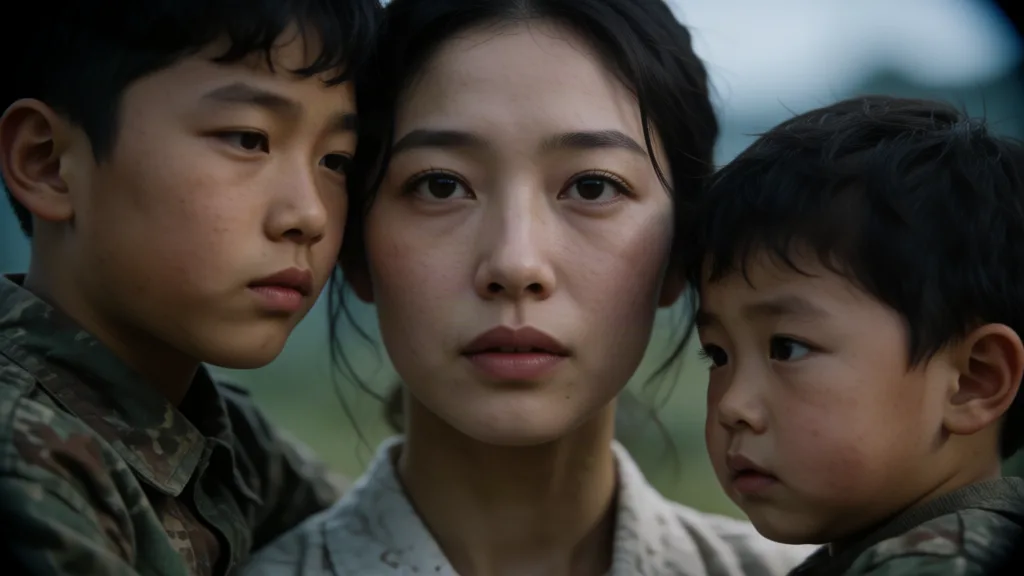
The bus smelled like diesel and dried squid and the sweat of forty people who hadn't washed in days. I pressed my forehead to the cold glass and watched the mountains slide past, green and gray and indifferent. My uniform itched at the collar. I had not taken it off in thirty-six hours.
The man next to me slept with his mouth open. He had a scar that ran from his ear to his jaw, a pale zipper of old violence. I wondered if he was going home too. I wondered if anyone was waiting for him. I didn't ask. You don't ask strangers on military transport buses anything. You sit and you stare and you wait for the road to end.
The road ended at a town called Yangpyeong.
I stepped off the bus and the air hit me different. Not the base air with its diesel and boot polish and the constant low hum of men preparing for war. This air smelled like rice fields and wood smoke and the river. The Han River ran close here. I could hear it before I saw it, a low constant murmur like the earth breathing.
My bag weighed nothing. I had packed it in fifteen minutes. A change of clothes. A photograph. A letter I had written and rewritten seventeen times and then left folded in my pocket, unsent.
The walk from the bus stop took twenty minutes. I knew every turn, every fence post, every dog that barked from behind a gate. I had grown up here. I had left here. I had come back from a place where women were not supposed to go, doing a thing women were not supposed to do, and now I was walking home in boots that still had dust from the DMZ on them.
The house looked smaller.
It sat at the end of a dirt lane, blue roof tiles faded to gray, the wooden gate hanging a little crooked on its hinges. The persimmon tree in the front yard had grown. It was heavy with fruit, orange globes fat and patient, and I remembered the year I planted it with my mother. She had said it would take seven years to bear fruit. I was thirty-two now. The tree had been bearing for a long time.
I stopped at the gate.
My hand went to the latch and did not lift it. I stood there like a fool, listening to the river, listening to the chickens scratching somewhere in the yard, listening to the silence of a house that should have been full of noise.
I had not seen my husband in fourteen months.
I had not seen my sons in ten.
The youngest, Jun-ho, had been five when I left. He had wrapped his arms around my leg at the bus station and refused to let go. I had to peel his fingers off one by one. He screamed. I got on the bus. I did not look back because if I had looked back I would have stayed, and I could not stay, I could not stay in that house with the quiet and the waiting and the way the other women looked at me when I walked through the market.
The eldest, Min-jun, had not cried. He was seven then. He stood straight and he shook my hand like a little soldier and he said, "I will take care of the house, Mother." I kissed his forehead and I felt his jaw tighten under my lips. He was holding it together. He was always holding it together. That was what scared me.
I lifted the latch.
The gate swung open and I stepped into the yard and there he was.
My husband. Seong-min.
He was at the well, pumping water into a plastic bucket. His back was to me. He wore a gray shirt with the sleeves rolled up and I could see the muscles in his shoulders shift as he worked. He had always been a strong man. A quiet man. A man who said I love you by fixing the roof and I miss you by leaving the porch light on.
He turned.
The bucket slipped from his hand. Water splashed across his feet and he did not look down. He looked at me and his face did something I had never seen it do before. It crumpled. Not like crying. Like something that had been held too tight for too long and finally let go.
He walked toward me. Not fast. Not slow. Just walked like the distance between us was a thing he had measured a thousand times in his head and now he was finally crossing it.
He stopped in front of me.
"You're thin," he said.
That was all. That was the first thing my husband said to me after fourteen months. You're thin.
I laughed. I did not mean to. It came out of me like a cough, sharp and surprised, and then I was crying and he was holding me and his shirt smelled like soap and sweat and home.
"The boys," I said into his chest. "Where are the boys?"
He pulled back. He looked at the house. The door was open now. I had not heard it open.
Min-jun stood in the doorway. He was eight now. Taller. His hair was longer. He wore a blue shirt that I did not recognize and his hands were at his sides and he was staring at me like I was a stranger.
Behind him, smaller, half-hidden behind his brother's leg, was Jun-ho.
Six years old. His face was rounder. His eyes were the same. Big and dark and full of everything he could not say.
Jun-ho stepped out from behind his brother.
He took one step. Then another. Then he was running across the yard, his small legs pumping, his arms open, and he hit me so hard I stumbled backward.
"Eomma," he said. His voice was muffled against my stomach. "Eomma, you came back."
I knelt down. I held his face in my hands. I looked at him, really looked at him, and I saw the gap where his front tooth had been and the tiny scar above his eyebrow that I did not remember and the way his nose had changed, sharpened, grown more like his father's.
"I came back," I said.
Min-jun had not moved from the doorway.
I stood up. I kept one hand on Jun-ho's shoulder and I looked at my eldest son and I waited.
He walked toward me. Slow. Careful. Each step measured like he was crossing a minefield. He stopped an arm's length away. He looked at my uniform. He looked at my boots. He looked at my face.
"You're a soldier," he said.
"I was a soldier."
"Are you still?"
I did not know how to answer that. I had signed the papers. I had handed in my gear. I had walked out of the gate and I was not coming back. But the soldier was still in me. The way I stood. The way I watched the corners of the yard. The way my hand had gone to my hip where my sidearm used to be.
"I'm your mother," I said. "That's what I am now."
He looked at me for a long time. Then he nodded. Just once. He stepped forward and he let me put my arm around him and he did not pull away.
Seong-min picked up the bucket. He filled it again. He carried it to the garden and I watched him water the pepper plants and I thought about the letter in my pocket, the one I had never sent, the one that said I was sorry and I was scared and I did not know if I could be what they needed me to be.
The river kept murmuring.
The persimmon tree kept waiting.
And I stood in my own yard with my sons pressed against me and I did not know if I had come home or if I had just arrived at a place where the real work was about to begin.
Watch this moment
Turn the current scene into a cinematic Live Chapter — what you watch becomes the story's next part.
Disclaimer
This is a work of fiction, assisted by artificial intelligence. Any names or characters, businesses or places, events or incidents, are fictitious. Any resemblance to actual persons, living or dead, or actual events is purely coincidental.
Content Removal Policy
- Users may report content that may be illegal or violates our Standards.
- All reported complaints will be reviewed and resolved within seven business days.
- Review Process: Our team will assess the reported content against our guidelines.
- Appeals: If you disagree with a decision, you may appeal within 14 days of notification.
- Potential outcomes include: content removal, account warning, or no action if no violation is found.
To report content, email us at [email protected]